
Resilient CP 2.0: Rethinking Connaught Place as a Green Urban Prototype
A shortlisted Neo Delhi entry proposes branching canopies, aerial gondolas, and phased ecological renewal for New Delhi's iconic circular hub.


Connaught Place is over a century old, and it is starting to show it. The Georgian colonnades and radial plan that once defined New Delhi's commercial heart now struggle under the weight of congestion, pollution, and infrastructure that was never designed for a city of 30 million. Resilient CP 2.0 takes that diagnosis seriously, proposing a layered green canopy, phased ecological restoration, and entirely new mobility networks to turn CP into a prototype for how Indian cities might survive the next century.
Designed by Inderpreet Kaur, Bharat Kumar Rolaniya, and Prajwal Kumar, this shortlisted entry to the Neo Delhi competition reimagines the iconic circular marketplace not as a static monument but as a living, resilient organism. The designers frame Delhi's environmental trajectory in stark terms: without intervention, urban congestion and pollution could render the city unlivable by 2035. Their response is a three-phase transformation that weaves green architecture, renewable energy integration, and smart mobility into CP's existing radial geometry.
Branching Canopies Over Terraced Green Mounds
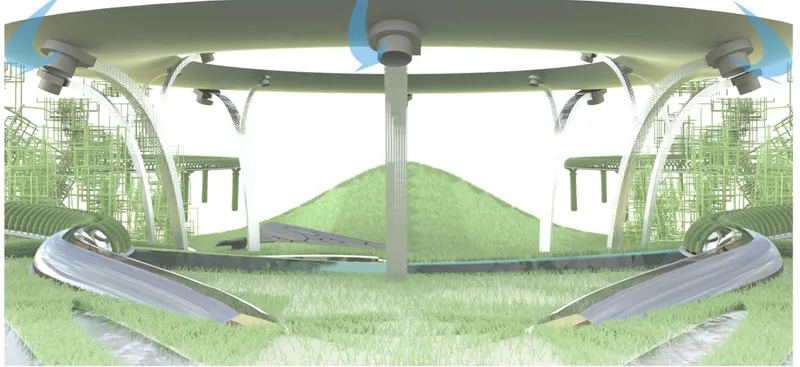
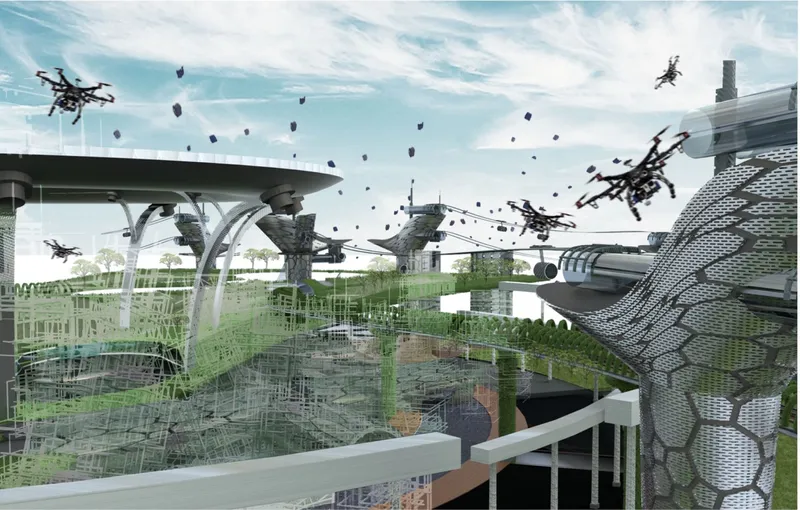
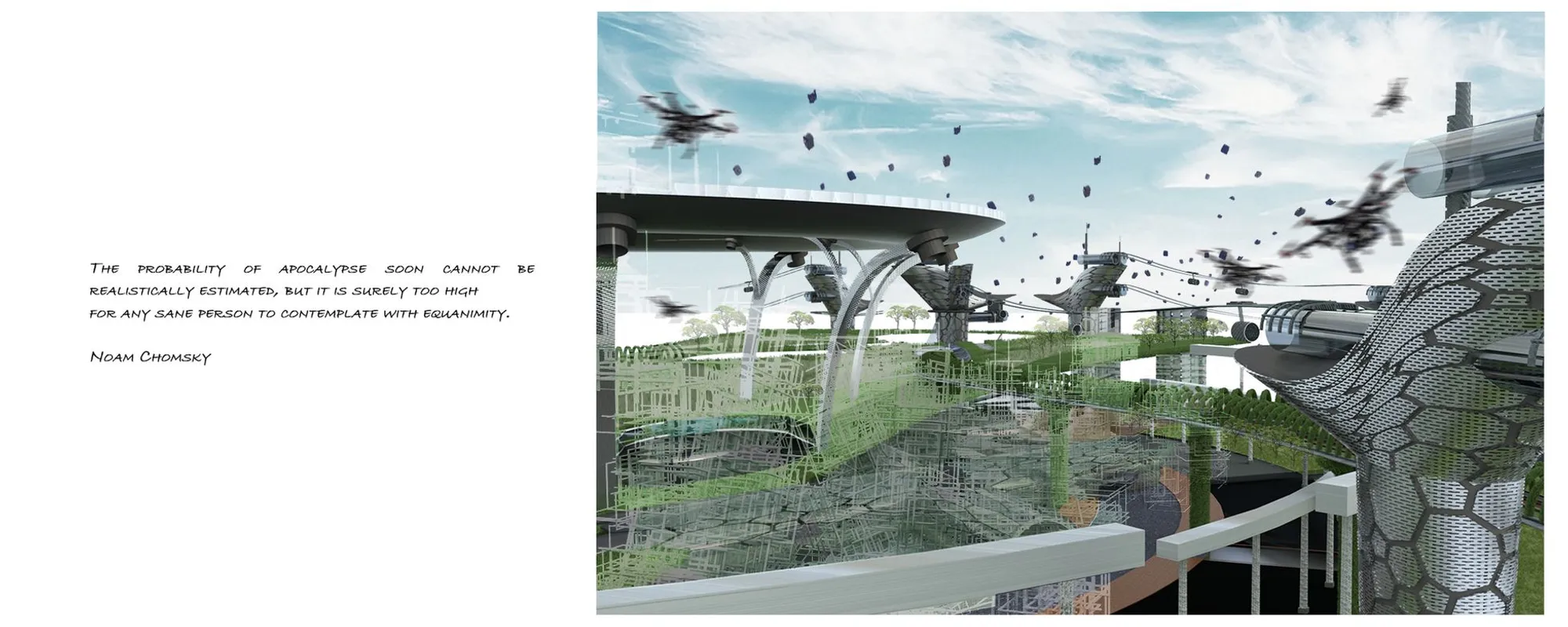
The project's most striking move is a circular canopy supported by branching structural columns that rise through terraced green mounds. The section rendering reveals how these tree-like supports distribute loads while creating generous, shaded ground planes beneath. Vegetation cascades across the terraced topography, converting what is now hard paving and parking into a continuous ecological surface. Above, latticed vertical towers punctuate the canopy, serving as structural anchors and environmental chimneys. Drones fly overhead in the aerial view, hinting at the project's ambitions for drone-based delivery logistics integrated directly into the architecture.
From Concentric Rings to Cellular Floor Zones

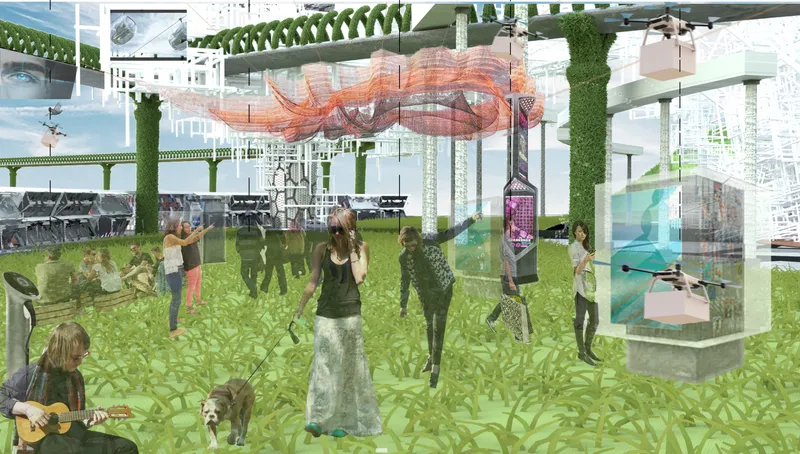
The axonometric diagram breaks the familiar circular plan into a lobed layout divided into red and grey cellular floor zones, each lobe accommodating distinct programmatic functions. This cellular approach allows the designers to phase construction and mix commercial, public, and ecological uses at a granular scale. The ground plane rendering shows what this means at eye level: figures move through lush vegetation beneath suspended orange mesh elements that filter light and define spatial boundaries without enclosing them. The result is a pedestrian-first environment where the boundary between shopping plaza and public park effectively dissolves.
Commerce here is not traditional retail. The designers envision a next-generation shopping experience with digital kiosks and open plazas replacing conventional storefronts. The socially engaging ground plane is meant to draw people in through spatial quality, not just commercial gravity.
Cycling Under Vegetated Ribs and Gondolas Above

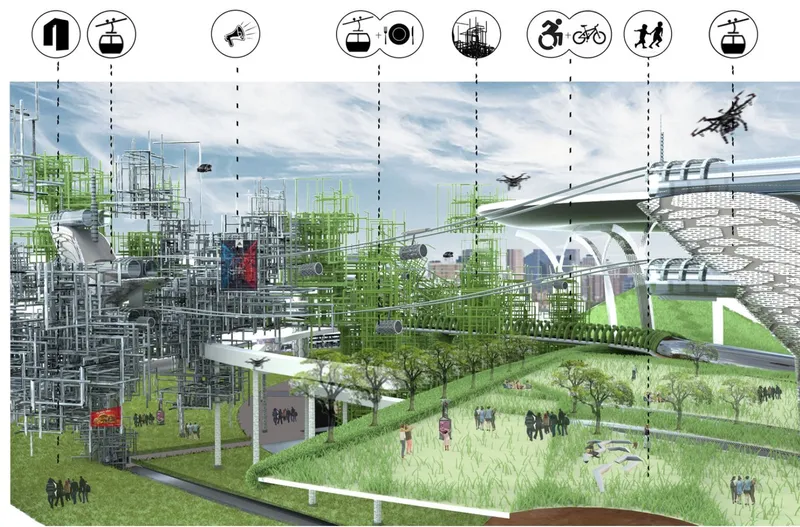
Mobility is treated as a design problem, not just an engineering one. A curved pathway lined with arched planting ribs creates a dedicated cycling corridor beneath a continuous vegetated canopy. The structure doubles as shade infrastructure and green corridor, turning transit into a pleasant spatial experience rather than an afterthought. The wider site rendering pulls back to show the full mobility ecosystem: aerial gondolas connect across the site, latticed towers serve as gondola stations, drones operate in the upper airspace, and visitors disperse across the terraced landscape below. Elevated bicycle tracks and cable car networks replace car-dominated streets, fundamentally redefining how people move through CP.
Reading the Radial Plan: Present Condition Versus Proposed Zoning

Two circular plan diagrams lay the argument bare. The existing condition shows CP's concentric rings locked into a rigid, mono-functional pattern. The proposed zoning redistributes program across concentric and radial bands, introducing green buffers, mixed-use zones, and public open space where none currently exists. It is a disciplined diagrammatic move: the designers respect the radial geometry that gives CP its identity while fundamentally reorganizing what happens within it. The comparison makes a persuasive case that resilience does not require erasing history; it requires rethinking how inherited forms can accommodate new demands.
Why This Project Matters
Resilient CP 2.0 operates at the intersection of preservation and provocation. It does not propose freezing Connaught Place in amber or demolishing it for a clean start. Instead, it layers ecological infrastructure, new mobility systems, and flexible commercial zones onto the existing radial framework, treating the site's geometry as an asset rather than a constraint. The designers' concept of a "reflex effect," where New Delhi's transformation models a strategy replicable in cities across India and beyond, is ambitious but grounded in specific spatial moves.
The apocalyptic timeline the team presents is deliberately unsettling, and it should be. Delhi's air quality, water stress, and urban heat island conditions are not hypothetical; they are measured and worsening. What Kaur, Rolaniya, and Kumar offer is not a finished blueprint but a conceptual proof that CP's next century can look fundamentally different from its last. The branching canopies, the cycling corridors under vegetated ribs, the aerial gondola network: these are propositions worth testing, and they demonstrate exactly the kind of forward-thinking resilience that competitions like Neo Delhi exist to provoke.
View the Full Project
About the Designers
Designers: Inderpreet Kaur, Bharat Kumar Rolaniya, Prajwal Kumar
Enter a Design Competition on uni.xyz
uni.xyz runs architecture and design competitions year-round that reward proposals with spatial conviction and real site intelligence.
Project credits: Resilient CP 2.0 by Inderpreet Kaur, Bharat Kumar Rolaniya, Prajwal Kumar Neo Delhi (uni.xyz).



Popular Articles
Popular articles from the community


The Ocean Hive: Sustainable Architecture for a Self-Sufficient Civilization at Sea
The Ocean Hive imagines sustainable architecture at sea, where modular habitats, algae, wave power and ocean waste sustain a growing colony.

Conexión: Biophilic Design Reimagines High-Rise Living in Hong Kong
Conexión reimagines high-rise living in Hong Kong through biophilic design, green facades, shared spaces, daylight, water and nature within.

Co-Life: Senior Housing Design That Reconnects Older Adults With the City
Co-Life reimagines senior housing design through healing gardens, shared streets, workshops, and a sustainable community across generations.

Co-life: Sustainable Architecture for Age-Friendly Community Living
Co-life reimagines sustainable architecture for seniors through courtyards, rammed earth, shared gardens, and spaces designed for belonging.

Similar Reads
You might also enjoy these articles

The Musturak Paradise: Senior Living Architecture for a Connected Future in Temara, Morocco
The Musturak Paradise reimagines senior living architecture in Temara via private homes, social spaces, culture, community, and shared care.

The Leaf Center: Cultural Center Architecture for Social Integration in Amsterdam
Cultural center architecture becomes a bridge at The Leaf Center, connecting international students with Amsterdam through art and exchange.
Conexión: Biophilic Design Reimagines High-Rise Living in Hong Kong
Conexión reimagines high-rise living in Hong Kong through biophilic design, green facades, shared spaces, daylight, water and nature within.

Wander to Wonder: Modular Playground Design for Children in Kutupalong Refugee Camp
Wander to Wonder uses modular playground design to create flexible, imaginative play spaces for children in Kutupalong refugee camp.


Comments (0)
Please login or sign up to add comments
No comments yet. Be the first to comment!