
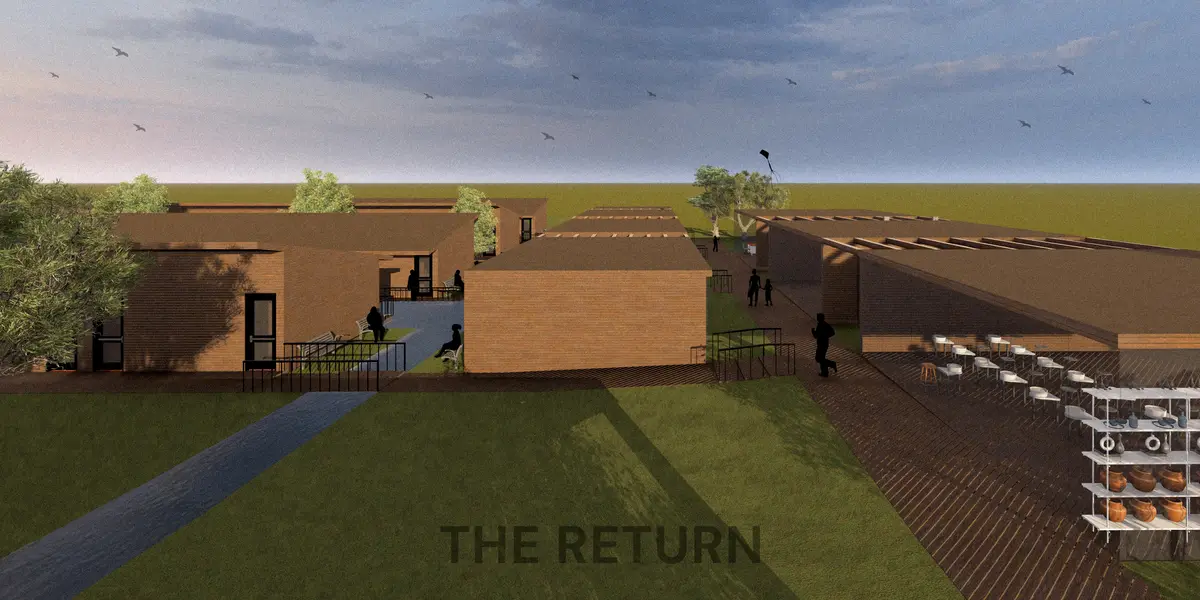
THE RETURN
This project goes beyond architecture—it's about creating a space for marginalized individuals to heal and reconnect with society.

Designed for former inmates, this rehabilitation and skill development center aims to offer a spatial experience grounded in the healing potential of architecture.
1. Conceptual Approach
The core idea shaping the project is that of gradual social reintegration. This process begins with the individual’s internal rehabilitation, evolves through interaction and production, and culminates in an open encounter with the public. Each step is carefully framed with thresholds that allow individuals to progress safely and confidently.
2. Spatial Sequencing
The project site is organized through three main spatial phases that mirror the emotional and social development of the individual:
Residential Units: These are private, inward-oriented living spaces where individuals can find solitude and safety. Designed around interior courtyards, they ensure a secure and supportive living environment.
Common Areas: Located after the residential units, these spaces (such as libraries and communal lounges) mark the beginning of social interaction within a safe internal community, enabling low-threshold social engagement.
Workshop Zones: At this stage, individuals engage in group-based production activities. The area includes three main units:
Kitchen Workshop: Individuals gain basic kitchen skills and are prepared for the production processes required in the restaurant.
Ceramics Workshop: Focused on handcraft, this space promotes patience, concentration, and production discipline.
Multipurpose Classroom: Theoretical training such as entrepreneurship, hygiene, management, and organizational skills are provided to prepare individuals for the next phase.
Each workshop is directly connected to the restaurant unit. By the end of the process, individuals are assigned roles in the restaurant based on their preferences and skills — whether in the kitchen, service, or administration. This is not only a production phase but also a process of taking responsibility, becoming visible, and developing a sense of belonging.
3. The Restaurant Unit A Scene for Encounter, Acceptance, and Hands-on Learning
As the final and most public layer of the spatial sequence, the restaurant serves both as the outcome of production and as a space for social confrontation.
The restaurant was planned with the idea of attracting people from surrounding schools, churches, and residential neighborhoods — not only as customers but as participants in a social exchange. This is not just a place to eat; it is where stories are shared, prejudices are questioned, and real human connections are forged.
With its open kitchen concept, visitors witness not only the meal being served but also the process behind it — the labor, care, and transformation. In this sense, the restaurant becomes not just a dining space but a stage for encounter, confrontation, and ultimately, acceptance.
Moreover, the restaurant functions as an applied workshop — the final step in the rehabilitation journey, where individuals put their skills into practice. Whether in food preparation, service, or management, this space allows participants to experience real-world responsibilities in a controlled yet open environment. It is a critical transition zone that merges learning with practice, and care with visibility.
4. Water as a Sensory and Symbolic Element
Water plays a vital role in the spatial organization. Positioned between buildings, water features provide a sense of tranquility while also offering a metaphor for the individual’s inner journey. The visual flow created by water surfaces instills calmness and slow pacing throughout the space. It also functions as a transitional element — blurring the boundaries between physical and social thresholds.
5. Material and Structural Expression
Wood is used throughout the project to evoke a sense of warmth, sincerity, and natural empathy. Its tactile and visual softness creates a supportive atmosphere for individuals undergoing transformation.
In contrast, the restaurant unit is deliberately differentiated: designed with steel structure, glass curtain walls, and a glass roof, it symbolizes the individual’s full transparency and readiness to re-enter society. This architectural clarity reflects visibility, openness, and acceptance.
6. Conclusion: A Journey, A New Beginning
This center is more than a collection of buildings — it is a spatial embodiment of transformation, responsibility, and acceptance. Each individual follows their own rhythm and path through this journey. Architecture, in this context, offers not only shelter, production, or service — but a sense of belonging, a safe space, and a new beginning.

Popular Articles
Popular articles from the community

Temporary Home for Dogs: A Reversed Zoo Rethinks Animal Shelter Architecture
In Bucharest, a sinuous corridor and freed landscape flip the logic of containment, designing a shelter that works to make itself unnecessary.
Extended Shell: Retrofitting Kolkata's Balconies as Living Urban Thresholds
A modular retrofit system recovers the social and environmental intelligence of Kolkata's historic verandas for contemporary Park Street residents.

Manzana Morphosis: Stretching Barcelona's Grid into a Living Landscape for 2050
A radical reworking of the Eixample manzana turns density into a tool for generous public space, vertical ecology, and environmental performance.

Opera on the Sea: Driftwood Logic Shapes a Timber Opera House on Estonia's Coast
Trevor Orgill's opera house translates the entangled drift of floating timber into a civic building where wood, water, and music converge.

Similar Reads
You might also enjoy these articles

The Rhythm of Seasons
A Farmers' Market Connecting Nature and the City

More Than a Building-Designing a Living System
More Than a Building-Designing a Living System
Base Beyond
DESERT COMPOUND ARID: TOURISM OF ABSENCE AND ABUNDANCE

Explore Experiential Architecture Competitions
Discover active competitions in this discipline


Challenge to reimagine the Iron Throne

Photograph architecture without architects

Illustrate the lost glory of Angkor Wat - Render Challenge

Design challenge to reuse E-waste
Comments (0)
Please login or sign up to add comments
No comments yet. Be the first to comment!