

The Rubber.er Cafe by SA-ARD studio
An adaptive-reuse café in Rayong transforming a former rubber factory into a contemporary social space through recycled materials and architectural storytelling.


Completed in 2023, The Rubber.er Cafe by SA-ARD studio is a modest yet deeply contextual adaptive-reuse project located in Rayong, Thailand, an area historically shaped by rubber cultivation and processing. The 180-square-metre café transforms the memory of a family-run rubber factory into a contemporary public space that combines hospitality, cultural storytelling, and material restraint.
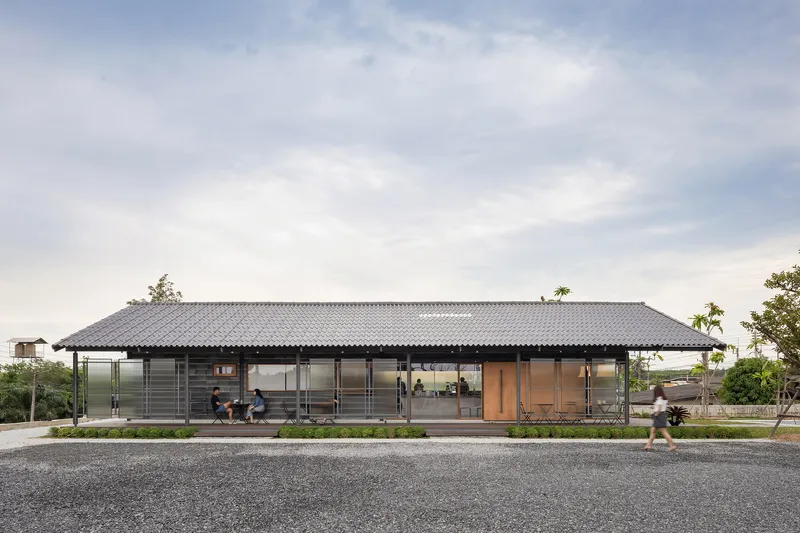
Rather than erasing the site’s industrial past, the project embraces it, translating production heritage into architectural language and everyday experience.
Reinterpreting an Industrial Legacy
The project is rooted in the owner’s family history, which spans generations of rubber production, including plantation management, sheet rolling, and drying operations. For SA-ARD, the café became an opportunity to preserve this legacy while giving it new relevance.
Instead of starting from scratch, the architects reused and reconfigured over 80% of the original factory materials. This approach ensured continuity between past and present while significantly reducing construction waste.
The resulting single-storey, 20-metre-long structure echoes the proportions and atmosphere of former processing sheds, reinterpreted through a softer and more refined spatial language.


Architecture as a Small Museum
Conceptually, The Rubber.er functions as both café and micro-museum. The building quietly archives local knowledge and industrial memory, embedding storytelling into daily routines.
Its elongated form, deep roof overhangs, and exposed steel structure establish a calm and grounded silhouette within Rayong’s industrial landscape. The architecture avoids formal excess, instead privileging clarity, repetition, and proportion.
This restrained approach allows the narrative of rubber production to remain central.
Material Strategy: Memory in Construction
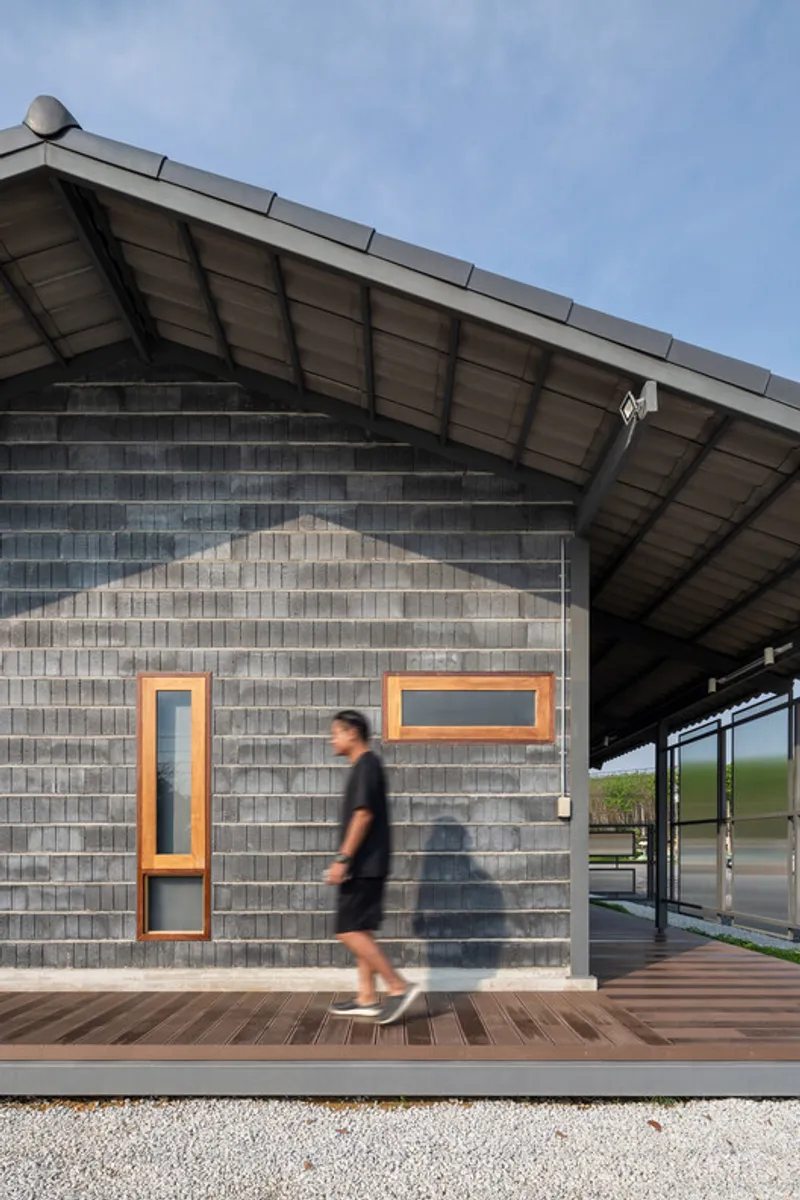
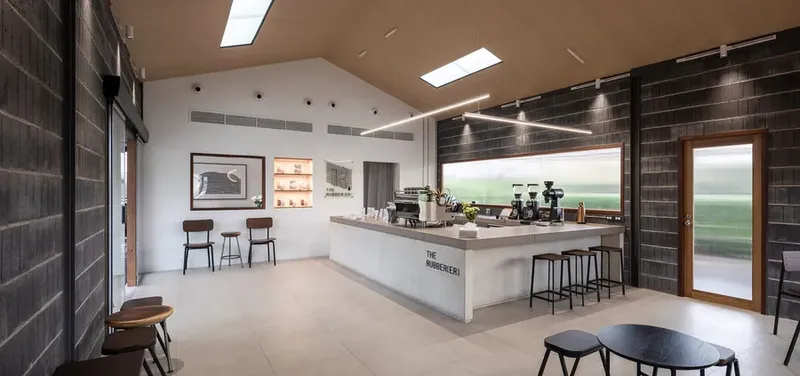
Materiality plays a crucial role in expressing the project’s identity. The primary construction system uses Eco Blocks, recycled masonry units characterized by subtle horizontal striations.
By carefully aligning these lines, the architects created a rhythmic surface pattern that animates both interior and exterior walls. Beyond aesthetics, the blocks provide thermal insulation and simplify construction.

Key materials include:
- Recycled Eco Blocks
- Exposed steel framing
- Cast-in-place concrete
- Warm timber joinery
- Custom wooden furniture
Together, they reflect SA-ARD’s commitment to structural honesty and material simplicity.


Expressive Structural Detailing
An innovative construction detail lies in the wall system. Instead of conventional reinforced concrete tie beams, Eco Blocks are combined with exposed steel angles.
This technique reduces material use and allows structural connections to remain visible. Rather than concealing joints, the building celebrates assembly and process, echoing the logic of industrial architecture.
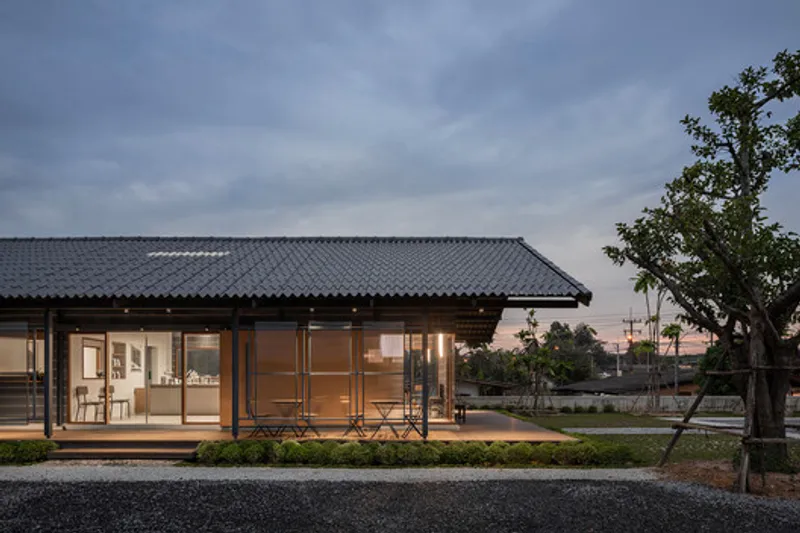
The result is a lightweight, efficient structure that communicates how it is made.
Interior: Calm, Functional, and Grounded
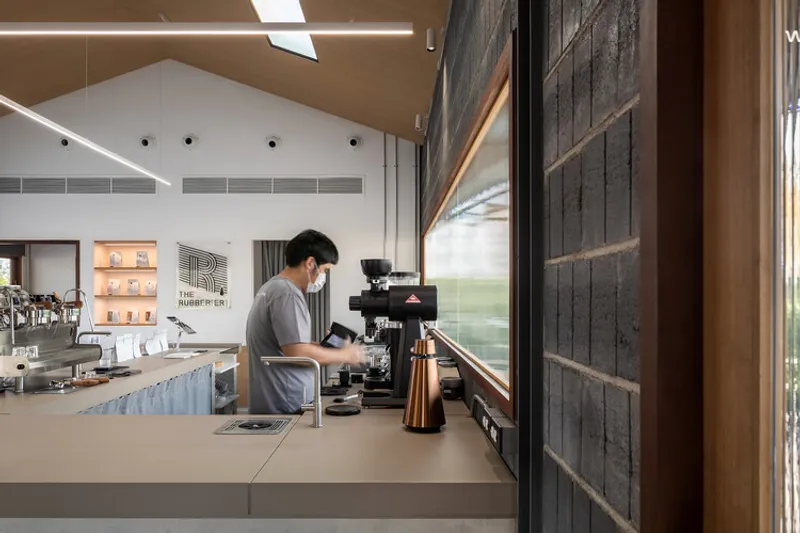
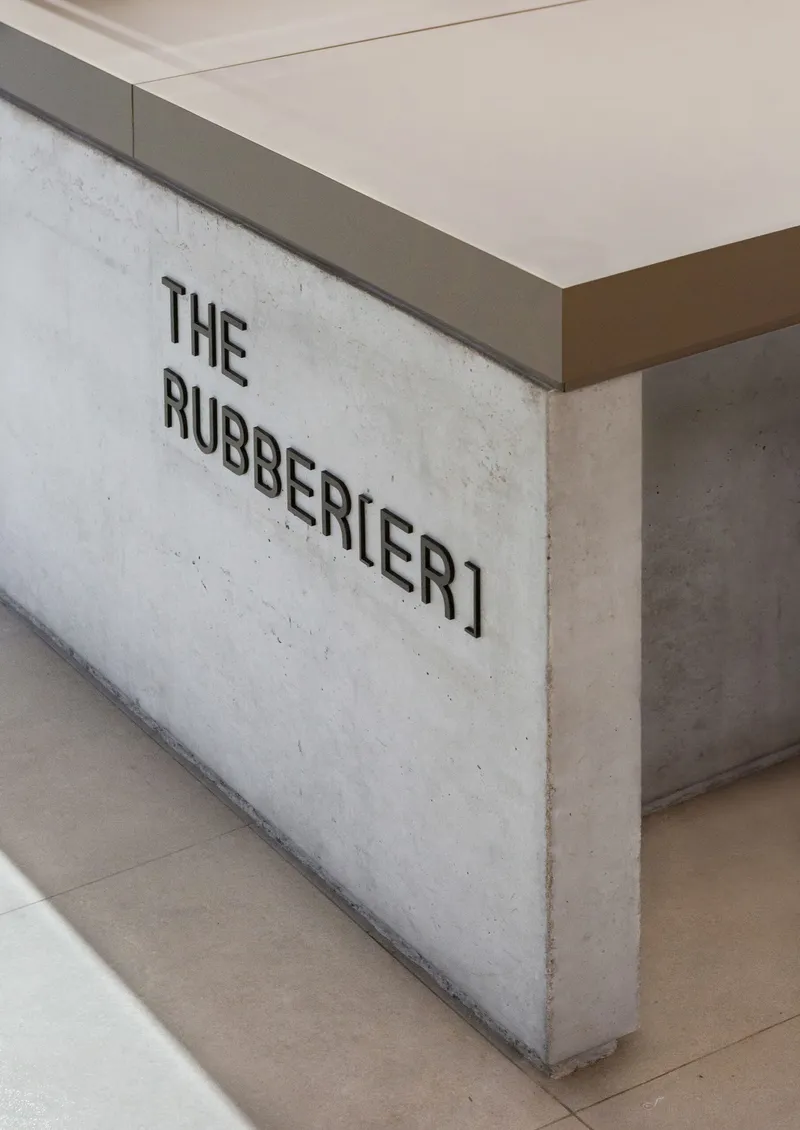
Inside, the café is organized around a large concrete counter that acts as both service hub and social anchor. Its mass contrasts with the lightness of timber frames and furniture.
Natural light enters through generous openings, softened by roof overhangs. The restrained palette enhances focus on texture, shadow, and material variation.


The interior atmosphere balances industrial memory with contemporary comfort, creating a welcoming environment for daily use.
A Living Archive of Rubber Production
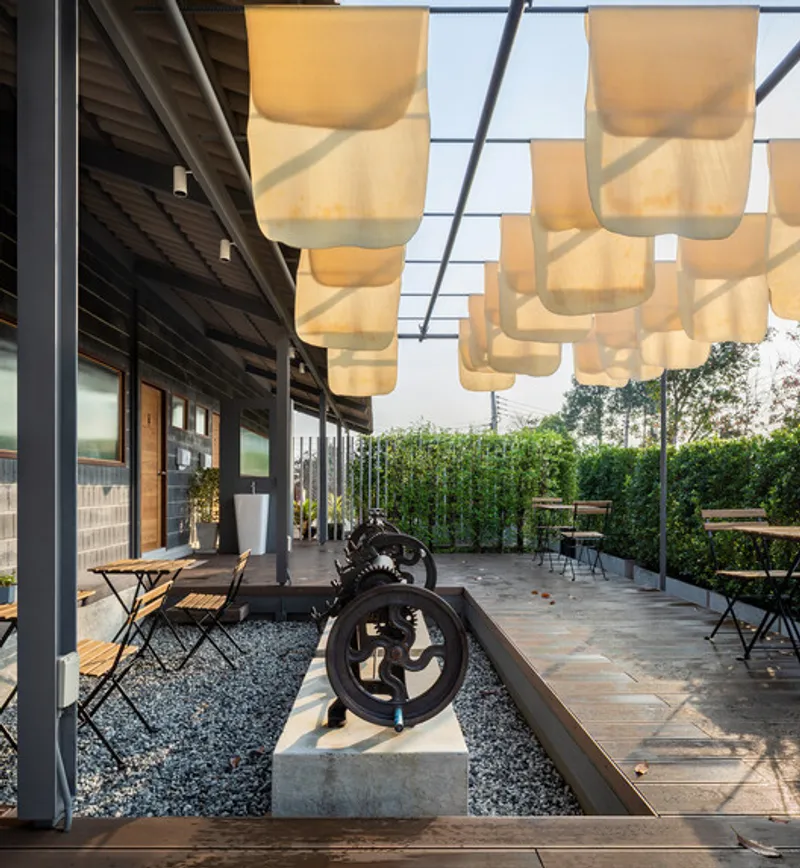
Behind the main café space lies a semi-outdoor exhibition zone that transforms industrial remnants into spatial narratives.

Here, three manual rubber-rolling machines, once central to production, are displayed alongside suspended sheets of raw rubber. Hung from a steel frame, the sheets sway gently in the breeze, creating a poetic kinetic installation.
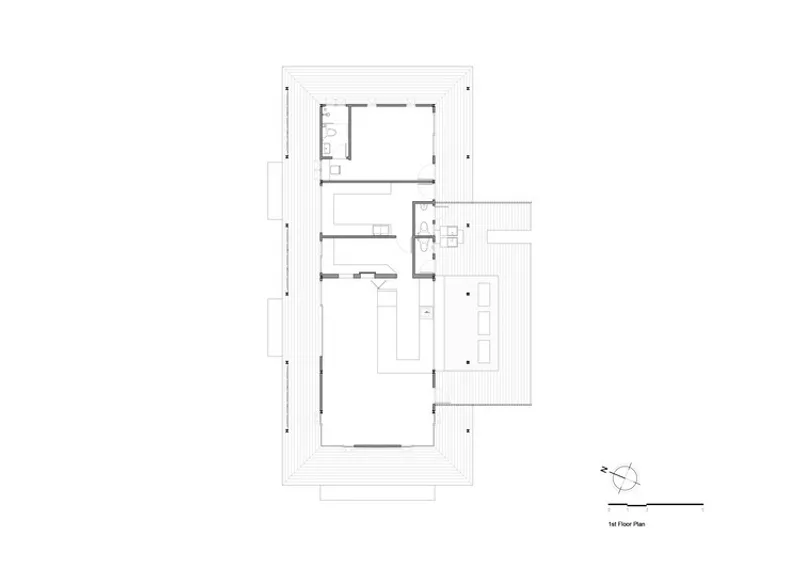
This space invites visitors to observe, rest, and learn. Without didactic displays, the architecture itself becomes the storyteller.
Landscape, Climate, and Passive Comfort
The elongated roof and deep overhangs protect the building from tropical sun and heavy rain, while allowing cross-ventilation. Semi-outdoor zones blur boundaries between inside and outside, reducing reliance on mechanical cooling.

The Eco Blocks further enhance thermal performance, supporting comfortable indoor conditions in Rayong’s hot, humid climate.
Environmental responsiveness is achieved through passive means rather than complex systems.
Community and Cultural Continuity
More than a commercial venue, The Rubber.er functions as a social platform. It reconnects local residents with shared histories, transforming private memory into collective experience.
By reactivating an industrial site through public use, the project contributes to cultural continuity and local pride. It demonstrates how small-scale architecture can sustain identity in rapidly changing contexts.
Sustainability Through Reuse
The project’s sustainability lies primarily in its adaptive-reuse strategy and material economy. By salvaging most of the original factory components, SA-ARD minimized embodied carbon and construction waste.

Simple construction methods, durable materials, and passive climate control further reinforce long-term environmental responsibility.
Sustainability here is embedded in practice rather than proclaimed through technology.
Modesty as Architectural Strength
The Rubber.er Cafe exemplifies an architecture of modesty. It does not rely on spectacle, branding, or stylistic excess. Instead, it achieves significance through care, restraint, and cultural awareness.
Every design decision, from material reuse to structural detailing, serves both narrative and function.
This modesty allows the building to age gracefully and remain relevant within its community.

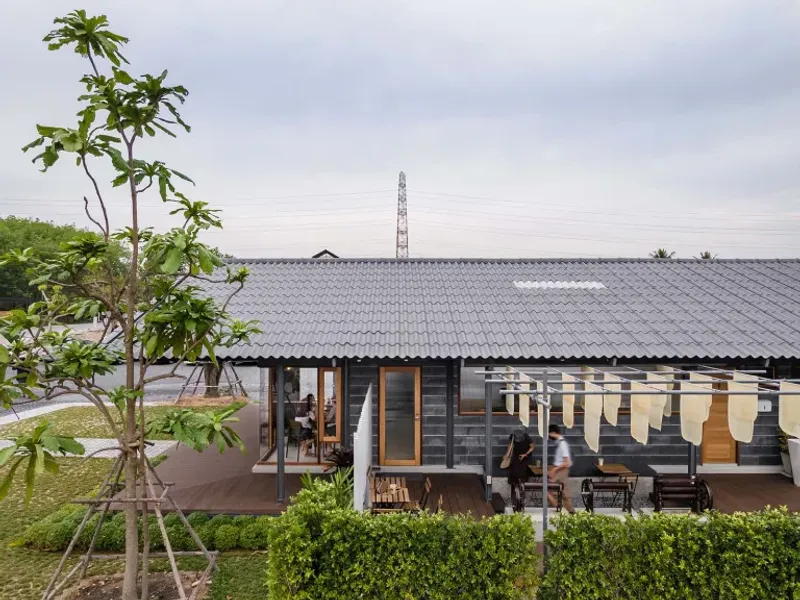
All the Photographs are works of Usssajaeree studio



Popular Articles
Popular articles from the community


Lunar Spiral: Space Architecture Shaped by the Mathematics of the Universe
Lunar Spiral reimagines space architecture through Fibonacci geometry, lunar regolith, levitating habitats, and self-sustaining Moon living.

Play: Fragments of Their World
Familiar architecture becomes modular playground design, creating safe spaces where displaced children can learn, connect, imagine and play.

Conexión: Biophilic Design Reimagines High-Rise Living in Hong Kong
Conexión reimagines high-rise living in Hong Kong through biophilic design, green facades, shared spaces, daylight, water and nature within.

Co-life: Sustainable Architecture for Age-Friendly Community Living
Co-life reimagines sustainable architecture for seniors through courtyards, rammed earth, shared gardens, and spaces designed for belonging.

Similar Reads
You might also enjoy these articles


Hodi-Mandai Geram
Project Function: Preservation and revitalization of the Intangible heritage and socio-spatial identity of the Hodi by Housing, Cultural Memory Center, Sacred Grove, landscape, local tourism economy


Olio Towers: A Mid-Rise for Performers That Fuses Housing, Rehearsal, and Stage
Located blocks from Houston's Theater District, this modular tower stacks living units around a central performance atrium.

Oasis: Modular Green Housing Carved into Dhaka's Urban Fabric
A shortlisted Plugin Housing entry reclaims unauthorized settlements in Dhaka with stepped concrete volumes, green roofs, and ventilation-driven design.

Black Hole: A Floating Megastructure for the Post-Physical Era
Emiliano Mazzarotto envisions a spherical, self-scaling arena where e-sports, digital hotels, and holographic stadiums replace traditional public space.
Explore Hospitality Building Competitions
Discover active competitions in this discipline



Challenge to reimagine the Iron Throne


Photograph architecture without architects


Illustrate the lost glory of Angkor Wat - Render Challenge


Design challenge to reuse E-waste
Comments (0)
Please login or sign up to add comments
No comments yet. Be the first to comment!