

The Shelter Bridge in Copenhagen
A landmark of sustainable urban design, The Shelter Bridge redefines active mobility, public space, and biodiversity in Copenhagen.


As cities confront climate change, overpopulation, and declining public health, sustainable urban design has become one of the most critical architectural strategies of our time. The Shelter, designed by Eve C., proposes a new model for infrastructure: one that is not merely connective, but regenerative, social, and ecological.
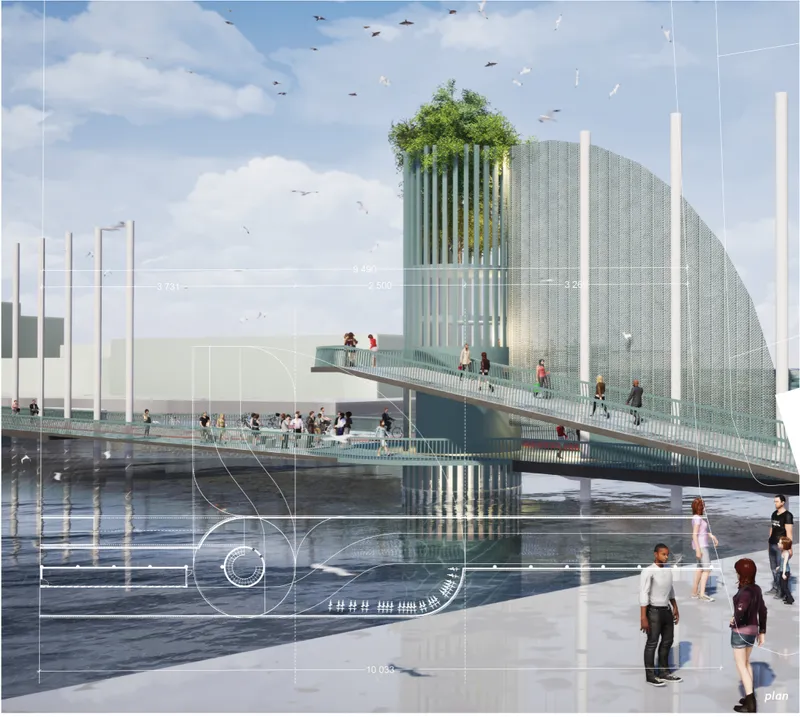
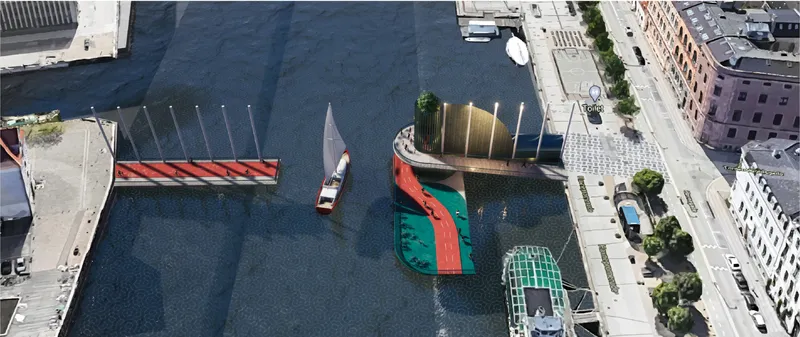
Located in Copenhagen, a global leader in bicycle culture and progressive mobility planning, The Shelter is more than a bridge. It is a multi-layered public realm that integrates cyclists, pedestrians, urban programs, and bird habitats into a single architectural gesture. Conceived as "a bridge for everyone," the project transforms mobility infrastructure into an inclusive civic landscape.
Architecture as a Space-Building Game
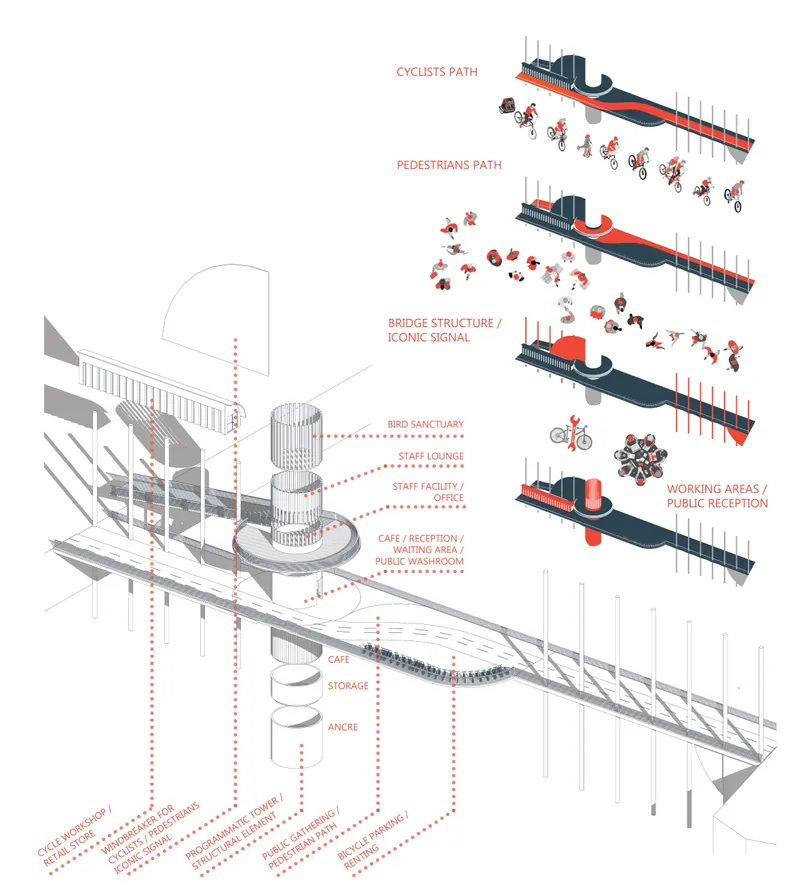
The concept behind The Shelter emerges from construction games, systems where elements nest within one another without conflict. In the same way, the bridge organizes multiple spatial programs that coexist fluidly. Cyclists move efficiently along dedicated lanes, pedestrians gather and stroll on elevated platforms, and public facilities are embedded within sculptural volumes.
This layered composition represents a new paradigm in sustainable urban design: infrastructure that performs socially, environmentally, and symbolically.
The opening form of the bridge: curved, elevated, and iconic, signals a new architectural typology. It is accessible at all times and adapts to varied speeds, uses, and users without interference.
Active Mobility as the Core of Urban Transformation
More than 100 years after the invention of the bicycle, cities are rediscovering its transformative potential. Today’s global challenges, air pollution, sedentary lifestyles, fossil fuel dependency, demand a radical shift toward active mobility.
The Shelter responds with clarity and precision:
- A 4.5-meter-wide cycling track divided into three lanes
- Two directional lanes plus a dedicated overtaking lane
- No changes in level, hills, or chicanes
- Full accessibility for all cyclists, from children to cargo-bike users
By physically separating cyclists from pedestrians, the design eliminates conflict and enhances safety. Pedestrians occupy their own elevated promenade, encouraging slower movement, pauses, and social interaction.
This integration of cycling infrastructure within architectural space demonstrates how sustainable urban design can prioritize vulnerable users while improving the overall efficiency of the city.
A Vibrant Public Space Above Water
Unlike conventional bridges that function purely as transit corridors, The Shelter operates as a civic platform. Its circular gathering deck expands into shared public space where cafés, waiting areas, workshops, and retail programs activate the structure throughout the day.
Programmatic elements directly linked to bicycle culture: rental services, repair workshops, parking, and retail, are positioned strategically along the route. Beneath the water level, a restaurant space offers a unique immersive experience, strengthening the relationship between architecture and landscape.
Through levels, curves, and color-coded paths, the bridge choreographs movement while maintaining visual unity. The red cycling track becomes both wayfinding device and iconic urban signal.
Biodiversity and Urban Ecology
At the heart of the structure stands a 15-meter-high cylindrical tower, a planted sanctuary inaccessible to the public. This vertical garden acts as a refuge for seabirds and urban birds, reinforcing Copenhagen’s commitment to biodiversity.
The Shelter demonstrates how sustainable urban design extends beyond human-centered planning. By integrating ecological habitats into infrastructure, the project positions architecture as mediator between species.
In an era of global deregulation and environmental uncertainty, this gesture becomes symbolic: a shelter not only for people, but for nature.
Intermodality and Inclusive Urban Planning
Good urban design must allow multiple mobilities to coexist without hierarchy. The Shelter embodies this principle through intermodality: enabling cyclists, pedestrians, commuters, tourists, and local residents to share space harmoniously.
Soft mobility modes are given architectural dignity. Instead of being squeezed into leftover urban fragments, cycling and walking become the primary generators of form.
This shift signals a reinvention of urban priorities:
- Reduced motorized travel
- Greater interaction among users
- Increased respect for shared space
- Enhanced public health
- Strengthened community identity
Such principles align directly with contemporary sustainable urban design strategies adopted across Europe.
A Landmark for Copenhagen
Copenhagen stands as a European showcase for progressive mobility and urban innovation. The Shelter contributes to this legacy by establishing a new architectural landmark rooted in performance rather than monumentality.
Its sculptural windbreak form, elevated pathways, and glowing red cycle track create a recognizable silhouette on the waterfront. Yet its true landmark status emerges from function, from enabling daily life to unfold sustainably.
The bridge becomes a symbol of urban resilience: a structure that shelters movement, biodiversity, and social exchange in a rapidly changing world.
The Shelter by Eve C. redefines what a bridge can be. It challenges traditional infrastructure by merging architecture, mobility, ecology, and civic life into a cohesive system.
In doing so, it demonstrates that sustainable urban design is not a stylistic choice, but a strategic framework for the future city: one where infrastructure supports human well-being, environmental restoration, and collective identity.
As cities worldwide search for models of low-carbon transformation, The Shelter offers a compelling answer: build infrastructure that shelters more than movement, build infrastructure that shelters life itself.



Popular Articles
Popular articles from the community


Hill & Cross Opera: Sculptural Opera House Architecture Shaped by Tallinn’s Landscape and Identity
Hill & Cross Opera reimagines opera house architecture in Tallinn through its sculptural hill, civic plaza, glass wave and a luminous cross.

Play: Fragments of Their World
Familiar architecture becomes modular playground design, creating safe spaces where displaced children can learn, connect, imagine and play.

Co-Life: Senior Housing Design That Reconnects Older Adults With the City
Co-Life reimagines senior housing design through healing gardens, shared streets, workshops, and a sustainable community across generations.

The Musturak Paradise: Senior Living Architecture for a Connected Future in Temara, Morocco
The Musturak Paradise reimagines senior living architecture in Temara via private homes, social spaces, culture, community, and shared care.


Similar Reads
You might also enjoy these articles

Eco Chapel: A Green Architecture Pavilion Designed in Symbiosis with the Forest
Eco Chapel uses green architecture to weave prayer, learning and reuse into a forest pavilion shaped by modular hexagonal canopies for life.
Kaffeebühnen: Coffee Shop Architecture Designed as a Civic Stage Between Vienna’s City and Park
Kaffeebühnen turns coffee shop architecture into a civic stage, linking Vienna’s park edge, urban life, warm timber yards, and coffee craft.
Healing Façade: Sustainable Architecture for Reforestation, Community, and Sacred Ecology in Ethiopia
Healing Façade reimagines sustainable architecture as a living wall that restores soil, catches water and renews Ethiopia's forest churches.


Urban Forest: A Vertical Ecosystem for 5,000 Workers in Singapore's Changi Business Park
Radially stacked pods and layered green decks turn a 7-acre plot into 47 acres of ecological workspace projected for 2040.


Comments (0)
Please login or sign up to add comments
No comments yet. Be the first to comment!