
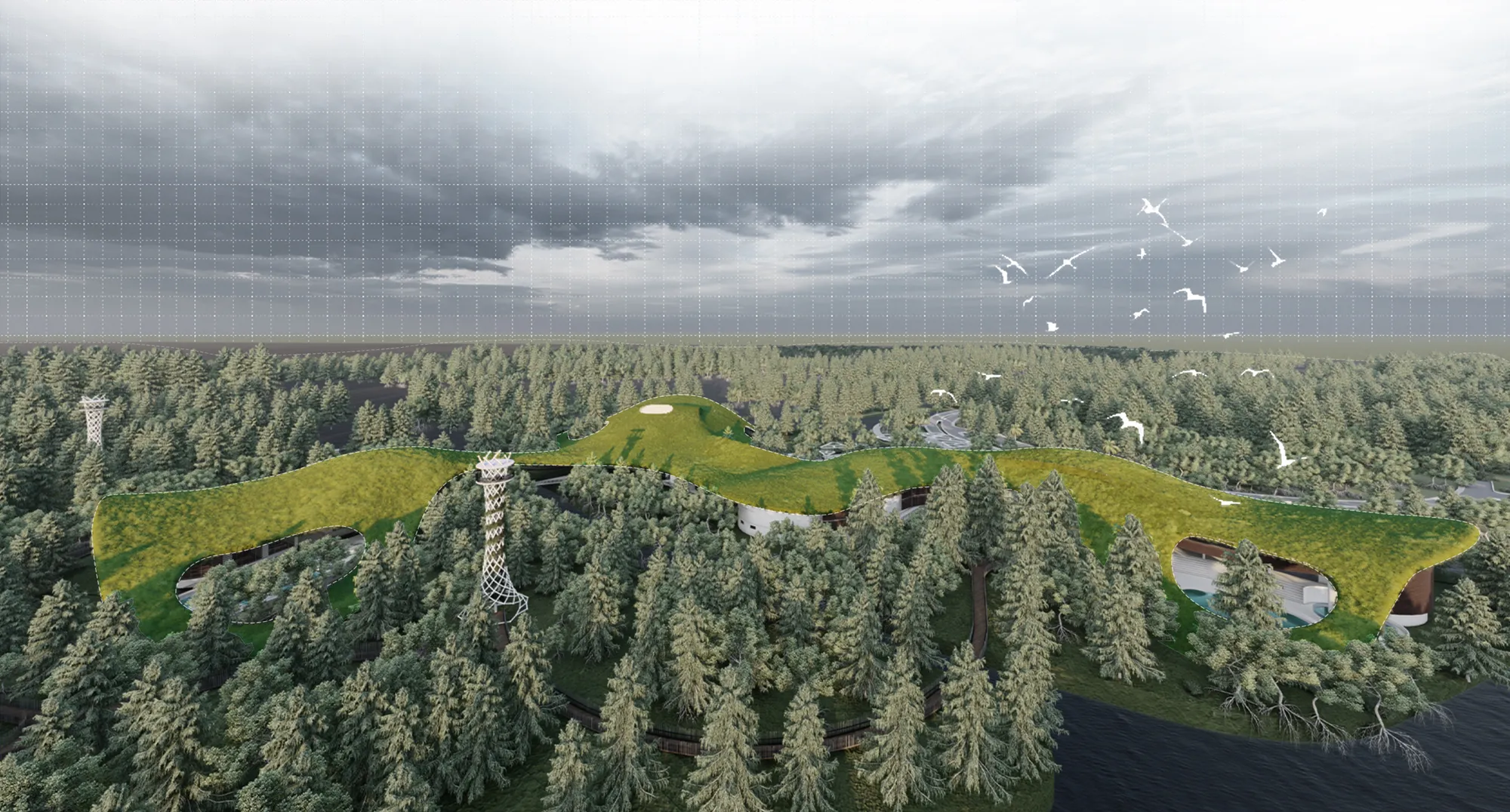
THE TALE OF MARINE LIFE: A SEA AQUARIUM COMPLEX
LOCATION: SONADIA | MOHESHKHALI | COX’S BAZAR SITE AREA: 20.3 acre

A SEA Aquarium Complex is a marine exhibit that houses and displays saltwater organisms, including fish, invertebrates, and marine mammals in large tanks for public viewing and educational purposes. It is a groundbreaking architectural initiative that integrates sustainability, conservation, education, and recreation. This project is a part of Bangladesh Government's eco-tourism development program which is managed by BEZA (Bangladesh Economic Zones Authority) has 910-acre in Sonadia Island, Moheskhali, Cox's Bazar is an attractive place for tourists to enjoy the sea.
The core idea of the project is to minimize disruption while enhancing sustainability. The design approach was tailored to harmonize with the local ecosystem, incorporating marine life, coastal geography, and unique environmental factors.
It aims to blend modern architecture with the natural environment, using innovative design to improve functionality and aesthetics while preserving ecological balance. Its goals include:
The project has goals that focus on the promotion of marine biodiversity, educational opportunities, research and conservation, environmental advocacy, cultural preservation, tourism and recreation, aesthetic appeal, stress reduction and so on.
* Conservation of Marine Biodiversity – The project creates areas for the display and conservation of marine species including fish, coral reefs, sharks and dolphins.
* Educational opportunities – including interactive exhibits, theater and library, aimed at educating visitors about the marine ecosystem and its importance.
* Research and Conservation – Dedicated research institutes enable scientists to study marine species in a controlled environment. which supports conservation efforts
* Tourism and recreation - walking trails, observation towers aquarium and cultural sites Helps enhance the visitor experience
* Cultural Preservation – The design promotes respect for local culture and the marine environment by combining traditional maritime practices with modern displays.
The design incorporates a strategic roadway design for direct, seamless access to the site, enhancing accessibility and navigation for the visitors. The project comprises three distinct segments:
· The Public Exhibition:
As the visitors enter, they experience a journey that tells the tale of the ocean. Diverse aquariums featuring different species of coral and fish, sharks and dolphins, tell the story of their individuality. Additionally, the visitors are offered with services like a café and a souvenir shop. The journey continues upstairs, where preserved flora and fauna are displayed. As the journey proceeds to the lowermost floor, the visitors experience an auditorium, a library and a 4D theatre, which serve to broaden their understanding about marine life
· Semi-Public Exhibition Zone
Houses conservation-precise tanks, along with quarantine and breeding tanks, and a coral reef exhibition. Accessible to researchers and traffic in managed settings to make certain minimal disturbance to marine existence.
· Research Institute
A secluded place devoted to analysis, housing facilities for 20 researchers, inclusive of a studies pool, quarantine tanks, and education tanks.
Promotes marine life and species conservation in quiet and useful resource-rich surroundings.
Trails and Accessibility:
To reduce the environmental footprint, the site is connected through trails made of eco-friendly materials like recyclable wood and bamboo. These trails lessen human impact while allowing site visitors to explore mangrove forests, coastal areas, and jungles. The design prioritizes pedestrian movement and seamless navigation, ensuring accessibility for all.
Considering the biodiversity of the environment, all the lights of the project will be switched off at dusk so that the birds can sleep in peace. Environmentally hazardous plastics will not be introduced in this project. So, nature can flourish without any hindrance.
Green Roof:
The innovative "Super Roof" concept is a green roof that blends seamlessly with the natural landscape. The superstructure is made of concrete and spec truss, with a layer of coco peat soil, allowing for the cultivation of lush grass that maintains temperature uniformity. “Aquaponic” and “Rainwater harvesting” methods have been adopted for the water management system.
It has features:
Cocopeat topsoil: Supports native grasses and plants. while maintaining a consistent temperature
Observation Tower: Visitors can enjoy spectacular views and interact with the animals on the island.
Energy efficiency: The roof acts as an insulator. Helps reduce energy use in climate control.
Sustainability characteristics
· Eco-friendly material
This project uses locally sourced recycled materials such as wood, bamboo and natural stone.
Avoiding environmentally harmful plastics helps ensure the long-term health of the ecosystem.
· Energy and water management
Rainwater Harvesting: A sustainable water collection system for reuse at the factory.
Aquaponics: Combining fishing with growing plants. Demonstrates sustainable agriculture
· Protection of biological diversity
Mangrove areas are protected as natural barriers and habitat for coastal plants.
All lights are turned off at dusk to ensure that nocturnal wildlife, especially birds, can sleep undisturbed.
· Climate adaptation
trails and buildings are designed to withstand climate change and coastal challenges. To ensure the resiliency of the park
Integration of technology:
The park uses cutting-edge technology to enhance the visitor experience and support research. The main components are:
Interactive displays: 3D and 4D holograms, digital displays, touch pools
Virtual Reality Simulation: Allow visitors virtually explore the underwater ecosystem.
Real-time monitoring: Provides information on marine biodiversity and ecosystem health. which contributes to conservation research.
Cultural and aesthetic attractions
The design celebrates the natural beauty of Sonadia Island while promoting cultural appreciation. Architectural forms inspired by coral reefs, underwater caves and sea formations create a sense of discovery. It bridges the gap between history and innovation by integrating traditional maritime practices and modern performances.
Facilities and activities for visitors
Marine Exhibits: Individual tanks for freshwater and saltwater species, reef tanks, shark tanks, stingray tanks and dolphins.
Interactive areas: touch pool, fossil exhibition and amazing theater
Recreational areas: coffee shop, souvenir shop, indoor seating, and bleachers.
Research facilities: Breeding tanks, research facilities and dedicated office space for scientists.
Observation Towers: Provides breathtaking views of the island's landscape and seascape.
Effects and benefits
The park has been designed to provide multidimensional benefits:
* Environmental support: Raising awareness about the importance of marine conservation.
* Educational Opportunities: Expanding knowledge through interactive and immersive experiences.
* Tourism and Recreation: Establishing Sonadia as an important ecotourism destination.
* Cultural Preservation: To respect traditional maritime practices and demonstrate their relevance.
* Stress reduction and wellbeing: Provides a tranquil natural space to relax and connect with nature.


Popular Articles
Popular articles from the community


Play: Fragments of Their World
Familiar architecture becomes modular playground design, creating safe spaces where displaced children can learn, connect, imagine and play.

The Musturak Paradise: Senior Living Architecture for a Connected Future in Temara, Morocco
The Musturak Paradise reimagines senior living architecture in Temara via private homes, social spaces, culture, community, and shared care.

Lunar Spiral: Space Architecture Shaped by the Mathematics of the Universe
Lunar Spiral reimagines space architecture through Fibonacci geometry, lunar regolith, levitating habitats, and self-sustaining Moon living.

The Earth Pod: 3D Printed Homes for Resilient Refugee Communities
The Earth Pod reimagines refugee housing through 3D printed homes made from clay, combining resilience, self-sufficiency, and rapid shelter.

Similar Reads
You might also enjoy these articles

Day and Night Park: A Time-Based Urban Newsstand in Beijing
A temporary urban newsstand in Beijing blending travel, light, and reading through poetic colors, compact form, and community-focused design.

Modernist Patio Renovation in El Masnou, Barcelona by Oliver Segura Arquitectura + Cebrià Arquitectura
Modernist patio renovation blending tradition and innovation with a movable pool, leveled floors, and Catalan materials in El Masnou.

Alto Residencial Coop: Cooperative Housing Development in Santiago de Compostela by Carbajo Barrios Arquitectos
A linear cooperative housing complex blending white volumes and perforated metal façades, enhancing community living, natural light, privacy, and urban integration.
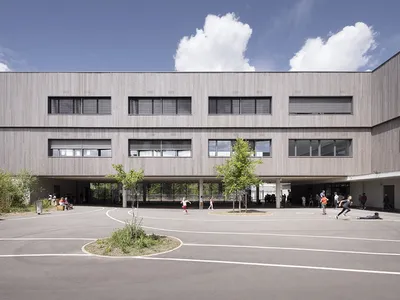
Vil Genis School by BPA ARCHITECTURE – Massy, France
Vil Genis School in Massy, France, features sustainable design, south-facing classrooms, community integration, accessible spaces, and modern educational architecture.
Explore Oceanarium Competitions
Discover active competitions in this discipline




From Logic to Configurators




Challenge to reimagine the Iron Throne


Photograph architecture without architects


Illustrate the lost glory of Angkor Wat - Render Challenge
Comments (0)
Please login or sign up to add comments
No comments yet. Be the first to comment!