

The Valley: A Sunken Linear City That Trades Saharan Heat for Underground Calm
Zuzanna Zuza's shortlisted EHC Sahara entry digs a terraced linear city into the desert, where a steady 25°C replaces the 50°C surface.


At the surface of the Sahara, the air can reach 50°C. A few metres down, the ground holds a constant 25°C. The Valley builds its whole argument on that difference. Rather than shielding buildings from the desert with ever thicker walls or ever larger cooling plants, the project cuts into the earth and moves daily life below grade. The result is a city defined less by its skyline than by its excavation: a long, stepped trench where housing, farms and public space sit in the ground's thermal stability.
Designed by Zuzanna Zuza and shortlisted in the EHC - Sahara competition, the proposal starts with a sober reading of the region. Sub-Saharan Africa faces poverty, water shortages, illiteracy, starvation, inadequate sanitation and poor health, and its cities are growing faster than anyone planned for. Zuza points to Nouakchott, the capital of Mauritania, which was designed for 15,000 citizens and now holds more than one million. The Valley treats that kind of growth as a given, and sets out to structure it before it happens. Its brief is split in two: what people need to survive (water, food, shelter, energy) and what they need to thrive (education, culture, health, safety, work, mobility, communication). The design tries to answer both lists at once, drawing on technology and on Arab building traditions.
Daily Life at the Bottom of a Cooler Ground Plane

The diptych sets the mood before any section drawing explains the mechanics. A figure crosses a lawn beside banana plants; next to it, pink terraced walls step down beneath a curving blue band of sky. These are not images of survival. They describe a planted, walkable public realm, the kind of scene that would be unthinkable on the open dunes at midday. Zuza leads with experience rather than infrastructure, and that choice tells you how the project wants to be judged: by whether people would actually choose to live there.
The pink, earth-toned walls matter too. They read as carved ground rather than applied cladding, which suits a scheme whose main material move is subtraction. The narrow framing of sky also reflects the logic of the trench: the deeper you go, the less sun reaches the floor, and the more shaded the inhabited levels become.
A Stepped Section Built Around a Planted Core

The first section shows how the idea works in practice. A sunken, multi-level structure steps down toward a central planted zone with palm trees, while cyclists move along the upper terraces and a city skyline rises beyond the rim. The terraces do several jobs. They make the excavation buildable, they put each level in partial shade from the one above, and they create a sequence of edges where circulation and public life can sit.
Putting greenery at the lowest, coolest point is a smart reversal of how desert settlements often work, where oases set the plan and buildings gather around them. Here the planted core is made, not found, and the city wraps itself around it. Next to the towers on the skyline, the section suggests the underground realm is not a retreat from urban life but a second layer of it.
Terraces, Pavilions and the Logic of the Linear City
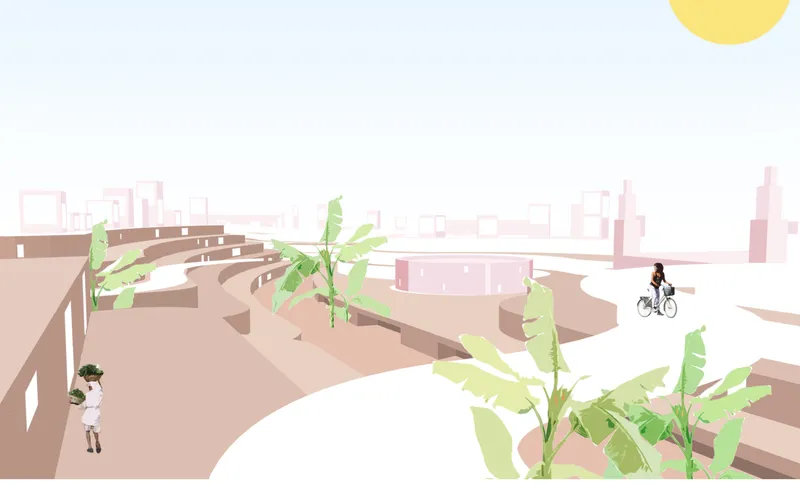
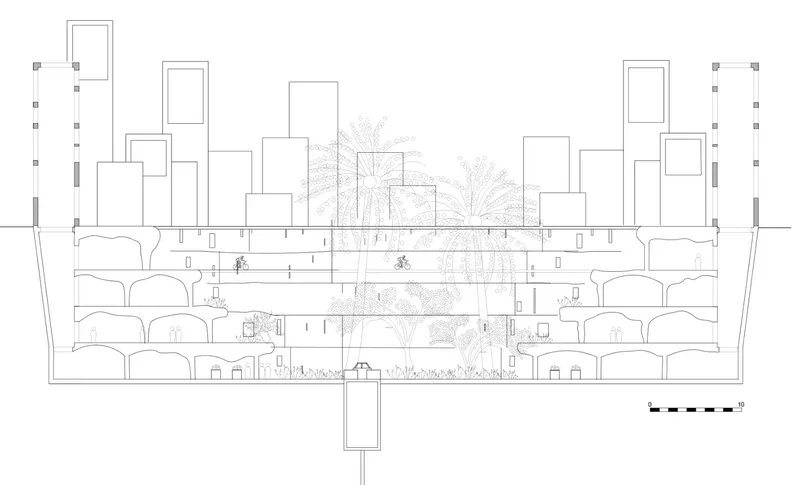
The second rendering returns to street level within the excavation: stepped pink terraces, banana plants, a cyclist on a path and a circular pavilion under a hard yellow sun. Set against it, the symmetrical section shows the full depth of the system, with palms at the centre, cyclists on the upper levels, vaulted rooms lower down and a central shaft rising beneath tall towers. The vaults recall regional building traditions of thick, cool interiors, while the shaft suggests vertical links and air movement between the depths and the surface.
Taken together, these drawings show why Zuza chose a linear plan. A trench can keep growing along its length without losing its section, so the city can expand as fast as Nouakchott did while staying compact. A hyperloop spine is proposed as the transport backbone, supported by electric vehicles, public roads and evacuation routes. The supporting systems are listed but not yet worked out in detail: solar thermal power plants and solar chimneys for energy; water tanks, wells, desalination and atmospheric harvesting for water; vertical farming, algae farms and holistic grazing for food; recycling and reuse for waste. Sandstorm-proof embankments and fire safety measures protect the edges, while parks and cultural hubs anchor community life. The zoning of living, agricultural, infrastructure and recreation areas gives each function a clear place along the line.
Why This Project Matters
Extreme habitat proposals often fall into one of two traps: technological fantasy that ignores the people living there, or survival bunkers that ignore everything beyond survival. The Valley avoids both by tying a simple thermal fact to a full programme of civic needs. Its two-part brief, survive and thrive, is a useful discipline, and the renderings show that Zuza took the second half seriously. Lawns, pavilions and cycling terraces are not decoration here; they are the test of whether an underground city can be somewhere people want to live.
The proposal is strongest in section and weakest where its systems remain a list. How the desalination plants, solar chimneys and hyperloop connect physically to the trench is left open, and those links would decide whether the city works. Even so, the core idea holds: in a region facing explosive urban growth and rising heat, digging down along a line that can keep extending offers a credible framework for future Saharan cities. As a shortlisted entry, The Valley earns its place by showing that the most effective climate strategy can be a change in level.
View the Full Project
About the Designers
Designer: Zuzanna Zuza
Enter a Design Competition on uni.xyz
uni.xyz runs architecture and design competitions year-round that reward proposals with spatial conviction and real site intelligence.
Project credits: The Valley by Zuzanna Zuza EHC - Sahara (uni.xyz).


Popular Articles
Popular articles from the community


David Ortega Stacks a Two-Story Mexico City Penthouse Around a Steel Stair and a Pergola-Shaded Roof Terrace
In Colonia Roma, a 300 m² penthouse uses oak joinery, a planted steel stair and a slatted roof pergola to make a new-build apartment feel like a house.

Jaramillo Van Sluys Arquitectura and Urbanismo Turn a Demolished Registry Lot in Quito into an Orchard Plaza
In Quito's Centro Histórico, a 2,800 m² plaza exposes the San Agustín convent wall and redraws its lost Augustinian orchard in volcanic stone.

GROUP A Strips a 1969 Rotterdam Harbor Headquarters to Its Frame and Wraps It in Timber Louvers
In Rotterdam's M4H harbor district, Ferro Offices reuses a 1969 frame, adds one timber storey and reaches BREEAM-NL Outstanding.

longwave studio Reorganizes a 112 m² Tainan Apartment Around the Daily Routines of a Family and Two Cats
In Tainan, Taiwan, birch plywood, rust-red furniture and a freestanding plaster wall link arrival, storage, work and family life in one apartment.

Similar Reads
You might also enjoy these articles


Hodi-Mandai Geram
Project Function: Preservation and revitalization of the Intangible heritage and socio-spatial identity of the Hodi by Housing, Cultural Memory Center, Sacred Grove, landscape, local tourism economy


Olio Towers: A Mid-Rise for Performers That Fuses Housing, Rehearsal, and Stage
Located blocks from Houston's Theater District, this modular tower stacks living units around a central performance atrium.

Oasis: Modular Green Housing Carved into Dhaka's Urban Fabric
A shortlisted Plugin Housing entry reclaims unauthorized settlements in Dhaka with stepped concrete volumes, green roofs, and ventilation-driven design.

Black Hole: A Floating Megastructure for the Post-Physical Era
Emiliano Mazzarotto envisions a spherical, self-scaling arena where e-sports, digital hotels, and holographic stadiums replace traditional public space.


Comments (0)
Please login or sign up to add comments
No comments yet. Be the first to comment!