

The Valley: A Visionary Approach to Sustainable Desert Living
Redefining Sustainable Living: Building Resilience Below the Sands to Create Habitable Spaces in the Harshest Climates on Earth


Africa is the world's poorest continent. People living there face numerous problems including poverty, water shortages, illiteracy, starvation, inadequate sanitation, and poor health. Sub-Saharan Africa seems to be especially affected by these issues to an even greater extent. That is why new habitat building in the Sahara should have solutions to these problems taken from both technology and Arab culture. More so, it should prepare for fast population growth, ensuring adequate living conditions.

Understanding Human Necessities
What Do Humans Need to Survive?
- Water
- Food
- Shelter
- Energy
What Do Humans Need to Thrive in Society?
- Education
- Culture
- Health
- Safety
- Work
- Mobility
- Communication
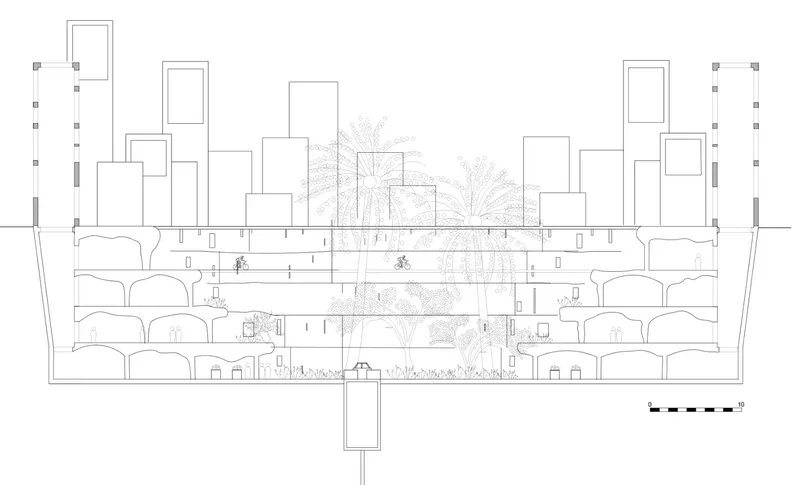
The project titled "The Valley" by Zuzanna Zuza, a shortlisted entry in the EHC - Sahara competition, aims to address these needs. Its core idea is to move human activities and functions underground, where the temperature is a constant and habitable 25°C, as opposed to the scorching 50°C above ground.

Core Concept: Adapting to the Sahara's Climate
By shifting functions underground, this habitat offers a sustainable and viable solution. Even with a sparse population density of the Sahara, the project anticipates urban expansion. Nouakchott, the capital of Mauritania, initially designed for 15,000 citizens, now hosts over one million inhabitants. "The Valley" utilizes this opportunity to plan a structured and efficient urban system.
Linear City Design
A linear city approach ensures optimal communication and mobility. Hyperloop technology serves as the backbone of transportation. This strategy enables dynamic growth while maintaining a compact urban footprint.
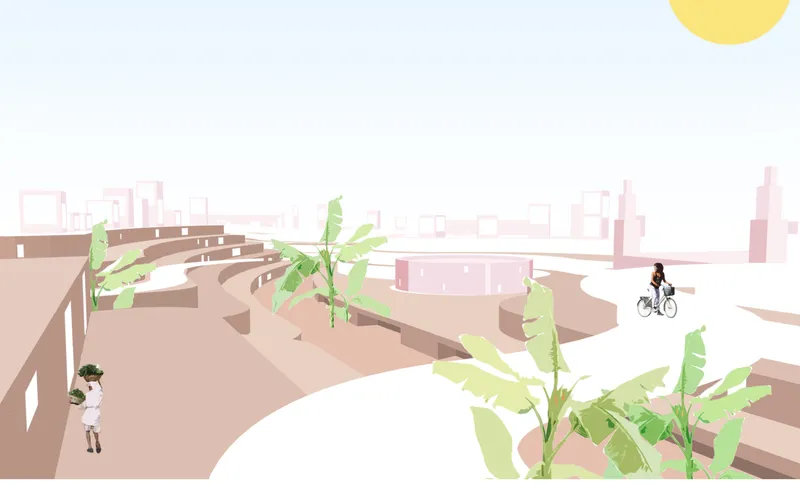
Key Features of "The Valley":
- Solar Energy Solutions: Solar thermal power plants and solar chimneys.
- Water Security: Water tanks, wells, and desalination plants.
- Sustainable Agriculture: Vertical farming, algae farms, and holistic grazing.
- Waste Management: Comprehensive recycling and reusing systems.
Program Layout and Functionality
The habitat is divided into zones, each serving specific purposes:
- Living Areas: Underground housing designed for energy efficiency.
- Agricultural Zones: Vertical and field farming managed sustainably.
- Infrastructure: Roads for evacuation, sandstorm-proof embankments, and fire safety measures.
- Recreation Spaces: Parks and cultural hubs to foster community engagement.
Transport and Water Systems
An integrated network ensures seamless mobility through electric vehicles and public roads. Water resources are optimized through desalination and atmospheric harvesting technologies.
"The Valley" is a visionary project by Zuzanna Zuza that reimagines urban living in one of the world's most challenging environments. By blending technology and traditional knowledge, it offers a sustainable and humane solution for future Sahara inhabitants.


Popular Articles
Popular articles from the community


Lunar Spiral: Space Architecture Shaped by the Mathematics of the Universe
Lunar Spiral reimagines space architecture through Fibonacci geometry, lunar regolith, levitating habitats, and self-sustaining Moon living.

The Earth Pod: 3D Printed Homes for Resilient Refugee Communities
The Earth Pod reimagines refugee housing through 3D printed homes made from clay, combining resilience, self-sufficiency, and rapid shelter.

Play: Fragments of Their World
Familiar architecture becomes modular playground design, creating safe spaces where displaced children can learn, connect, imagine and play.

Riyadh For All: Intergenerational Urban Design for Active Aging in Rabat
Riyadh For All reimagines urban design in Rabat with intergenerational co-living, adaptive courtyards, and Moroccan cultural exchange today.

Similar Reads
You might also enjoy these articles


Hodi-Mandai Geram
Project Function: Preservation and revitalization of the Intangible heritage and socio-spatial identity of the Hodi by Housing, Cultural Memory Center, Sacred Grove, landscape, local tourism economy


Olio Towers: A Mid-Rise for Performers That Fuses Housing, Rehearsal, and Stage
Located blocks from Houston's Theater District, this modular tower stacks living units around a central performance atrium.

Oasis: Modular Green Housing Carved into Dhaka's Urban Fabric
A shortlisted Plugin Housing entry reclaims unauthorized settlements in Dhaka with stepped concrete volumes, green roofs, and ventilation-driven design.

Black Hole: A Floating Megastructure for the Post-Physical Era
Emiliano Mazzarotto envisions a spherical, self-scaling arena where e-sports, digital hotels, and holographic stadiums replace traditional public space.


Comments (0)
Please login or sign up to add comments
No comments yet. Be the first to comment!