

Hidenori Tsuboi Architects Turns an Osaka Rail Overpass into a Craft Brewery That Opens Onto the Street
Hibi Hitoawa Brewery slots 260 square meters of taproom and brewing facility beneath JR Fukushima Station's elevated tracks in Osaka.


There is an entire subgenre of urban architecture devoted to colonizing the leftover spaces under railway infrastructure, and most of it settles for warehouse chic: strip the concrete back, hang some Edison bulbs, call it adaptive reuse. Hidenori Tsuboi Architects takes a sharper position with Hibi Hitoawa Brewery, a 260-square-meter craft brewery and taproom wedged beneath the elevated tracks of JR Fukushima Station in Osaka. Rather than treating the overpass as a moody backdrop, the design uses it as structural fact, then pushes everything else outward toward the street.
The result is a building that barely reads as a building at all. Its wide glazed facade dissolves the boundary between the interior and Fukumaru Street 57, the lively eat-street that surrounds it. Fermentation tanks are visible from the sidewalk. Patrons perch on stools that face the passing crowd. The brewery does not just occupy an underpass; it activates it, turning dead infrastructure into a social magnet for the neighborhood. Completed in 2024 as part of JR West Group's craft beer venture launched two years earlier, Hibi Hitoawa is a case study in how tight constraints can produce generous architecture.
A Facade That Performs Like a Threshold


The street elevation is dominated by a single bold move: a wide, nearly full-width glazed opening set into a painted blue surround, with a glowing horizontal light band running across its top edge. At dusk the effect is immediate. The blue reads as signal, not decoration, pulling the eye toward the opening and framing the activity inside like a stage set. The proportions are generous enough that the boundary between inside and out genuinely blurs: you can order a beer from the street-facing counter without stepping through a door.
What makes the facade work is restraint everywhere else. There is no signage tower, no cascading neon. The blue paint and the single luminous strip do all the heavy lifting, and the transparency of the glass lets the interior life serve as the primary advertisement. For a brewery that states its ambition as contributing to the vibrancy of the town, this is the right call: let the people be the spectacle.
Concrete, Glass, and the Craft of Visibility
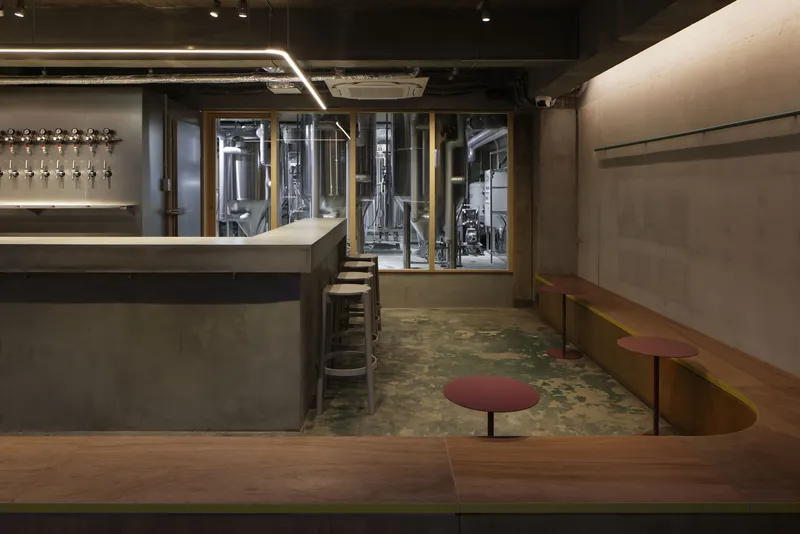
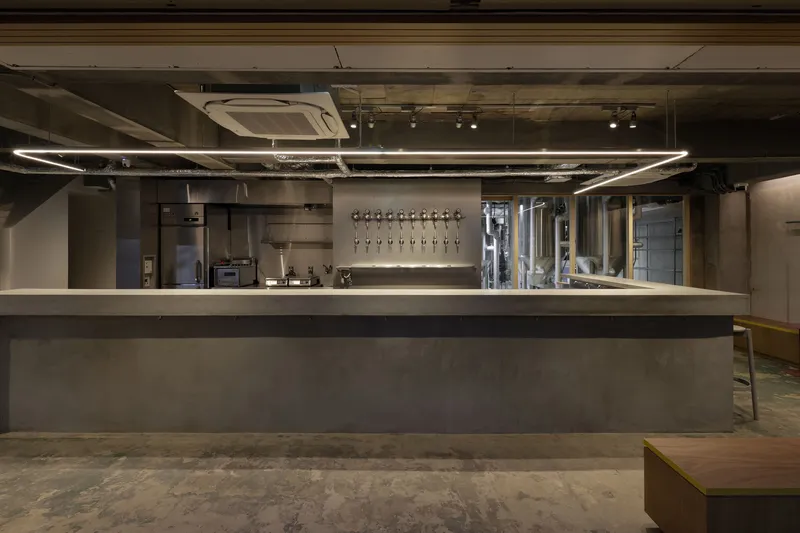

Inside, the material palette is honest to the point of bluntness: bare concrete ceilings inherited from the overpass structure, exposed ductwork, and a long concrete bar that anchors the taproom. Behind the bar, stainless steel fermentation tanks sit in a glass-enclosed volume, making the brewing process continuously visible. The decision to put production on display is both practical and theatrical. It gives the taproom a sense of purpose beyond consumption: you are drinking where the beer is made, and you can see it happening.
The timber-framed glazed partition that separates the brewing equipment from the seating counter is a particularly clean detail. It mediates between the industrial zone and the social zone without severing them. Patrons at the counter can watch brewers work; the partition controls sound and temperature without blocking sightlines. It is the kind of design choice that distinguishes a considered brewery from a themed bar.
Color as Punctuation
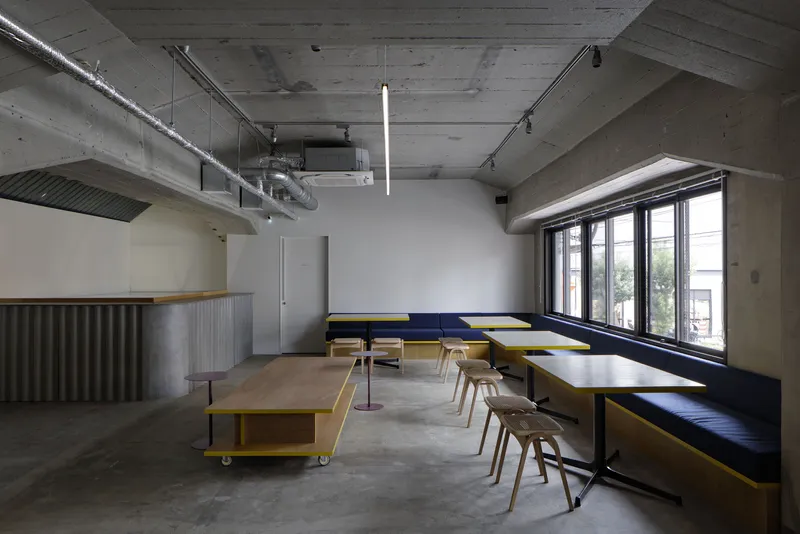
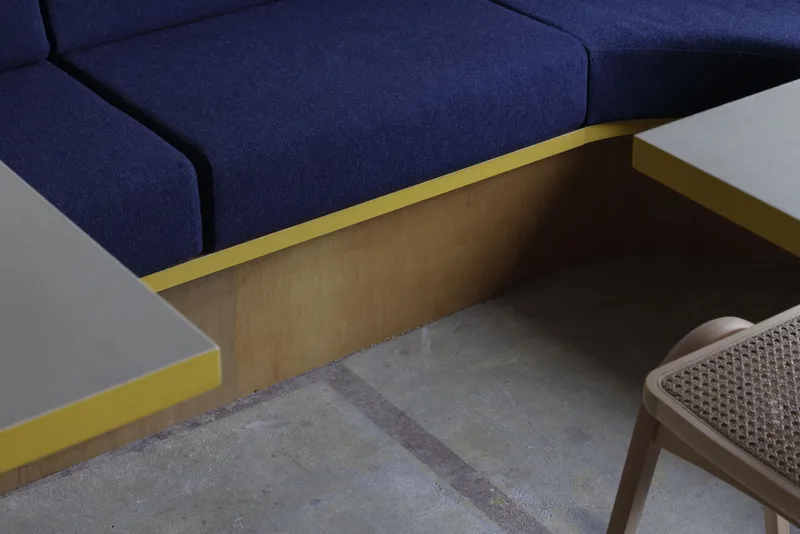

Against the raw concrete and industrial steel, Tsuboi introduces color sparingly but with purpose. Blue upholstered banquettes run along the window wall. Yellow tables on casters add mobility and warmth. The yellow metal edge trim recurs as a recurring accent, visible on table edges, glass floor panels, and furniture connections. These are not arbitrary palette choices; they map loosely to the graphic language of craft beer packaging, tying the spatial experience back to the brand identity without turning the interior into a billboard.
The detail shot of curved painted metal panels in blue and black, sandwiched between oak veneer and concrete, reveals the care taken at material junctions. Each surface change is deliberate, each color transition handled with a clean edge or a brass trim line. The effect is playful but disciplined, exactly the tone you want in a space designed to feel like a neighborhood pub rather than a corporate taproom.
Vertical Ambition Under a Low Ceiling
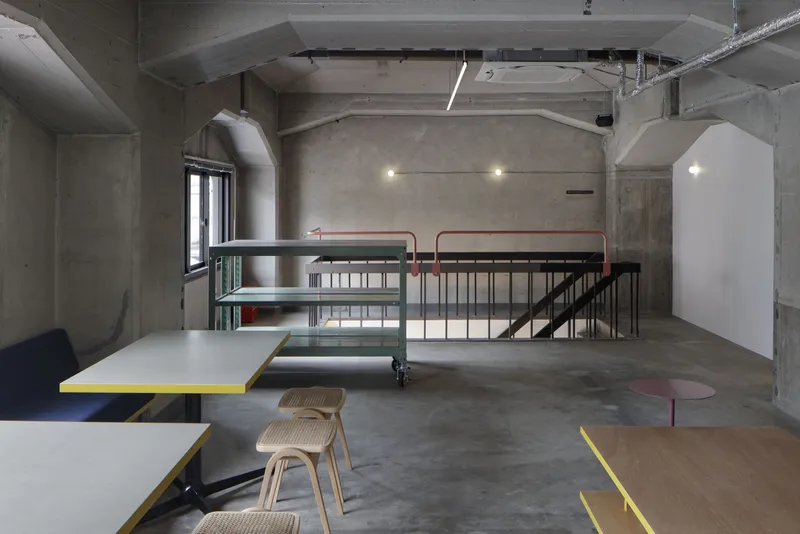
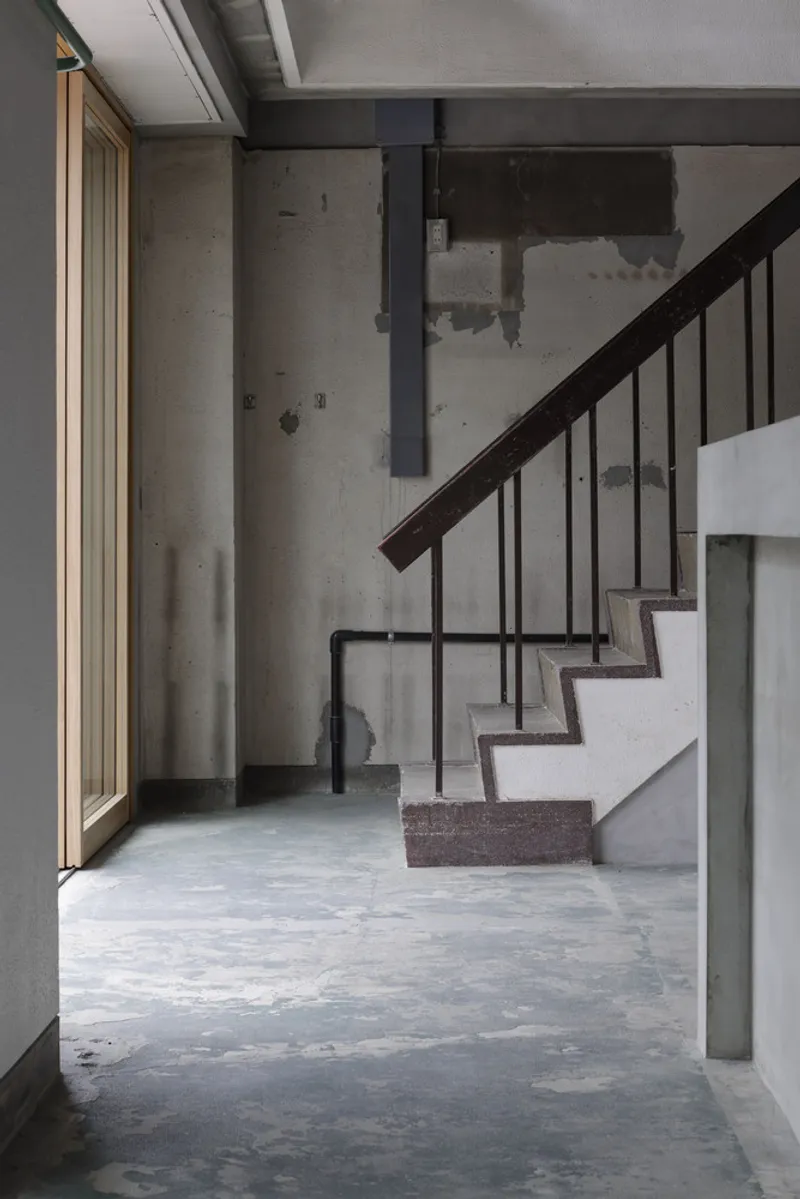

Building under an overpass imposes a ceiling height that most breweries would consider punishing. Tsuboi responds by carving out a double-height volume where the section allows it, and by using a glass floor panel to visually connect the upper taproom level to the brewing and storage zones below. The yellow-edged glass panel is a small gesture with outsized effect: looking down through it, you see pipes and equipment, and the brewery suddenly feels deeper and more complex than its modest footprint suggests.
The industrial steel staircase with its vertical balusters reinforces the raw vocabulary of the space while providing access between levels. Bare concrete columns are left exposed rather than clad, an honest acknowledgment of the host structure. The overpass is not hidden; it is simply absorbed into the new program.
Details That Hold the Room Together

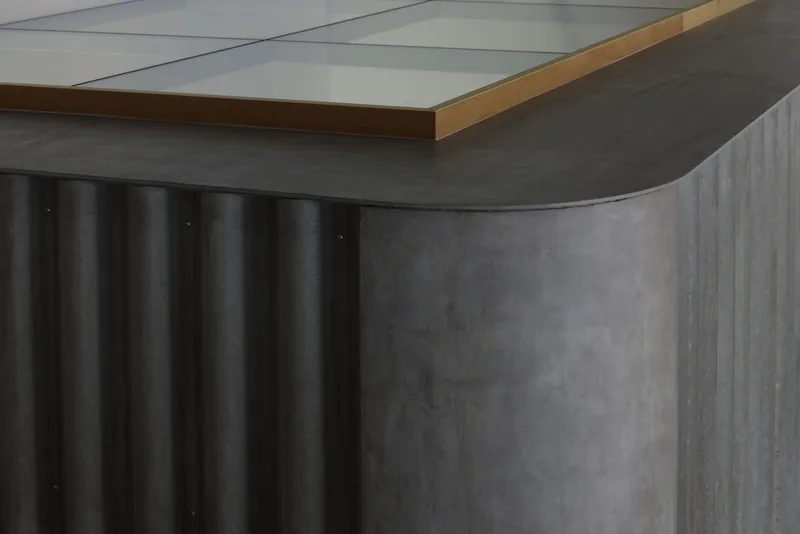
Two close-up details reveal the project's attention to craft. A red tubular steel railing meets black vertical balusters against a concrete wall with the kind of precision you associate with furniture making rather than construction. Nearby, a curved corrugated metal surface receives a thin brass trim along its top edge, a gesture that elevates an industrial material into something almost ornamental. These moments matter because they signal that the rawness of the interior is a choice, not a budget shortcut.
Plans and Drawings

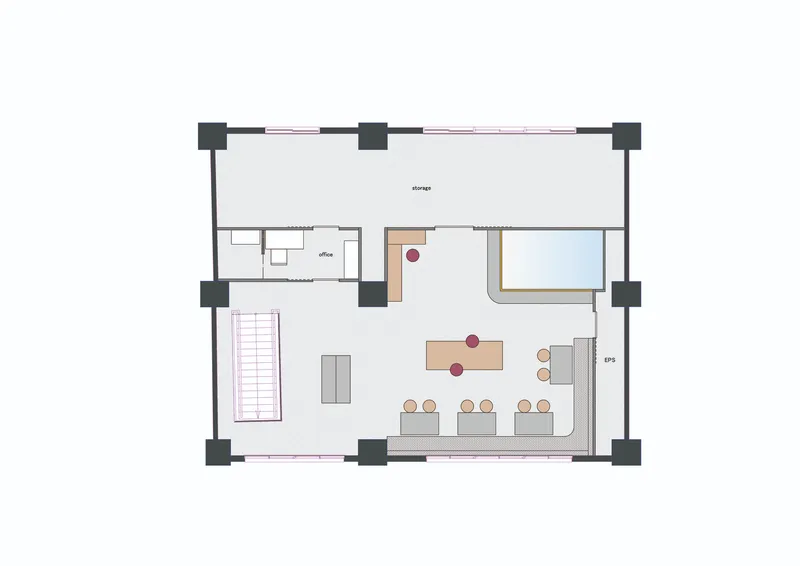
The floor plans confirm the efficiency of the layout. At ground level, the taproom wraps a long bar with the brewing area visible through the glass partition, while a kitchen and toilet facilities are tucked to one side. Below, a storage level houses the office, a meeting room, and the staircase connection. The plan is compact by necessity: 260 square meters is not a lot of space when you are accommodating both production and hospitality. But the deliberate gaps and openings that Tsuboi inserts, the glass floor, the street-facing counter, the transparent brewery wall, give the plan a porosity that makes it feel far larger than its footprint.
Why This Project Matters
Hibi Hitoawa Brewery is a useful counterpoint to the increasingly formulaic world of taproom design. Instead of importing an aesthetic from Brooklyn or Berlin, Tsuboi works with what the site gives: the overpass structure, the street energy, the constraints of building beneath active rail infrastructure. The architecture does not romanticize these conditions. It simply uses them as the starting point for a space that feels genuinely rooted in its Osaka neighborhood.
More broadly, the project demonstrates that activating leftover urban infrastructure does not require massive investment or heroic engineering. A clear facade strategy, an honest material palette, a few well-placed color accents, and a willingness to put the production process on display can turn a dead zone into one of the liveliest spots on the street. For cities sitting on miles of unused rail undercrofts, Hibi Hitoawa is a persuasive argument that the best new public spaces might already have a roof.
Hibi Hitoawa Brewery by Hidenori Tsuboi Architects. Fukushima-ku, Osaka, Japan. 260 square meters. Completed 2024. Photography by Daisuke Shima.
About the Studio
Share Your Own Work on uni.xyz
If projects like this are the kind of work you want to make, uni.xyz is a place to publish your own, find collaborators, and enter design competitions.




Popular Articles
Popular articles from the community


Riyadh For All: Intergenerational Urban Design for Active Aging in Rabat
Riyadh For All reimagines urban design in Rabat with intergenerational co-living, adaptive courtyards, and Moroccan cultural exchange today.

AL-JANNAH: Sustainable Architecture and Permaculture for Afghan Widows
AL-JANNAH uses sustainable architecture and permaculture to create resilient oasis of housing, learning, work and renewal for Afghan widows.

The Ocean Hive: Sustainable Architecture for a Self-Sufficient Civilization at Sea
The Ocean Hive imagines sustainable architecture at sea, where modular habitats, algae, wave power and ocean waste sustain a growing colony.

The Musturak Paradise: Senior Living Architecture for a Connected Future in Temara, Morocco
The Musturak Paradise reimagines senior living architecture in Temara via private homes, social spaces, culture, community, and shared care.


Similar Reads
You might also enjoy these articles


Hodi-Mandai Geram
Project Function: Preservation and revitalization of the Intangible heritage and socio-spatial identity of the Hodi by Housing, Cultural Memory Center, Sacred Grove, landscape, local tourism economy


Olio Towers: A Mid-Rise for Performers That Fuses Housing, Rehearsal, and Stage
Located blocks from Houston's Theater District, this modular tower stacks living units around a central performance atrium.

Oasis: Modular Green Housing Carved into Dhaka's Urban Fabric
A shortlisted Plugin Housing entry reclaims unauthorized settlements in Dhaka with stepped concrete volumes, green roofs, and ventilation-driven design.

Black Hole: A Floating Megastructure for the Post-Physical Era
Emiliano Mazzarotto envisions a spherical, self-scaling arena where e-sports, digital hotels, and holographic stadiums replace traditional public space.


Explore Architecture Competitions
Discover active competitions in this discipline



Challenge to reimagine the Iron Throne


Photograph architecture without architects


Illustrate the lost glory of Angkor Wat - Render Challenge


Design challenge to reuse E-waste
Comments (0)
Please login or sign up to add comments
No comments yet. Be the first to comment!