
Thesis Background
SOLID WASTE MANAGEMENT INDUSTRY SIRAJGANJ, RAJSHAHI

In countries like Bangladesh, solid wastes make a significant environmental hazard and social problem in city lives. The overall environmental and health condition of our country has also deteriorated due to the lack of proper management of municipal waste. Uncollected solid waste is clogging drains and polluting water bodies. The majority of the waste remains uncollected which means that the remaining mixed waste is dumped every day in the Municipalities' roadsides, drains, lakes and rivers. One of the reasons for flooding and pollution in our cities is indiscriminate waste disposal in the drainage system. Due to the lack of segregation of waste, a large portion of waste with economic value is becoming contaminated and soiled.
However, well-managed household waste can be a resource for any city through material recovery; waste to electricity, and even bio-digesters. Energy, on the other hand, is another demanding and ever-increasing concern in Bangladesh. The energy recovery from waste can be the alternative for meeting the local demand from its resource-"waste".
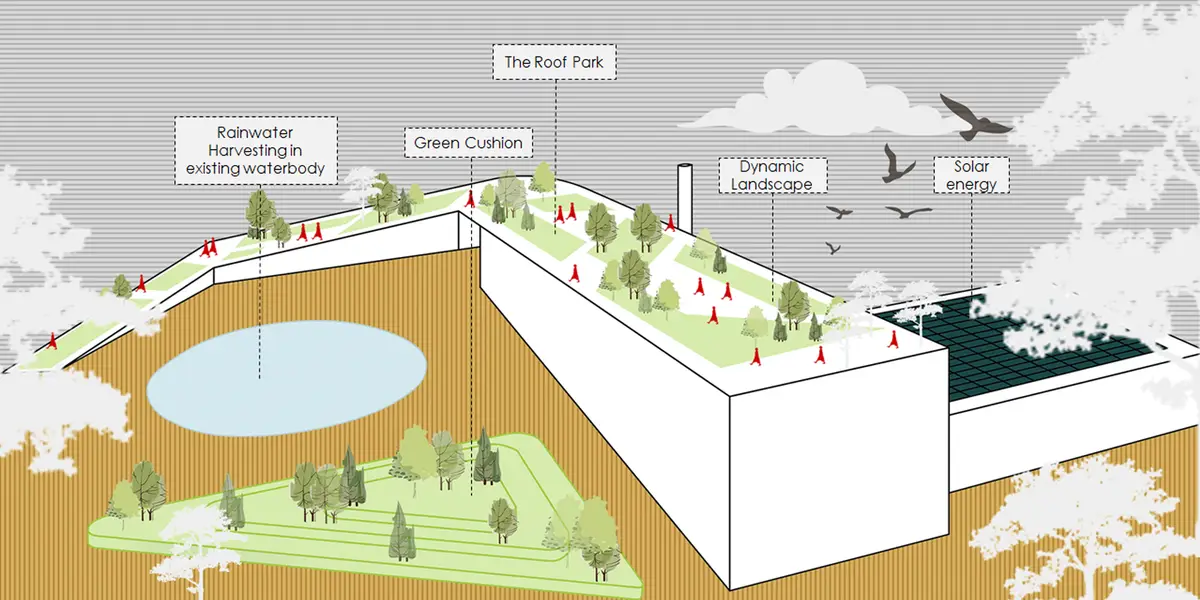
As my project site is in Sirajganj district of Banglades, this research focused on determining the most feasible and sustainable way of waste management for Sirajganj municipality. With energy production from solid waste, recycling was also advocated as a waste management option. This project's main objective was not just energy production; it also aimed to create a self-sustaining and environmentally friendly industry. As a result, wastewater treatment & algae production was also incorporated into the programs. To make the project more environmentally friendly, a compact volume was designed to reduce the footprint on the site, and while detailing, eco-friendly materials were proposed. Besides designing industrial machinery, the research was also focused on the work environment for the staff and workers. The comfort & safety of the works was one of the major concerns of the research.
Moreover, only the design industry will not help reduce waste production and mismanagement. It's necessary to grow awareness among the general public. To increase awareness among the general public, this research focused on some policies and architectural design interventions. Public activities were introduced to the project to make social integration the project. Learning scope was developed for the industry to connect people more to the waste management system. Recycling craft center & exhibition programs were incorporated into the project to break the physical and mental barrier between the public and waste and raise recycling awareness.


Popular Articles
Popular articles from the community


The Amber Palace Opera: A Geological Fiction Surfaces on Tallinn's Baltic Waterfront
Pierre Brillard reimagines a Baltic legend as a public landscape, opera house, and waterfront promenade rooted in Tallinn's coastal identity.

Singing Woman: An Opera House That Performs Before the Curtain Rises
Ovidiu Cristian Pavel's conceptual opera house translates Estonia's choral identity into a sculpted waterfront landmark facing the Baltic Sea.


graciastudio Turns a Viewless Tijuana Lot Inward Around a Courtyard of Concrete, Timber and Trees
In Tijuana, Jorge Gracia's GA2 House stacks a timber-clad private floor over exposed concrete and replaces a missing view with a planted interior patio.

ETEH Reworks the Shared Spaces of São Domingos School in Brazil Around Timber, Color and Hanging Plants
At São Domingos School in Brazil, 436 m² of hall, refectory and library are recast with timber joinery, a yellow and blue code and trailing greenery.

Similar Reads
You might also enjoy these articles

Vereda Arquitetos Renovates a 40-Square-Meter Apartment Inside Niemeyer's Copan Building
A compact unit in São Paulo's most iconic residential tower gets a material overhaul that pairs exposed concrete with bold blue Formica.

Shakur's House: Exposed Brick as an Interior Organiser in a 168 m² Mashhad Residence
Brick moves indoors in this Mashhad residence, where masonry walls, glass partitions and teal planes sequence a compact home without closing it off.

Day and Night Park: A Time-Based Urban Newsstand in Beijing
A temporary urban newsstand in Beijing blending travel, light, and reading through poetic colors, compact form, and community-focused design.

Modernist Patio Renovation in El Masnou, Barcelona by Oliver Segura Arquitectura + Cebrià Arquitectura
Modernist patio renovation blending tradition and innovation with a movable pool, leveled floors, and Catalan materials in El Masnou.

Explore Waste Management Competitions
Discover active competitions in this discipline


Design challenge to reuse E-waste

Packaging challenge - Design meets sustainability
Comments (0)
Please login or sign up to add comments
No comments yet. Be the first to comment!