
Thesis Journal: From Ghosts to Groundwork – My Journey with “Sambhav”
Title: Sambhav: Reclaiming the Invisible Author: Abhinav K Thesis Journal | School of Architecture | 2025

When I began my thesis journey, I set out to revive a ghost village in Uttarakhand—an idealistic vision rooted in off-grid living and eco-tourism. But as I dug deeper, reality struck. The location was remote, inaccessible, and the idea lacked clarity. It felt more like an escape than a solution. I needed to root myself in a real, urgent problem.
That’s when Chennai, a city I’ve long admired for its complexity and chaos, called me in a way I hadn’t expected. As a booming metropolitan city, I was shocked to discover it lacked a formal, integrated waste management system. Curiosity turned to obsession. I started mapping the waste cycle. I visited dumpyards, read article after article, spoke to locals, and unearthed something that shook me—a hidden community of waste pickers.
Invisible yet essential, these people have been working silently, sorting through the city’s filth, with no dignity, no infrastructure, no voice. Among them, the Narikuruvar community stood out—marginalised not just by occupation, but by centuries of systemic neglect. This was no longer about a thesis. This was personal.
Initially, I thought of designing a waste management facility—but I was told bluntly in a crit that "this isn’t a thesis." I took that hit, hard. But it pushed me to dig even deeper. I realised the solution had to be multi-layered—one that acknowledged the urban waste crisis, addressed economic inclusion, and celebrated human dignity.
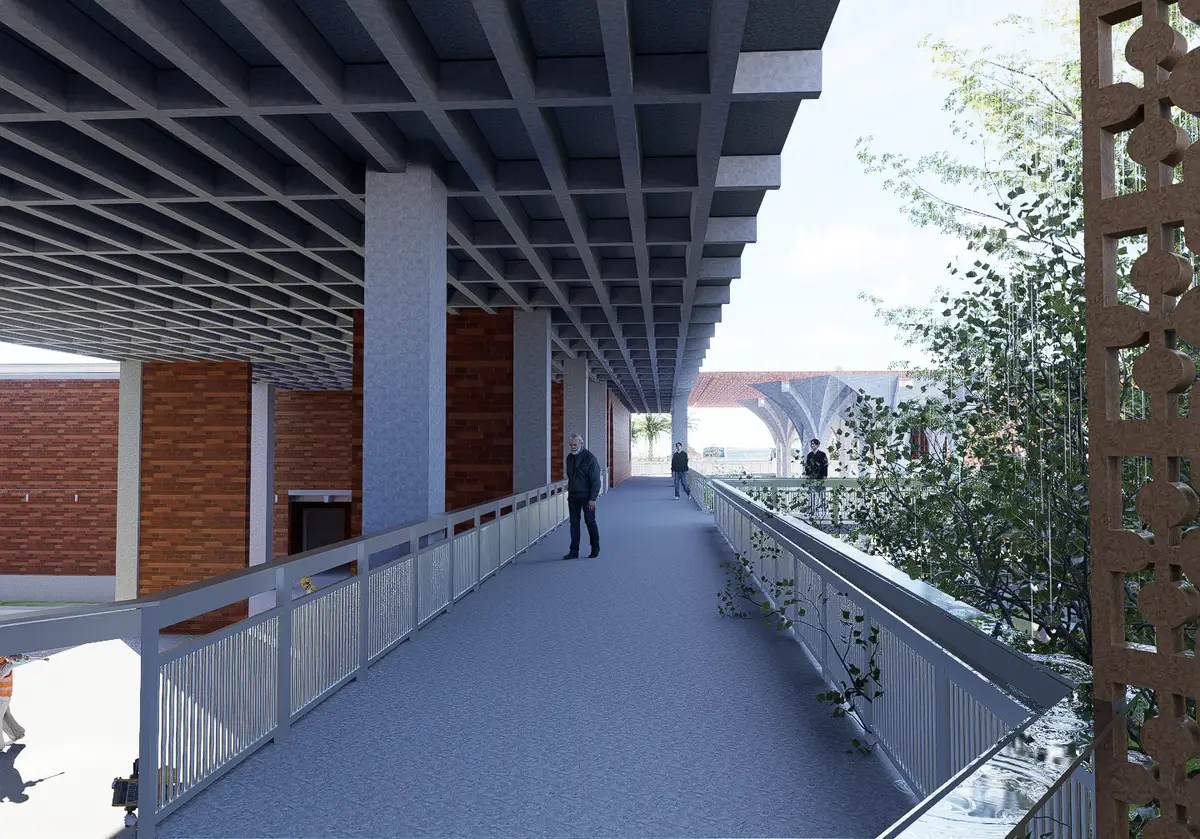
So, I envisioned “Sambhav”—a regenerative ecosystem on a decommissioned dumpyard that does more than manage waste. It reclaims land, uplifts forgotten communities, integrates public spaces, and becomes a cultural and economic engine. It’s not just a building—it’s a nexus.
The site design is driven by the rhythm of life itself—human movement, the rail network, logistical flows, and social interactions. Every path, every space, is carved like water—fluid, inclusive, open. It invites not just the waste worker, but the everyday citizen. Everyone has a place here.
In the end, I turned a “non-thesis” into a thesis. I turned waste into wealth, exclusion into empowerment, and neglect into narrative. This is more than architecture—it’s reparation through design.


Popular Articles
Popular articles from the community


U.GA Architects Wraps an Oval Rooftop Pool in Curved Board-Formed Concrete on Busan's Jeollidan-gil
In Busan's Jeonpo-dong, a 454 m² mixed-use block stacks a neighborhood facility, guest rooms and an oval rooftop pool inside spiraling concrete walls.

Architekt Andreas Gruber Scatters 23 Dark Timber Chalets Across a South Tyrolean Forest Edge
In Molini di Tures, Amonti Chalets breaks a resort into a hamlet of gabled timber houses, with parking, storage and services pushed into the slope.

LT2A and OPEN Architectes Thread a Brick and Glass High School Through a Wooded Belgian Campus
In Braine-l'Alleud, a 3,000 m² wing for Collège Cardinal Mercier pairs pale brick with a glazed colonnade, deferring to a small chapel and a dense wood.

Juan García Correa, John González and Claudia Rueda Sink a Circular Amphitheater into a Manizales Engineering Building
On the La Nubia campus in Manizales, Colombia, the S1 Building folds labs and offices into a hillside of ramped lawns that double as a campus route.

Similar Reads
You might also enjoy these articles


Vereda Arquitetos Renovates a 40-Square-Meter Apartment Inside Niemeyer's Copan Building
A compact unit in São Paulo's most iconic residential tower gets a material overhaul that pairs exposed concrete with bold blue Formica.

Shakur's House: Exposed Brick as an Interior Organiser in a 168 m² Mashhad Residence
Brick moves indoors in this Mashhad residence, where masonry walls, glass partitions and teal planes sequence a compact home without closing it off.

Day and Night Park: A Time-Based Urban Newsstand in Beijing
A temporary urban newsstand in Beijing blending travel, light, and reading through poetic colors, compact form, and community-focused design.

Modernist Patio Renovation in El Masnou, Barcelona by Oliver Segura Arquitectura + Cebrià Arquitectura
Modernist patio renovation blending tradition and innovation with a movable pool, leveled floors, and Catalan materials in El Masnou.

Explore Architecture Competitions
Discover active competitions in this discipline


Challenge to reimagine the Iron Throne

Photograph architecture without architects

Illustrate the lost glory of Angkor Wat - Render Challenge

Design challenge to reuse E-waste
Comments (0)
Please login or sign up to add comments
No comments yet. Be the first to comment!