
Thirdspace Architecture Studio Hovers a New Office Above a 50-Year-Old Building in Belagavi
Eight columns and two red trusses lift 1,200 square meters of workspace over an existing campus headquarters in India's Western Ghats.


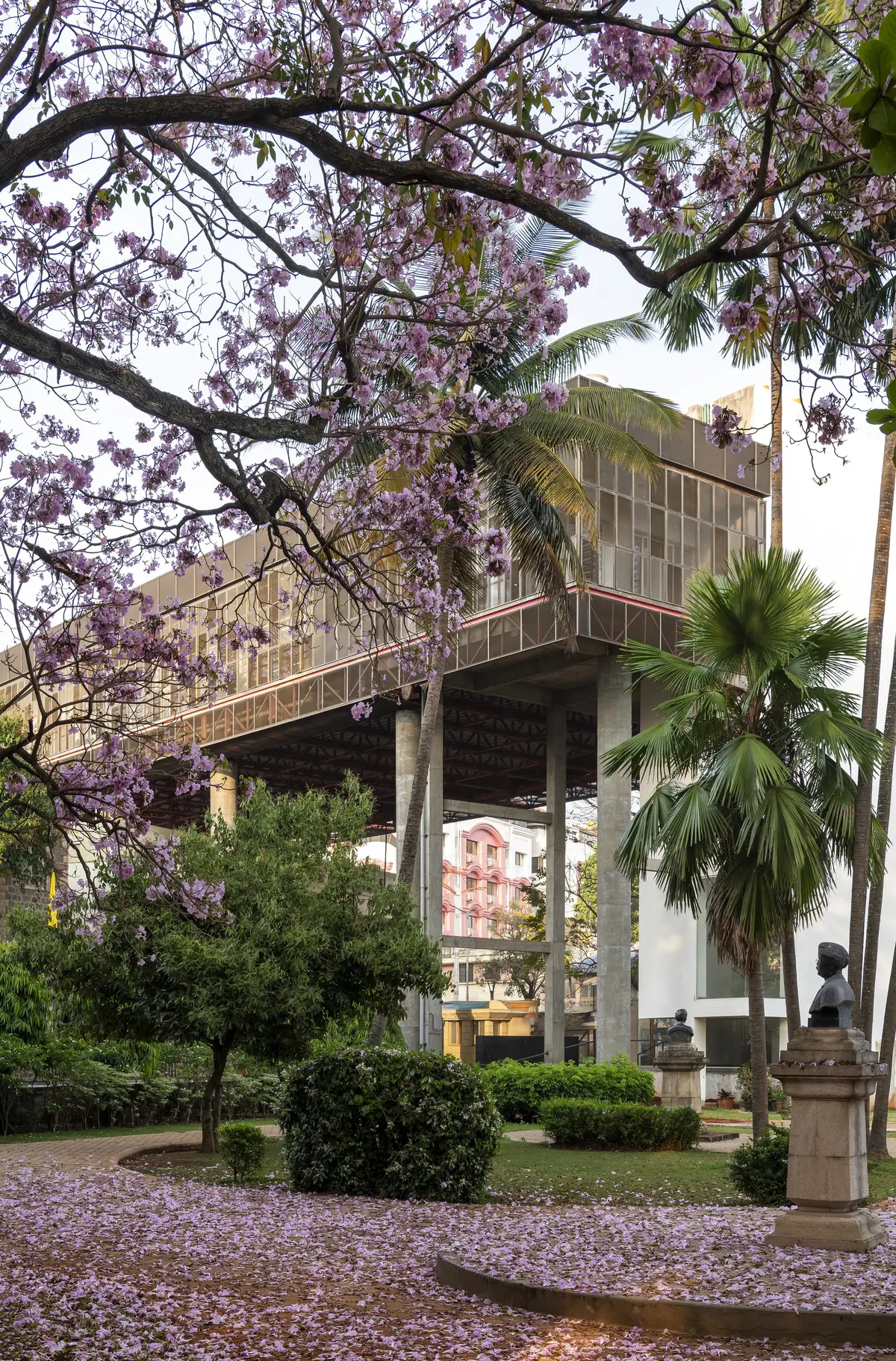
What do you do when a building is architecturally unremarkable but institutionally irreplaceable? For the KLE Society's head office in Belagavi, a city nestled in the Western Ghats of southern India, Thirdspace Architecture Studio answered the question by simply going over it. Rather than demolishing or heavily retrofitting the existing two-story structure on a century-old educational campus, the architects lifted an entirely new 1,200-square-meter office volume above it, held aloft by just eight cylindrical reinforced concrete columns positioned to avoid disturbing the ground plane below.
The result, completed in 2020, is a building that neither mimics nor negates what existed before. The original office continued to function throughout construction. Its rooftop terrace now operates as a buffer zone, a garden and event space sitting between old and new. The extension itself is framed by two floor-height red-painted steel trusses that do all the structural heavy lifting, freeing the interior from columns and wrapping the workspace in a continuous verandah borrowed from the colonial architectural tradition of the subcontinent. It is a project about restraint, leverage, and the idea that the best way to respect an existing building might be to barely touch it.
Lifting Off the Ground Plane

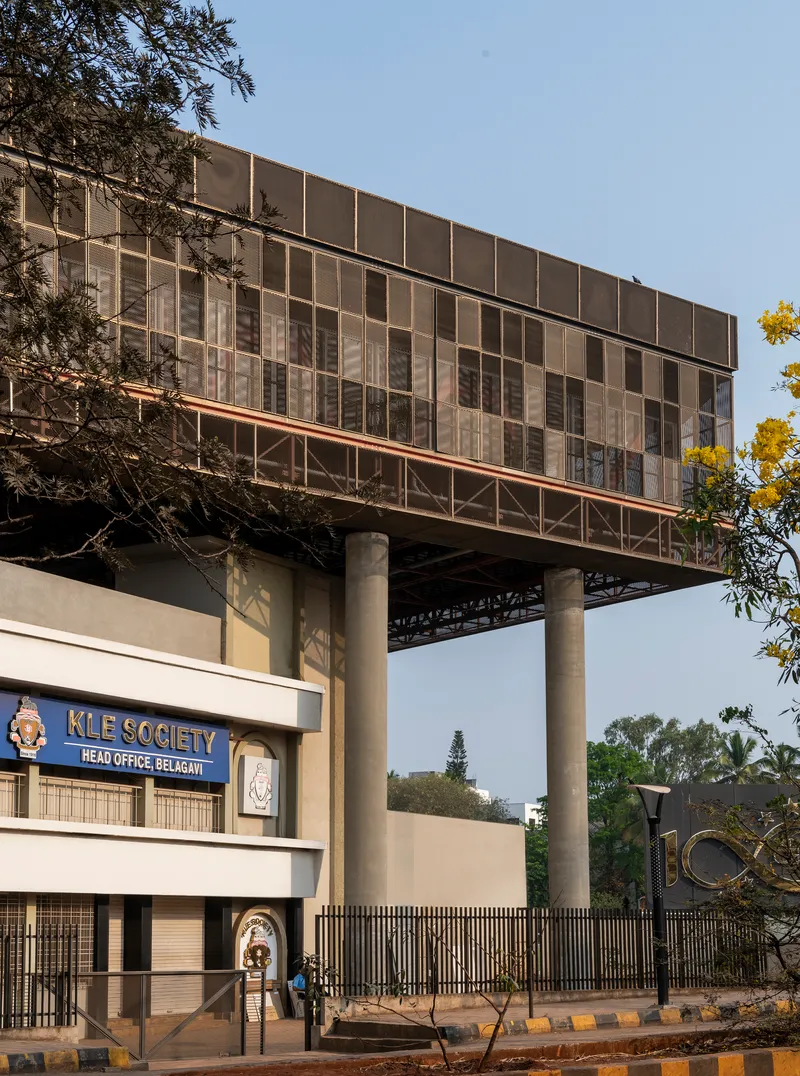
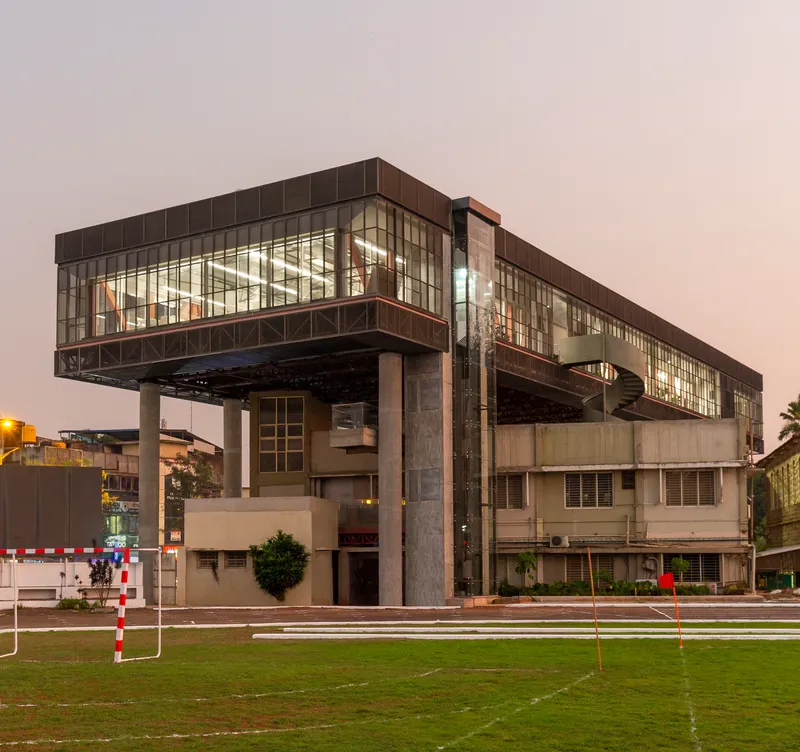
The structural premise is bracingly simple. Eight RCC columns, carefully placed at the periphery of the existing building, carry two full-height edge trusses that span the length of the new volume. The office space sits between these trusses like a platform held in the air. From the street, the effect is legible immediately: the new building floats above the old one, its glazed and screened facades hovering over an institutional entrance gate. At dusk, the glass-wrapped volume glows against the sky, making the structural gap between old and new unmistakable.
The inverted L-shaped configuration gives the building three distinct relationships with its surroundings. On the arterial road side, it presents a screened facade that filters the city out. Toward the campus interior, it creates a welcoming portal aligned with a central tree-lined avenue. And along its longest edge, it becomes a spectator's perch overlooking the campus sports field. The eight columns, rather than reading as obstacles, dissolve into the landscape of palm trees and jacaranda that surround the paved courtyard below.
The Red Trusses as Organizing Element


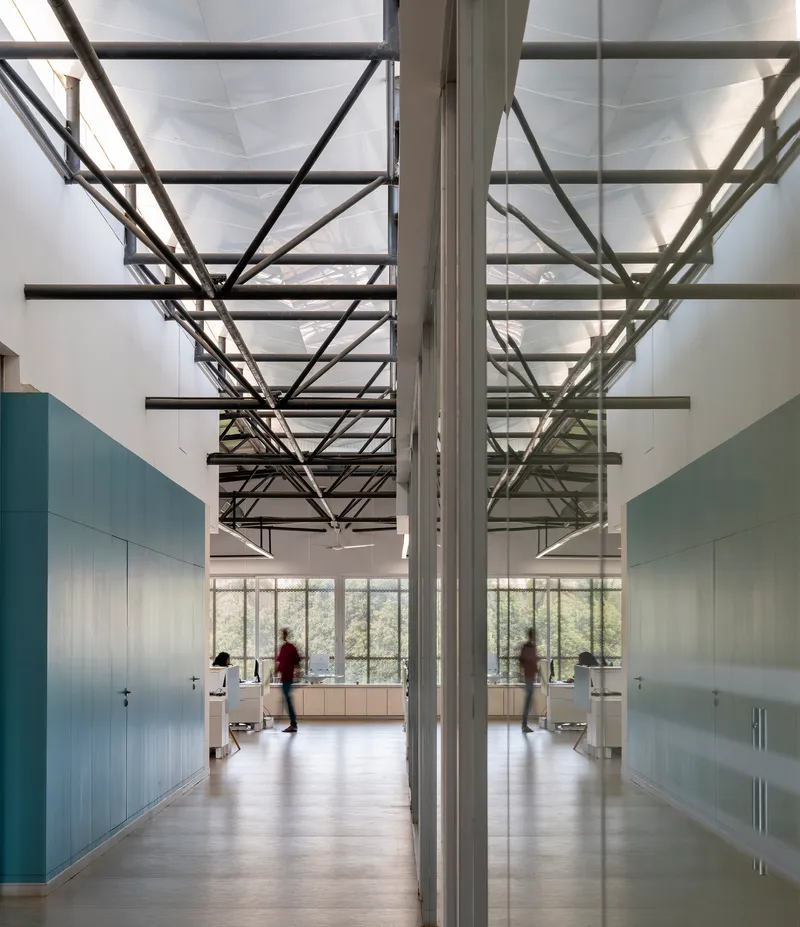
Painted a deep red, the pair of floor-height trusses are far more than structure. They define the edge between the core office space and the surrounding verandah, acting as a datum line that organizes everything on the upper level. Inside the office, the diagonal members of the trusses become a sculptural backdrop to open workstations and meeting rooms, their geometry adding visual rhythm to an otherwise column-free floor plate. Walk down the central circulation spine, and the trusses frame a clerestory skylight that washes the corridor with natural light.
In the double-height corridor, where mirrored walls amplify the depth, the trusses overhead read as infrastructure turned ornament. Thirdspace uses their exposure honestly: there is no effort to hide the structural logic, and the red paint turns what could be merely industrial into something deliberate and identifiable. It is a color decision that gives the project its graphic signature.
The Verandah as Climatic Buffer

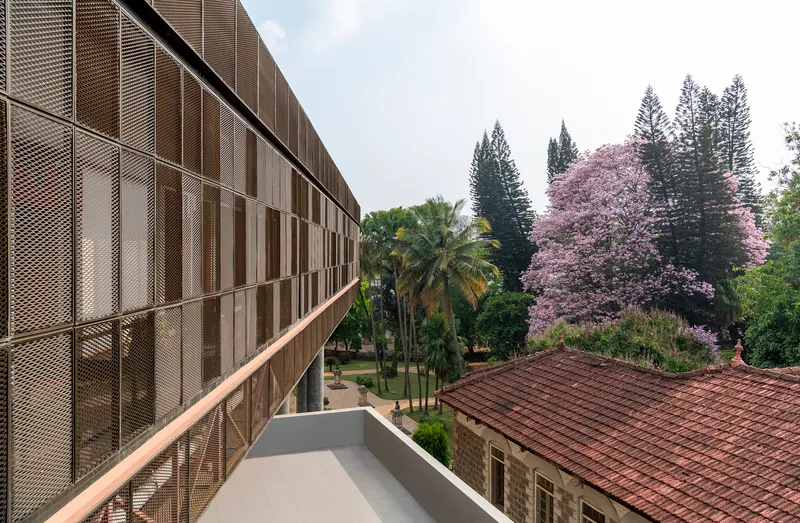

The continuous verandah wrapping the office floor is the project's most culturally and climatically specific move. In the subtropical conditions of Belagavi, where rain and sun are equally aggressive, the verandah serves as a first line of defense: a shaded, ventilated zone that keeps harsh light and monsoon downpours away from the enclosed workspace. Operable aluminum fins and expanded metal mesh line the outer edge, filtering sunlight on the eastern and western facades into dappled patterns that shift across the floor throughout the day.
But it is not just a climatic device. The verandah doubles as a social breakout space, a decompression zone between the controlled interior and the campus landscape beyond. Potted plants line the corridors. The perforated screens frame views of jacaranda canopies and tiled roofs below. It is a reinterpretation of a colonial typology, stripped of its nostalgic associations and put to work as passive architecture.
Between Old and New: The Interstitial Terrace
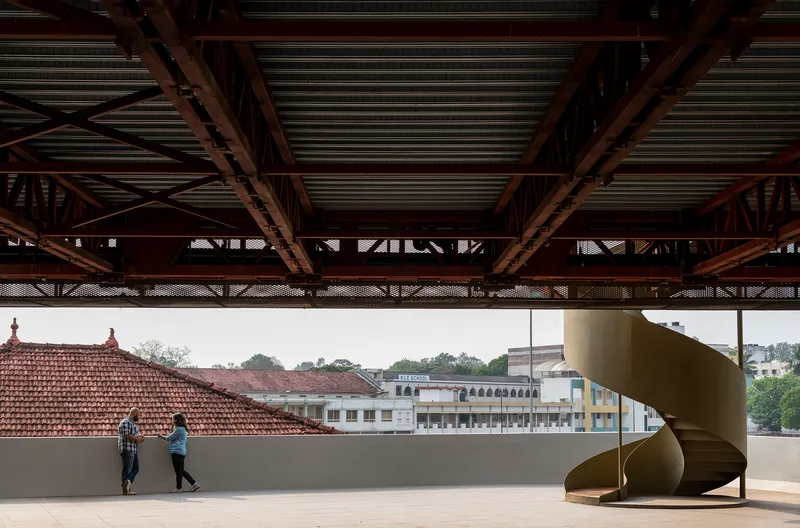

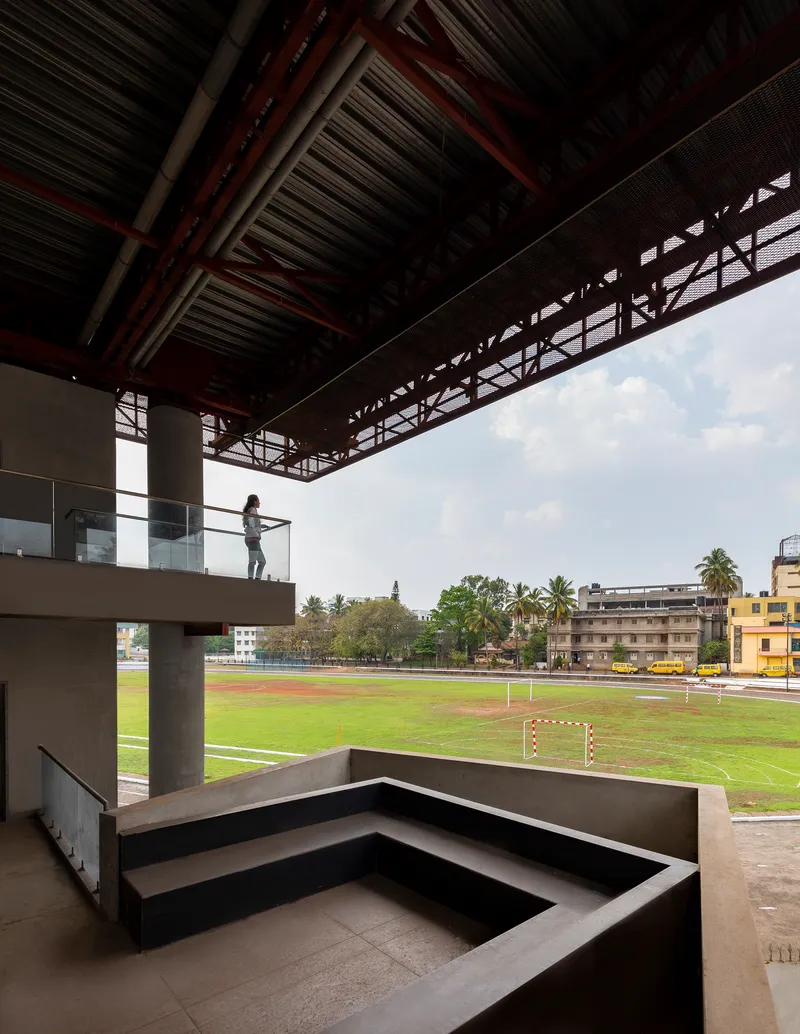
The rooftop of the original building, now sandwiched between the old office below and the hovering extension above, has been reimagined as an interstitial event space and terrace garden. A sculptural helical staircase in bright yellow provides access, its spiral form a deliberate counterpoint to the linear geometry of the trusses overhead. Two figures ascending the stair look momentarily suspended between the weight of the old institution and the lightness of the new.
On the other side of the building, a covered terrace with concrete bleacher seating faces the football pitch. Athletes sprint across the adjacent track while the trusses provide a canopy overhead. The space is programmatically flexible: event venue, informal gathering spot, spectator stand. It is the social seam of the project, the place where the act of hovering above becomes a spatial gift rather than just a structural strategy.
Interior: Open Floor, Precise Zoning


Inside the hovering volume, the column-free floor plate divides into three zones along its length. The entrance lobby and chairman's chambers anchor one end, establishing institutional presence. A central block of private offices and meeting rooms occupies the middle. Open workstations fill the rear section, benefiting from the longest uninterrupted views across the campus. Floor-to-ceiling glazing at the corners opens the office to the surrounding green landscape, dissolving the boundary between workspace and sports field.
A glass elevator overlooking the sports field stitches the old and new vertically, its transparent shaft rising between exposed trusses. The choice of glass here is consistent with the project's broader transparency: you can always see the structure, always understand the relationship between the levels, always orient yourself relative to the campus outside. Nothing is concealed.
Plans and Drawings


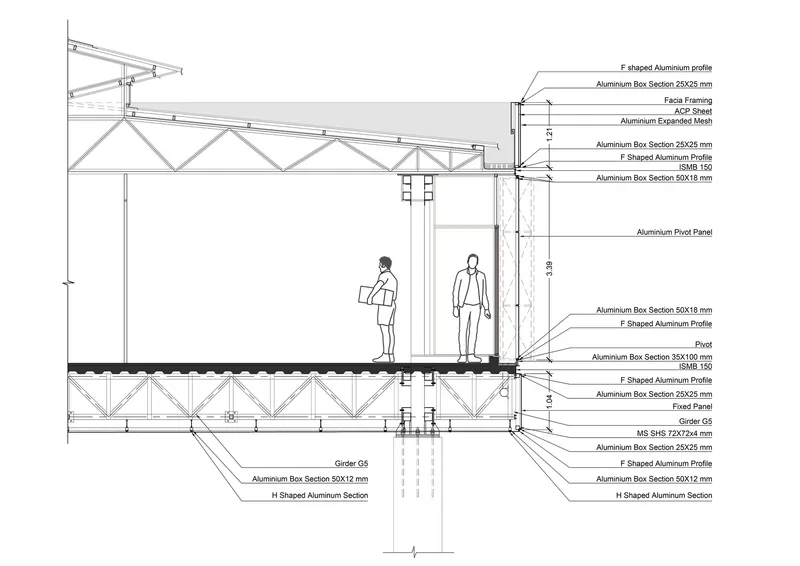

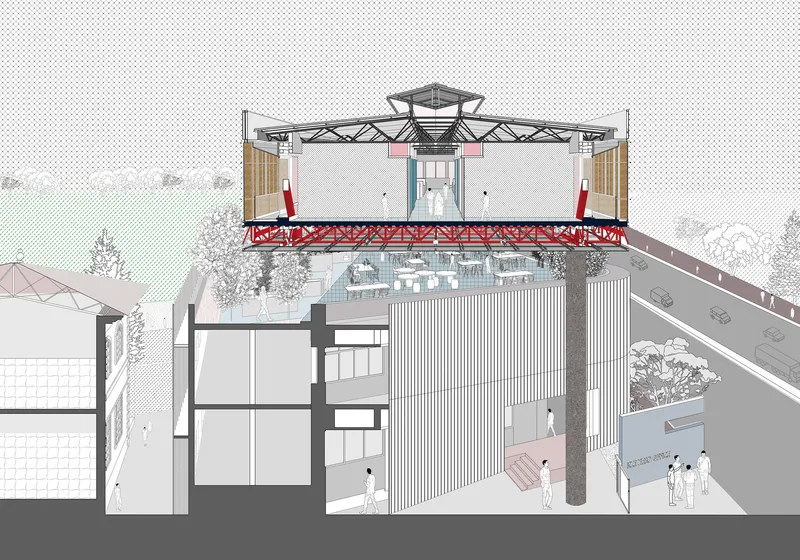
The drawing set reveals the project's structural logic with clarity. The site plan shows the extension's relationship to the running track and landscaped campus. Floor plans progress from the open ground condition, where the eight columns stand among scattered trees, up through the first-floor lobby, the interstitial terrace with its central courtyard and seating, to the third-floor office layout with its linear workstations and meeting rooms flanking a central corridor. The longitudinal section is the most instructive drawing: it shows the red trusses spanning the full length, the planted rooftop terrace sitting atop the new volume, and the spatial gap between old and new where the terrace garden breathes.
The front elevation drawing makes the triangulated truss facade legible as a graphic composition, its red geometry layered above corrugated cladding and brick columns. The axonometric explodes the verandah wrapping, showing how aluminum screens and glazing panels relate to the primary structure. A construction detail section zooms into the truss assembly itself, confirming that the structural ambition was matched by precision in execution.
Why This Project Matters
Hover Space makes a strong argument for addition over replacement. In a country where institutional buildings are routinely demolished and rebuilt the moment they fall short of contemporary standards, this project demonstrates that the existing can be preserved, kept functional, and even enhanced by an extension that deliberately chooses not to interfere. The structural economy is part of the message: eight columns and two trusses are all it takes to add an entire new floor of office space without disrupting what lies beneath. That restraint extends to the design language, which avoids spectacle in favor of a clear, repeatable logic.
What makes the project genuinely interesting, though, is the space it creates between the two buildings. The interstitial terrace, the glass elevator, the helical staircase: these are the connective tissues that turn a structural conceit into a social one. Hovering is not just about keeping distance. It is about creating a new kind of public space in the gap, one that belongs to neither the old nor the new but to the life of the institution itself. For a campus that has operated for over a century, that is the more important contribution.
HOVER SPACE Extension to the KLE Society Head Office by Thirdspace Architecture Studio. Belagavi, India. 1,200 m². Completed 2020. Photography by Suryan // Dang.
About the Studio
Share Your Own Work on uni.xyz
If projects like this are the kind of work you want to make, uni.xyz is a place to publish your own, find collaborators, and enter design competitions.


Popular Articles
Popular articles from the community


ETEH Reworks the Shared Spaces of São Domingos School in Brazil Around Timber, Color and Hanging Plants
At São Domingos School in Brazil, 436 m² of hall, refectory and library are recast with timber joinery, a yellow and blue code and trailing greenery.

Cube Design Draws an Ecological Corridor Between Two Shenzhen Hills with the Nankai Building
Beside Shenzhen's container docks, the Nankai Building pairs stacked balconies with a climbing green screen to connect two hillsides across its height.


Opera on the Sea: Driftwood Logic Shapes a Timber Opera House on Estonia's Coast
Trevor Orgill's opera house translates the entangled drift of floating timber into a civic building where wood, water, and music converge.

Aquadapt: An Underwater Habitat That Rewrites Its Rooms by the Hour
Curved modules ring the seabed while one shell shifts from breakfast room to cinema, farm and football pitch as residents' needs change.

Similar Reads
You might also enjoy these articles

LAVA Architecten Gives Vocational Education a Sawtooth-Roofed Face on a Mechelen School Campus
In Mechelen, Belgium, a 2,053 m² STEM school on a 6×6 m grid turns workshops and classrooms into rooms that can be rearranged as teaching changes.

KEMA Studio Turns a Derelict Marvila Attic into a 60 m² Lighthouse Apartment Above Lisbon
In Lisbon's Marvila district, a rebuilt roof, four skylights and two plywood volumes turn an unlivable attic into a bright home facing the Tagus.

Pixel Gardens: One Repeated Module Stacked Into a Terraced Social Housing Tower for Famagusta
Salem Bader's shortlisted housing tower builds a vertical neighbourhood from one repeated module, offsetting units to carve terraces, light and air.

Bao Huynh Watercolor Atelier: A Serene Art Retreat in Hội An
Bao Huynh Watercolor Atelier in Hội An blends multifunctional art spaces, sustainable design, local materials, and family-friendly living in a serene environment.

Comments (0)
Please login or sign up to add comments
No comments yet. Be the first to comment!