
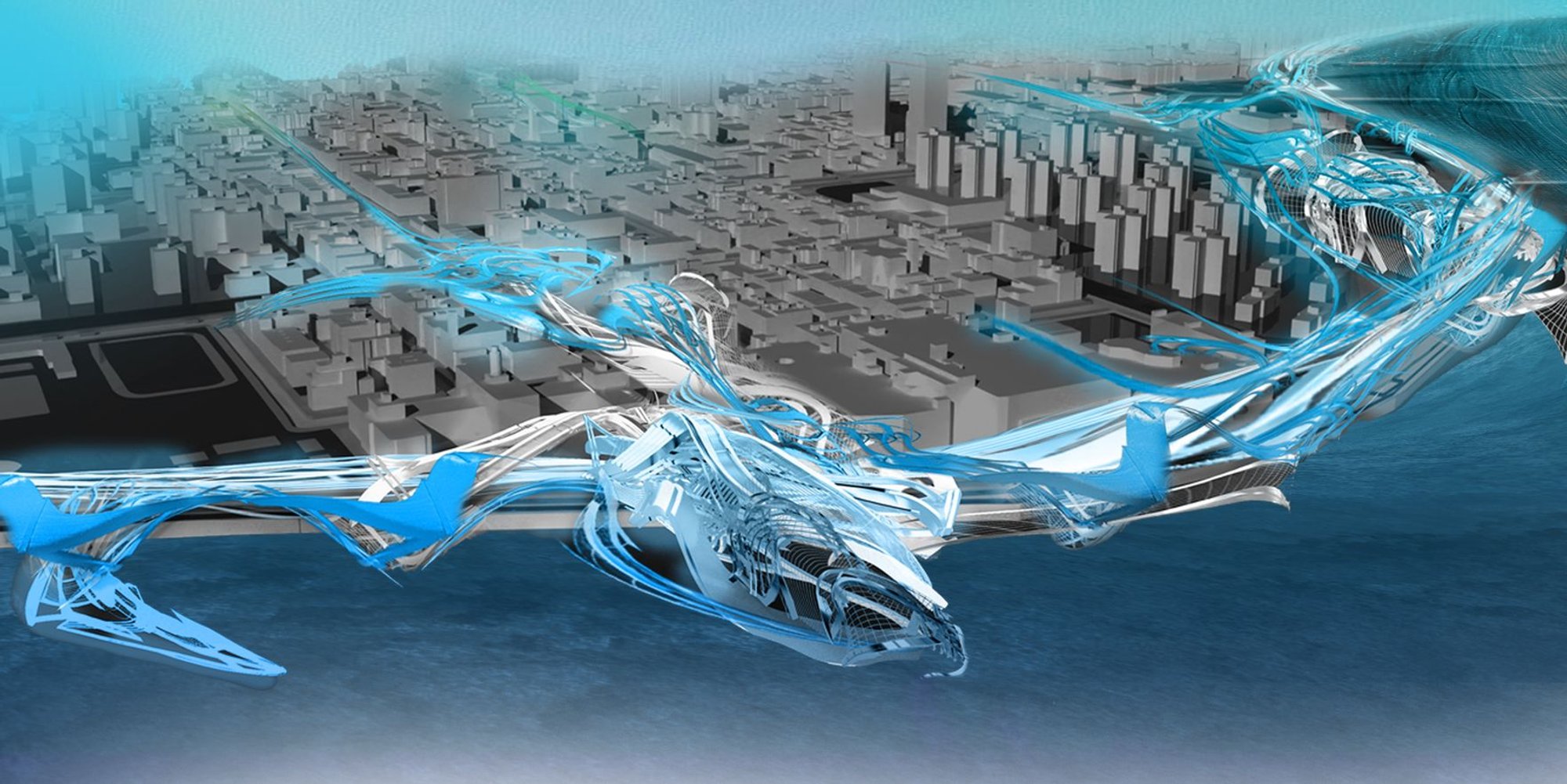
Threaded City: Jazz-Inspired Ribbons Stitch Harlem Back to Its Waterfront
A People's Choice entry reimagines Harlem as an adaptive network of cultural, housing, mobility, and wellness ribbons along the East River.

What if a city could be composed like a jazz improvisation: structured enough to hold its ground, loose enough to respond to every shift in tempo? Threaded City takes that premise literally, proposing a network of interlaced "ribbons" across Harlem that each carry a distinct urban function. A cultural spine celebrates the neighborhood's jazz legacy. A housing ribbon shelters and connects communities. A mobility loop relinks neighborhoods severed by highways. A wellness band introduces green infrastructure where environmental injustice has left its mark. Together, these threads form a continuous adaptive fabric that transforms Harlem's future without erasing its memory.
Designed by Tobias Maiden and entered as a People's Choice Award submission in Peak, the project spans East Harlem, Central Harlem, and Morningside Heights. Its central ambition is reconnection: stitching these neighborhoods back to the East River waterfront, a relationship severed decades ago by highways and industrial zoning. The proposal operates as a community-first framework rather than a top-down master plan, with participatory structures that involve community councils, cultural organizations, and youth groups in shaping the evolving urban fabric.
A Precinct-Level Thread Plan Over Flood Risk Terrain
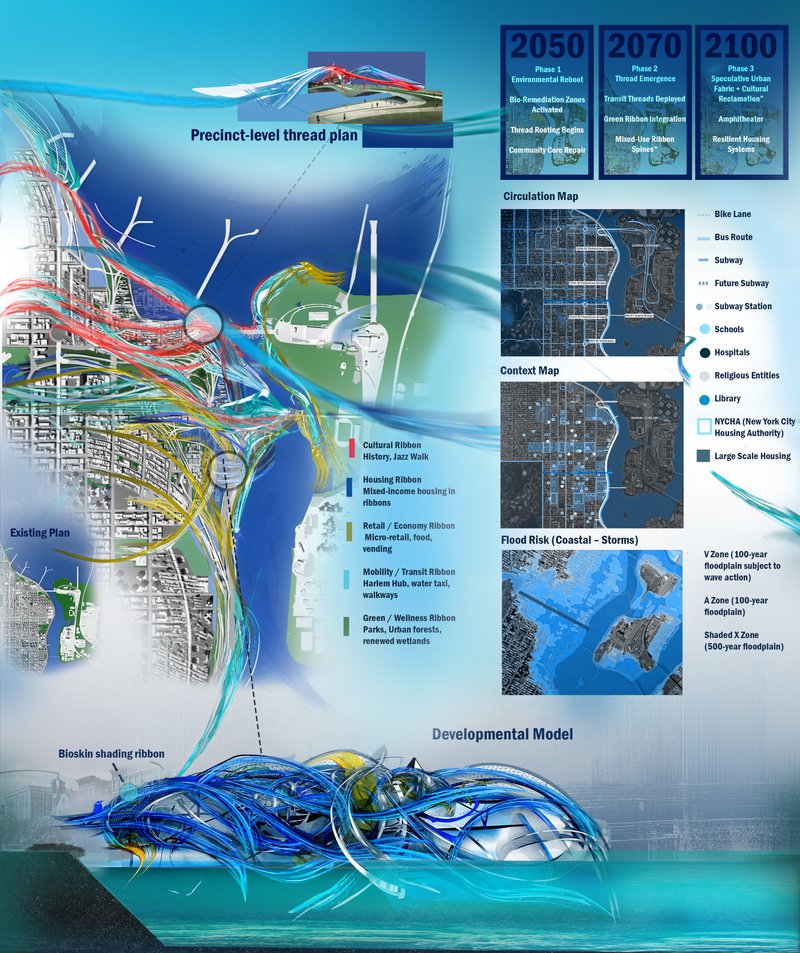
The composite diagram lays out the logic of the system at precinct scale. Color-coded ribbons overlay an aerial site plan and flood risk maps, making visible the dual challenge the project confronts: spatial fragmentation and environmental vulnerability. Each ribbon carries a programmatic identity, but none operates in isolation. The cultural thread and the mobility loop share corridors. The wellness band and water capture systems overlap along flood-prone edges. Reading the plan feels less like studying a conventional zoning map and more like following a musical score, where independent lines converge into harmony.
Layering flood risk data directly into the design framework is a deliberate move. It means the project's sustainability strategies, including rainwater capture canopies, tidal micro-turbines along the East River, and an AI-driven resource management system called ThreadWeaver, are not decorative additions. They are responses to measurable conditions on the ground. ThreadWeaver monitors water, energy, and transit flow in real time, dynamically redistributing supply based on need. The ribbons become infrastructure in the fullest sense.
A Cultural Entry Point Suspended Over Water
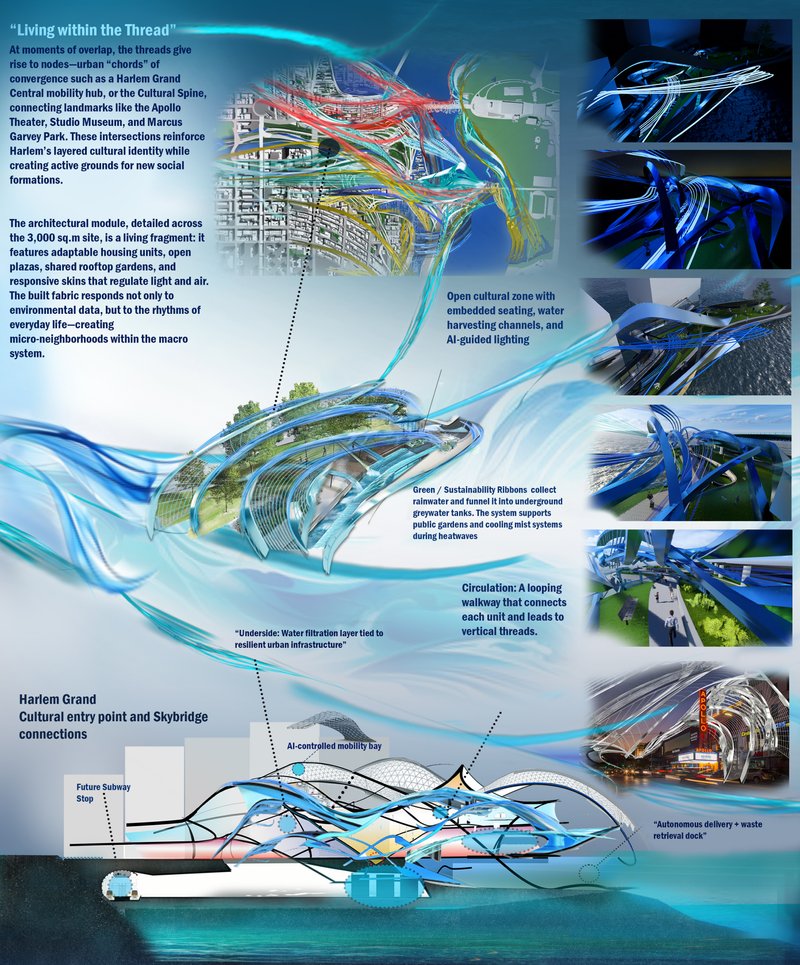
The exploded axonometric drawing reveals one of the project's key nodes: a cultural entry point where a looping skybridge arcs over the waterfront, connecting housing modules above to public gathering space below. The drawing sections through the housing to expose its internal organization, showing how residential units stack and interlock above the water's edge. The skybridge is not merely a connector; it frames views, channels pedestrian movement, and acts as a threshold between the neighborhood's interior life and the reclaimed riverfront.
Architecturally, this node embodies the project's call-and-response philosophy. Public program on the ground level, including potential performance venues and market spaces, generates activity that the housing above can participate in or retreat from. The spaces are designed for transformation: a market becomes a performance venue, a rooftop becomes a garden, a street shifts with the rhythm of public life. The curving geometry of the skybridge echoes the project's jazz metaphor, suggesting a form that bends rather than breaks under changing conditions.
Housing Types and Infrastructure Ribbons at Section Scale
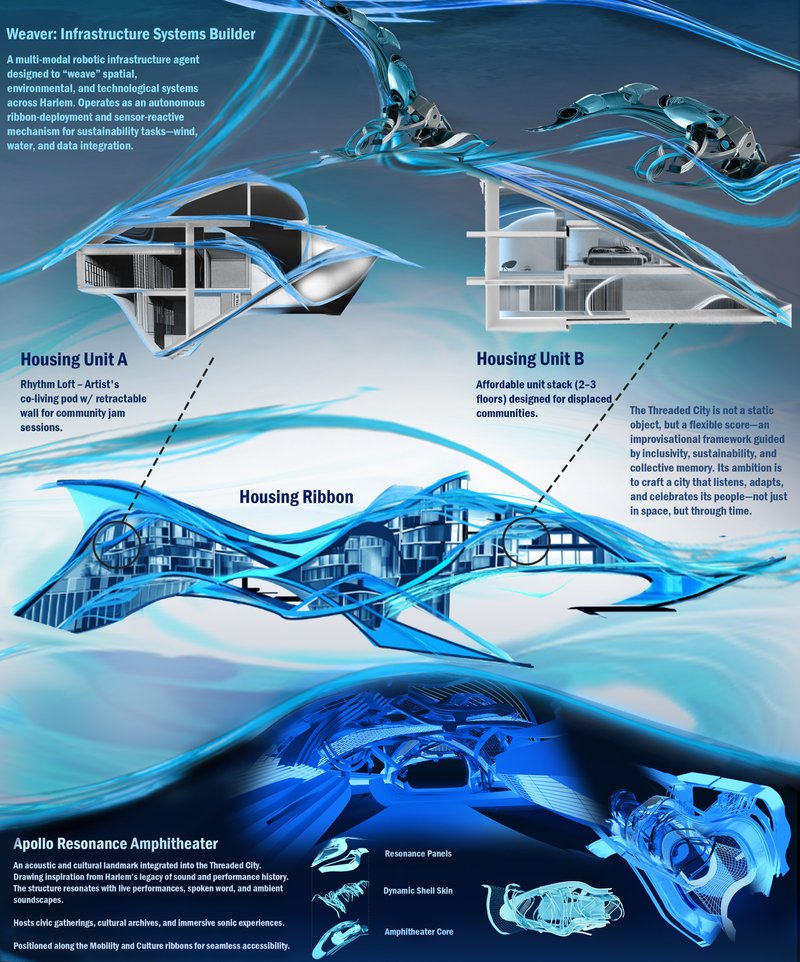
The sectional perspective cuts through two distinct housing unit types, placing them in direct relationship with an infrastructure ribbon that arches over a reflective water surface. The drawing clarifies a crucial spatial argument: the ribbons are not abstract planning gestures but physical structures with real thickness, curvature, and material consequence. They shelter, they span, and they channel resources. The water below is not decorative either; it represents both the recovered relationship with the East River and the environmental systems, such as tidal energy harvesting and rainwater storage, that the project embeds into its architecture.
What the section also reveals is the project's commitment to variety within a unified system. The two housing types respond to different household configurations and orientations, yet they share the same structural logic and connect to the same ribbon infrastructure. Wind-activated kinetic fins along these ribbons convert airflow into renewable energy, while curved tensile canopies capture rainwater for underground storage tanks that feed gardens, cooling systems, and non-potable uses. The architecture is inseparable from its ecological performance.
Sound as Structure: The Apollo Resonance Amphitheater
Among the most evocative programmatic elements is the Apollo Resonance Amphitheater, a cultural and acoustic landmark positioned along the waterfront. Its shell-like form is designed to amplify live performances, spoken word, and ambient sound, reinterpreting Harlem's musical heritage through architectural geometry. The amphitheater is more than a venue; it is a spatial argument that Harlem's identity as a global center for Black art, culture, and identity should be physically manifest in the city's built environment, not just commemorated in plaques and street names.
Why This Project Matters
Threaded City refuses the false choice between preservation and progress. Its ribbon system proposes a way of building that is simultaneously forward-looking and deeply rooted, technically sophisticated and culturally legible. The jazz metaphor is not a surface flourish; it genuinely structures how the project thinks about urban form. Structured yet flexible, grounded in rhythm and variation, it treats the city as a collective improvisation where residents hold real agency over how their neighborhoods evolve.
For a neighborhood that has experienced both cultural renaissance and environmental injustice, the proposal's integration of AI-responsive infrastructure, participatory governance, and ecological systems into a single design framework represents a serious contribution to what urban resilience architecture might look like in practice. It is not a utopian sketch. It is a working hypothesis for how Harlem's fragmented neighborhoods might be rewoven into a coherent, living whole, threaded back to the waterfront that was taken from them.
View the Full Project
About the Designers
Designer: Tobias Maiden
Enter a Design Competition on uni.xyz
uni.xyz runs architecture and design competitions year-round that reward proposals with spatial conviction and real site intelligence.
Project credits: Threaded City by Tobias Maiden Peak (uni.xyz).



Popular Articles
Popular articles from the community

Kaffeebühnen: Coffee Shop Architecture Designed as a Civic Stage Between Vienna’s City and Park
Kaffeebühnen turns coffee shop architecture into a civic stage, linking Vienna’s park edge, urban life, warm timber yards, and coffee craft.
Inside a Timeless Mumbai Residence by Aether Studio
Aether Studio's 2,250 sq ft apartment in Malad, Mumbai uses marble, brass, boucle, and disciplined restraint to build a quiet retreat from the city.

The Faith: Modular Architecture for Play, Learning, and Hope in Kutupalong Refugee Camp
A modular playground architecture project in Bangladesh where play, learning, safety, and hope rebuild childhood inside a refugee camp anew.
Reincarnation Weaves a Three-Story Retreat into the Green Landscape of Rural Bangladesh
Ara Manor in Narsingdi dissolves the line between domestic architecture and its lush surroundings through screens, courtyards, and planted rooftops.

Similar Reads
You might also enjoy these articles
The Faith: Modular Architecture for Play, Learning, and Hope in Kutupalong Refugee Camp
A modular playground architecture project in Bangladesh where play, learning, safety, and hope rebuild childhood inside a refugee camp anew.
Locus Habitat: Mixed-Use Architecture for Bhopal’s Future Smart City
Locus Habitat reimagines Bhopal’s Smart City living with transit-oriented mixed-use architecture, green edges, courtyards, and shared life.
IKC de Geluksvogel: Sustainable School Architecture Designed for Free Movement and Digital Learning
IKC de Geluksvogel turns sustainable school architecture into a flexible Maastricht campus for digital learning, nature, and free movement.
FLOWING: Cinema Architecture as a Living Film Space in the Persian Gulf Desert
Flowing turns Persian Gulf desert into cinema architecture where film, landscape, audience, and culture move through one shared desert stage
Explore Housing Competitions
Discover active competitions in this discipline




The Global Benchmark for Architecture Dissertation Awards


The Global Benchmark for Graduation Excellence

Bring back Drive In's
Comments (0)
Please login or sign up to add comments
No comments yet. Be the first to comment!