
Three Japanese Firms Build India's Largest Folded Plate Structure for IIT Hyderabad's Sports Complex
A 49-meter concrete span and a village of sawtooth roofs bring athletic and cultural life to a new campus outside Hyderabad, India.


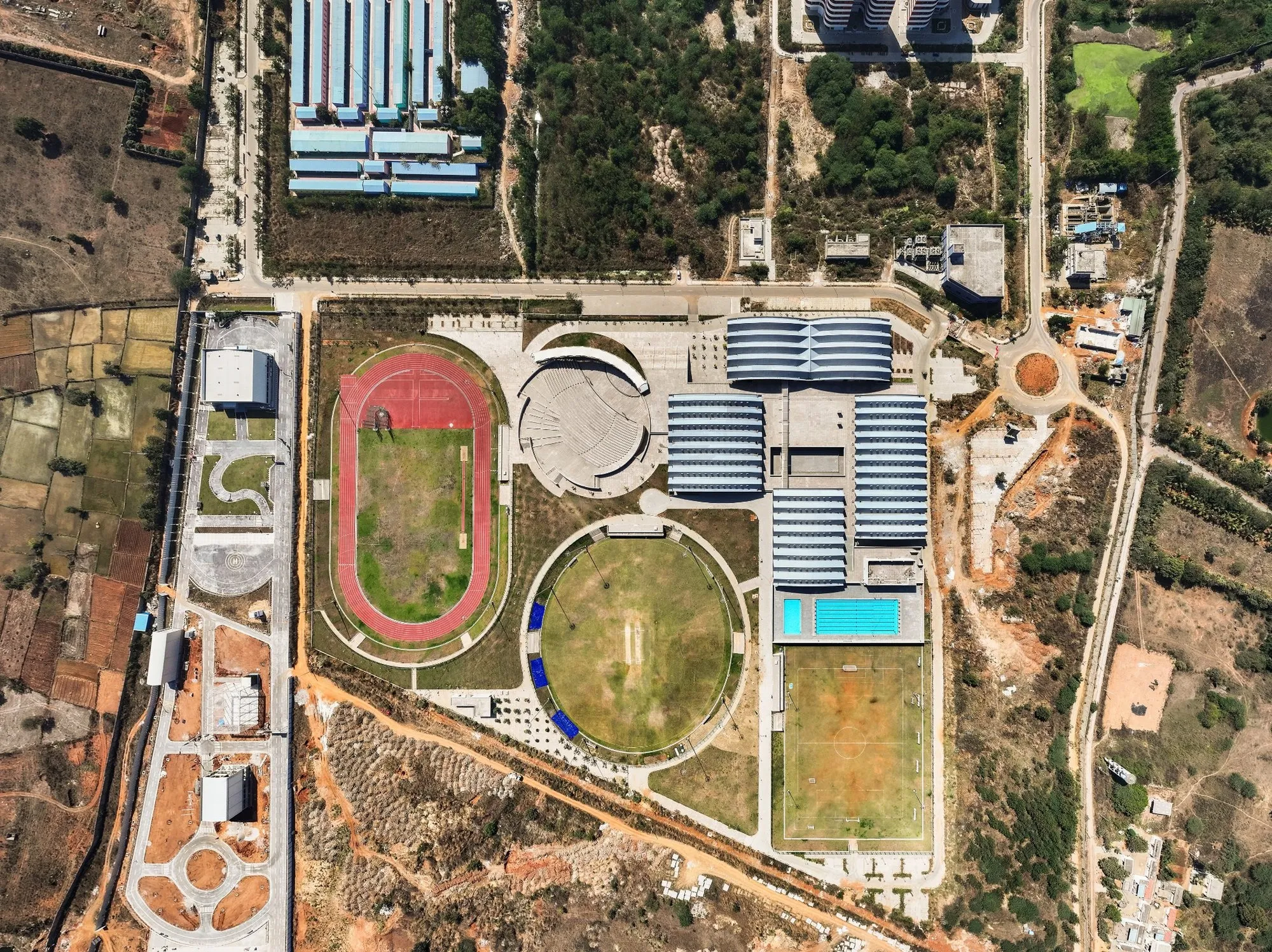
Sixty kilometers from the center of Hyderabad, on a two-square-kilometer plateau of scrubby farmland, a new campus for the Indian Institute of Technology is taking shape. Among its six core complexes, the Sports and Cultural Complex designed by the IITH Campus Design Team of the University of Tokyo, NIHON SEKKEI, and APL design workshop is arguably the most structurally ambitious: a 30,881 square meter cluster of vaulted halls, outdoor pools, a circular amphitheater, and sheltered plazas unified by India's largest reinforced concrete folded plate roof, spanning 49 meters without intermediate supports.
What makes the project genuinely interesting is not its scale but the collision it stages between two distinct architectural cultures. Japanese design thinking, with its emphasis on threshold spaces between inside and outside, meets the material constraints and climate demands of south India, where timber is scarce and shade is essential. The result is a building that reads as a small town: a landscape of repeating concrete forms, stepped stone seating, and deep covered concourses that blur the line between sport, gathering, and daily campus life.
A Village on the Plateau
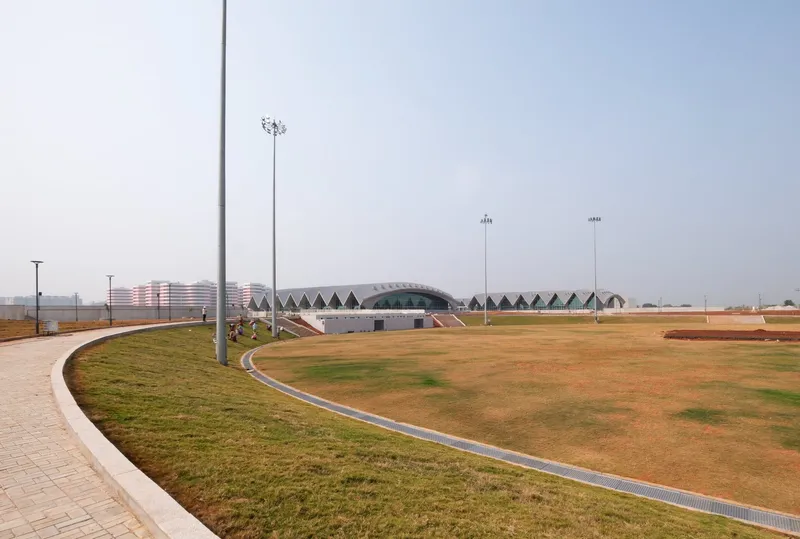
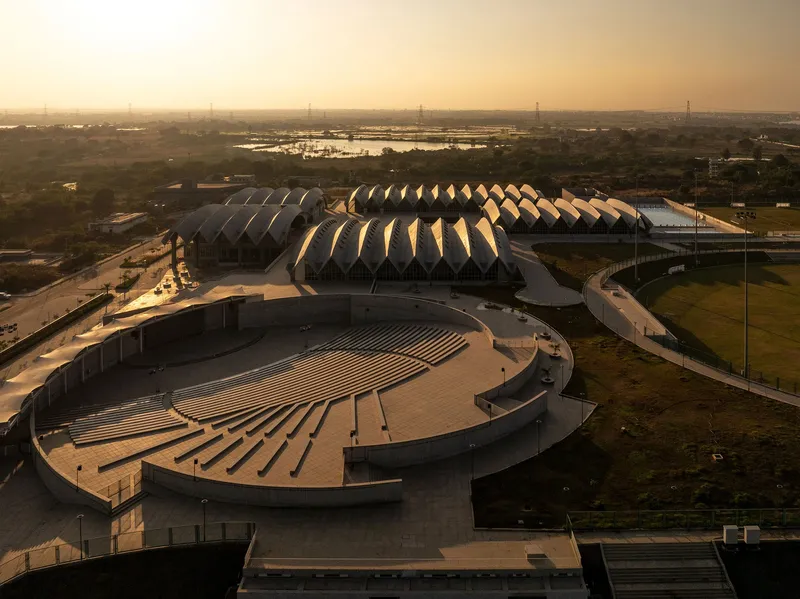

From a distance, the complex looks less like a single building and more like a settlement. The serrated sawtooth roofline stretches across the landscape at a scale that matches the dormitory clusters to the south, establishing a horizontal datum rather than a landmark. The choice is deliberate. Positioned at the northern edge of the residential zone, the complex is designed to be walked through, not admired from afar. Its silhouette of triangular gables, arched vaults, and a single circular opening speaks to a programmatic diversity that refuses to be wrapped in a single envelope.
Aerial views reveal the organizational logic: rectangular sport halls and pool volumes cluster around a circular arena, with courtyards and covered plazas stitching them together. The wetlands beyond the campus edge provide an unexpected backdrop, situating athletic activity within a wider ecology.
The Sawtooth Canopy and Its Sheltered Ground
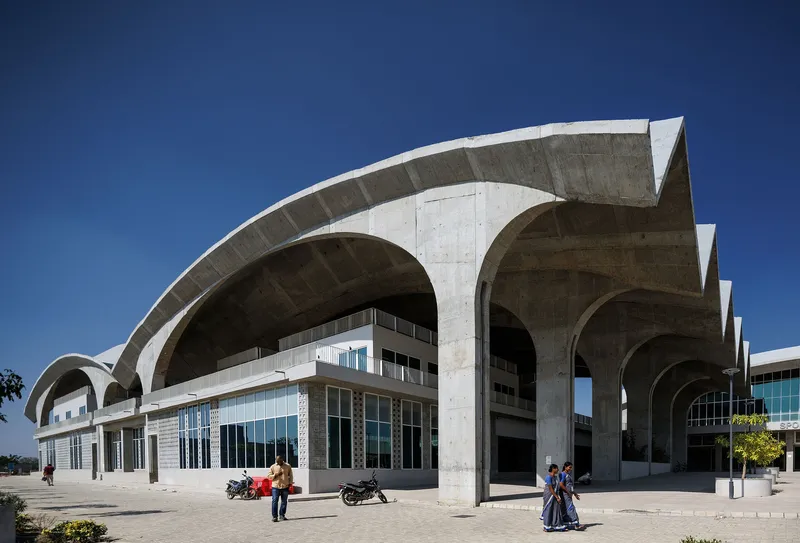
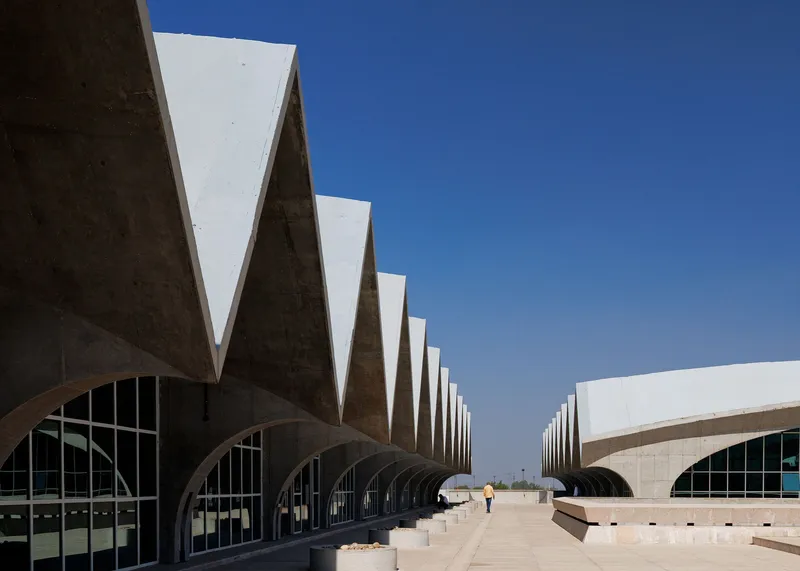
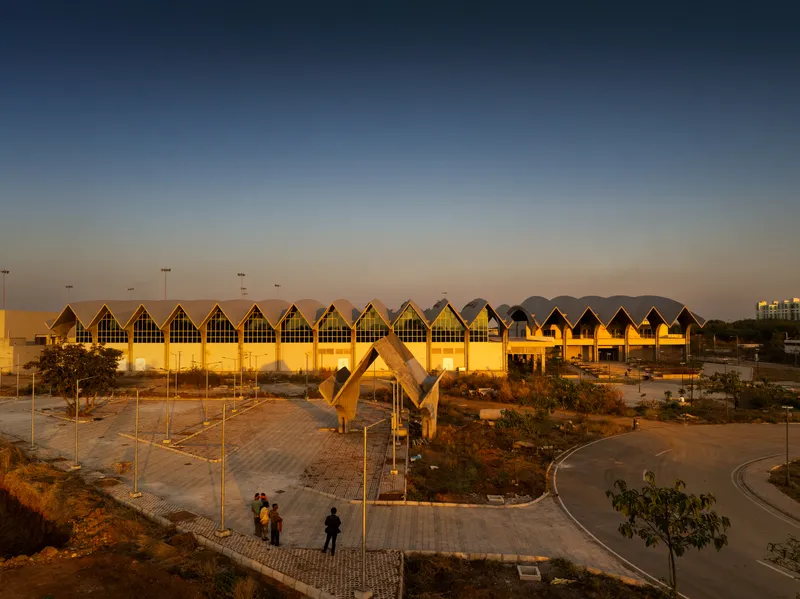
The repeating triangular concrete roof forms are the project's most immediately legible gesture. Seen from the ground, the zigzagging profile creates a rhythmic facade that is both monumental and modular. Each gable shelters a glazed arched opening below, pulling daylight into the interiors while the overhangs protect the lower levels from Hyderabad's relentless sun. The repetition is not monotonous; it generates a visual cadence that allows you to read the building's organization as you walk along it.
At twilight, the triangular glazed facades glow from within, revealing the sectional complexity hidden behind the uniform roofline. The pedestrians approaching at ground level get the scale right: these are generous public facades, not hermetic sports enclosures.
Intermediate Spaces as Primary Architecture


The Japanese design teams brought a clear preoccupation with the space between exterior and interior, and it is in these intermediate zones that the complex is most successful. Covered plazas beneath the arched concrete canopies are not leftover circulation but principal gathering spaces. Young trees grow in circular planters; stone benches invite sitting. Walking through the covered concourses, you pass from shade to dappled light to open sky and back again. The sequence is carefully calibrated.
One particularly strong moment frames a view through angular concrete arches toward a distant river, collapsing the scale of the building against the horizon. These are passive design strategies dressed as spatial experiences: deep shade, cross ventilation, visual connection to landscape. In a climate where temperatures routinely exceed 40 degrees Celsius, these thresholds are not amenities. They are what make the complex livable.
Concrete Vaults and the 49-Meter Span
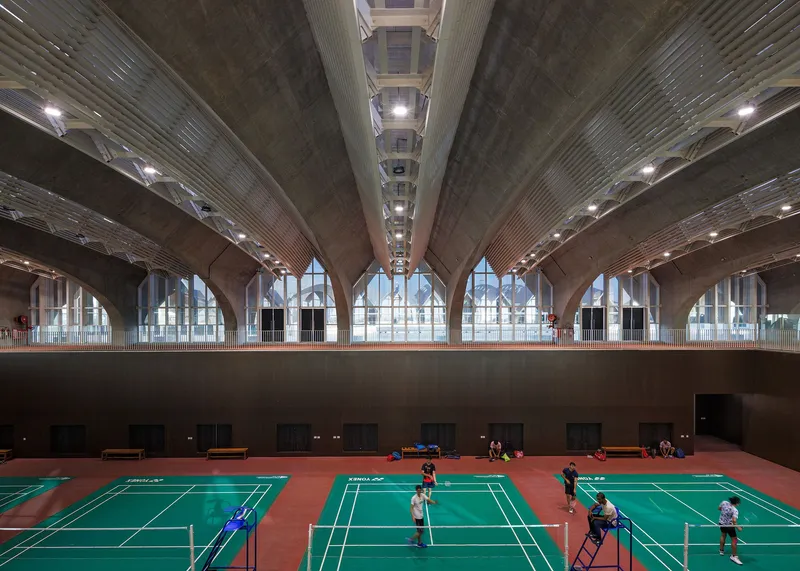
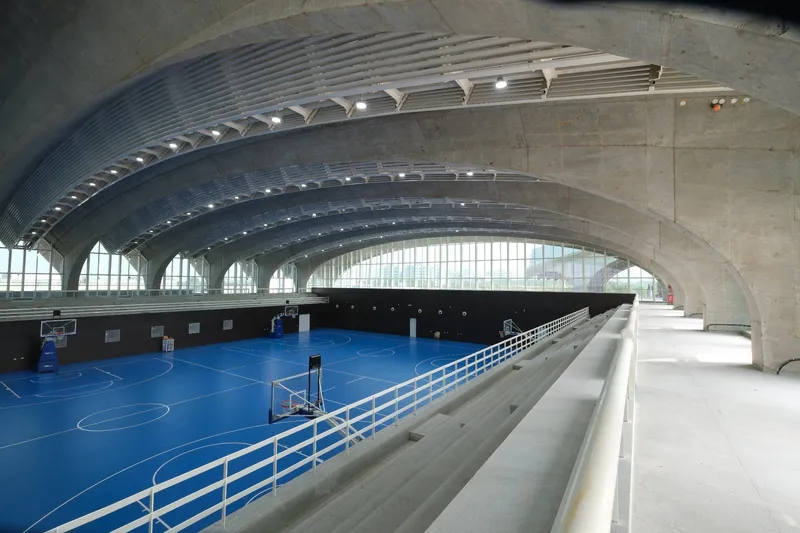
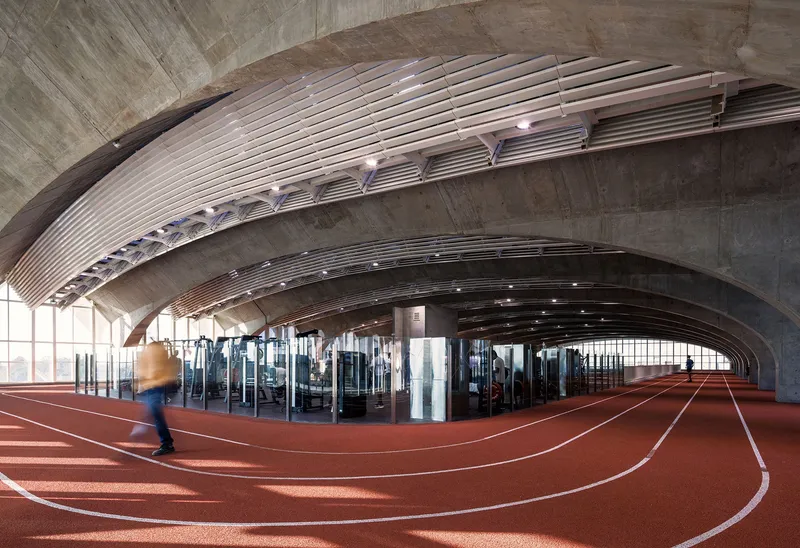
The main sports halls are the structural centerpiece. The ribbed concrete vaults span up to 49 meters as folded plate structures, a technique that achieves long spans without the weight or cost of steel trusses. Structural advisor Jun Sato's involvement with the University of Tokyo team is legible in the engineering clarity of the result: the vaults are not decorative. They are working structure, with clerestory windows cut into the folds to admit controlled natural light across badminton courts, running tracks, and spectator seating.
The interior experience beneath these vaults is surprisingly warm. Formwork lines left visible on the concrete give the ceilings a textured, handmade quality. On the indoor running track, the arched vault overhead and the curved white lane markings below create a spatial loop that compresses vertical and horizontal movement into a single continuous gesture.
Stone, Concrete, and a Timber Substitute
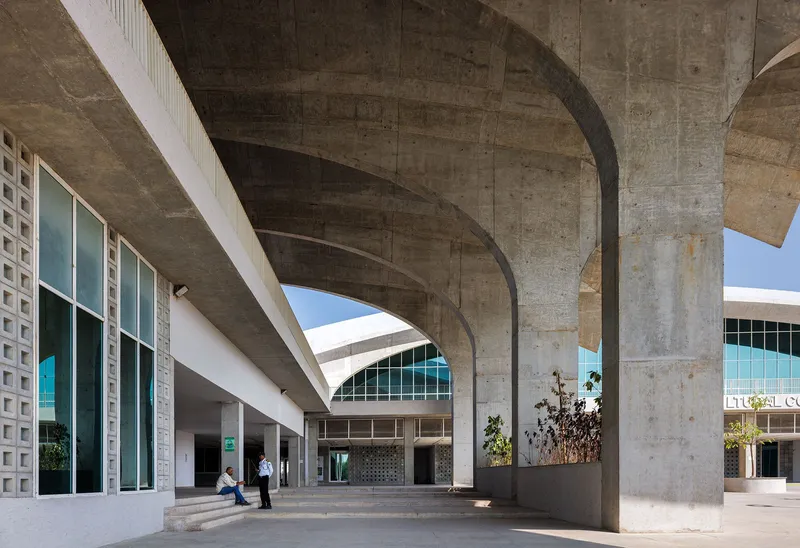
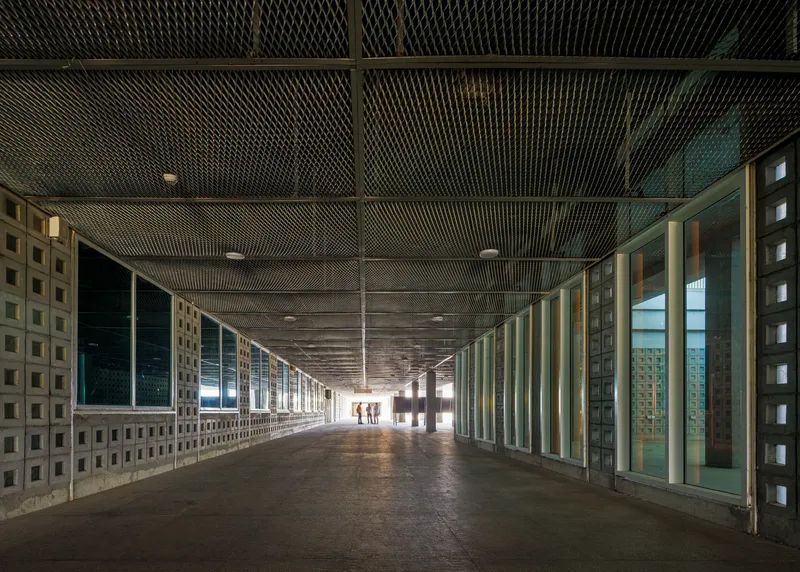
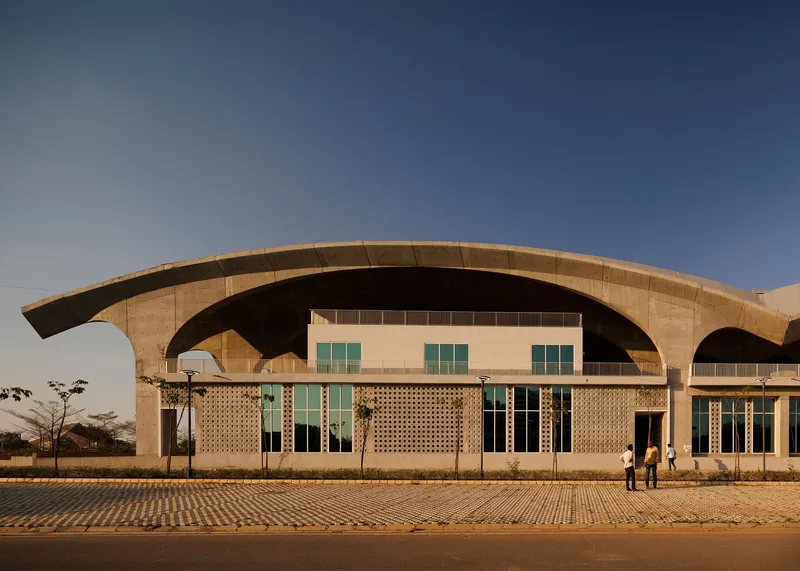
Material choices reflect local realities. Timber is scarce in this part of India, so stone and concrete carry nearly the entire palette. The cylindrical columns and broad vaulted ceilings are exposed reinforced concrete, with formwork imprints providing the only surface ornament. Perforated concrete block walls line some corridors, filtering light and air through a patterned screen that nods to traditional Indian jali work without mimicking it.
At dusk, the perforated brick facade beneath the curved arches takes on a lantern-like quality. The material economy is strict, but the architects extract real atmospheric range from a limited set of elements. Where wood does appear, as on a railed terrace overlooking the campus, it reads as an exception, a moment of tactile contrast against the dominant mineral surfaces.
The Amphitheater and Cultural Program
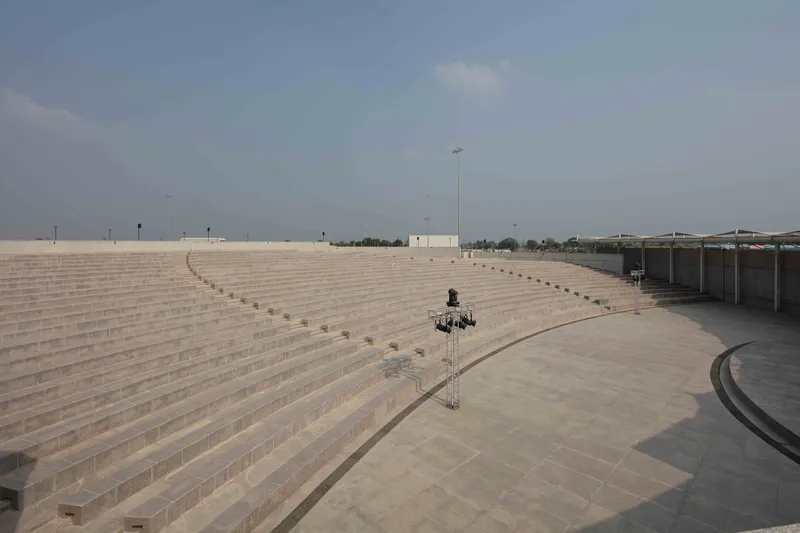
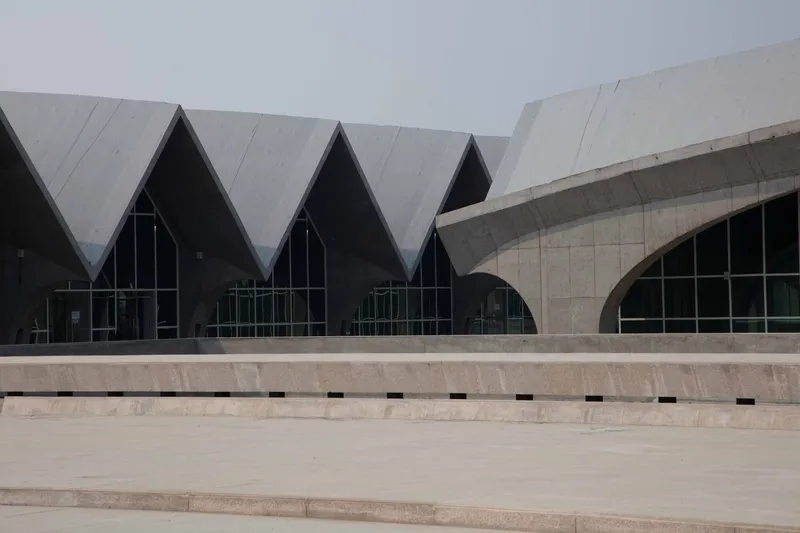

The circular amphitheater is the complex's civic anchor. Its wide stone steps descend toward a central platform under open sky, forming a gathering space that can serve lectures, performances, or simply informal campus life. Stepped concrete seating adjacent to the zigzag roofline creates a secondary outdoor venue facing the main plaza, blurring the boundary between sport and culture.
Inside the cultural wing, an arched concrete vault rises over a mezzanine level with timber screens and warm uplighting. The space has a quality closer to a civic hall than a university auditorium, suggesting that the designers understood culture as something that requires spatial generosity, not just programmatic allocation.
Water, Light, and the Night Campus


The outdoor swimming pool, with its concrete deck and curved metal hooks overhead, adds a further programmatic layer. The night aerial shows the two blue pools illuminated alongside the vaulted roofs and courtyards, revealing the complex as a continuous landscape of activity rather than a collection of isolated facilities. Lighting is handled with restraint: warm tones on interior vault surfaces, cooler functional lighting on sports courts, and strategic exterior illumination that picks out the sawtooth silhouette against the sky.
The interplay of arched glazed walls and mezzanine levels allows controlled daylight deep into the building's section. Clerestory windows along the vault ridges create linear skylights that track across court surfaces over the course of the day. The building's relationship to light is not theatrical; it is operational, tuned to the needs of athletes and spectators alike.
Plans and Drawings
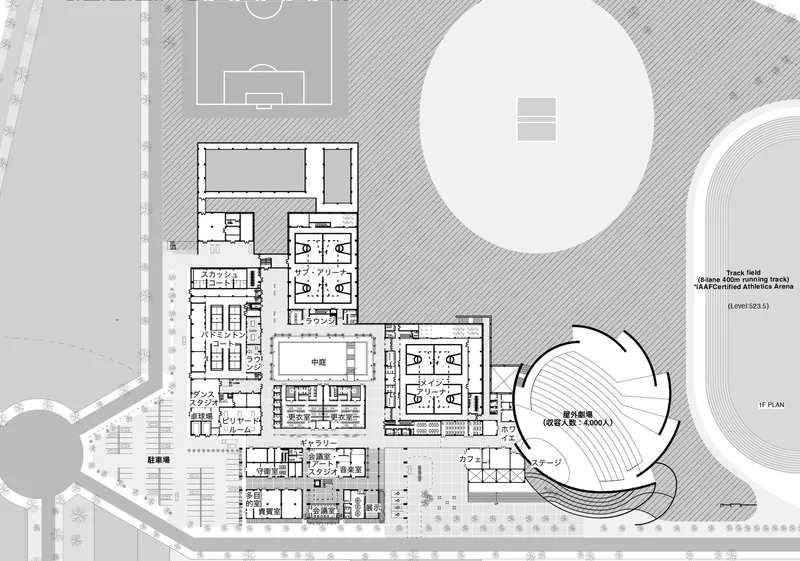
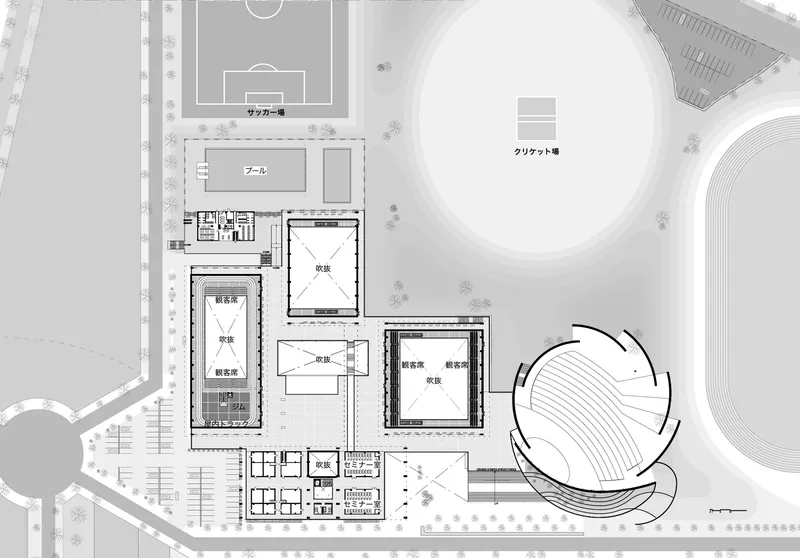
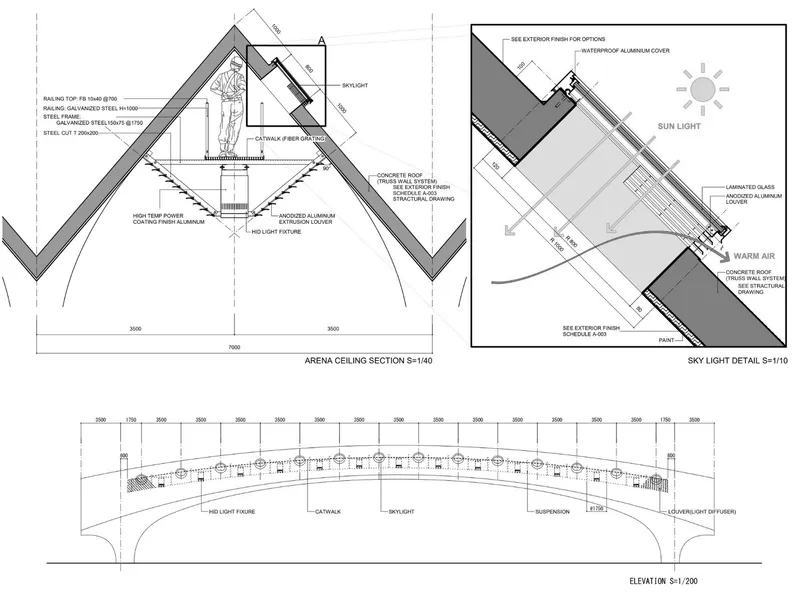


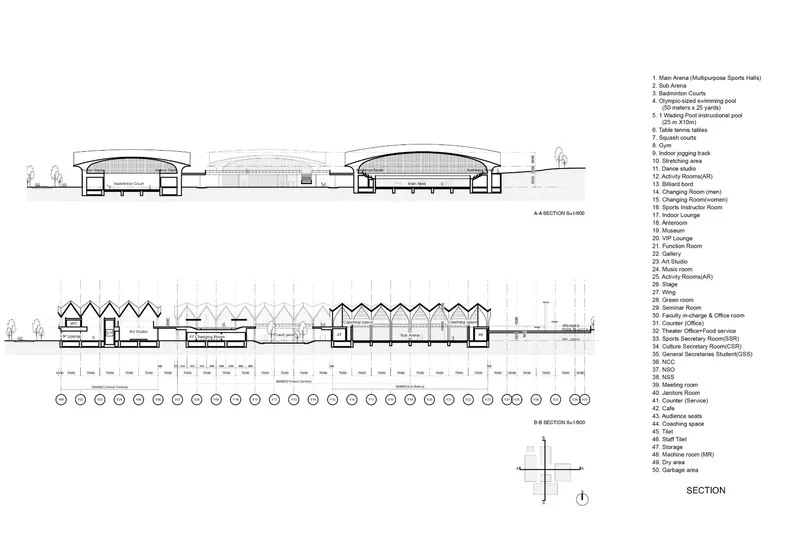
The floor plans make the organizational strategy explicit. Rectangular sport volumes, each governed by the structural rhythm of the folded plate roof, cluster around the circular arena. The ground floor distributes pool halls and gymnasiums beside the performance space, while the first floor adds spectator galleries and support rooms. The section drawings are where the engineering ambition becomes legible: arched roof trusses spanning the central halls, folded steel profiles with integrated skylights and ventilation, and layered anteroom sequences with sloped ceilings and louvers that mediate between conditioned interiors and the hot exterior.
Three domed roof profiles, each with a distinct structural diagram, confirm that this is not a single structural idea repeated. It is a family of related systems, each calibrated to the program it shelters. The variety is disciplined but real, and it is the source of the building's character.
Why This Project Matters
University sports facilities are often afterthoughts: steel sheds dressed up with colored cladding, tucked at the campus periphery. The Sports and Cultural Complex at IIT Hyderabad treats athletic and cultural infrastructure as civic architecture. Its folded plate vaults, deep shaded concourses, and central amphitheater create a public realm within the campus, not just a set of enclosed programs. The collaboration between the University of Tokyo's campus design team, NIHON SEKKEI, and APL design workshop demonstrates that cross-cultural architectural partnerships can produce buildings that are genuinely responsive to place rather than generic exports of a single national style.
The 49-meter reinforced concrete span is a technical achievement worth noting on its own terms, but what matters more is the spatial culture it enables: column-free halls where light, air, and movement are given room to unfold. In a country where institutional architecture too often defaults to either bombastic monumentality or bare pragmatism, this complex stakes out a middle ground that is structurally rigorous, climatically intelligent, and spatially generous. It is a building that treats its users, students playing badminton, swimmers doing laps, audiences gathering for a lecture, as citizens of a shared public life.
Sports and Cultural Complex IIT Hyderabad, designed by IITH Campus Design Team of the University of Tokyo, NIHON SEKKEI, and APL design workshop. Hyderabad, India. 30,881 m². Completed 2022. Photography by Masaki Hamada (kkpo) and Hidetoshi Ohno.
About the Studio
Share Your Own Work on uni.xyz
If projects like this are the kind of work you want to make, uni.xyz is a place to publish your own, find collaborators, and enter design competitions.



Popular Articles
Popular articles from the community


Co-life: Sustainable Architecture for Age-Friendly Community Living
Co-life reimagines sustainable architecture for seniors through courtyards, rammed earth, shared gardens, and spaces designed for belonging.

The Musturak Paradise: Senior Living Architecture for a Connected Future in Temara, Morocco
The Musturak Paradise reimagines senior living architecture in Temara via private homes, social spaces, culture, community, and shared care.

The Ocean Hive: Sustainable Architecture for a Self-Sufficient Civilization at Sea
The Ocean Hive imagines sustainable architecture at sea, where modular habitats, algae, wave power and ocean waste sustain a growing colony.

The Earth Pod: 3D Printed Homes for Resilient Refugee Communities
The Earth Pod reimagines refugee housing through 3D printed homes made from clay, combining resilience, self-sufficiency, and rapid shelter.


Similar Reads
You might also enjoy these articles

Bao Huynh Watercolor Atelier: A Serene Art Retreat in Hội An
Bao Huynh Watercolor Atelier in Hội An blends multifunctional art spaces, sustainable design, local materials, and family-friendly living in a serene environment.

Atelier Macri Concept Store Interior Design by CASE-REAL
Atelier Macri store features a "ko" counter, walnut wood details, cork displays, blending retail, gallery, and seamless customer experiences.

Manuel Vargas Izquierdo Stadium and High-Performance Sports Center: Architectural Excellence in Jalpa de Méndez
The Manuel Vargas Izquierdo Stadium blends sustainable design, inclusive sports facilities, and cultural-inspired architecture, revitalizing Jalpa de Méndez’s public spaces.

KAKR Buluh Awar Hall: Revitalizing Community and Ecology Through Bamboo Architecture
Community built bamboo hall revitalizes Buluh Awar village, empowering youth, restoring ecology, celebrating vernacular craftsmanship through sustainable architecture and culture.

Explore Sports Architecture Competitions
Discover active competitions in this discipline


Challenge to design a barrier free sports center


Challenge to design an outdoor ice-rink and park


Challenge to design public laboratory
Comments (0)
Please login or sign up to add comments
No comments yet. Be the first to comment!