
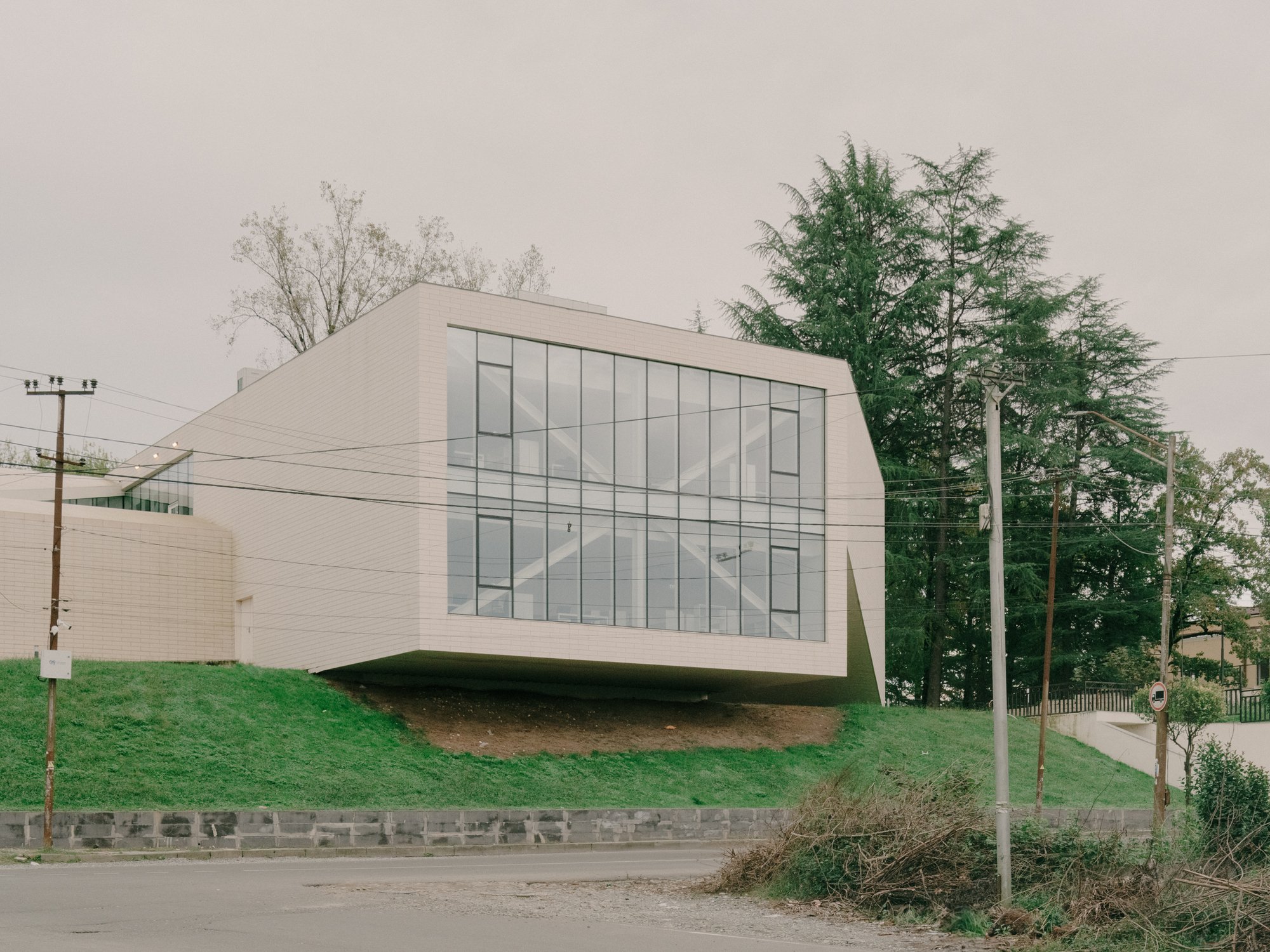
Three Studios Give Georgia's Second City a Cantilevered Cultural Landmark in a Park
The Zviad Gamsakhurdia Presidential Center lands a muscular civic program on a green slope in Zugdidi, pushing Georgian decentralization forward.

Presidential libraries and memorial centers tend to gravitate toward capital cities, where land is expensive and symbolism is easy. The Zviad Gamsakhurdia Presidential Center refuses that logic. Sited in Zugdidi, the western Georgian city where the country's first post-independence president was born, the 2,880 square meter building makes a deliberate case for regional investment. Designed collaboratively by Tsanava, Maisuradze, and T-architects, it threads a multifunctional civic program through an angular pair of volumes that cantilever boldly over the park landscape below.
What makes the project genuinely interesting is the tension between its physical assertiveness and its programmatic openness. The building is not a shrine. It is a library, a study center, a dining hall, and a public gathering space that happens to carry a president's name. The architecture reinforces that duality: heavy white and grey brick masses hover above grade on sloped walls and structural cantilevers, yet from inside, floor-to-ceiling glazing dissolves those masses entirely, framing the surrounding conifers and park paths as if the building were a clearing rather than an object.
A Building That Lifts Itself Off the Ground
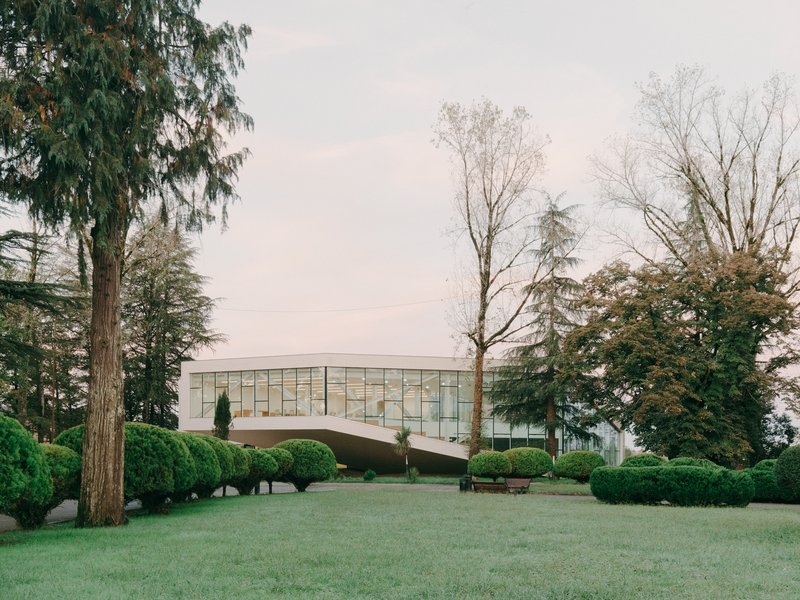
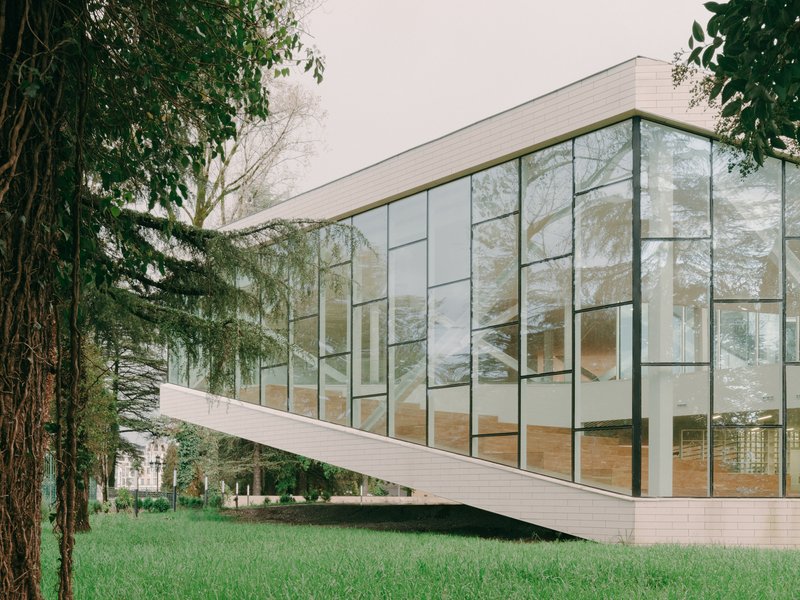
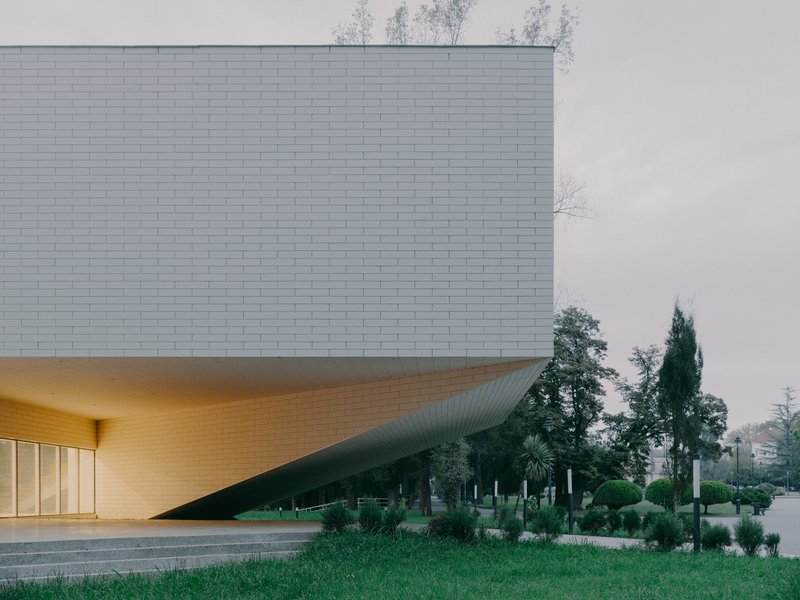
The cantilever is not decorative. Zugdidi sits on relatively flat terrain that slopes gently toward its central park, and the architects exploit that topography by lifting the upper volume above the grade change. From the street, the building reads as a floating bar of white brick and gridded glass suspended above a grassed slope. A timber soffit warms the underside of the cantilever, transforming what could feel oppressive into something almost domestic.
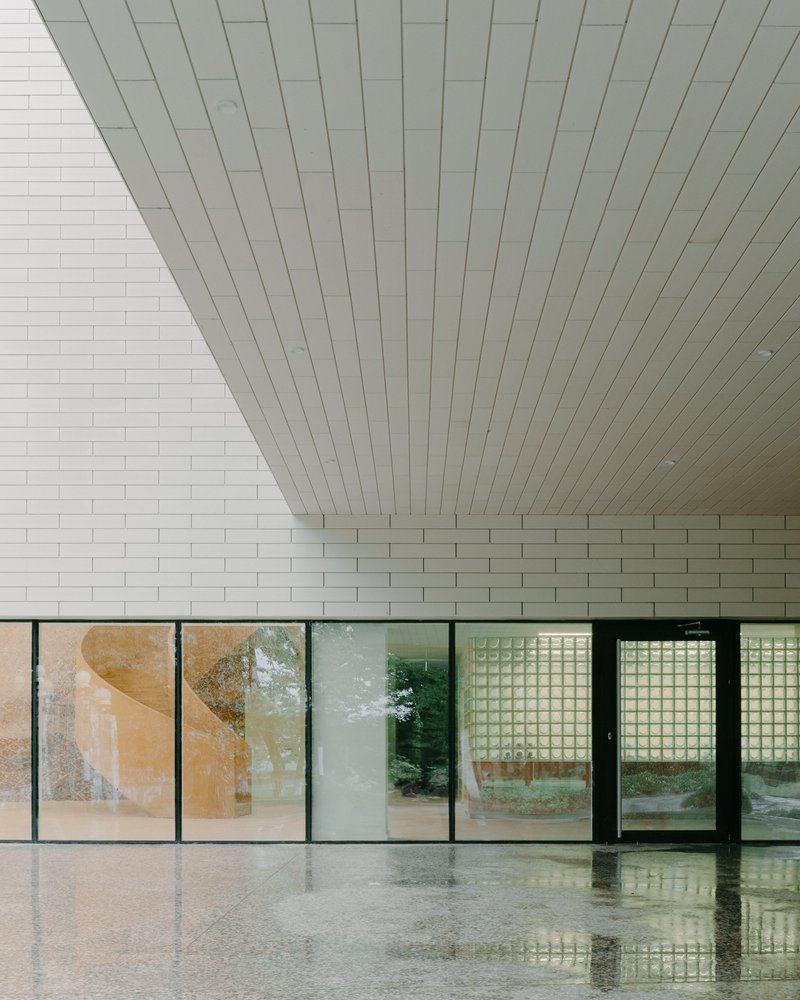
The decision to elevate the mass rather than dig into it preserves the parkland and creates sheltered outdoor space at ground level. It also establishes a clear hierarchy: the public entrance sits below, welcoming visitors through a covered threshold, while the cantilevered volume above signals institutional presence without walling anything off.
White Brick and Ribbon Windows
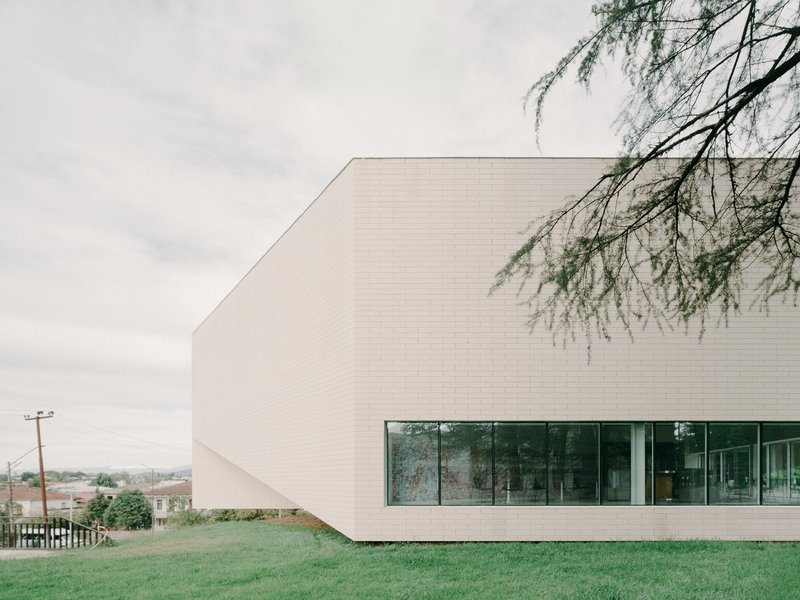
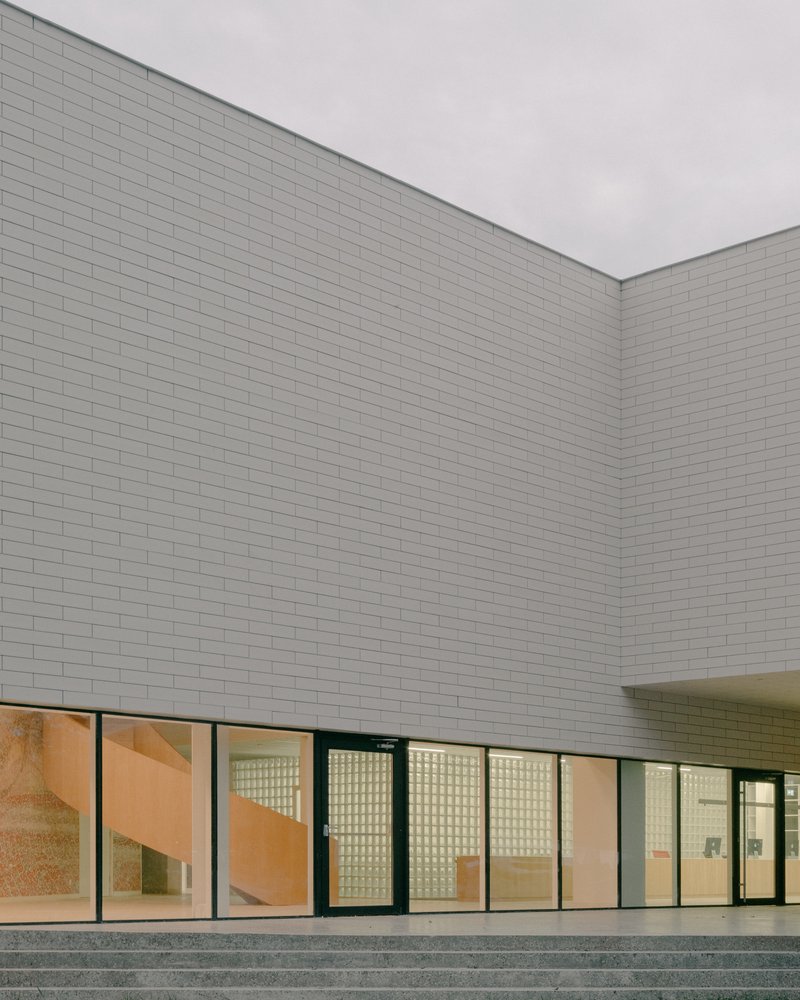
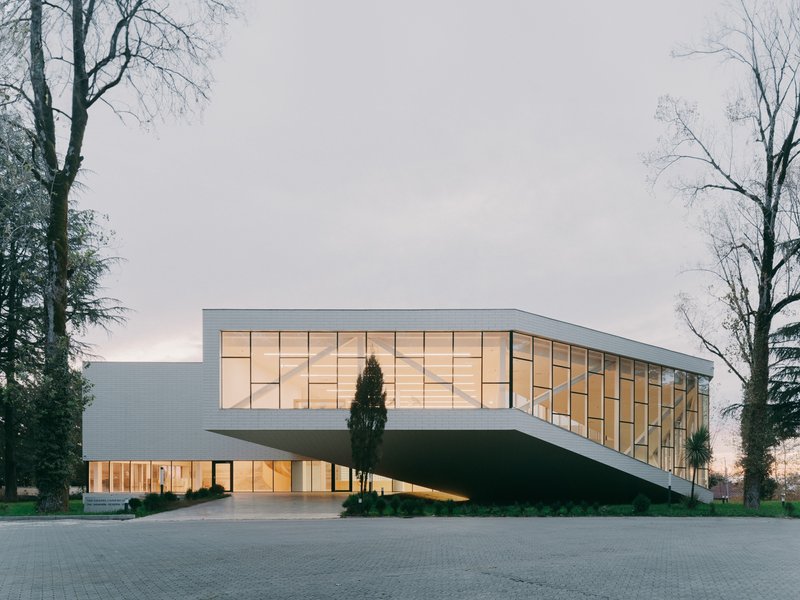
The facade material is white brick, laid in clean horizontal courses that stretch across the building's long elevations. Ribbon windows punctuate the surface at strategic intervals, offering controlled views outward and providing the interiors with a wash of diffused light. At dusk, those same ribbons glow with warm interior illumination, turning the building into a lantern above its stepped concrete terraces.
The architects avoid the temptation to treat every surface as glass. The solid brick stretches establish weight and permanence, qualities appropriate for a civic building in a city that has not historically received this caliber of public architecture. The restraint pays off: when the glazed facade does appear, it feels earned rather than reflexive.
The Street and the Park
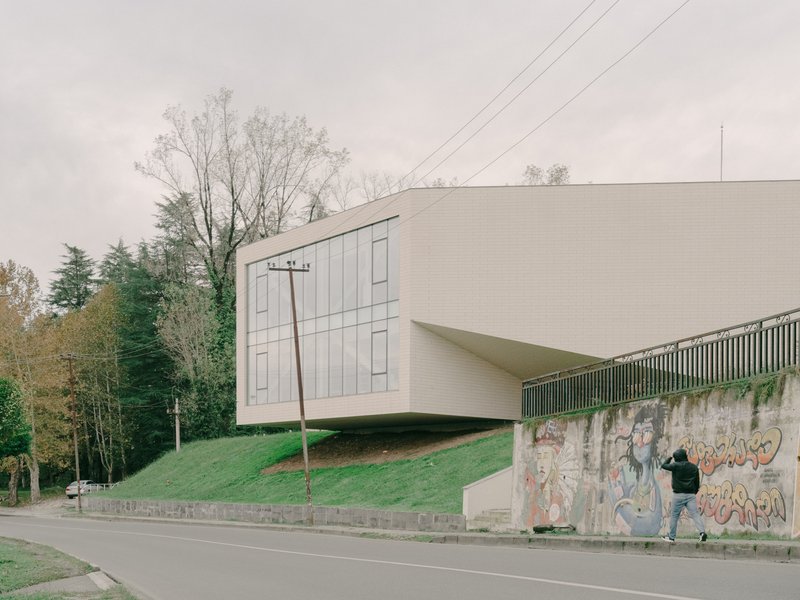
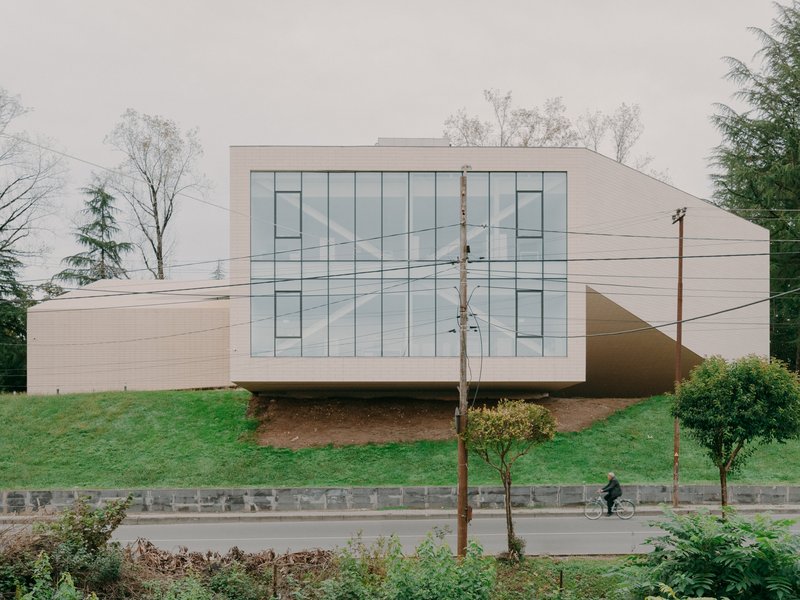
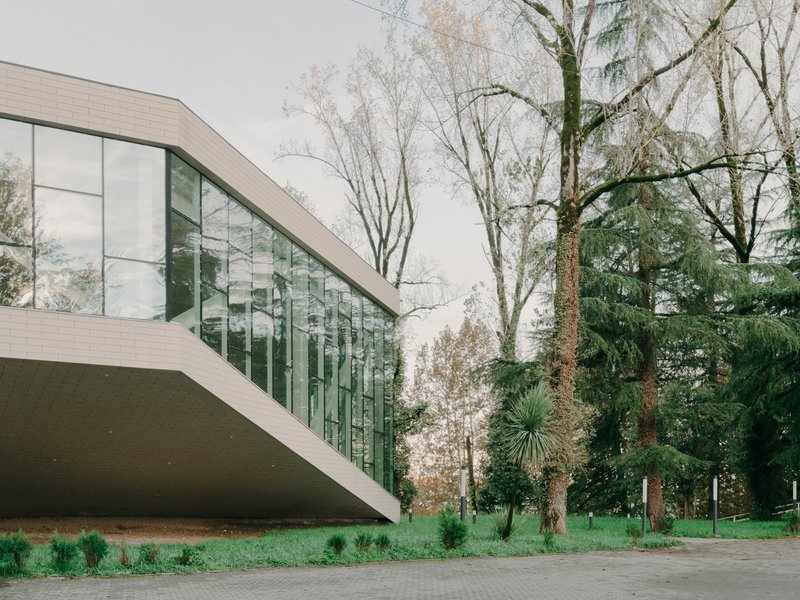
From the roadside, the center presents a graffitied retaining wall and an elevated white volume, a condition that is blunt but honest about the site's grade change. A cyclist passes; overhead power lines cross the frame. Zugdidi is not a polished European capital, and the building does not pretend otherwise. It meets the city's existing infrastructure head-on, using the cantilever to bridge the gap between street level and park level without cosmetic landscaping.
On the park side, the mood shifts entirely. Clipped hedges, evergreen conifers, and mature deciduous trees soften the building's geometric clarity. The glazed corner beneath bare winter branches reads almost like a pavilion, transparent and inviting. The building is Janus-faced in the best sense: civic on one side, pastoral on the other.
Timber, Stairs, and Vertical Circulation
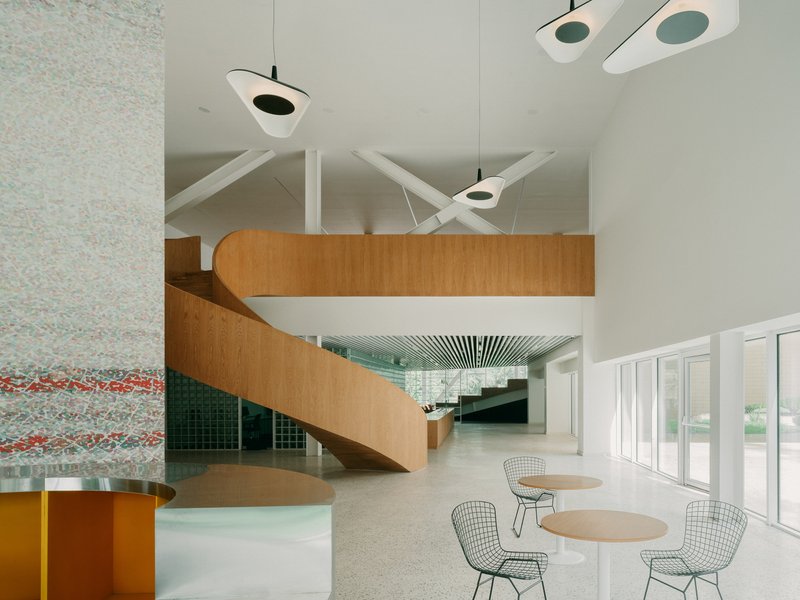
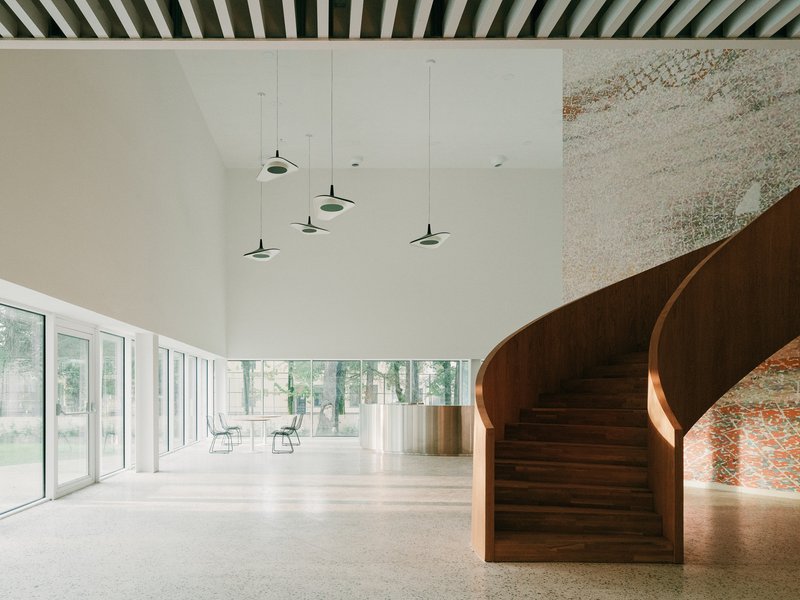
Inside, a curving timber staircase anchors the double-height lobby, functioning as both circulation and furniture. Its sculptural sweep contrasts with the orthogonal structural grid, drawing visitors upward with a warmth that the white brick exterior deliberately withholds. Pendant lights cluster overhead, and wire mesh chairs at round tables signal that this is a place to linger.
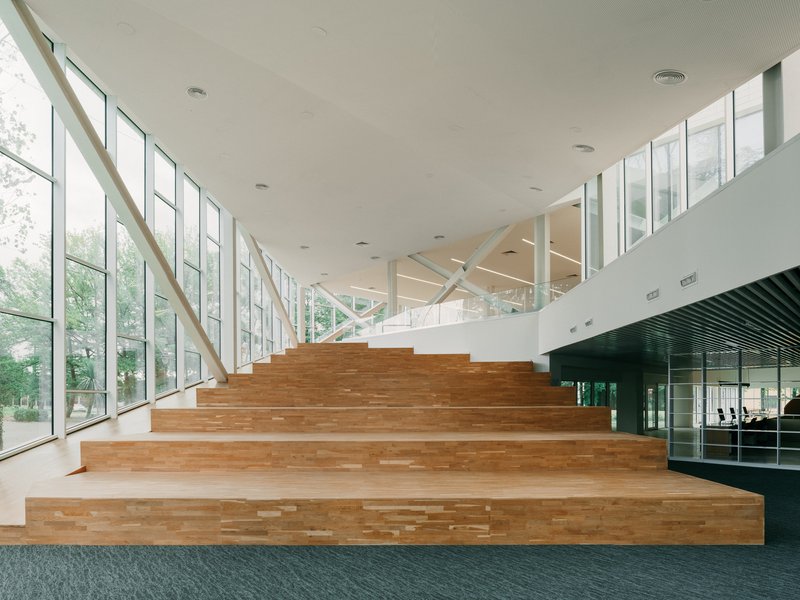
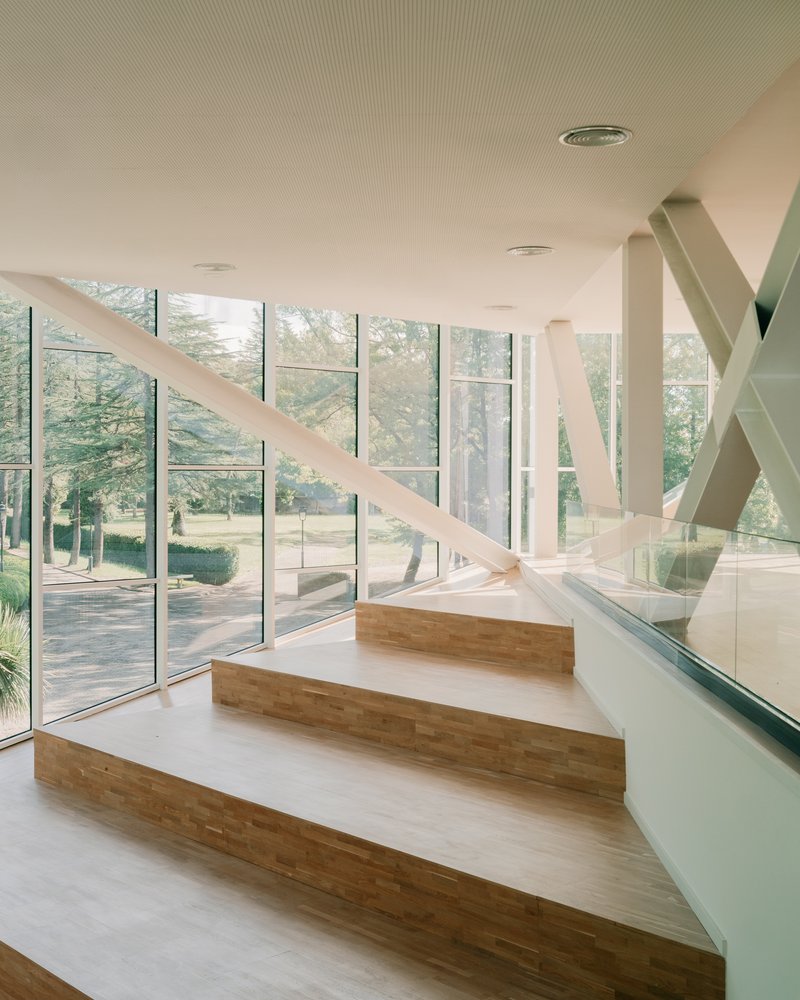
Elsewhere, a wide timber grandstand staircase sits between full-height glazed walls, creating an informal amphitheater that could host lectures, screenings, or simply serve as a place to read between the trees. The architects treat vertical circulation as program rather than service, a move that keeps the building's relatively compact footprint feeling generous.
Reading Rooms and Workspaces Open to the Landscape
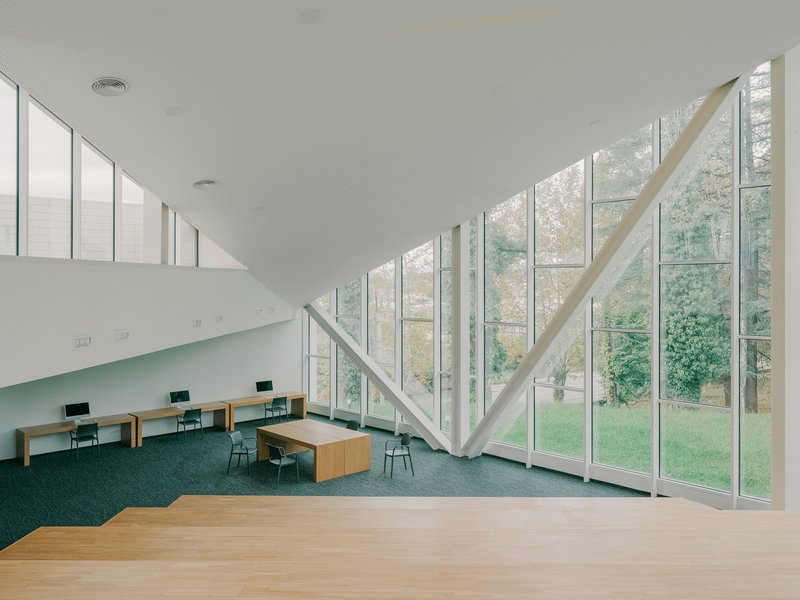
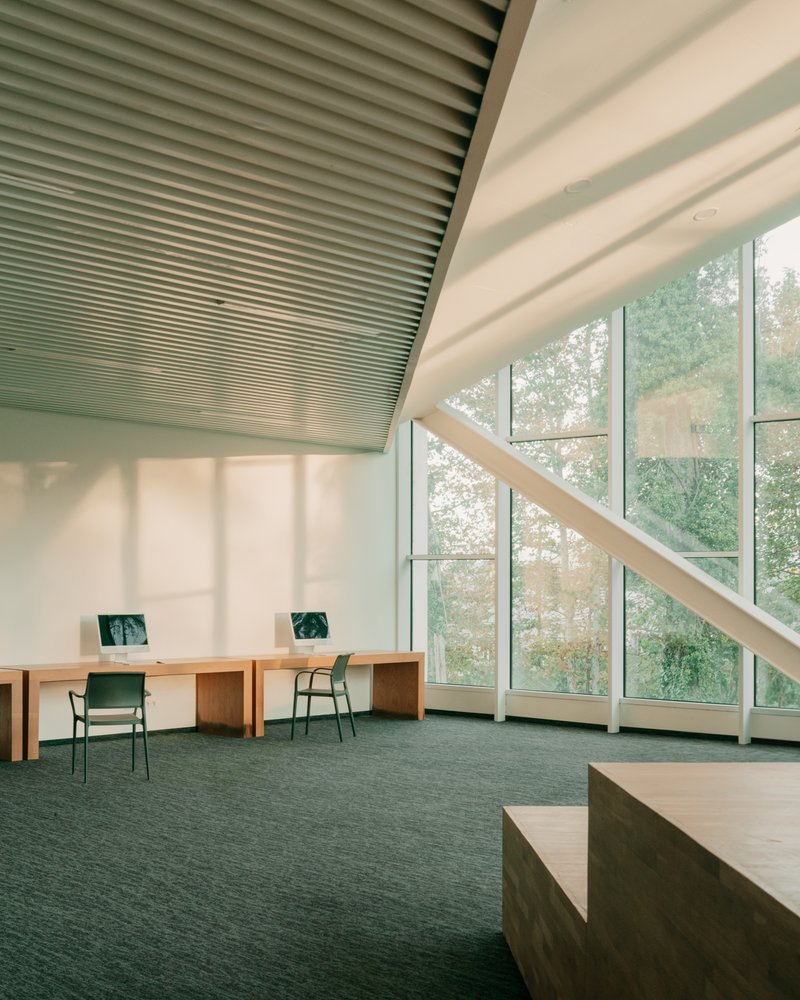
The reading room may be the project's finest single space. Angled white structural beams frame floor-to-ceiling windows that look out onto the park canopy, creating a kind of inhabited truss. The structure is not hidden; it is the room. Diagonal timber bracing at the study desks reinforces the geometry, while green chairs add a quiet burst of color that echoes the conifers outside.
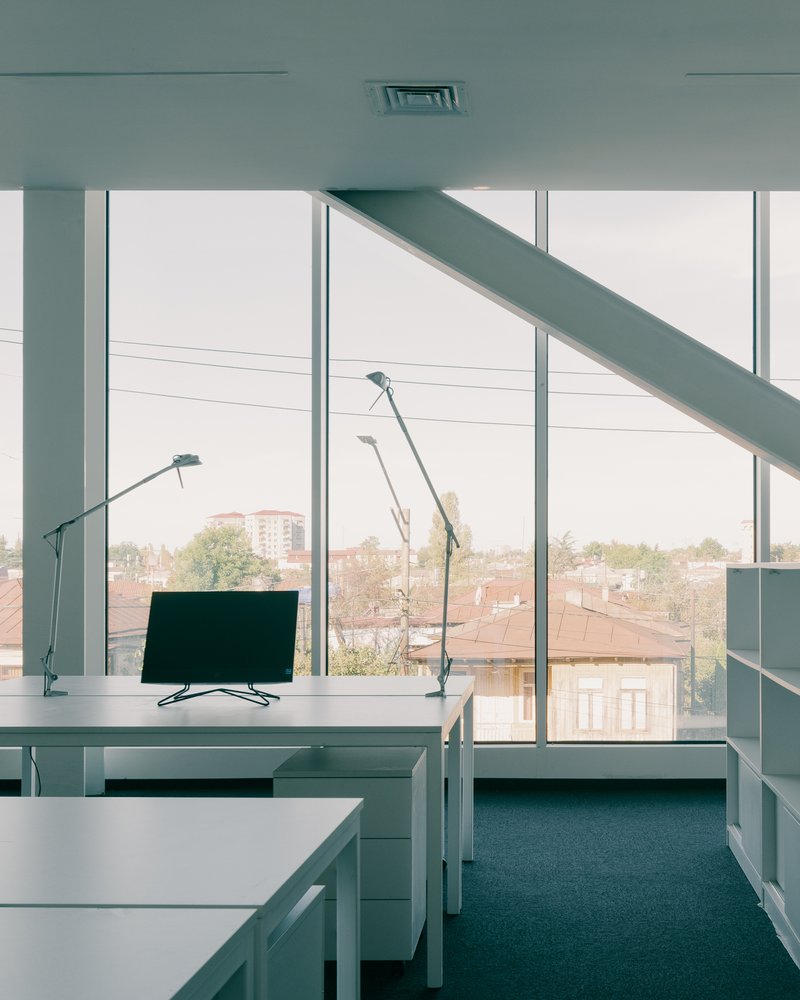
At individual workstations facing suburban rooftops, task lamps and soft daylight suggest a co-working space more than a traditional library. The architects clearly intend the building to serve Zugdidi's young professionals and students as a daily resource, not only as a memorial destination. That dual register, commemorative and quotidian, is what gives the program its resilience.
Courtyards, Green Glass, and Material Detail
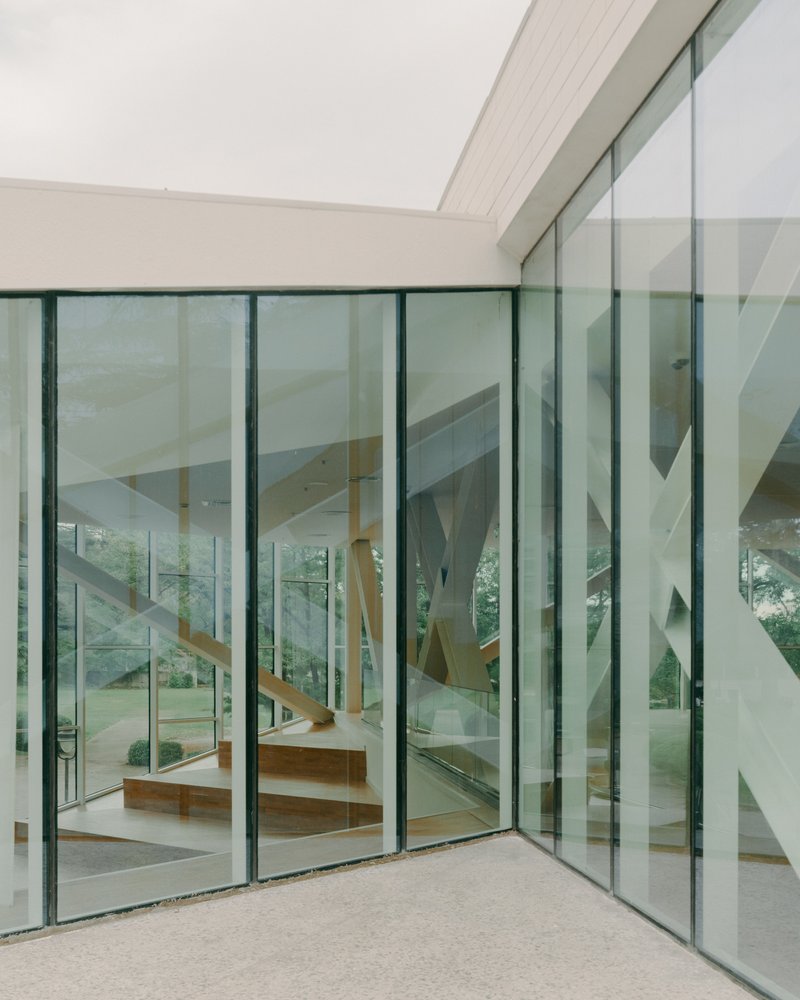
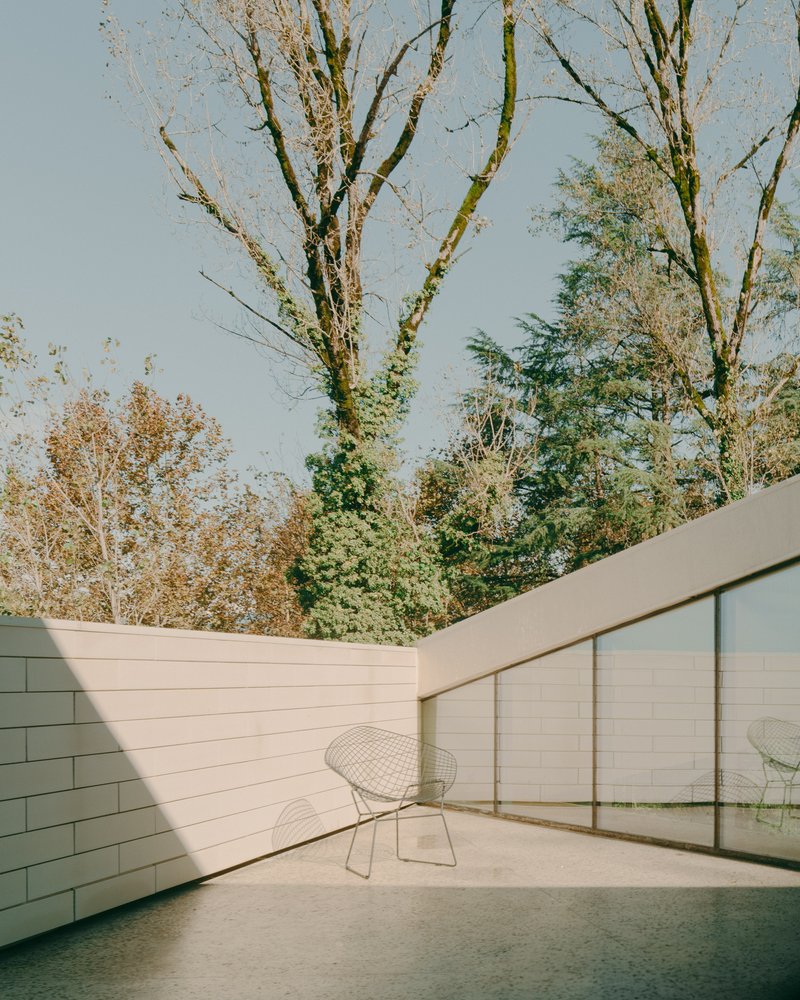
A corner courtyard enclosed by glass walls pulls daylight deep into the plan and offers an outdoor room sheltered from Zugdidi's rainy winters. Bare autumn trees inside the court blur the line between interior and exterior. A wire mesh chair sits against white brick, inviting pause.
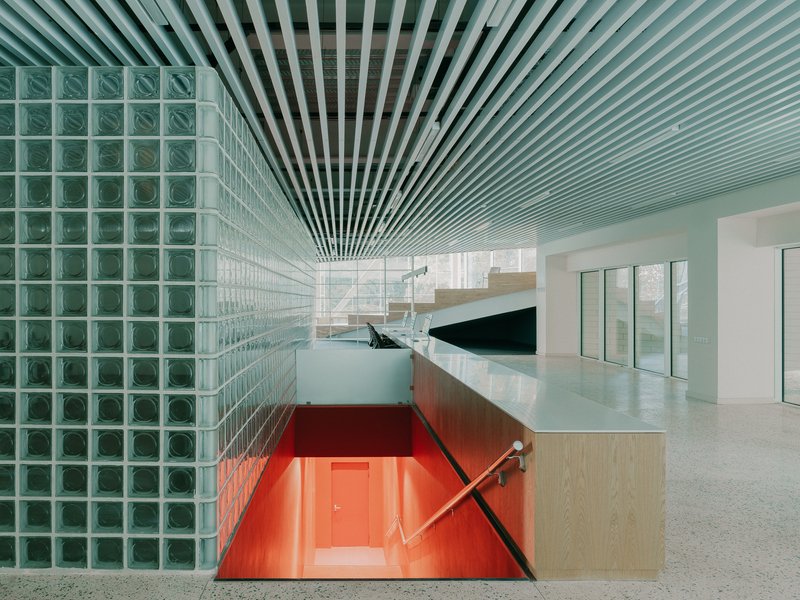
Inside, a green glass block wall paired with a radial slatted ceiling and a red-lit stairwell descending below introduces a more theatrical register. The green tone runs through the project, appearing in ceiling ribs, chair upholstery, and tiled soffits. It is the building's signature chromatic move, linking the interiors to the dense greenery of the park without resorting to living walls or overt biophilic clichés.
Structure as Expression
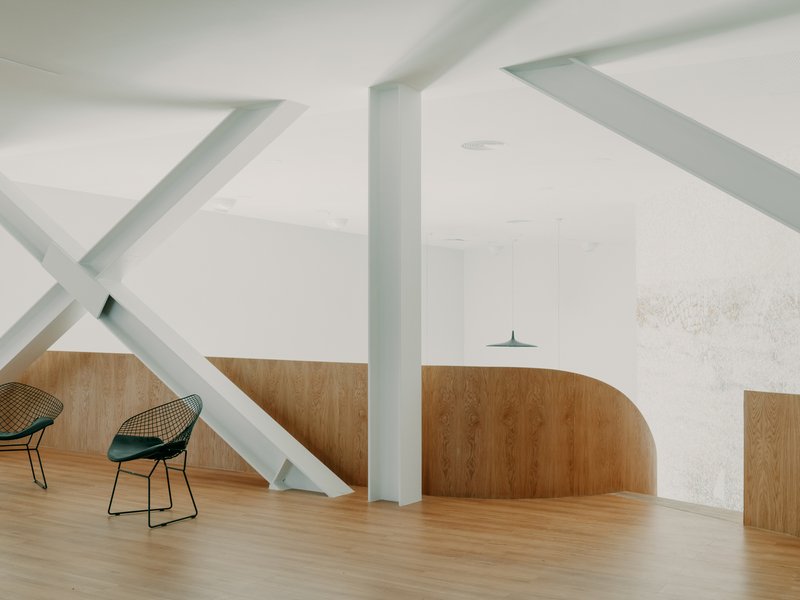
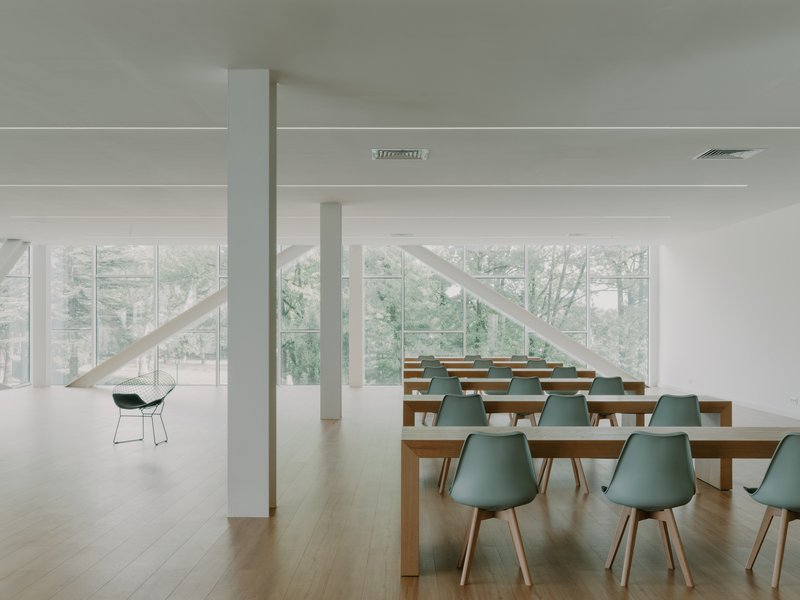
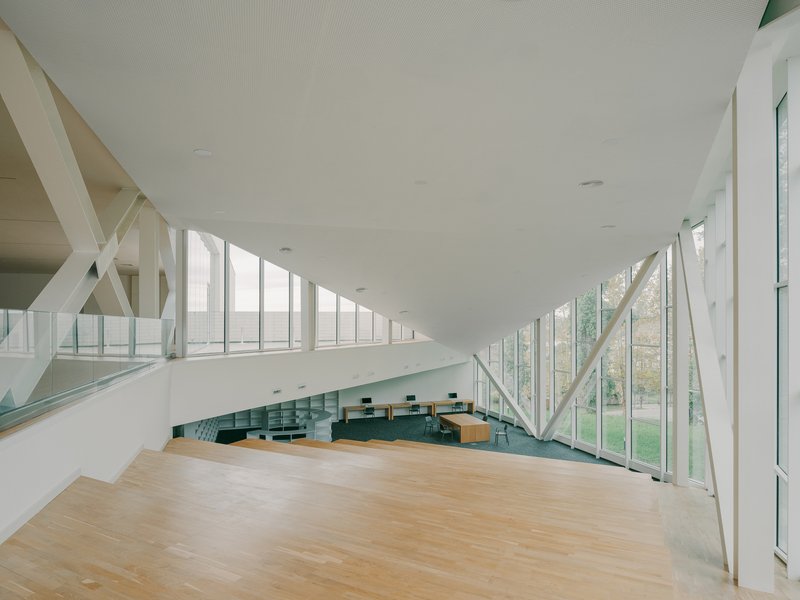
Exposed diagonal white steel bracing appears throughout the upper levels, visible from the mezzanine and the dining hall alike. Rather than concealing the engineering required to achieve the cantilever, the architects celebrate it. Curved plywood walls wrap around the bracing, creating moments where structure and enclosure negotiate openly.
In the dining hall, rows of timber tables and pale green chairs sit beneath white structural cross-braces that recall industrial trusses scaled for domestic comfort. The space is generous but not cavernous, calibrated for the kind of daily use that ensures a civic building actually becomes part of its city.
The Entrance at Dusk
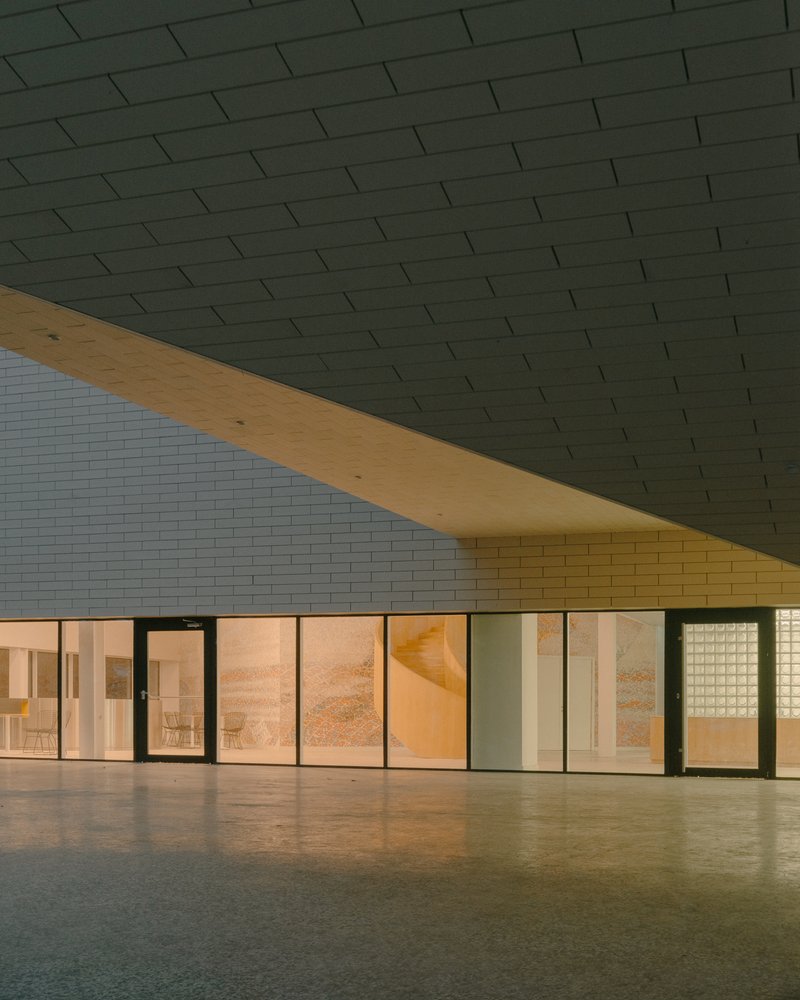
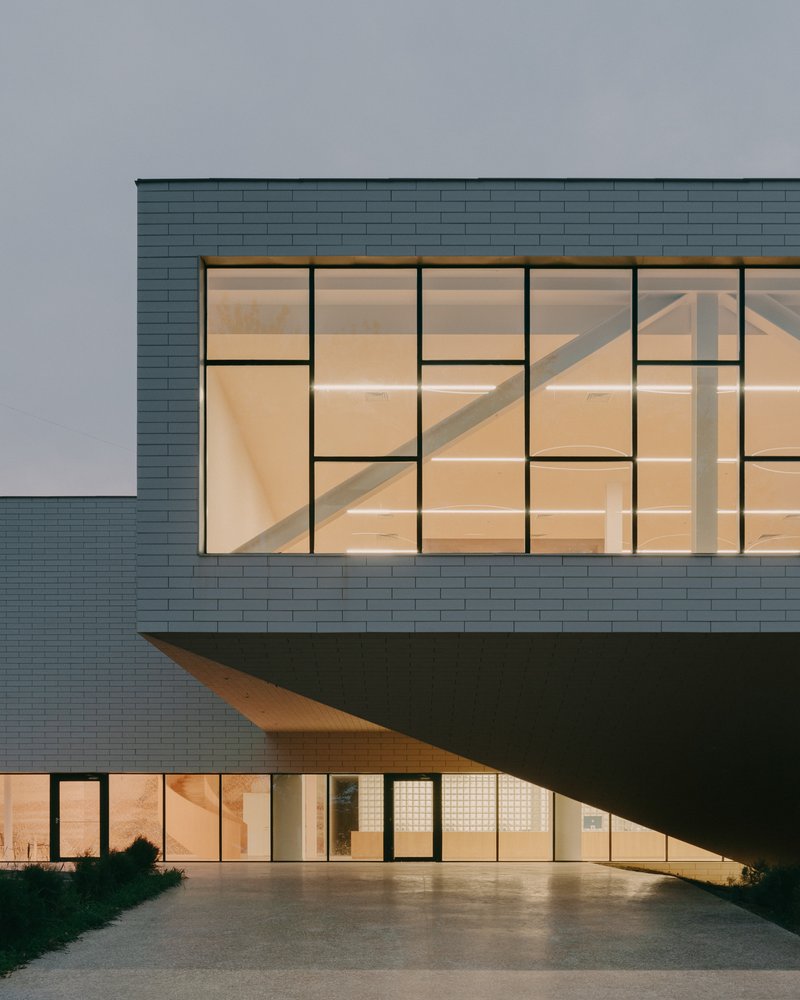
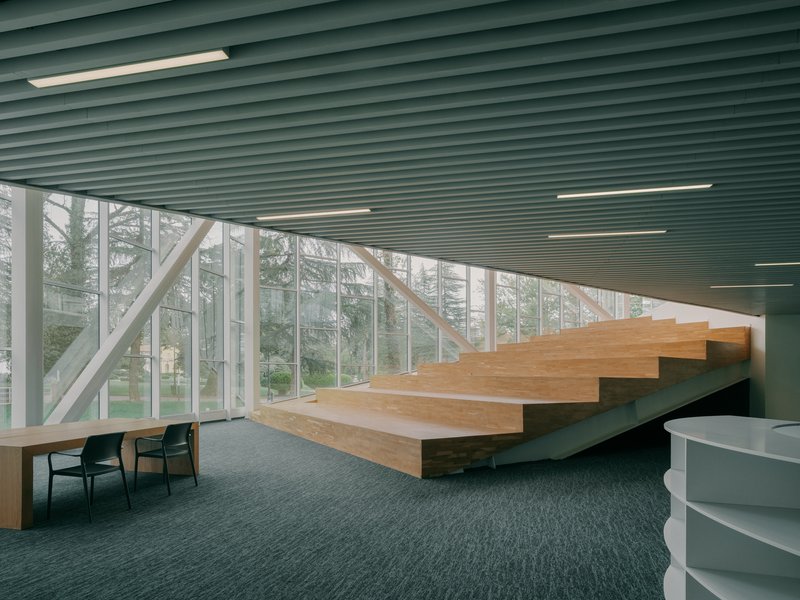
A green tiled soffit marks the covered entrance, with a timber beam spanning across the glazed interior to frame the threshold between outside and in. At twilight, the grid-patterned glazing of the upper level glows warmly, and the sloped walls that support the cantilever cast dramatic shadows. It is the building's most photogenic moment, but also its most revealing: the entrance is welcoming precisely because it is sheltered, human-scaled, and materially distinct from the institutional mass above.
Plans and Drawings
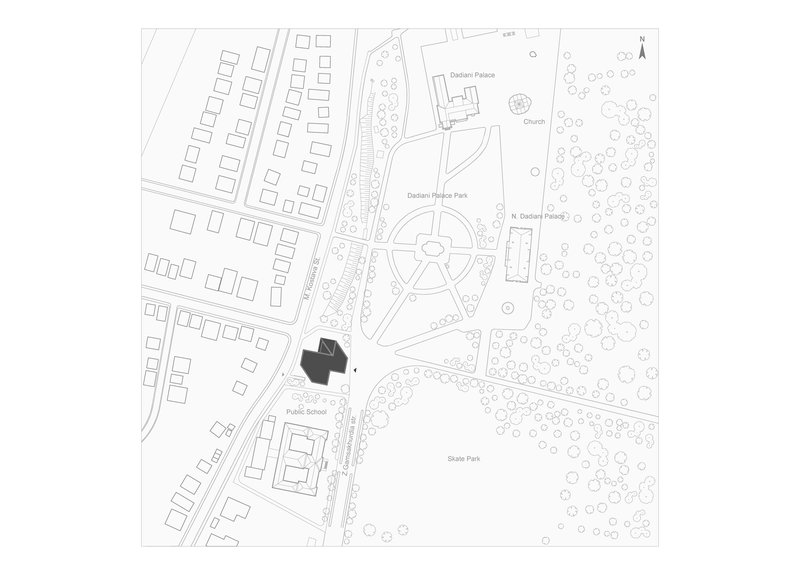
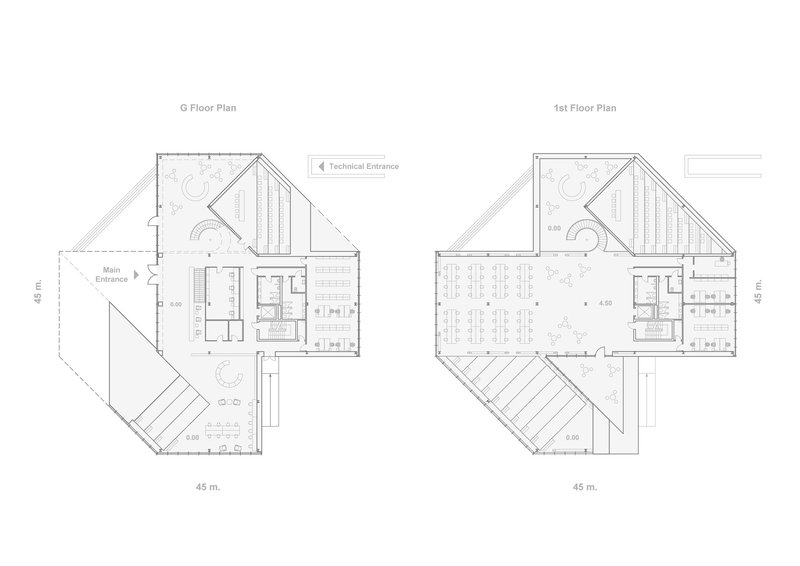
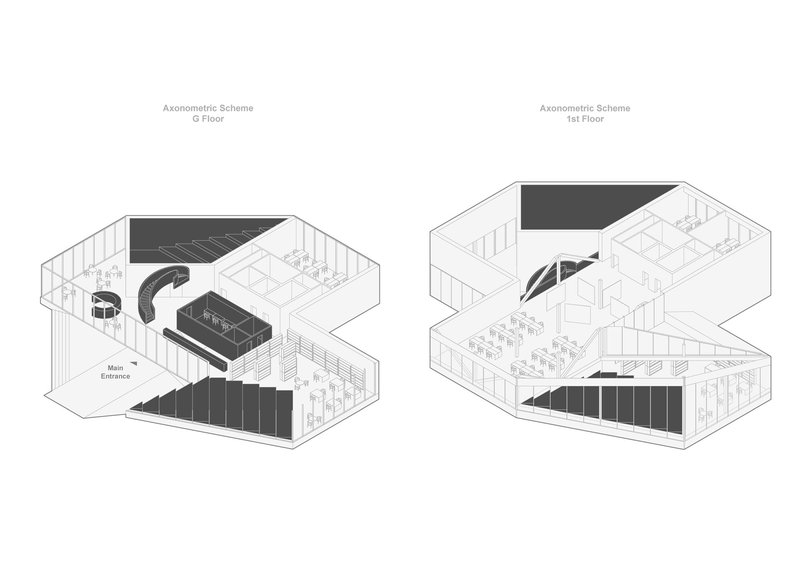
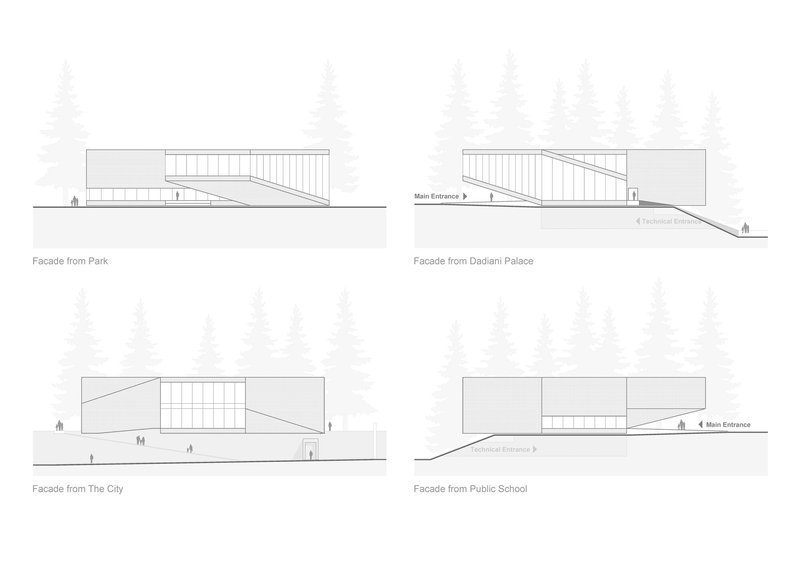
The site plan reveals the building's relationship to the park: it sits at the edge, oriented to maximize its frontage along the tree canopy while keeping its street-side presence compact. The floor plans show an angular footprint with diagonal wings radiating from central circulation cores, a geometry that generates different wing conditions for each programmatic zone. The four elevations confirm the roofline's gentle slope and the interplay between solid brick panels and vertical glazing, while the axonometric drawings make the spatial continuity between ground and first floors legible in a way that photographs alone cannot.
Why This Project Matters
Georgia's architectural ambitions have often been concentrated in Tbilisi, where a string of high-profile commissions over the past two decades reshaped the capital's skyline. The Gamsakhurdia Presidential Center matters because it directs equivalent architectural ambition toward a regional city. Zugdidi now has a building that functions as a library, a study center, a gathering hall, and a memorial, all housed in architecture that takes its site, its climate, and its structural expression seriously. The collaboration between Tsanava, Maisuradze, and T-architects produced something coherent rather than compromised, a testament to shared design intent rather than design by committee.
The building's long-term success will depend on whether Zugdidi's residents adopt it as an everyday resource or treat it as an occasional monument. The architecture is clearly betting on the former. Open floor plans, informal seating, reading rooms oriented toward the park, a dining hall that could host community meals: these are the ingredients of a building that earns its public role through daily use. If it succeeds, it will become a model not just for Georgia but for any post-Soviet city reconsidering where civic investment should land.
Zviad Gamsakhurdia Presidential Center, Zugdidi, Georgia. 2,880 m², completed 2025. Architects: Tsanava, Maisuradze, and T-architects. Photographs by Grigory Sokolinsky.
About the Studio
Share Your Own Work on uni.xyz
If projects like this are the kind of work you want to make, uni.xyz is a place to publish your own, find collaborators, and enter design competitions.



Popular Articles
Popular articles from the community

Community Library in Girona: A Replicable Model for Inclusive Library Architecture
A modular community library in Girona transforms learning, culture, and climate-responsive design into a shared civic network for all users.
Shinkō Komyuniti: Public Space Architecture Reimagining Sport, Culture and Community in Tokyo
Shinkō Komyuniti transforms sports spectatorship into public space architecture that reconnects play, culture, community and Tokyo life now.

A.N. Tombazis and K-Studio Bury a Luxury Resort into a Peloponnese Hillside
Mandarin Oriental Costa Navarino scatters 99 earth-sheltered rooms across 140 hectares above the Bay of Navarino in Pilos, Greece.
Terra e Tuma Scatters Four Concrete Pavilions Through the Atlantic Forest in Mairiporã
A fragmented compound of music studio, art studio, chapel, and living quarters preserves every tree on a steep forested hillside near São Paulo.

Similar Reads
You might also enjoy these articles
Private Villa in Ubud by BAMM ARCHITECTS: Contemporary Design Amidst Bali’s Jungle
Private Villa in Ubud blends contemporary design with tropical landscape, featuring open-air pavilion, stone and wood materials, suspended master bedroom, and jungle pool views.
School Group Samuel Paty in Béziers: A Contemporary Educational Campus by Ateliers O-S Architectes and NAS Architecture
Samuel Paty School in Béziers features concrete massing, porous courtyards, metal structures, and landscaped playgrounds, creating a child-scaled, light-filled learning environment.
Four Public Pavilions in Beijing by Aurélien Chen and CSCEC
Four park pavilions in Beijing combine public services with floating roofs, acting as subtle urban signals integrated into landscape contextually.
LÁ-SÁCH House by Atelier tho.A
Compact tropical tube house-library with polycarbonate louvers, flexible interiors, concrete core, crafted materials, and community-focused alley setback.

Explore Religious Building Competitions
Discover active competitions in this discipline




The Global Benchmark for Architecture Dissertation Awards

Design Challenge - Contemporary interpretation of a religious complex


Challenge to design public laboratory
Comments (0)
Please login or sign up to add comments
No comments yet. Be the first to comment!