

Three Studios Rebuild a Hurricane-Damaged Cancún Neighborhood One Apartment Block at a Time
Domus Peepem 8.1 pairs raw concrete and local craft to bring dense, dignified housing back to a forgotten Cancún colonia.


Cancún's tourism economy is a machine, but the neighborhoods that house its workers rarely benefit from the same design attention lavished on beachfront resorts. Colonia Donceles, developed in the 1980s as social housing for the service industry, was hit hard by Hurricane Wilma in 2005. Many homes were abandoned, and the urban fabric frayed. Edificio Domus Peepem 8.1, a collaboration between Kiltro Polaris Arquitectura, WEWI Studio, and JC Arquitectura, is one installment in a deliberate campaign to reverse that decline, not with grand gestures but with careful, replicable housing.
What makes the project genuinely interesting is its refusal to treat economy and quality as opposites. The three lead architects, Victor Imre Ebergenyi Kelly, Juan Carral O'Gorman, and Patricio Manzo Díaz, designed a pair of narrow buildings that accommodate fourteen units, ground-floor commercial space, rooftop penthouses with pools, and a shared courtyard, all within 450 square meters and using construction methods familiar to local builders. No exotic materials, no imported labor, no paint. The walls are sealed with polished putty and wax. The result feels expensive but costs what the neighborhood can sustain.
Two Towers and a Green Spine
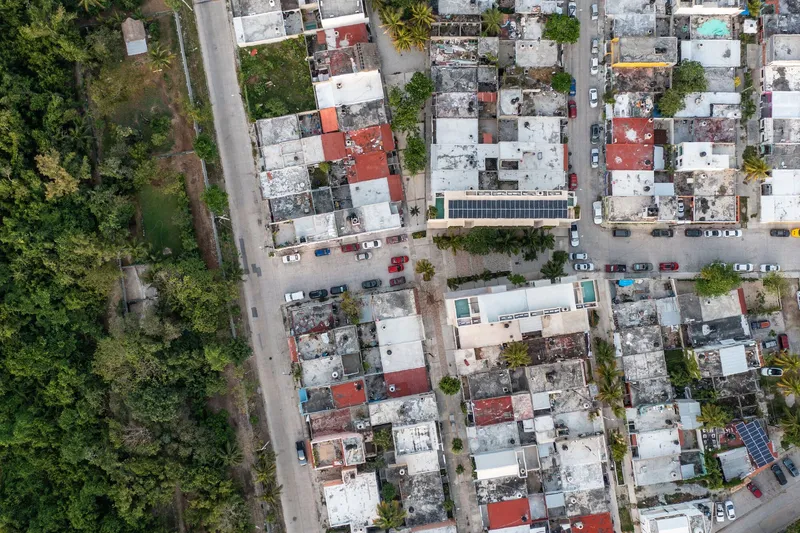
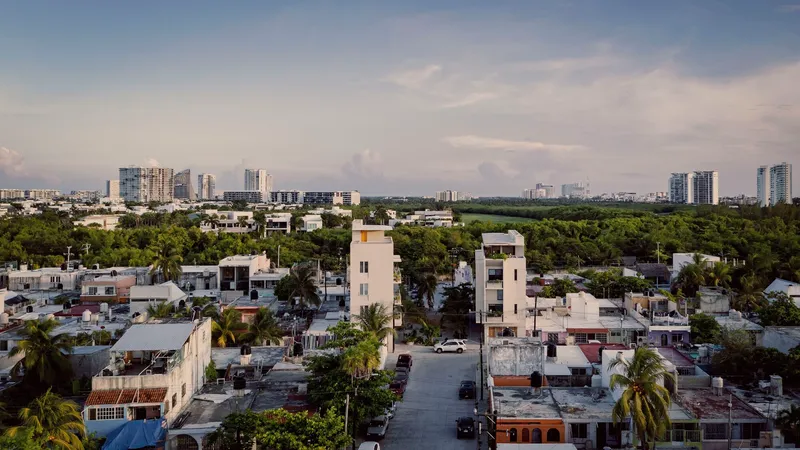
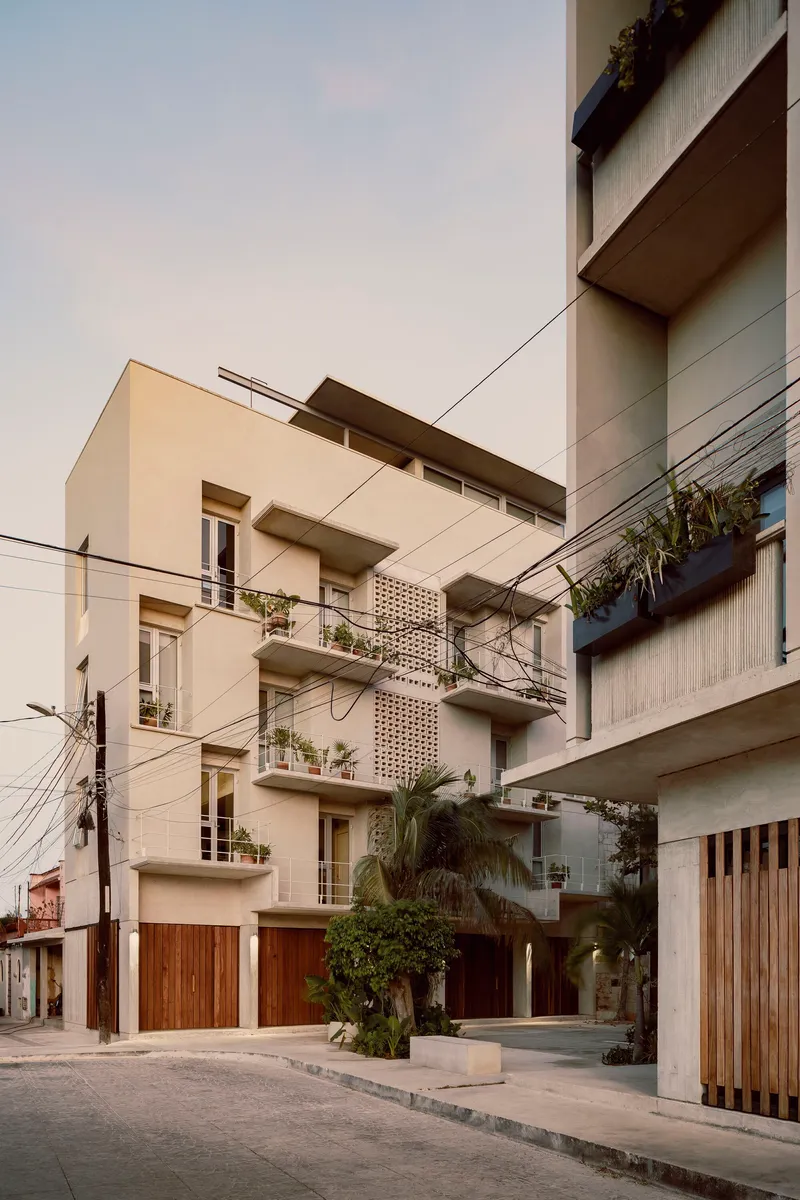
From the air, the project reads as two pale volumes rising above a low-rise sea of corrugated metal and concrete block. That vertical ambition is tempered at street level, where cream stucco facades, timber garage doors, and planted balconies keep the scale conversational. The real move is the space between the buildings: a landscaped courtyard that functions as shared garden, light well, and social buffer. In a neighborhood where density often means claustrophobia, the gap is the luxury.
Commercial units on the ground floor connect each building to the street and the renewed plaza in front. The architects understand that housing isolated from commerce becomes dormitory. By threading retail into the base, they give residents a reason to engage with the public realm rather than retreat from it.
Concrete, Putty, Wax: A No-Paint Palette
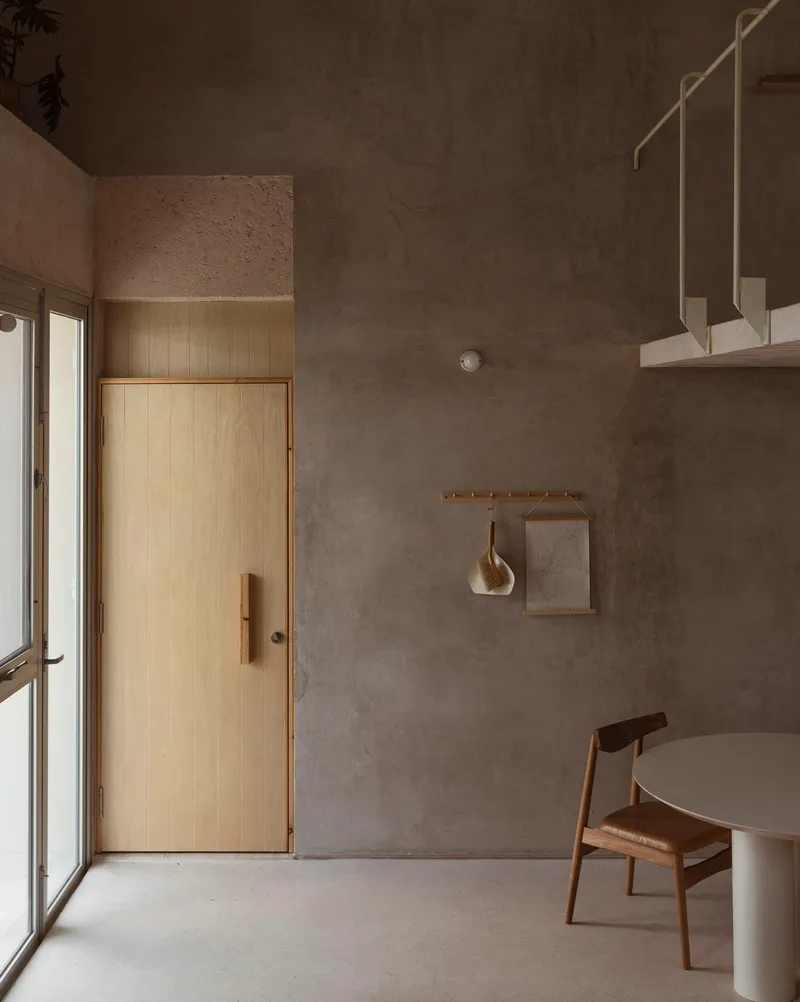
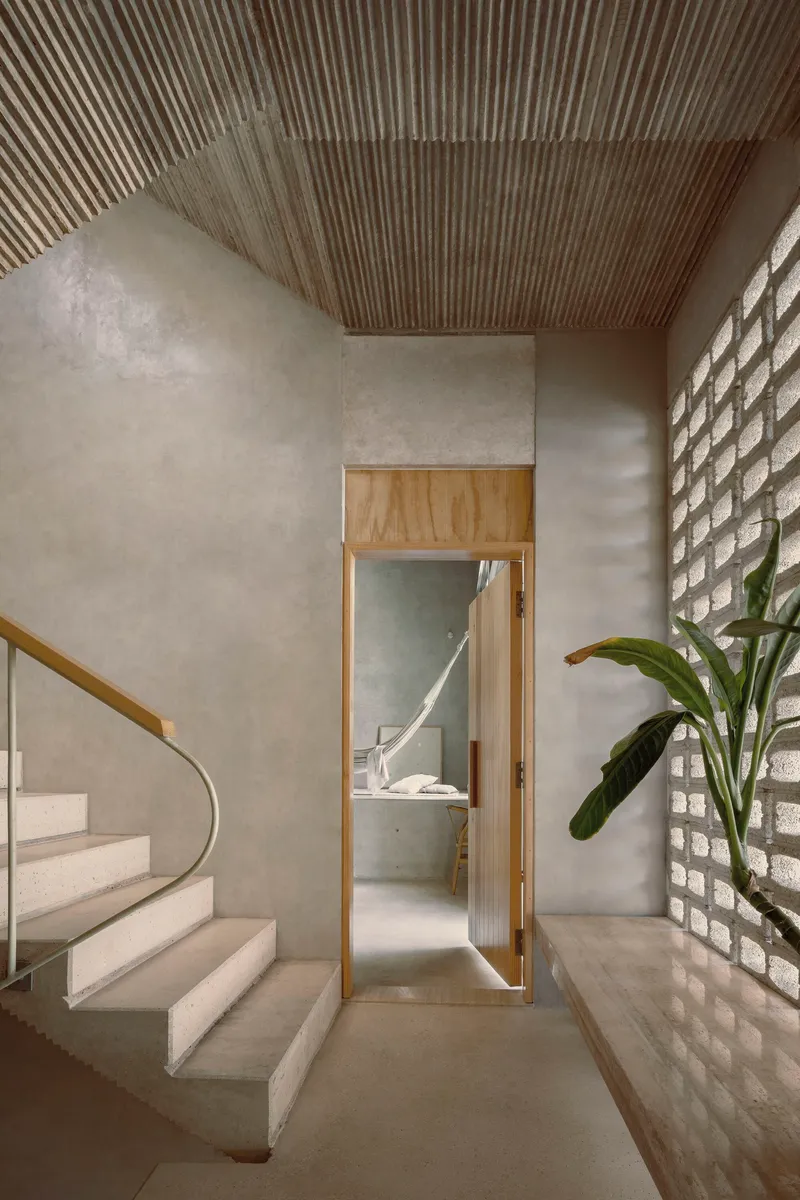
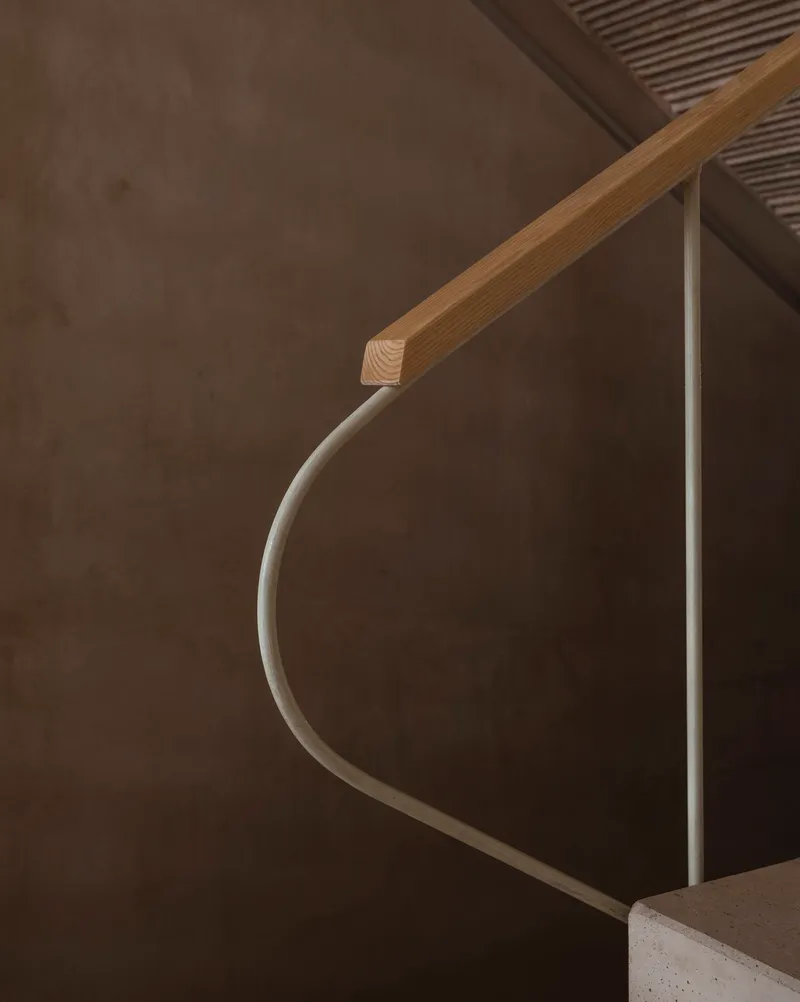
The interiors are defined by a material strategy that trades conventional finishing for craft. Concrete walls and floors are polished rather than clad. Block walls are plastered with putty, then polished and sealed with wax, producing a surface that feels almost mineral. Tropical wood species appear in doors, shelving, and handrails, their warmth calibrated against the coolness of the concrete. Brass fixtures and glass brick add punctuation without dominating.
Eliminating paint is not just aesthetic posturing. It removes a maintenance cycle, reduces chemical inputs, and leans on skills that local masons already possess. The curved timber handrail meeting its metal counterpart at a concrete wall is a quiet detail that speaks to the level of care the architects brought to every junction. Nothing here is accidental.
The Perforated Screen and Controlled Light
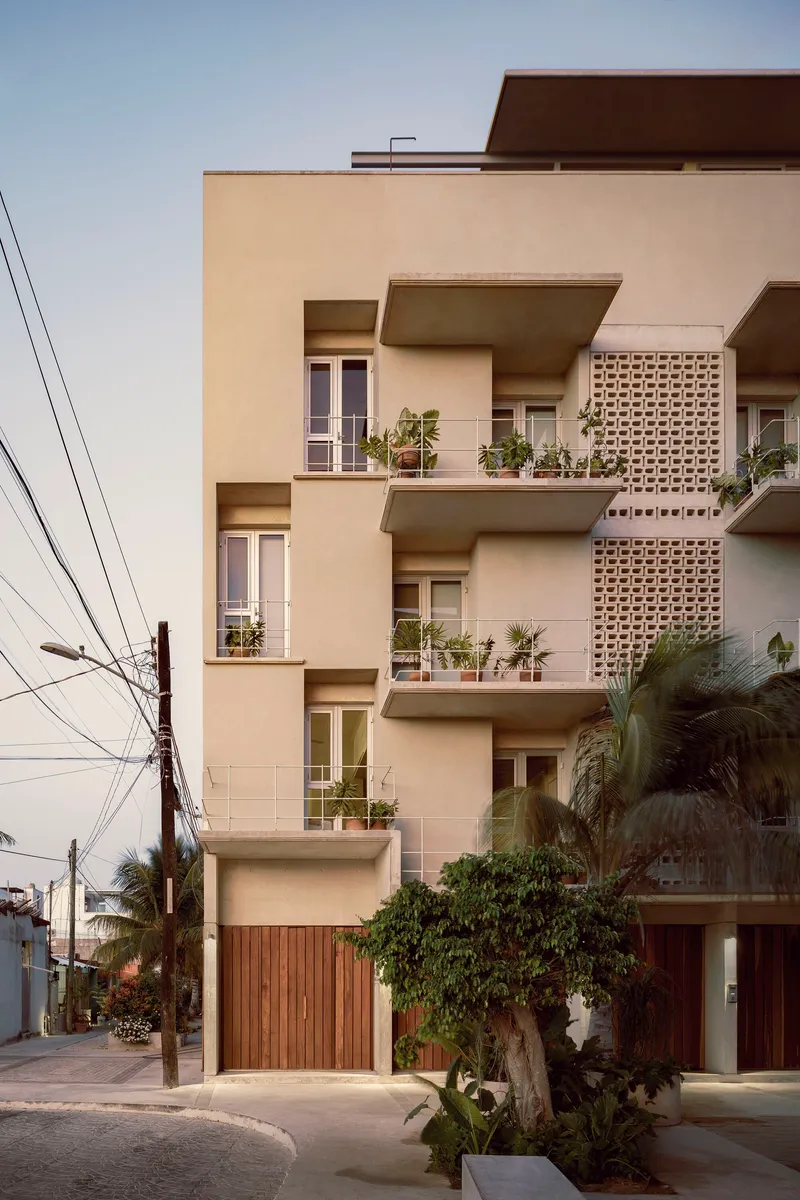
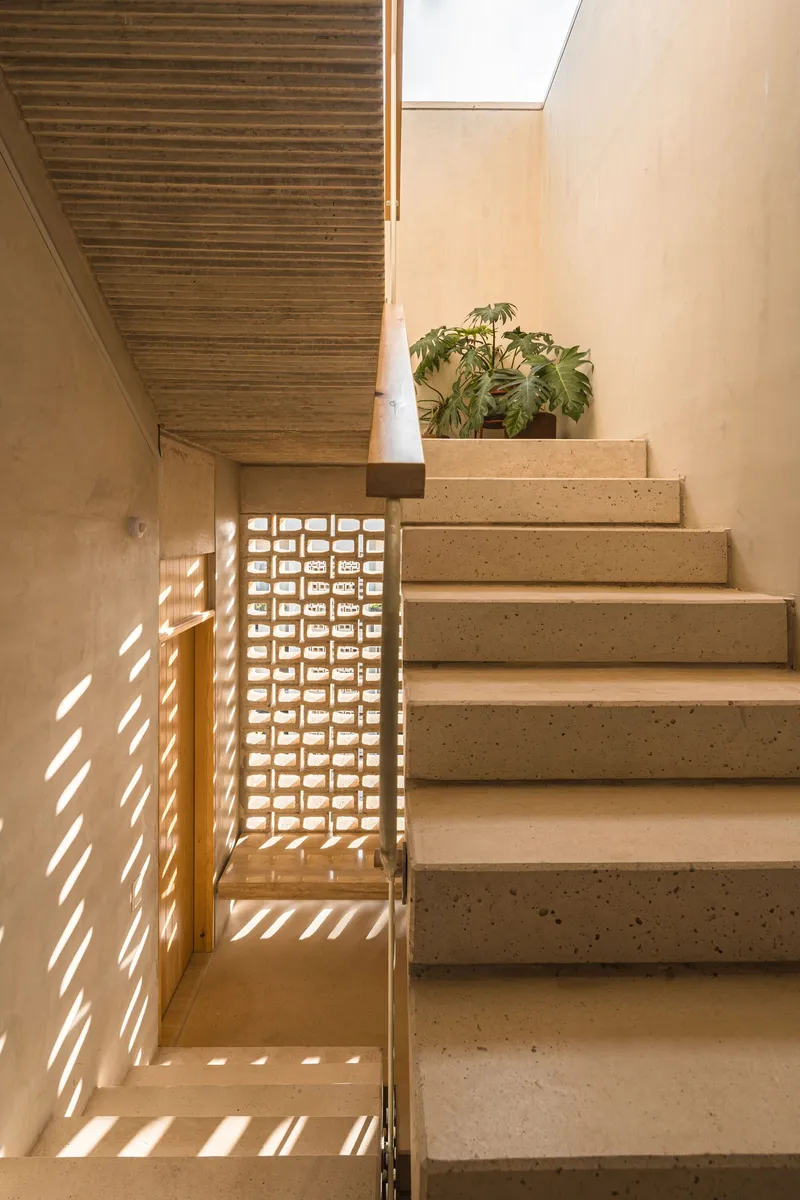
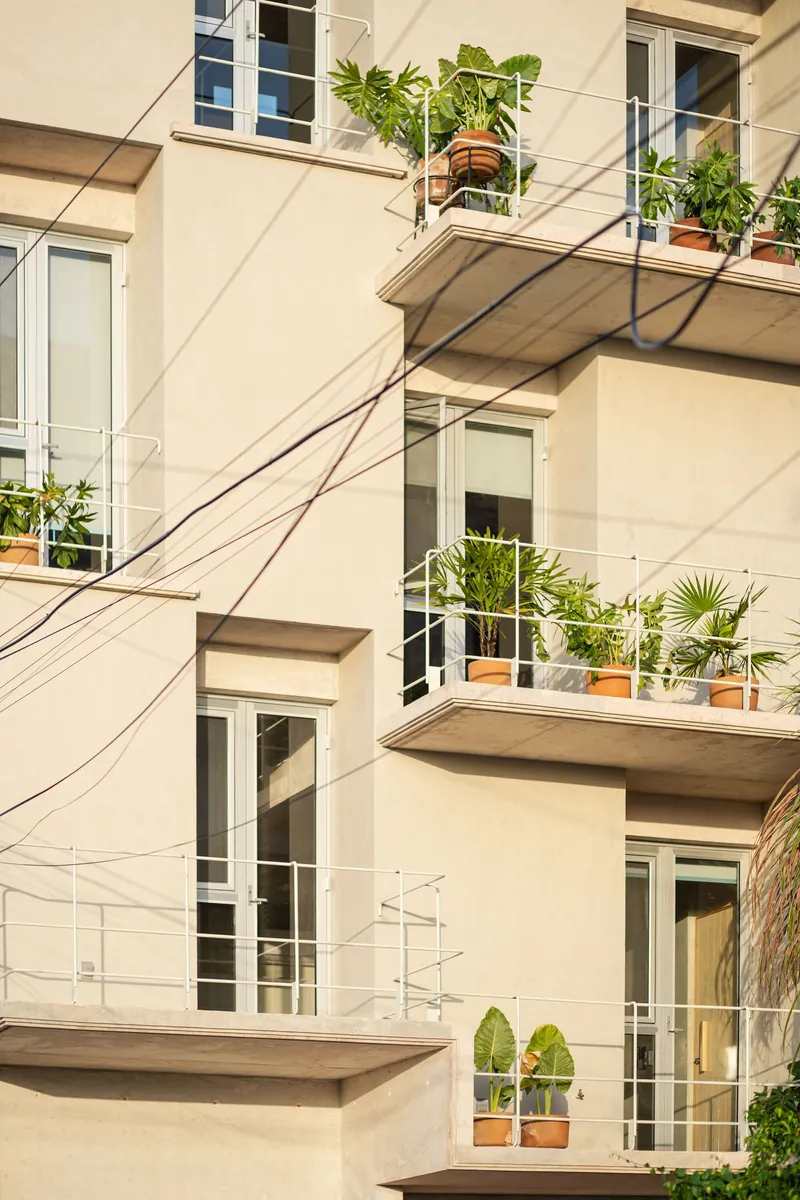
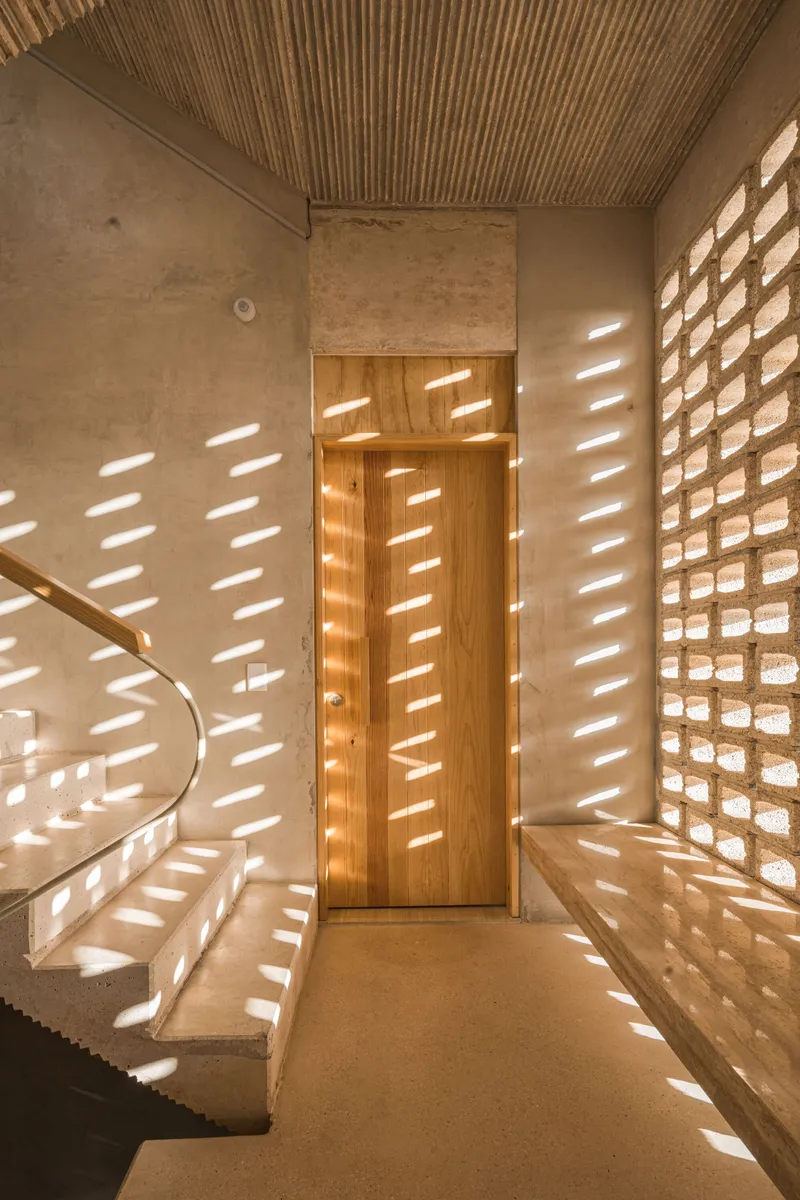
Cancún's latitude demands that buildings manage solar gain without sealing themselves off from breeze. The perforated brick screens on the street facade and stairwell walls solve both problems at once. They break direct sunlight into dappled patterns that shift through the day, animating otherwise austere concrete surfaces. At dusk the screens glow from within, turning the facade into a lantern that signals life on the street.
The stairwell is the project's most photogenic space: a vertical slot lined with timber slats overhead, perforated brick to one side, and a skylight pulling hot air upward. It doubles as a passive ventilation chimney. The architects paired these strategies with solar cells and motion sensors, but the real energy savings come from the architecture itself, from the orientation and perforation of the envelope.
Living Vertically with Mezzanines and Hammocks
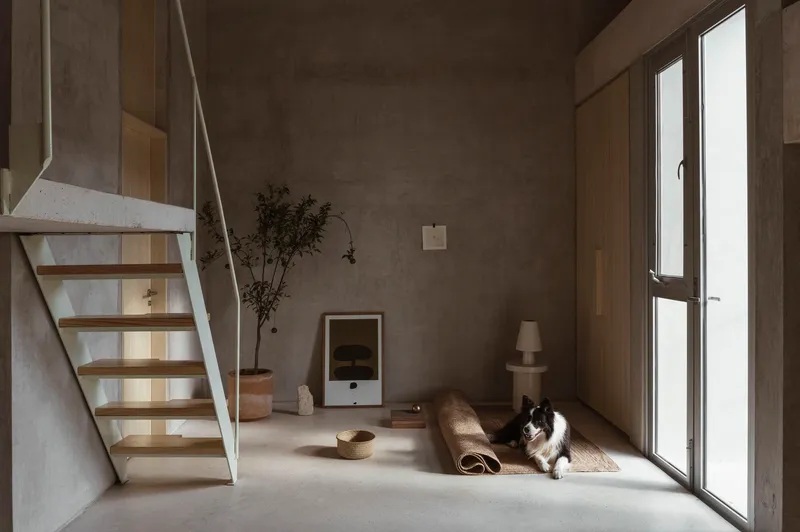
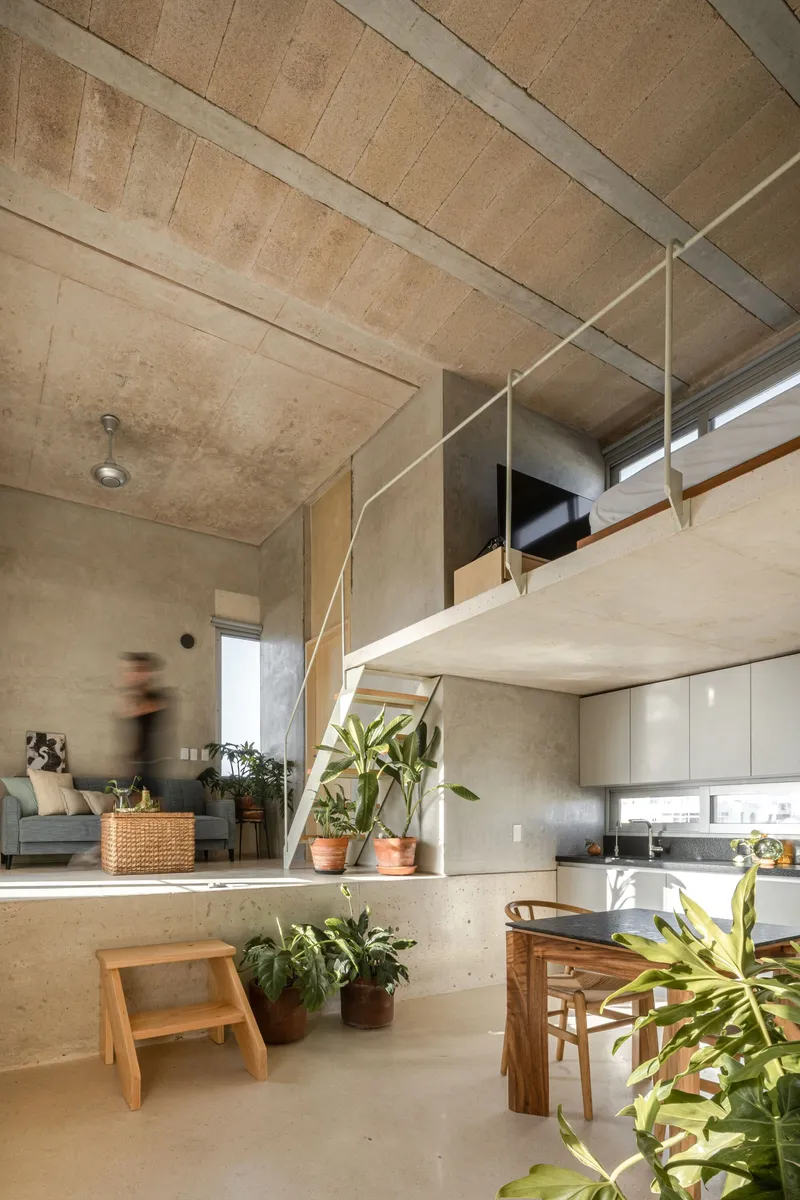
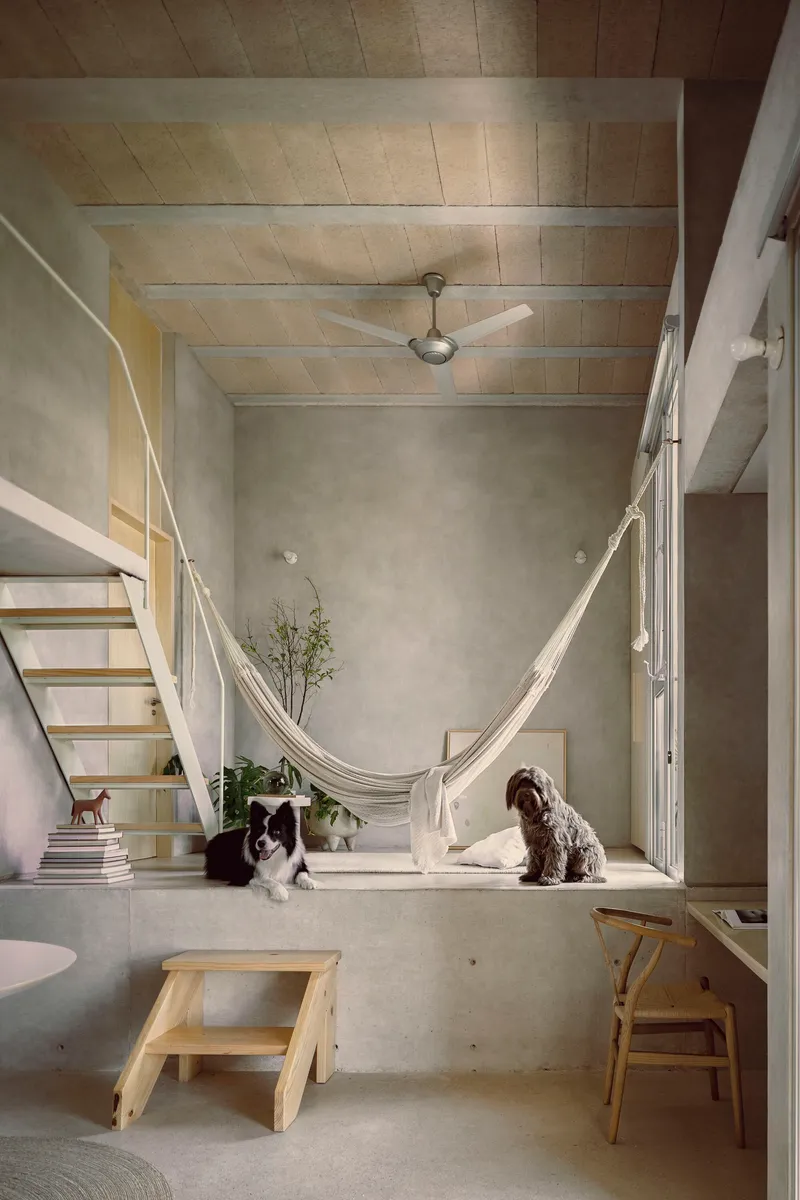
The one-bedroom apartments gain spatial generosity through section rather than plan. Third-floor units have taller ceilings that accommodate mezzanines above the living areas, effectively doubling usable space within the same footprint. A hammock strung between concrete walls in a double-height volume is not decoration; it is the Yucatecan living room, and its inclusion signals that the architects designed for how people in this region actually inhabit space.
Plywood shelving, potted plants, dogs on polished floors, a cat in a stripe of afternoon sun: the photographs capture these apartments already lived in, already claimed. That is the test of any housing project. The architecture has to be robust enough to absorb personality without losing its coherence. Here it does.
Mezzanines, Bedrooms, and the Rooftop
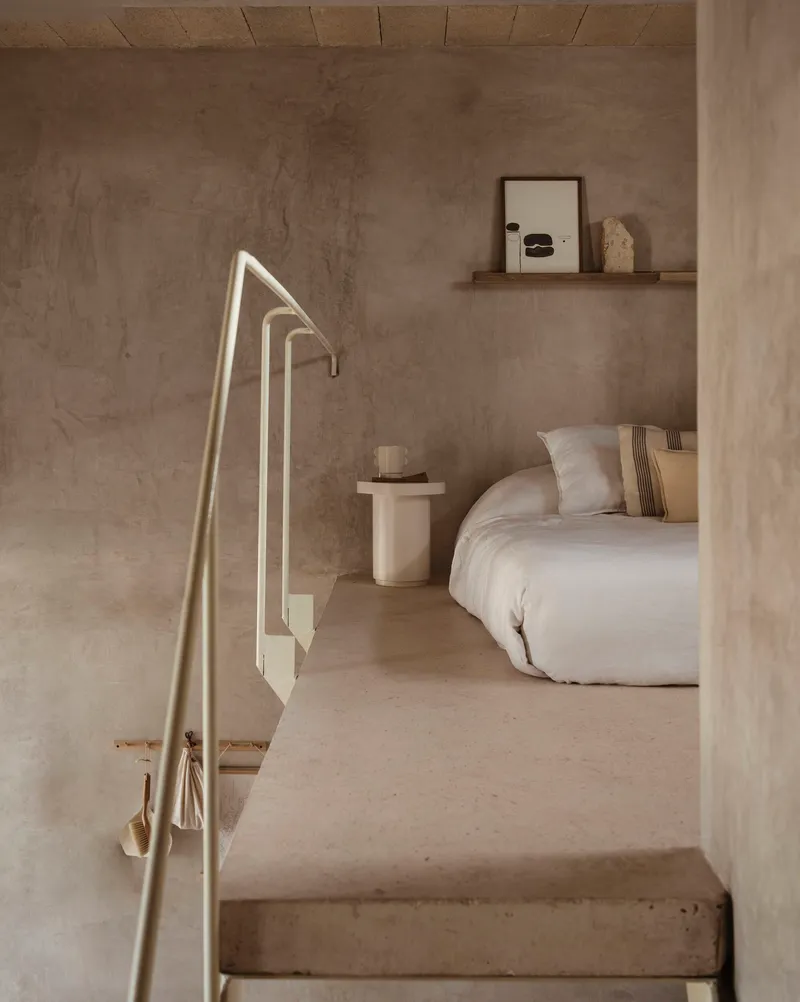
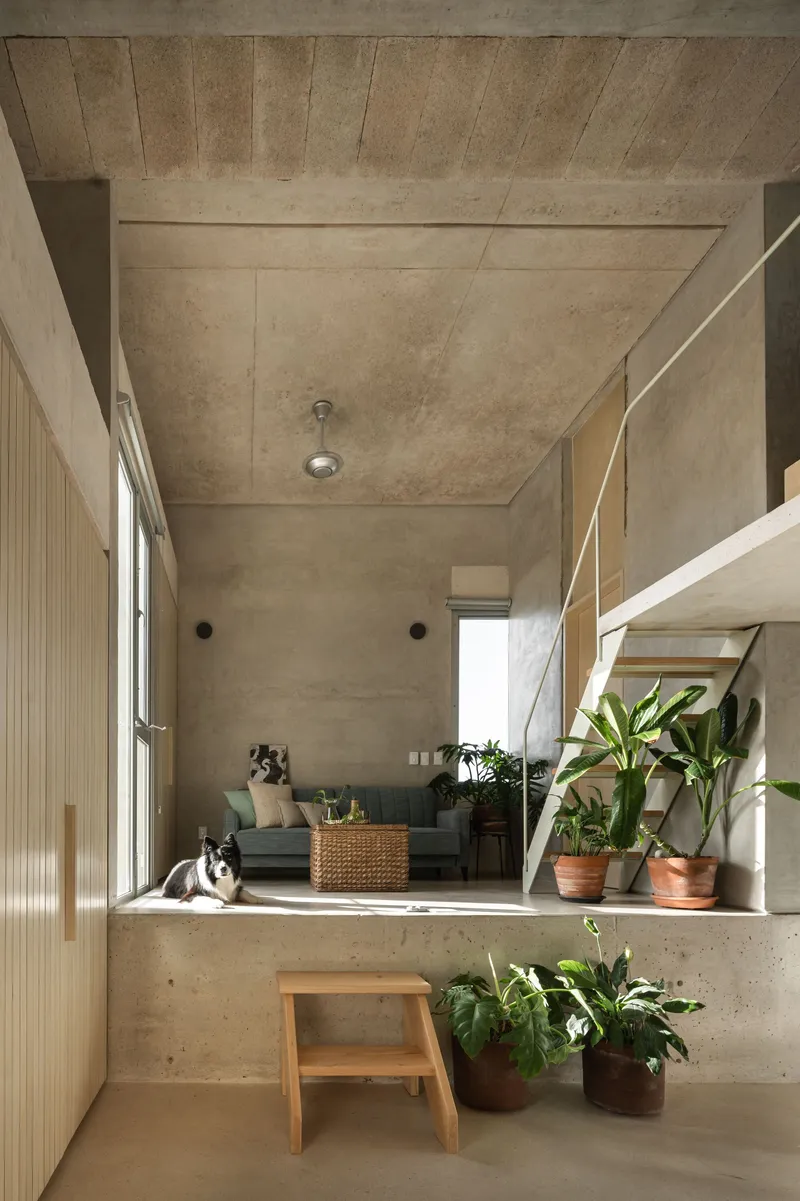
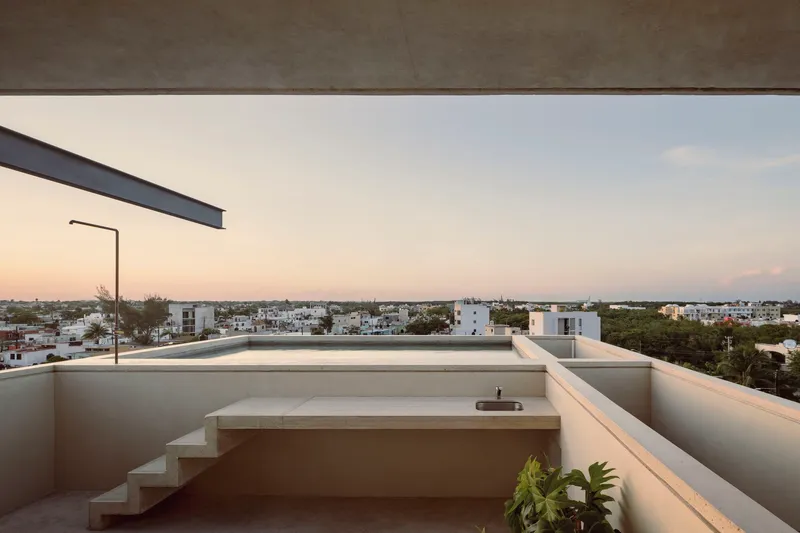
Bedrooms are framed by concrete columns and metal handrails, giving even private thresholds a sense of architectural intention. The split-level interiors, with their exposed concrete ceilings and timber joinery, avoid the monotony that plagues many affordable housing projects. Each unit has a slightly different relationship to light and view depending on its floor.
The rooftop terrace with its white parapet walls and stepped seating offers residents a vantage point over the low-rise neighborhood. At dusk, the distant high-rises of the hotel zone hover on the horizon, a reminder of the economic engine that funds these communities but rarely invests in their built environment. The penthouse pools are a small indulgence, proof that social housing need not be ascetic to be responsible.
Plans and Drawings
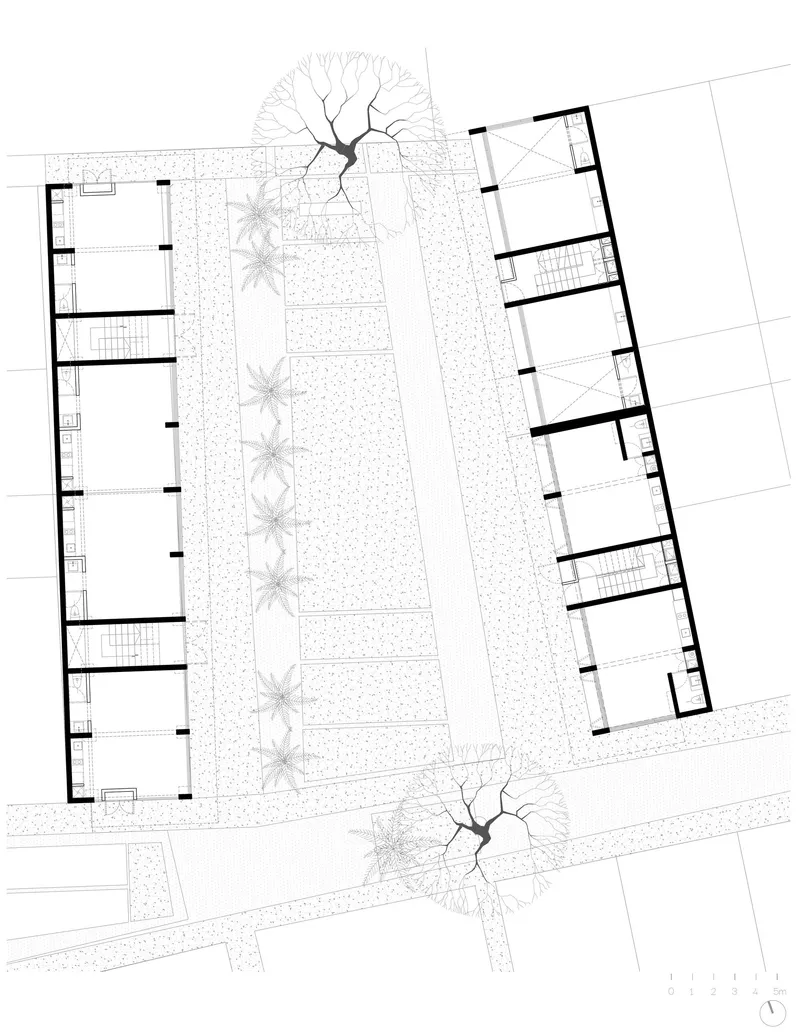
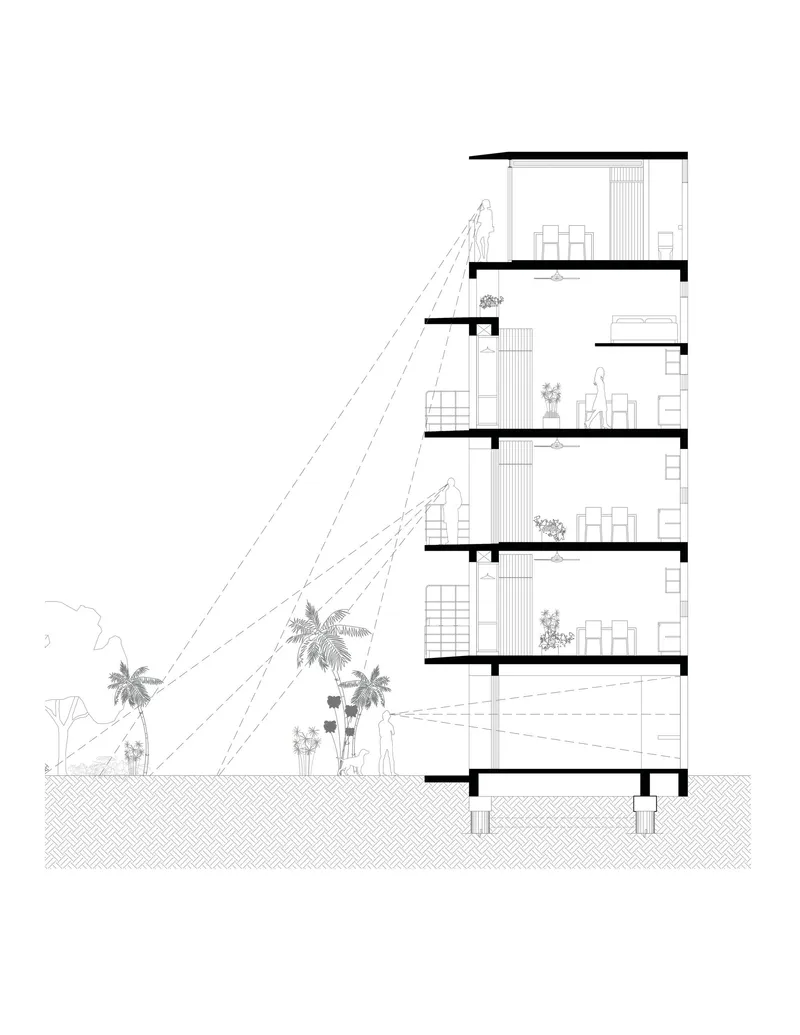
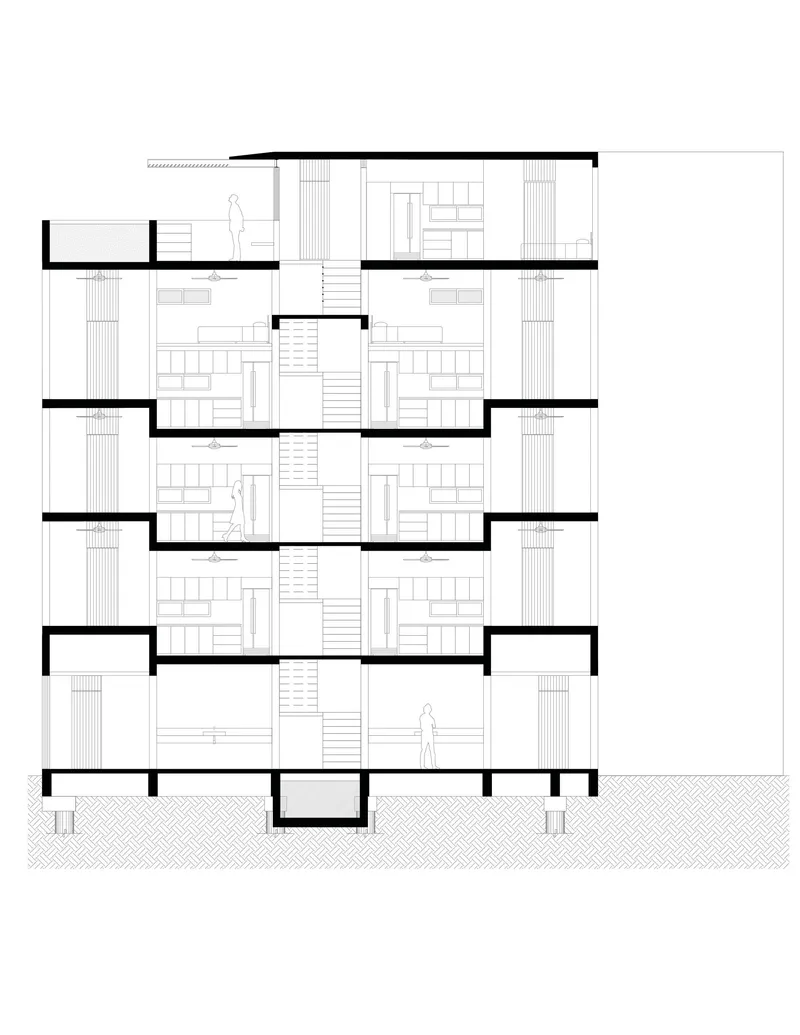
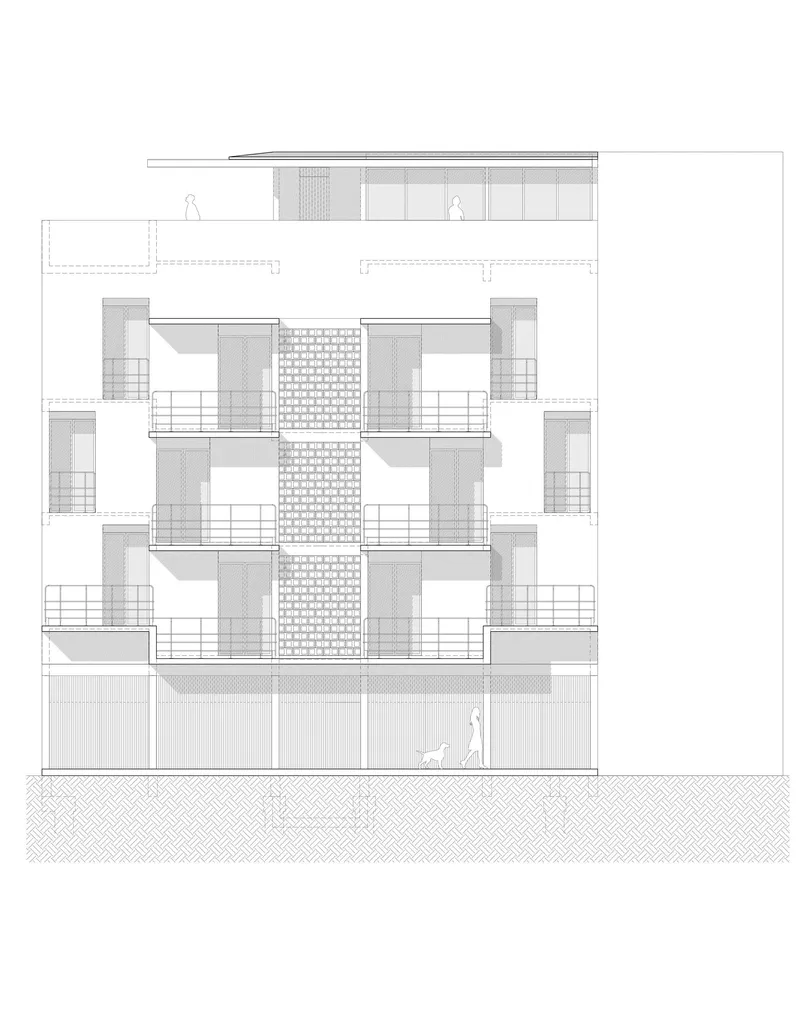
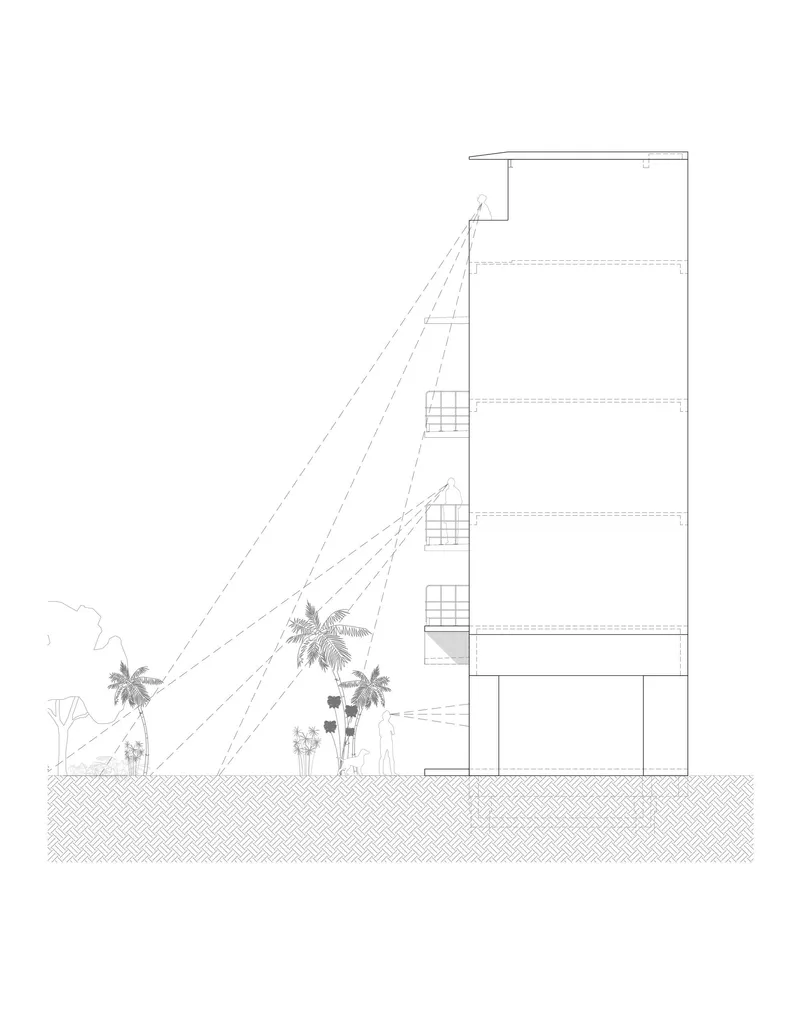
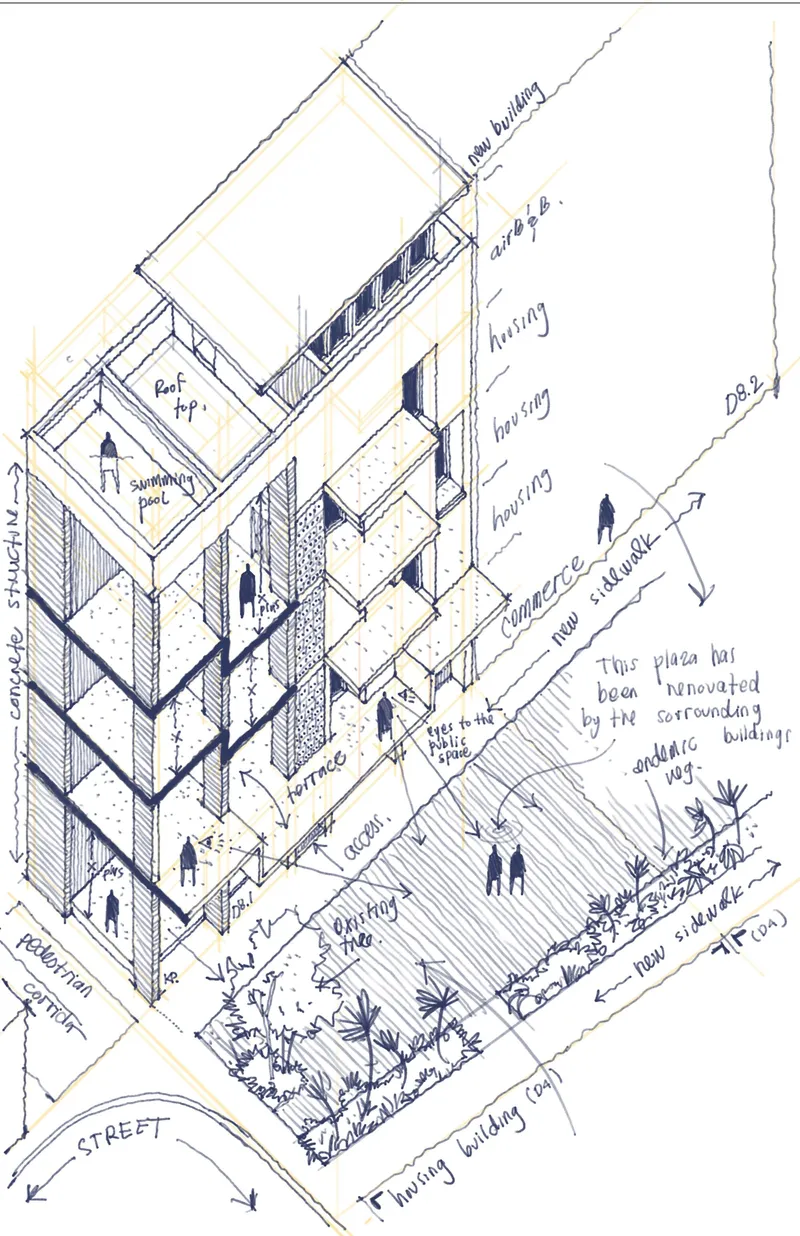
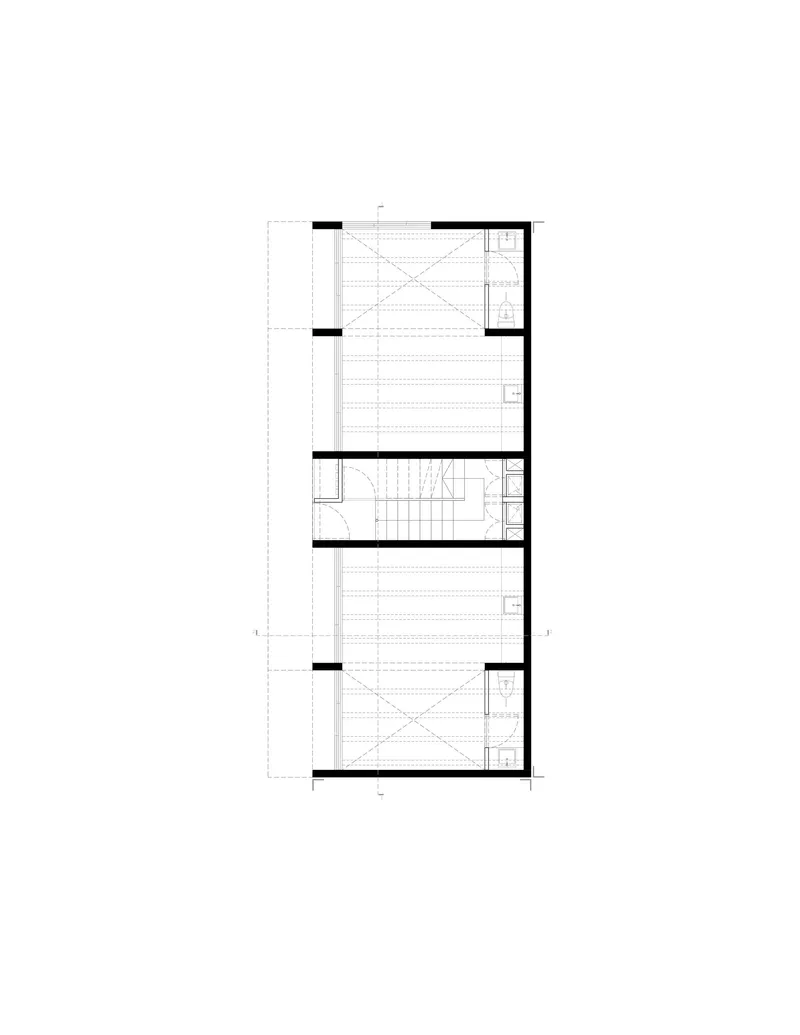
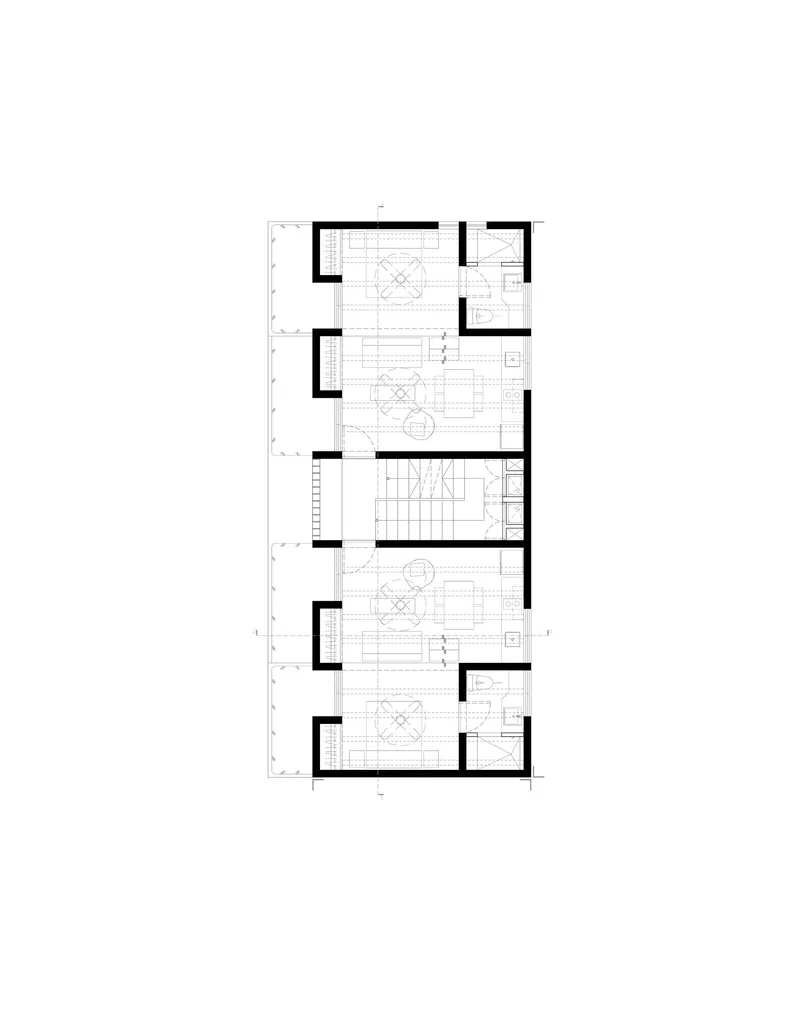
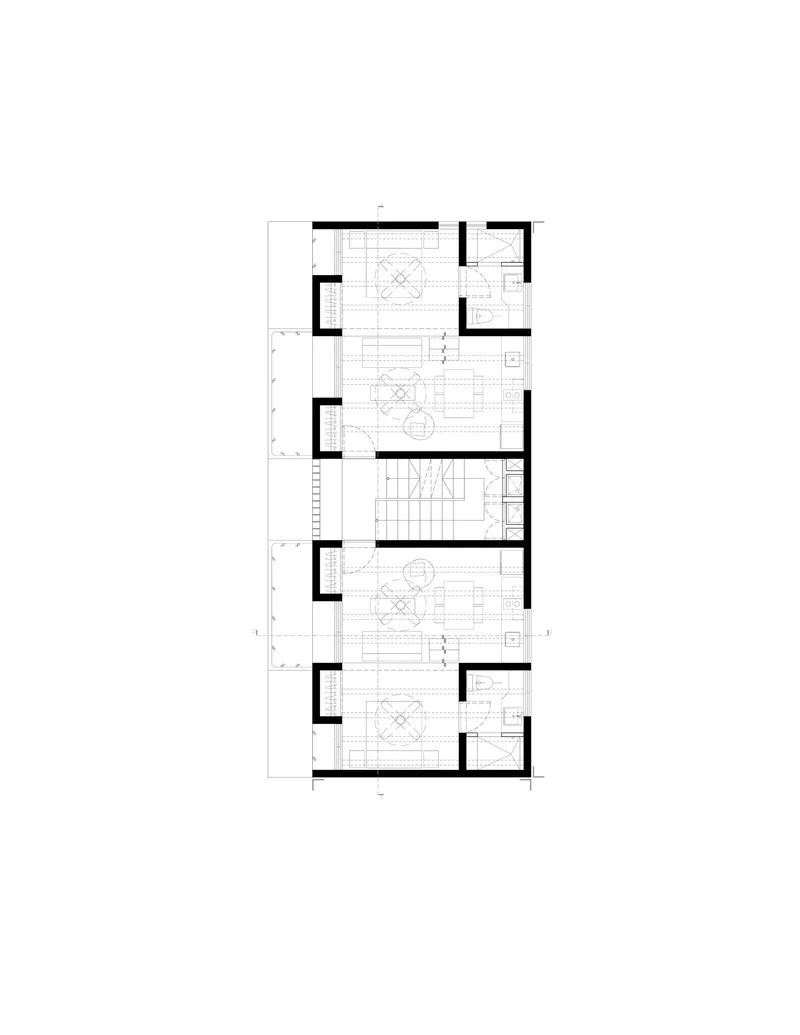
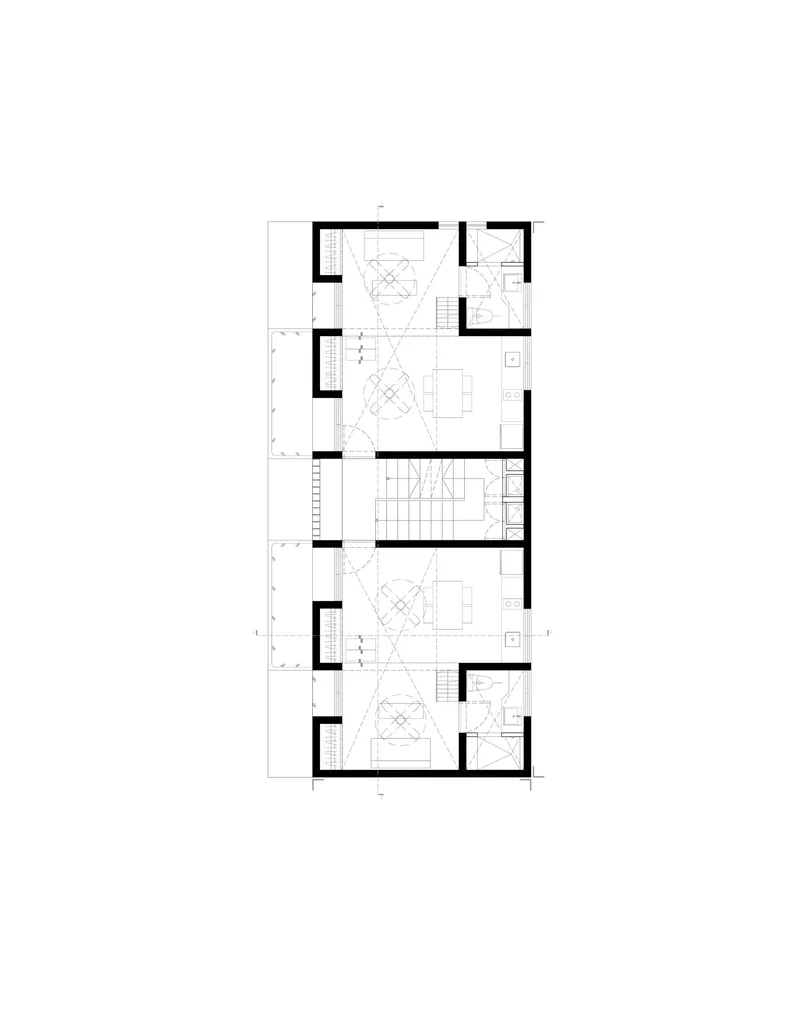
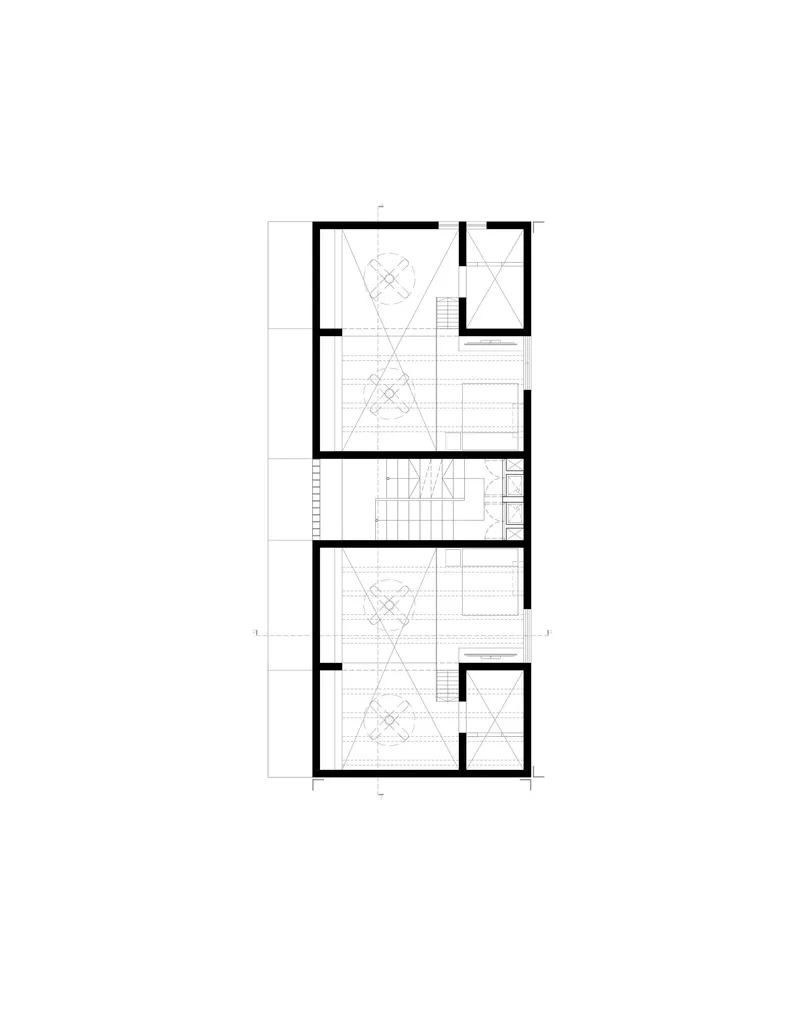
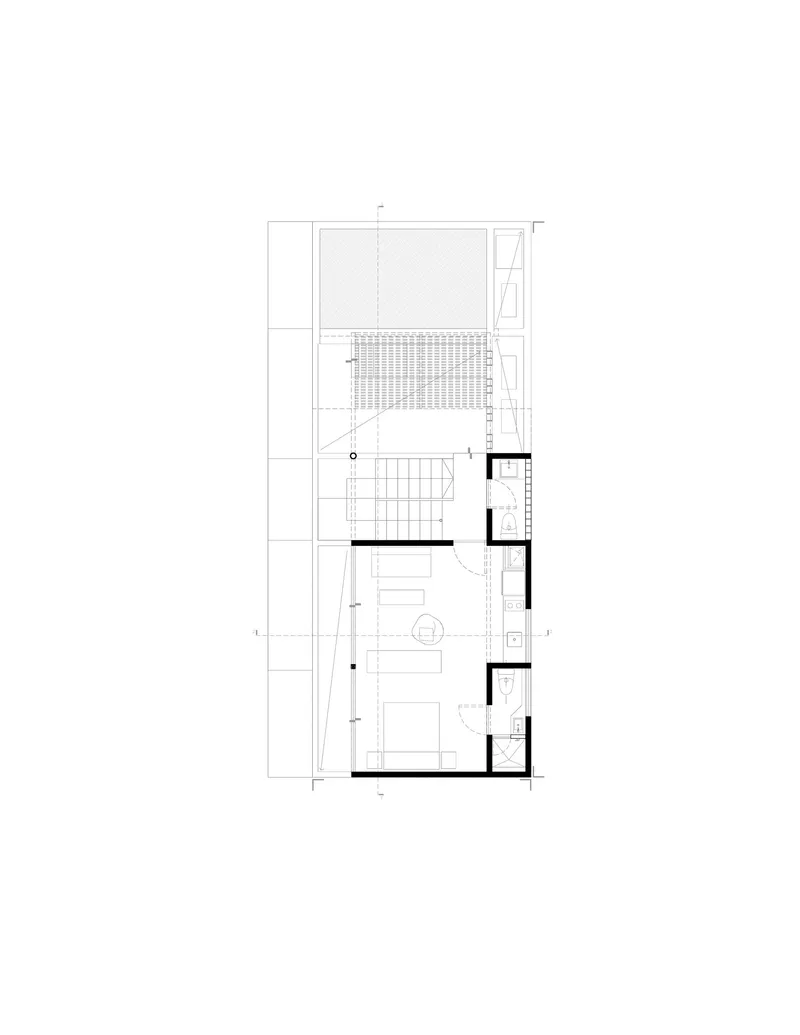
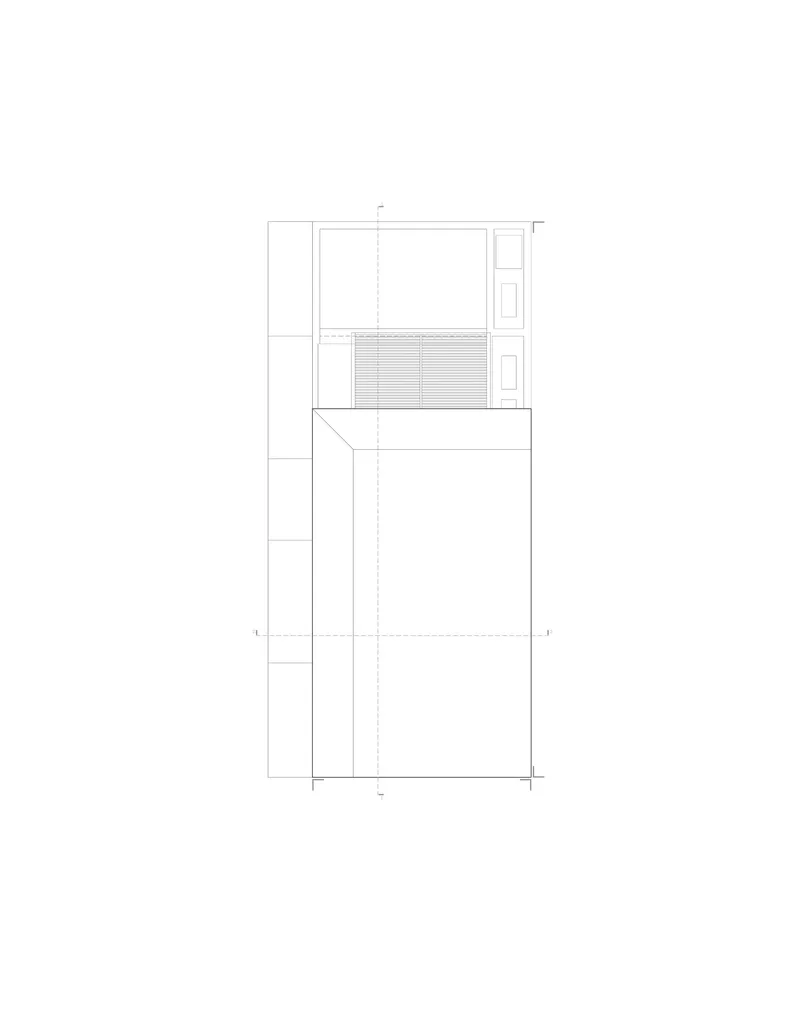
The floor plans reveal how tightly the program is organized around a central stair core, with units flanking each side. The section drawings show the stacking logic clearly: commercial base, residential middle, penthouse crown. Diagonal sight lines and palm trees in the sections are not mere graphic flourishes; they describe the visual relationship between the courtyard, the balconies, and the sky. The handwritten axonometric sketch is worth studying for the way it maps shared outdoor space at every level, from ground courtyard to rooftop garden.
What the drawings make explicit is the structural economy. A concrete frame carries the entire building, freeing the infill walls to be made of block, brick screen, or glass as the program demands. The narrow street elevation, shown in the final drawing, is an honest portrait of a building that does not pretend to be wider or grander than it is. It fits its lot, meets the sidewalk, and gets on with the business of housing people.
Why This Project Matters
Domus Peepem 8.1 matters because it treats a damaged neighborhood as a design problem worth solving with rigor. The three studios involved did not import a vocabulary; they built with local hands, local materials, and local climate logic, then elevated those constraints into architecture. The result is dense housing that breathes, commercial space that activates the street, and shared landscape that makes density feel generous rather than oppressive.
It also matters because it is not a one-off. As part of a series of interventions in Colonia Donceles, the project demonstrates that incremental urban repair, building by building, plaza by plaza, can rebuild the social contract between a city and its workers. In a tourist economy that treats labor as invisible, making that labor's housing visible, well-crafted, and proud is a political act as much as an architectural one.
Edificio Domus Peepem 8.1 by Kiltro Polaris Arquitectura, WEWI Studio, and JC Arquitectura. Cancún, Mexico. 450 m². Completed 2021. Photography by Cesar Béjar, Oscar Hernández, and Fabián Martínez.
About the Studio
Share Your Own Work on uni.xyz
If projects like this are the kind of work you want to make, uni.xyz is a place to publish your own, find collaborators, and enter design competitions.


Popular Articles
Popular articles from the community


Opera on the Sea: Driftwood Logic Shapes a Timber Opera House on Estonia's Coast
Trevor Orgill's opera house translates the entangled drift of floating timber into a civic building where wood, water, and music converge.

Manzana Morphosis: Stretching Barcelona's Grid into a Living Landscape for 2050
A radical reworking of the Eixample manzana turns density into a tool for generous public space, vertical ecology, and environmental performance.

Opera by the Sea Estonia: Three Shells Dissolving Architecture into Tallinn's Coastline
A winning opera house proposal replaces monumental form with interconnected shells that blur the boundary between building, park and Baltic Sea.

Temporary Home for Dogs: A Reversed Zoo Rethinks Animal Shelter Architecture
In Bucharest, a sinuous corridor and freed landscape flip the logic of containment, designing a shelter that works to make itself unnecessary.

Similar Reads
You might also enjoy these articles

Bao Huynh Watercolor Atelier: A Serene Art Retreat in Hội An
Bao Huynh Watercolor Atelier in Hội An blends multifunctional art spaces, sustainable design, local materials, and family-friendly living in a serene environment.

Atelier Macri Concept Store Interior Design by CASE-REAL
Atelier Macri store features a "ko" counter, walnut wood details, cork displays, blending retail, gallery, and seamless customer experiences.

Manuel Vargas Izquierdo Stadium and High-Performance Sports Center: Architectural Excellence in Jalpa de Méndez
The Manuel Vargas Izquierdo Stadium blends sustainable design, inclusive sports facilities, and cultural-inspired architecture, revitalizing Jalpa de Méndez’s public spaces.

KAKR Buluh Awar Hall: Revitalizing Community and Ecology Through Bamboo Architecture
Community built bamboo hall revitalizes Buluh Awar village, empowering youth, restoring ecology, celebrating vernacular craftsmanship through sustainable architecture and culture.

Explore Domus Academy Milano Competitions
Discover active competitions in this discipline

Challenge to reimagine the Iron Throne

Photograph architecture without architects

Illustrate the lost glory of Angkor Wat - Render Challenge

Design challenge to reuse E-waste
Comments (0)
Please login or sign up to add comments
No comments yet. Be the first to comment!