

VIASCAPE Wraps a Circular Pavilion in Trees to Revive a Shanghai Neighborhood Park
Tianlin Park in Xuhui District layers timber amphitheaters, looping paths, and gallery spaces beneath a mature canopy to serve a dense residential quarter.


Most urban park renovations in Chinese megacities follow a predictable script: tear out the old, pour new hardscape, add a sculptural pavilion for the drone shot. Tianlin Park in Shanghai's Xuhui District tells a different story. VIASCAPE Design kept the existing tree canopy almost entirely intact and threaded a new ring of architecture, play areas, and tiered seating through the gaps. The result is a park that reads as if it grew rather than was built, even though every surface and sightline has been carefully reconsidered.
What makes Tianlin Park genuinely interesting is the way it treats density as an asset rather than a problem. Ringed by residential towers on all sides, the site could easily feel like leftover space. Instead, the circular geometry of the central lawn and the looping paths create a centripetal pull, drawing neighbors in from every direction. The pavilion structures stay low, one story at most, so the trees remain the tallest elements in the composition. It is a project where restraint does most of the heavy lifting.
A Ring in the Urban Grain
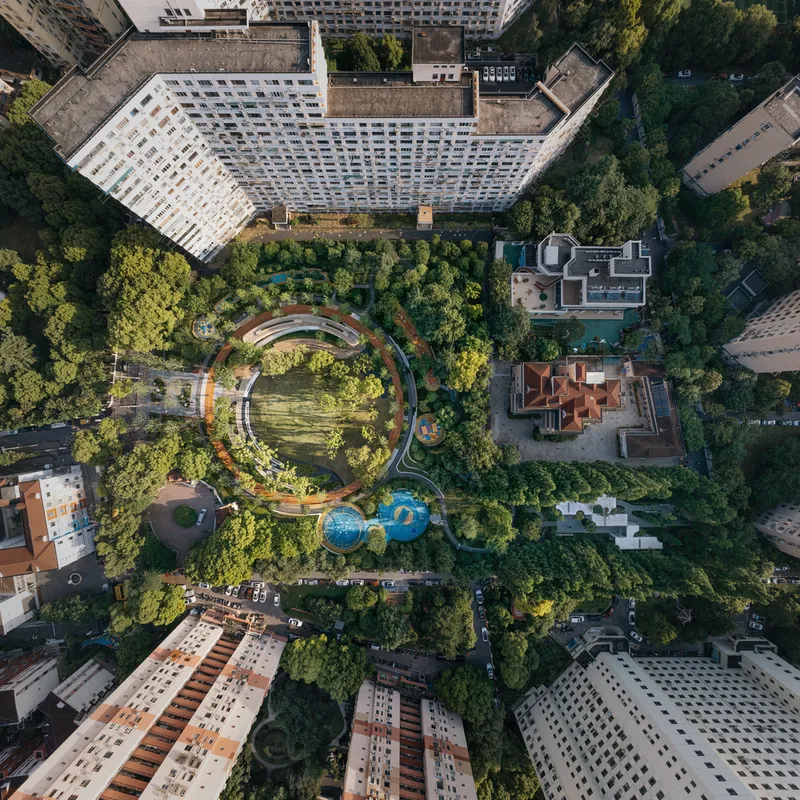
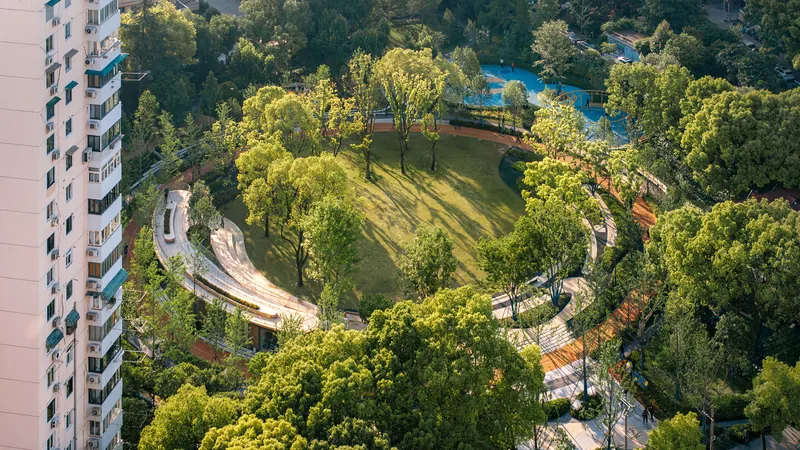
From the air the scheme reveals its organizing logic: a ring-shaped structure sits within a circle of mature trees, which in turn sits within a block of apartment towers. The concentric geometry is not arbitrary. It maximizes edge condition, giving every bench, amphitheater step, and play surface a direct relationship with both the central lawn and the surrounding canopy. The white folded roof reads cleanly against the green, but it never dominates.
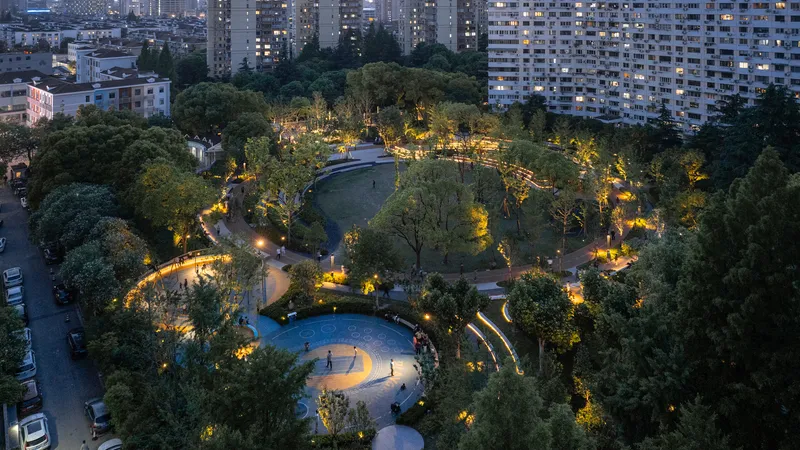
At twilight the park becomes legible in a different way. Warm lighting traces the paths and the pavilion edges, turning the circle into a glowing clearing amid the tower grid. The aerial dusk views reveal just how tightly the neighborhood wraps around this green void, and how much that proximity matters for the project's social contract: this is not a destination park but a living room for several thousand households.
Keeping the Canopy
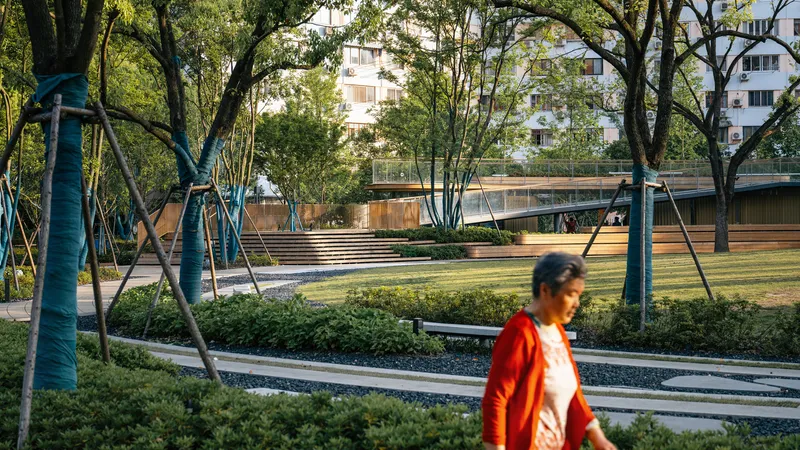
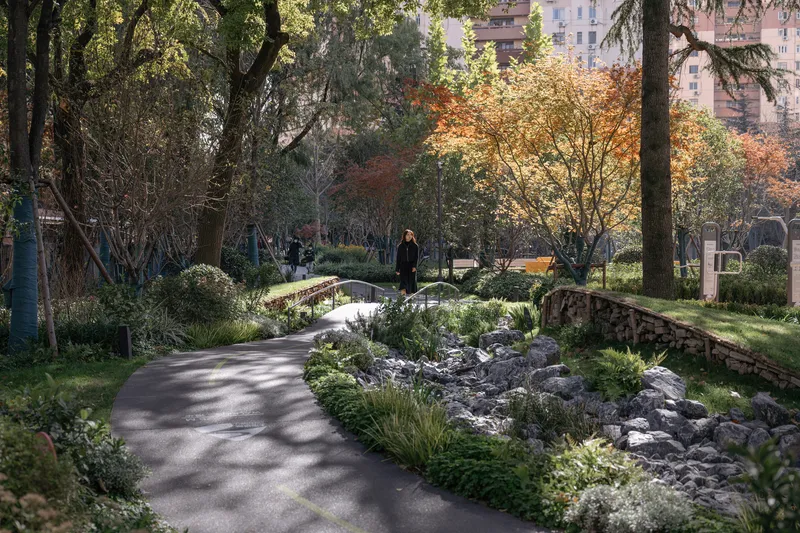
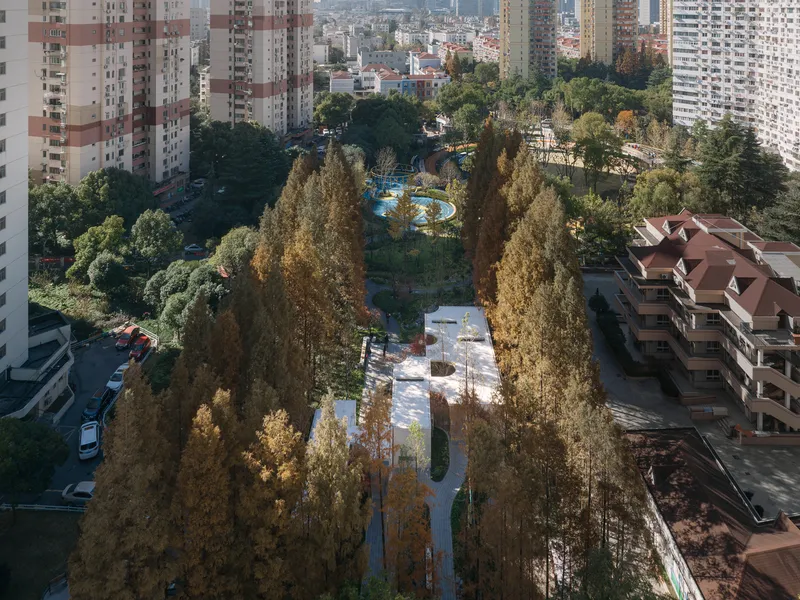
The most consequential design decision was to preserve the existing mature trees and route every path, structure, and terrace around them. Preserved trunks punctuate walkways; branches frame views of the pavilion rather than the other way around. It is an approach that demands precision in setting out, because a two-meter shift in a path alignment can mean the difference between saving a camphor tree and losing it.
The planting strategy supplements the canopy with layered understory: ornamental grasses, rockery beds, and low hedges that create pocket spaces without blocking sightlines. The seasonal range is evident across the image set, from bare winter branches casting graphic shadows on white concrete to the deep autumn foliage filtering golden light onto the pathways.
Timber Pavilions and Screened Thresholds
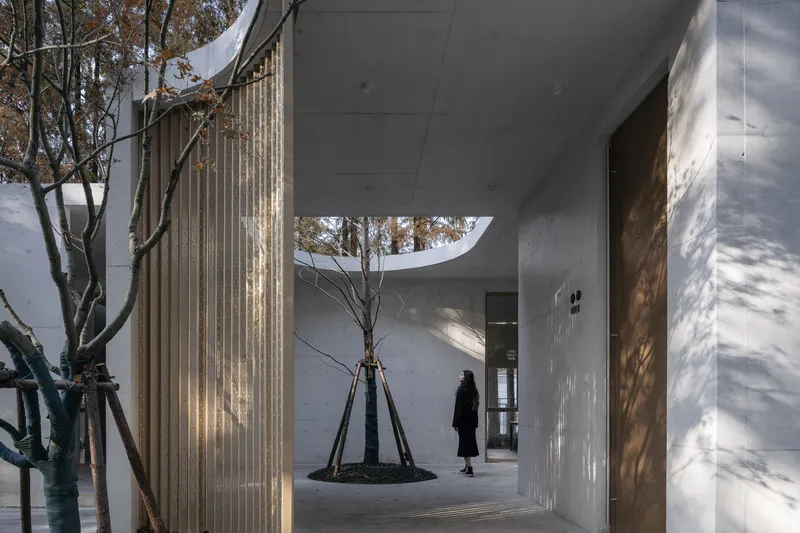
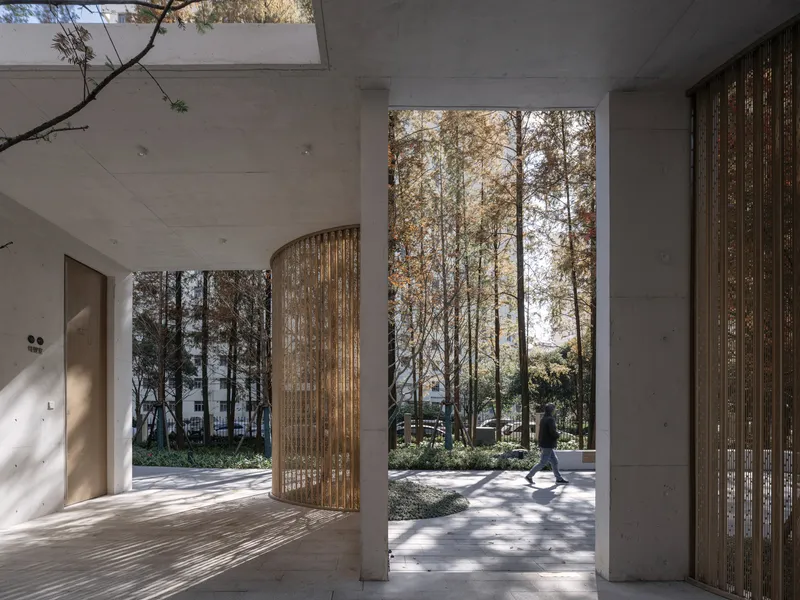
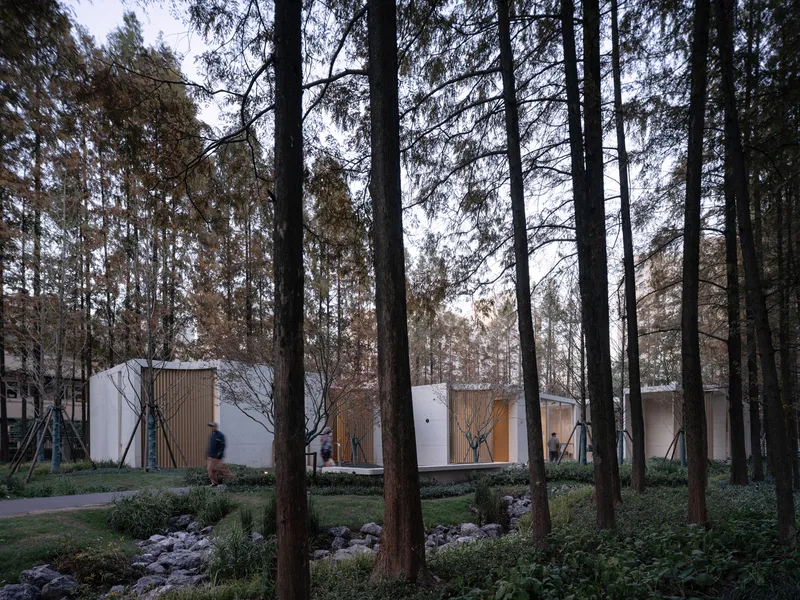
The architectural volumes cluster at the edges of the ring, clad in vertical timber slats and horizontal screen panels that filter light and blur the boundary between interior and landscape. A covered entrance passage uses a circular skylight to frame a single courtyard tree, turning arrival into a moment of compression before the park opens up. The gesture is simple but effective: it slows you down.
Inside, curved wooden screen panels line corridors that look directly into the woods. The palette is deliberately restrained: white concrete, warm timber, glass. Nothing competes with the trees outside. At dusk the cluster of white volumes among tall pines reads almost like a Nordic cabin compound, a strange and welcome quality for a park embedded in one of the densest districts in Shanghai.
Gallery and Interior Program
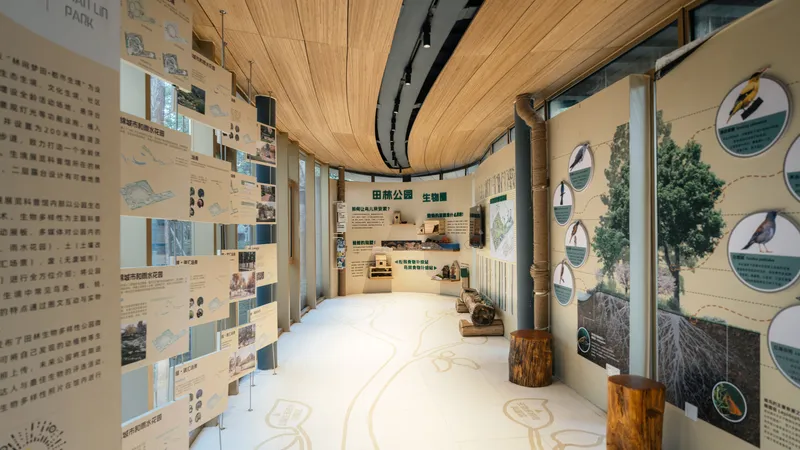
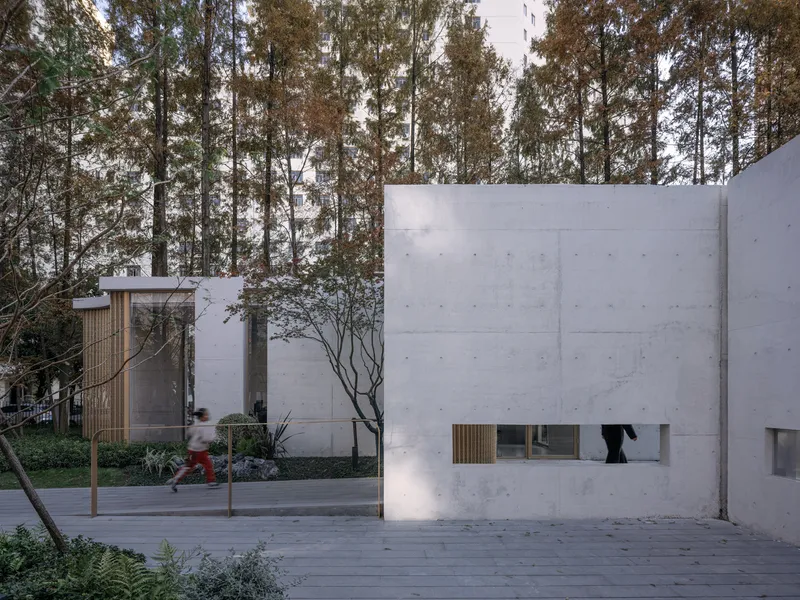
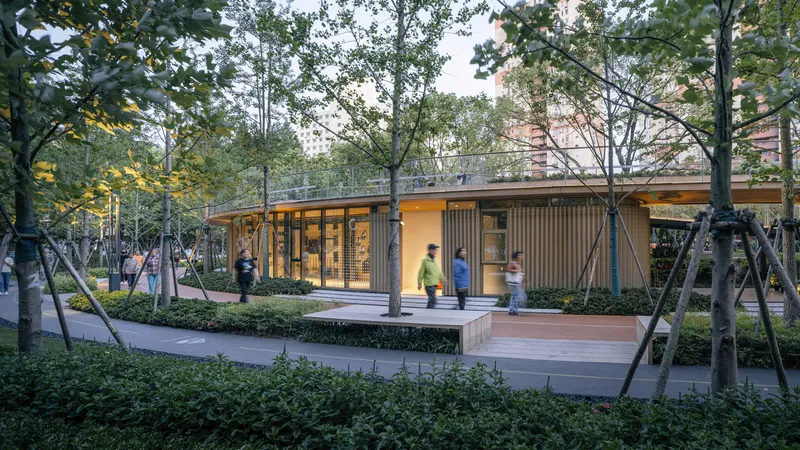
VIASCAPE embedded a small exhibition gallery within the pavilion complex, fitted with curved timber ceiling panels and informational display walls. Floor graphics supplement the exhibits, suggesting the space doubles as an interpretive center for the park's ecology and neighborhood history. It is a smart programmatic move: giving the park an indoor anchor extends its usability in Shanghai's humid summers and cold winters.
The single-story pavilion with its timber-slatted facade sits quietly among the birch grove, its horizontal window openings framing controlled slices of landscape. The architecture never shouts. It offers shelter, information, a reason to linger for ten more minutes. That modesty is precisely what allows the park, rather than any single building, to remain the protagonist.
Amphitheaters and Social Infrastructure
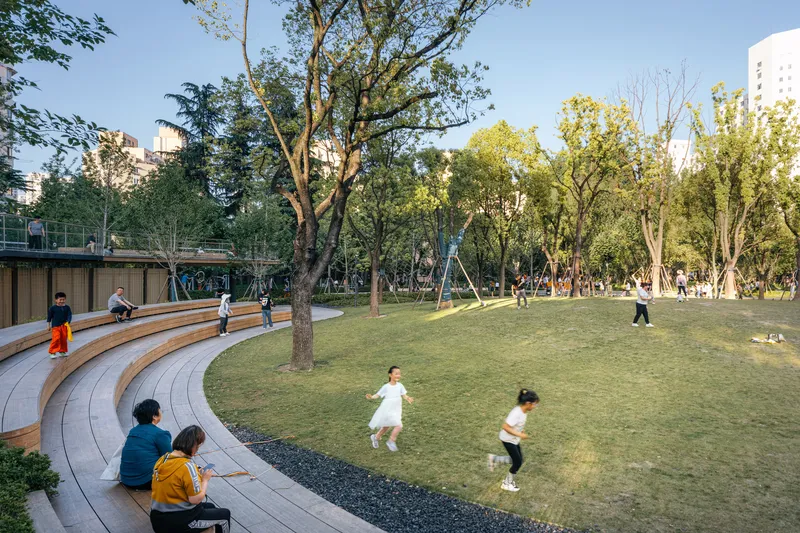
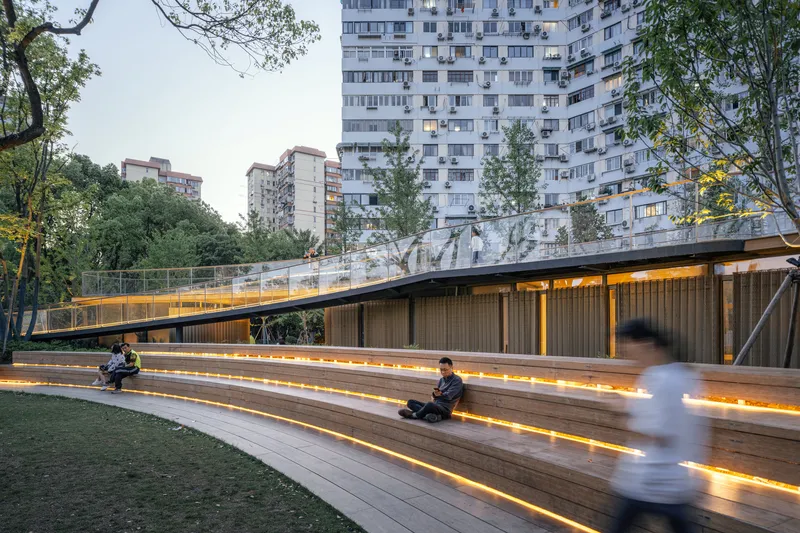
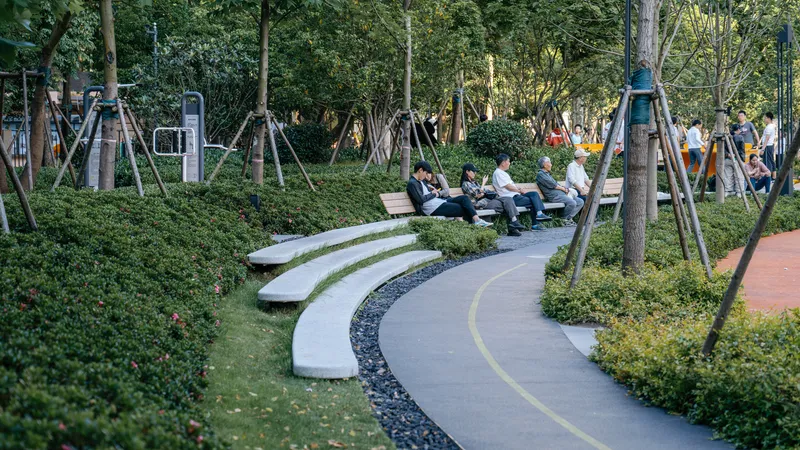
Two amphitheater conditions appear in the park: a curved timber version with wide steps descending toward a lawn, and a concrete terrace variant with planted strips. Both serve as informal gathering spots where residents sit, watch children play, or simply rest. The timber amphitheater's integrated LED strip lighting extends its use into the evening, a small detail that signals the designers thought carefully about when and how people actually occupy public space.
The curved concrete seating terraces pair with hedges to define sub-spaces within the larger park loop. Visitors appear comfortable here, not performing leisure for a camera but genuinely using the infrastructure. That is the hardest thing to design for, and the clearest evidence that the park works.
Play, Fitness, and Everyday Activation
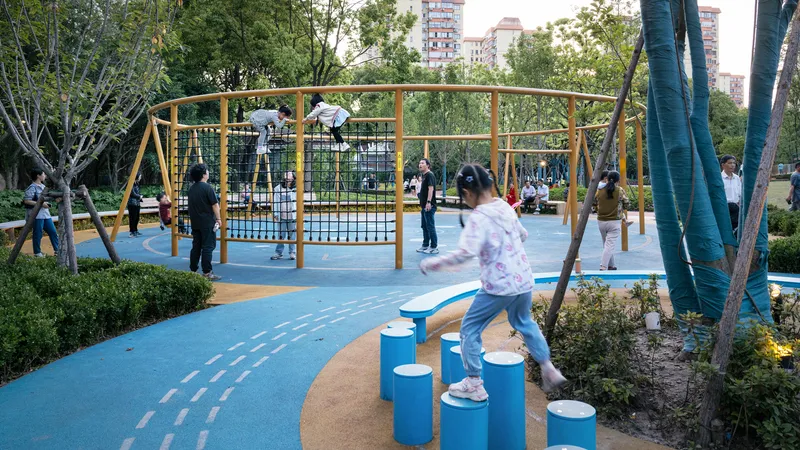
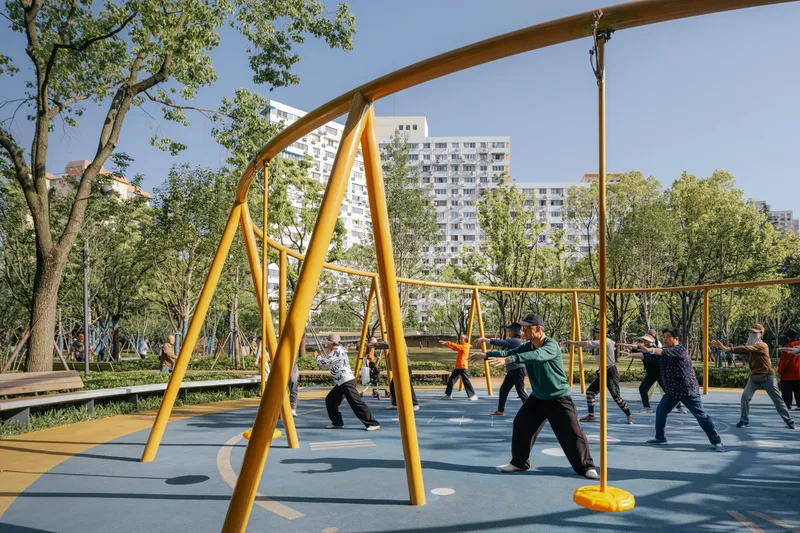
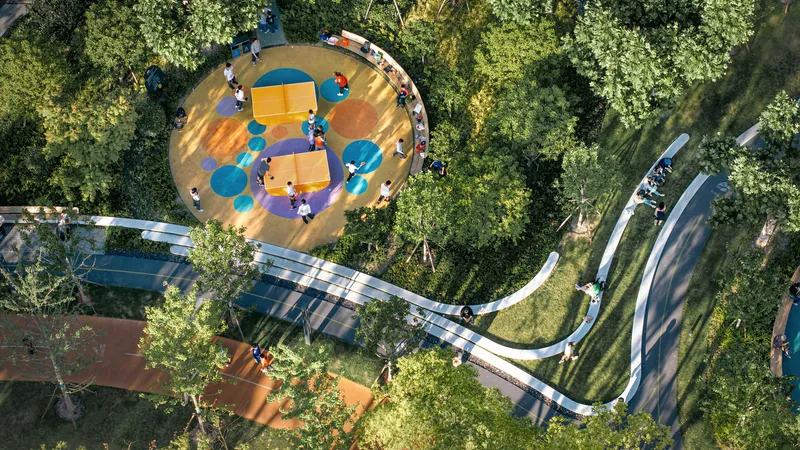
The children's play area deploys a yellow tubular climbing frame and blue stepping disc path on colorful safety surfacing, visible in overhead views as a bright graphic element within the otherwise green and white palette. A separate fitness zone tucks exercise equipment among hedges with enough screening to let joggers and exercisers feel semi-private. The yellow steel exercise frame sheltering group activity beneath the tower canopy is particularly well integrated, using the apartment blocks as a backdrop rather than hiding from them.
These are not afterthought amenities. They occupy dedicated zones along the loop, each with its own ground treatment and planting edge. The circular play area canopy ties back to the ring geometry of the overall plan, reinforcing the sense that every element belongs to a single coherent system.
Paths, Bridges, and the Landscape Loop
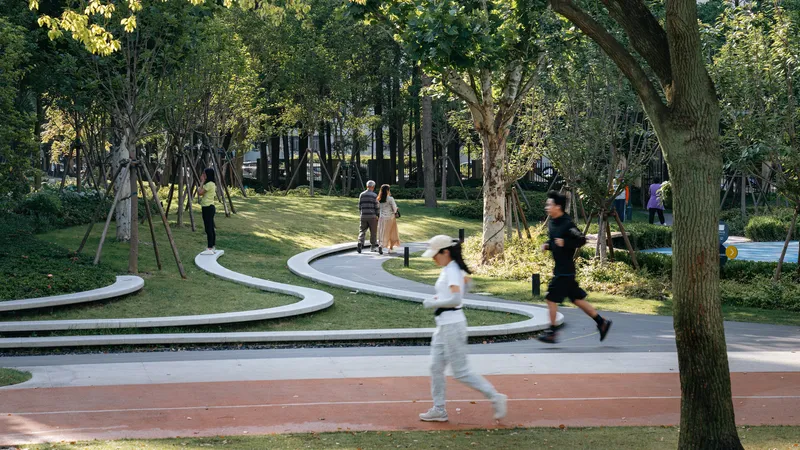
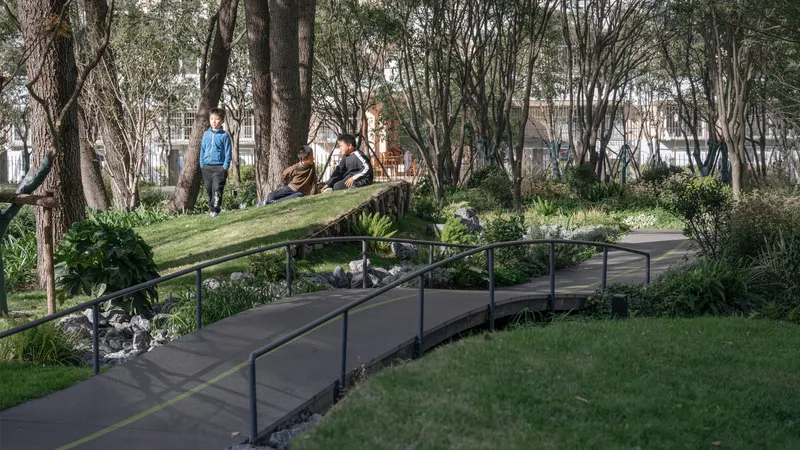
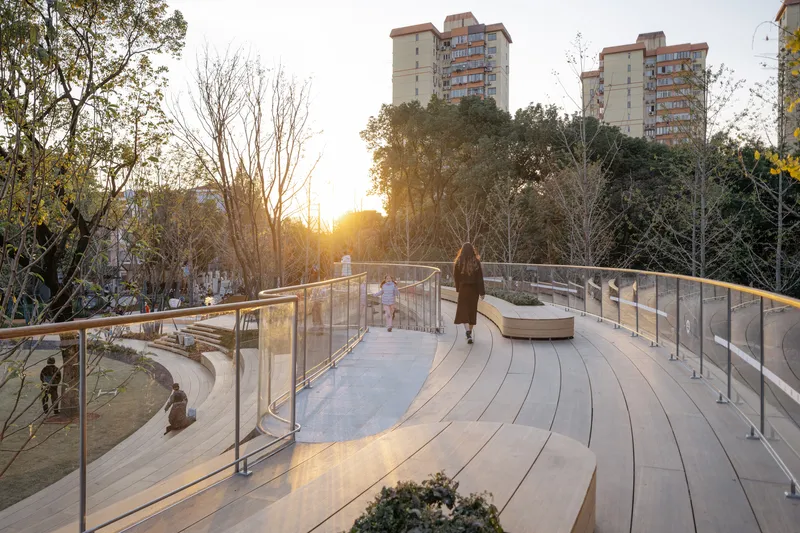
Movement through Tianlin Park is structured by a network of winding concrete paths, timber boardwalks, and at least one bridge crossing a sunken path. The bridge introduces a brief sectional shift that separates pedestrian flows and creates a moment of elevation change in an otherwise flat site. Steel railings keep the vocabulary industrial enough to avoid preciousness, while visitors seated on grassy banks below the bridge suggest the sunken path doubles as a casual hangout.
The curving timber boardwalk with glass railings and stone benches catches the best of the sunset light. It functions as the park's promenade, the path you take when you have no destination but want to be among trees and neighbors. Good urban parks need exactly this kind of aimless, pleasant route, and VIASCAPE has calibrated the curves tightly enough that the walk always feels like it is going somewhere.
Plans and Drawings
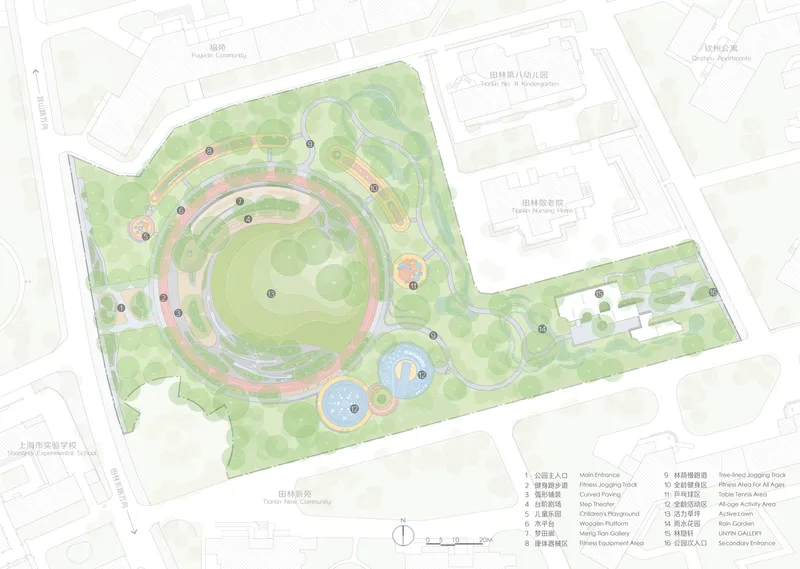
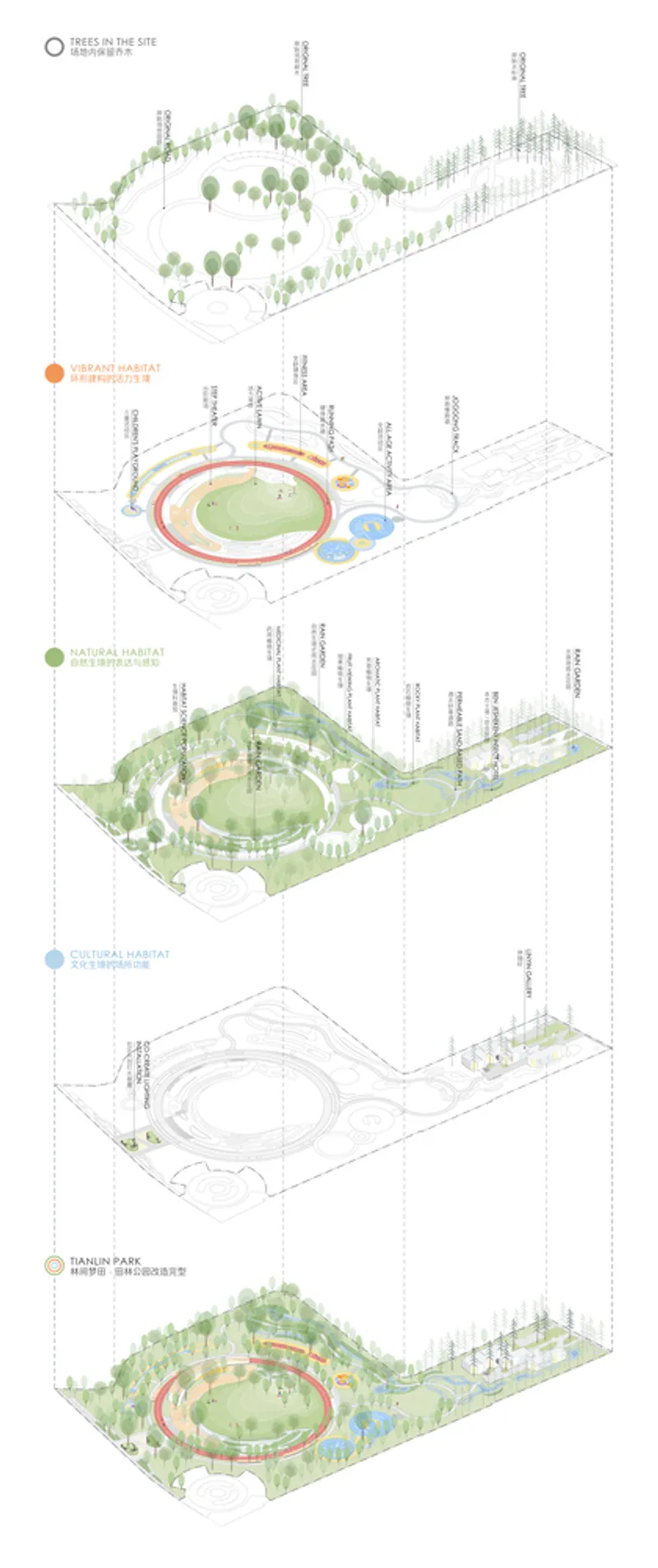
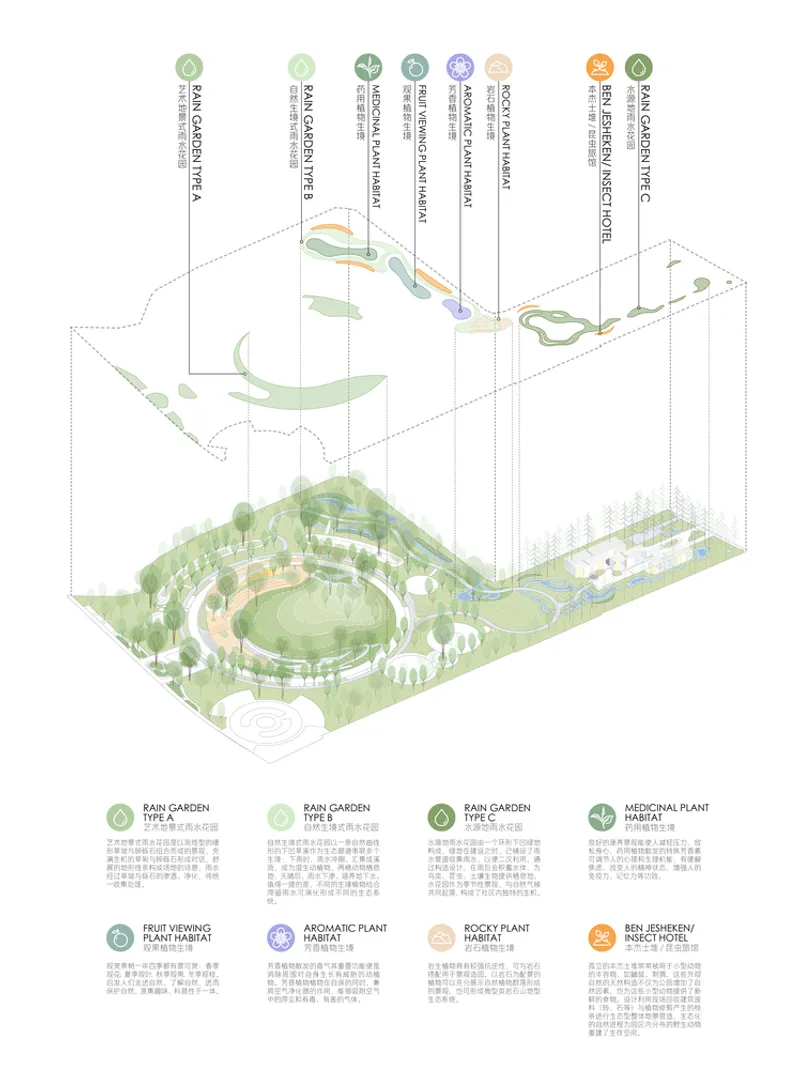
The site plan confirms the concentric organization: a circular central lawn radiates outward through rings of path, pavilion, planting, and perimeter walk before meeting the adjacent building footprints. An axonometric section drawing peels the project into five layers from green roof terraces down to underground levels, revealing a subterranean program that the surface experience conceals entirely. The exploded landscape diagram floats different garden types above the site base, mapping the thematic planting zones that give each stretch of path a distinct character.
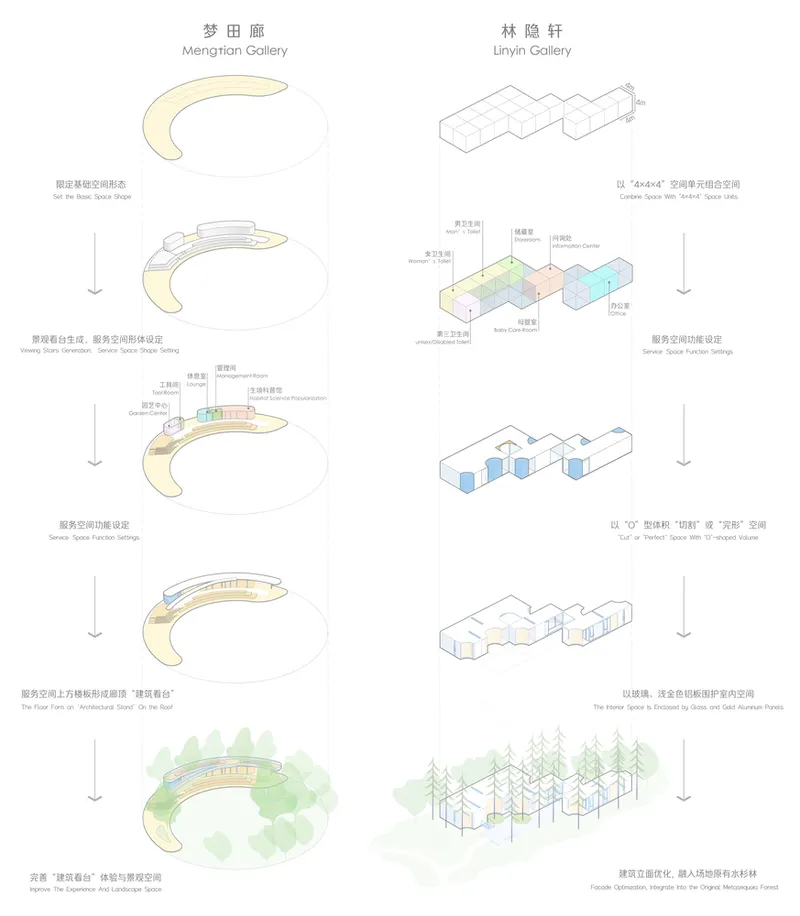
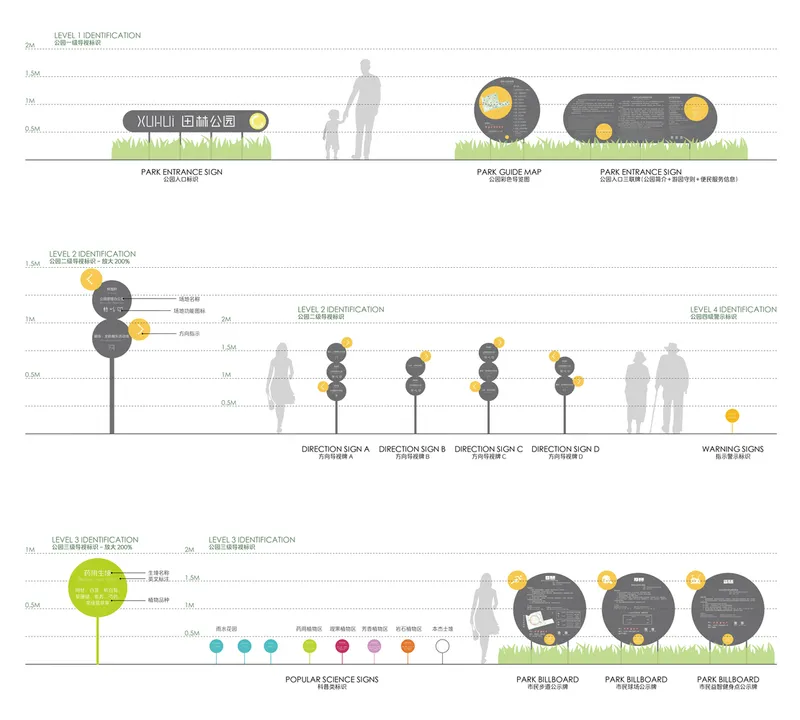
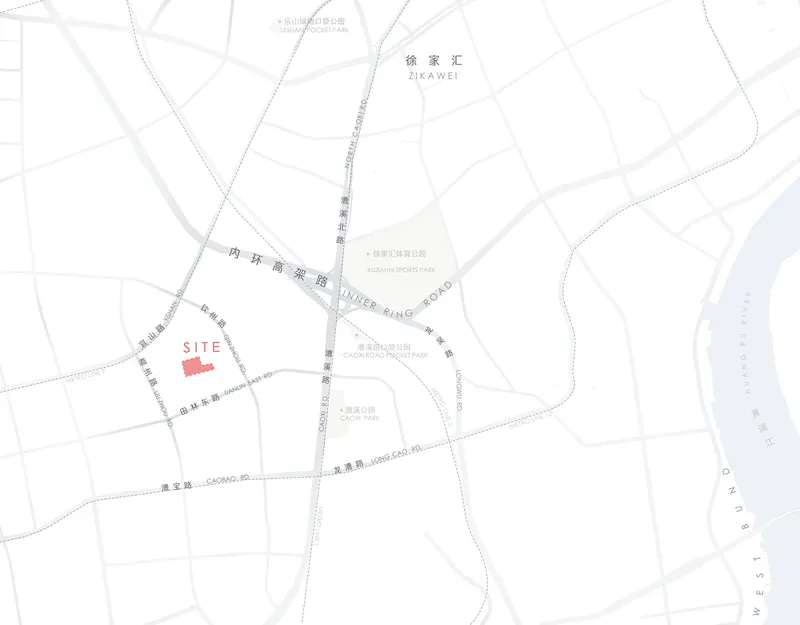
A form evolution diagram traces the two gallery volumes from abstract shapes through programmatic zoning to their final placement in the forest setting. It is a useful record of how the architecture adapted to the trees rather than the reverse. The wayfinding signage elevation details various totem heights against human figures, showing a coordinated graphic system that extends the design language beyond built form. The site location map situates the project within Xuhui's street grid, underscoring just how embedded this park is in everyday urban life.
Why This Project Matters
Tianlin Park matters because it demonstrates that neighborhood-scale green space in a hyper-dense city does not require spectacle to succeed. The architecture stays low, the trees stay tall, and the geometry organizes without dominating. Every design choice, from the ring plan to the timber screens to the sunken crossing, serves the daily rituals of the surrounding community: morning exercise, evening strolls, weekend play. There is no signature gesture competing for magazine covers, and the project is stronger for it.
For designers working on park renewals in Asian megacities, VIASCAPE's approach offers a credible alternative to the tabula rasa model. Preserving existing canopy, embedding modest indoor program, and distributing activation across a legible loop creates a park that functions from day one with the spatial richness of a place that has been loved for decades. That is a harder trick than it looks, and Tianlin Park pulls it off with quiet confidence.
Tianlin Park Renewal, designed by VIASCAPE Design, is located in Xuhui District, Shanghai, China. Photography by CreatAR Images.
About the Studio
VIASCAPE Design
Share Your Own Work on uni.xyz
If projects like this are the kind of work you want to make, uni.xyz is a place to publish your own, find collaborators, and enter design competitions.


Popular Articles
Popular articles from the community


Singing Woman: An Opera House That Performs Before the Curtain Rises
Ovidiu Cristian Pavel's conceptual opera house translates Estonia's choral identity into a sculpted waterfront landmark facing the Baltic Sea.


graciastudio Turns a Viewless Tijuana Lot Inward Around a Courtyard of Concrete, Timber and Trees
In Tijuana, Jorge Gracia's GA2 House stacks a timber-clad private floor over exposed concrete and replaces a missing view with a planted interior patio.

David Ortega Stacks a Two-Story Mexico City Penthouse Around a Steel Stair and a Pergola-Shaded Roof Terrace
In Colonia Roma, a 300 m² penthouse uses oak joinery, a planted steel stair and a slatted roof pergola to make a new-build apartment feel like a house.

Manzana Morphosis: Stretching Barcelona's Grid into a Living Landscape for 2050
A radical reworking of the Eixample manzana turns density into a tool for generous public space, vertical ecology, and environmental performance.

Similar Reads
You might also enjoy these articles

Cube Design Draws an Ecological Corridor Between Two Shenzhen Hills with the Nankai Building
Beside Shenzhen's container docks, the Nankai Building pairs stacked balconies with a climbing green screen to connect two hillsides across its height.

Praksis A and Studio Sted Bend a Red Timber Cabin Across the Granite of Norway's Southern Coast
On the southern Norwegian coast, a 105 m² cabin follows the rock on slender posts, pairing red cladding outside with pine, brick and plywood within.
David Ortega Stacks a Two-Story Mexico City Penthouse Around a Steel Stair and a Pergola-Shaded Roof Terrace
In Colonia Roma, a 300 m² penthouse uses oak joinery, a planted steel stair and a slatted roof pergola to make a new-build apartment feel like a house.

PARALELA and LB2 Thread a Public Walkway Through the Base of a Las Condes Residential Tower
In Las Condes, Santiago, the Hamlet Building gives its fenceless ground floor to a 70-metre wooded passage linking two streets and the metro.

Explore City Park Competitions
Discover active competitions in this discipline

Challenge to reimagine the Iron Throne

Photograph architecture without architects

Illustrate the lost glory of Angkor Wat - Render Challenge

Design challenge to reuse E-waste
Comments (0)
Please login or sign up to add comments
No comments yet. Be the first to comment!