

Tidal: A New Paradigm in Sustainable Airport Architecture
A sustainable airport architecture inspired by tidal pools, transforming transit into an immersive journey through Koh Phangan’s culture and landscape.


In the evolving discourse of sustainable airport architecture, the project Tidal by Beomi Labio redefines the airport not as a transient infrastructure but as an experiential threshold. Conceptualized as a “First Window” to Koh Phangan, Thailand, the design challenges the conventional notion of airports as purely functional transit nodes, instead positioning them as immersive environments that preview the cultural and ecological richness of their context.
Shortlisted as an entry in the First Window competition, the proposal introduces a spatial narrative rooted in the logic of tidal pools. Much like these ecological microcosms reveal fragments of a larger oceanic system, the airport distributes moments of activity, landscape, and program across the passenger journey, creating a sequence of curated experiences that gradually unfold.
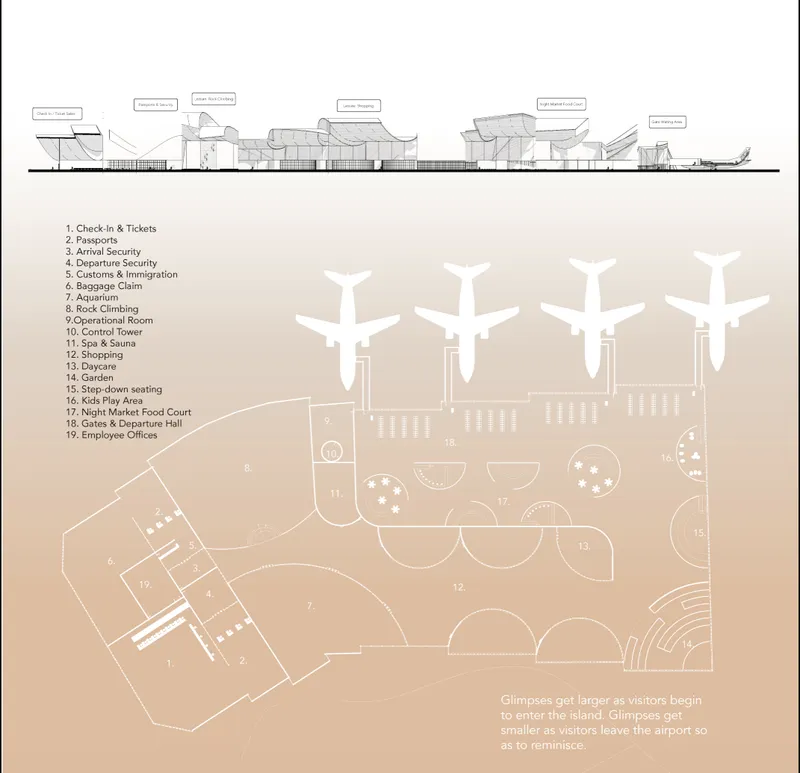
Reimagining the Airport Journey
Traditional airport planning is structured around linear efficiency, prioritizing movement, security, and operational clarity. Tidal retains this essential linearity but strategically disrupts it through spatial interventions that introduce “glimpses” of the island.
As passengers move from check-in through security to departure gates, the architecture orchestrates a deliberate progression. On arrival, spaces expand in scale, offering openness, exploration, and discovery. On departure, these same programs contract, becoming more intimate and reflective, allowing visitors to reminisce on their experience of Koh Phangan.
This dual-directional spatial strategy maintains navigational clarity while embedding a layered experiential dimension. The airport thus becomes both an introduction and a memory device, a rare synthesis in contemporary airport design.
Programmatic Landscape: Beyond Transit
The project expands the conventional airport program into a hybridized landscape of activities. Alongside essential functions such as check-in, customs, and baggage claim, the design integrates unconventional amenities including aquariums, rock climbing areas, gardens, spas, daycare facilities, and stepped seating zones.
These insertions are not arbitrary but are carefully positioned to align with the broader concept of “tidal moments.” Each program acts as a micro-environment, offering sensory and spatial variation. Together, they transform the airport into a destination in itself, addressing a critical gap in contemporary aviation infrastructure where waiting is often reduced to passive consumption.
By embedding leisure, wellness, and cultural programs into the circulation sequence, the airport challenges the dominant paradigm of commercialized transit spaces and instead promotes active engagement.
Climatic Responsiveness and Material Intelligence
A central component of sustainable airport architecture is responsiveness to local climate. Located in a tropical region characterized by heavy rainfall, high humidity, and strong winds, the design adopts passive strategies derived from Thai vernacular architecture.
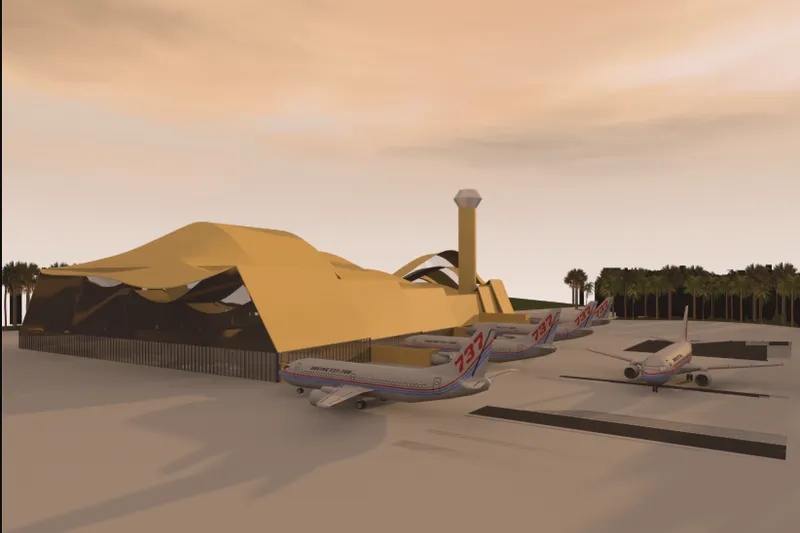
The most prominent feature is the sweeping, curvilinear roofscape. Inspired by traditional steep and swooping roofs, this form facilitates natural ventilation, enhances daylight penetration, and enables efficient rainwater management. The roof’s geometry is not merely aesthetic but performative, mediating environmental forces while creating a distinctive architectural identity.
Material selection further reinforces sustainability. The use of heavy timber and bamboo, sourced locally, reduces embodied energy and contributes to carbon sequestration. These materials also establish a tactile and visual continuity with the island’s natural context, reinforcing the project’s commitment to ecological integration.

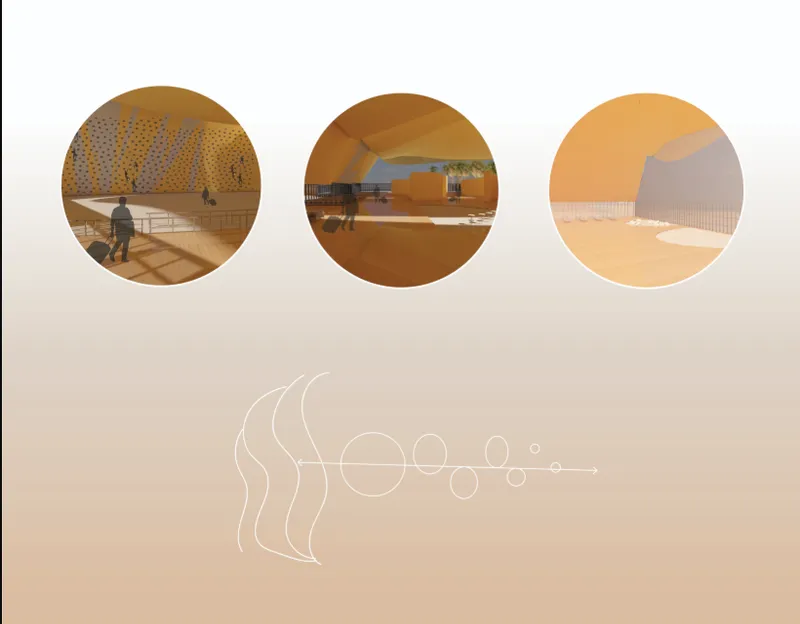
Spatial Form and the Logic of Tides
The formal language of the airport is deeply rooted in the metaphor of tides. The overall massing adopts a wave-like configuration, appearing as a fluid form shaped by environmental forces. This geometry is not symbolic alone but directly informs spatial organization.
Circulation paths are interspersed with expanding and contracting volumes, echoing the ebb and flow of water. Larger spaces near arrival zones encourage exploration and social interaction, while smaller, enclosed spaces near departure zones foster introspection.
This rhythmic modulation of space introduces a temporal dimension to architecture, where the experience of movement is synchronized with emotional states of anticipation and reflection.
Challenging Conventional Airport Typologies
Airports are typically perceived as neutral infrastructures, devoid of identity and disconnected from their surroundings. Tidal actively resists this neutrality by embedding context-specific narratives into every aspect of its design.
Rather than functioning as a mere gateway, the airport becomes a cultural interface. It offers visitors an immediate connection to Koh Phangan’s landscape, climate, and traditions, effectively collapsing the boundary between arrival and destination.
Moreover, by incorporating spaces for rest, play, and contemplation, the project addresses the often-overlooked human experience of transit. It acknowledges the psychological dimension of travel and proposes architecture as a medium for comfort and engagement.
Toward a New Model of Sustainable Airport Architecture
Tidal represents a significant shift in how airports can be conceptualized and designed. By integrating sustainable strategies, contextual sensitivity, and experiential programming, it proposes a holistic model that extends beyond operational efficiency.
The project demonstrates that airports can serve as catalysts for cultural expression and environmental stewardship. It repositions infrastructure as an active participant in shaping user experience, rather than a passive backdrop.
In doing so, Tidal contributes to a broader rethinking of sustainable airport architecture, one that prioritizes not only ecological performance but also spatial richness and human connection.
Project Credits
Project: Tidal
Designer: Beomi Labio
Recognition: Shortlisted Entry, First Window Competition




Popular Articles
Popular articles from the community


Hill & Cross Opera: Sculptural Opera House Architecture Shaped by Tallinn’s Landscape and Identity
Hill & Cross Opera reimagines opera house architecture in Tallinn through its sculptural hill, civic plaza, glass wave and a luminous cross.
AL-JANNAH: Sustainable Architecture and Permaculture for Afghan Widows
AL-JANNAH uses sustainable architecture and permaculture to create resilient oasis of housing, learning, work and renewal for Afghan widows.

Riyadh For All: Intergenerational Urban Design for Active Aging in Rabat
Riyadh For All reimagines urban design in Rabat with intergenerational co-living, adaptive courtyards, and Moroccan cultural exchange today.

The Ocean Hive: Sustainable Architecture for a Self-Sufficient Civilization at Sea
The Ocean Hive imagines sustainable architecture at sea, where modular habitats, algae, wave power and ocean waste sustain a growing colony.


Similar Reads
You might also enjoy these articles

Eco Chapel: A Green Architecture Pavilion Designed in Symbiosis with the Forest
Eco Chapel uses green architecture to weave prayer, learning and reuse into a forest pavilion shaped by modular hexagonal canopies for life.
Kaffeebühnen: Coffee Shop Architecture Designed as a Civic Stage Between Vienna’s City and Park
Kaffeebühnen turns coffee shop architecture into a civic stage, linking Vienna’s park edge, urban life, warm timber yards, and coffee craft.
Healing Façade: Sustainable Architecture for Reforestation, Community, and Sacred Ecology in Ethiopia
Healing Façade reimagines sustainable architecture as a living wall that restores soil, catches water and renews Ethiopia's forest churches.


Urban Forest: A Vertical Ecosystem for 5,000 Workers in Singapore's Changi Business Park
Radially stacked pods and layered green decks turn a 7-acre plot into 47 acres of ecological workspace projected for 2040.

Explore Architecture Competitions
Discover active competitions in this discipline



Challenge to reimagine the Iron Throne


Photograph architecture without architects


Illustrate the lost glory of Angkor Wat - Render Challenge


Design challenge to reuse E-waste
Comments (0)
Please login or sign up to add comments
No comments yet. Be the first to comment!