

Tina Bergman Tucks a Timber Cabin Shaped Like a Fairytale Hat into a Swedish Birch Forest
A 95-square-metre family retreat near Tänndalen borrows its silhouette from a Swedish children's story and its materials from the mountain landscape.


There is a Swedish fairytale about three children who live inside a hat. It is a strange, compact premise, and it produces exactly the kind of spatial logic that a 95-square-metre cabin for a family of five (plus a dog) demands. Tina Bergman Architect took the story as both metaphor and generator for this house in Tänndalen, a site just below the treeline in western Sweden where birch trunks crowd a gently sloping meadow and yellow orchids surface in summer. The form reads immediately: a steep gable that swells outward, hat-like, giving the interior more volume than its modest footprint suggests.
What makes the Hat House genuinely worth studying, though, is not the storybook silhouette. It is the way the section works. Local regulations capped the building at 100 square metres, so every cubic centimetre had to perform. Bergman organized the program vertically along the slope: sleeping under the peaked roof, bathing below, and communal living a few steps down where the terrain drops toward views of a lake and mountains to the south and west. The result is a cabin that feels layered and generous despite its legal constraints, clad almost entirely in locally sourced heart pine treated with Kebony, a plant-derived impregnation that weathers gracefully and sidesteps toxic preservatives.
A Clearing Among the Birch
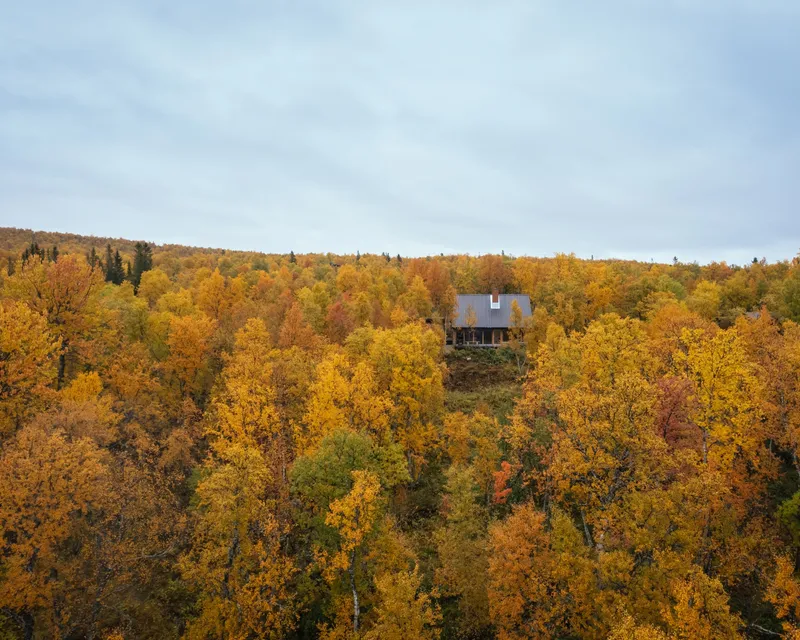


The cabin occupies a naturally formed clearing, withdrawn from the forest road and elevated just enough to survey the autumn canopy. Seen from a distance, it reads as a dark, steep-roofed volume floating above a sea of yellow birch. The horizontal timber cladding on the lower volume and the vertical weathered boarding above give the building two distinct registers: a grounded base and a lighter, almost textile-like crown. Bergman oriented the house to maximize south and west exposure, pulling daylight deep into the plan without sacrificing the intimacy that comes from being surrounded by trees.
Timber Detailing and Material Honesty

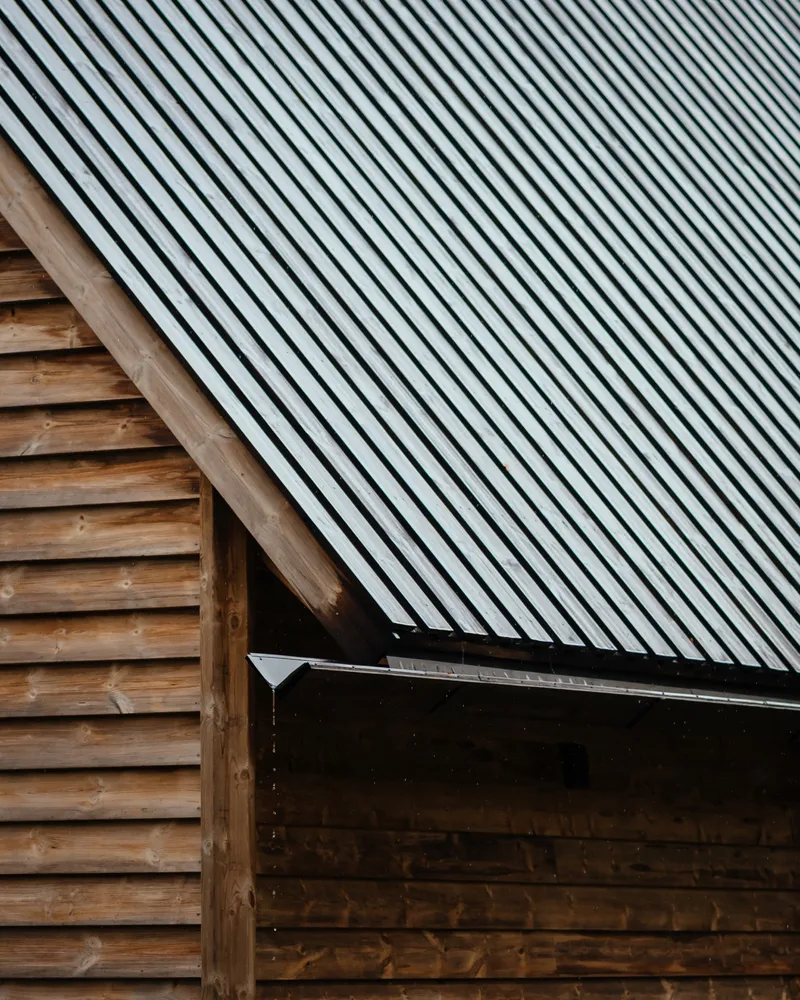

The junction between corrugated metal roofing, exposed gutters, and horizontal pine siding is handled with surgical precision. There is no attempt to hide the construction logic. Gluelam beams and softwood framing do the structural work, and they are left legible at every connection. The Kebony-treated heart pine will silver over time, slowly narrowing the visual gap between the cabin and the birch bark that surrounds it. That trajectory is part of the design: the building is meant to recede, not announce itself.
Corrugated metal at the soffit is an honest, even blunt, choice. It keeps maintenance low in a climate that oscillates between deep snow and brief, intense summers. Combined with the timber column detail at the overhang, it gives the eaves a workshop clarity that suits the cabin typology far better than any attempt at refinement would.
Glass, Reflections, and Borrowed Landscape


At the lower level, a glazed pavilion volume pushes out from the main body of the house. During the day, its glass walls mirror the surrounding birch trunks and undergrowth so completely that the cabin seems to dissolve into the forest floor. At twilight, the interior warmth inverts the relationship: the cabin becomes a lantern, its timber-lined rooms glowing through the trees. The corner window overlooking the valley is placed at precisely the height where a seated person's eye line meets the distant landscape, pulling the view in without framing it theatrically.
The Communal Heart
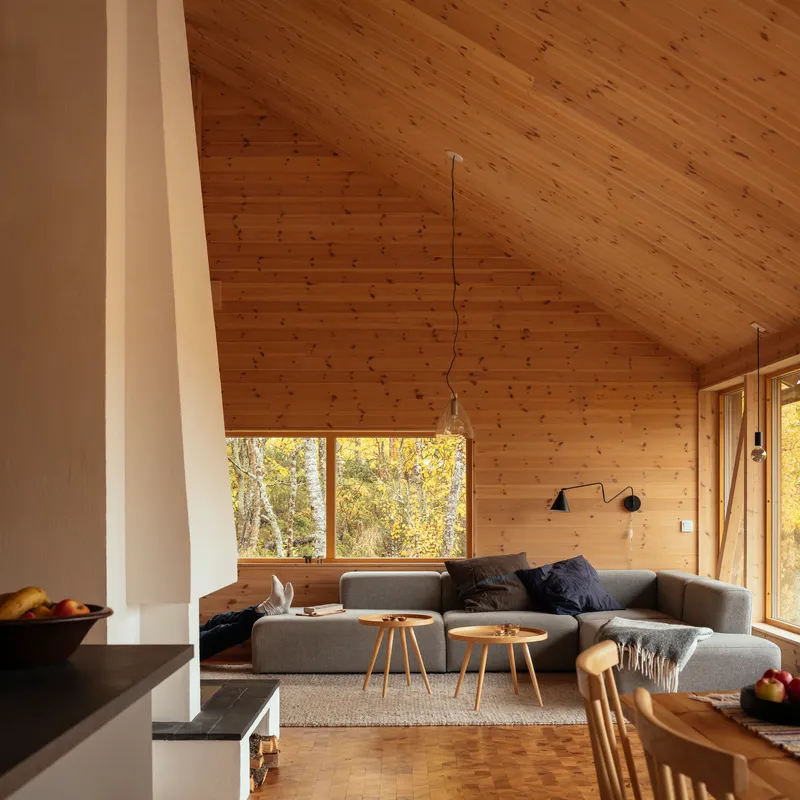

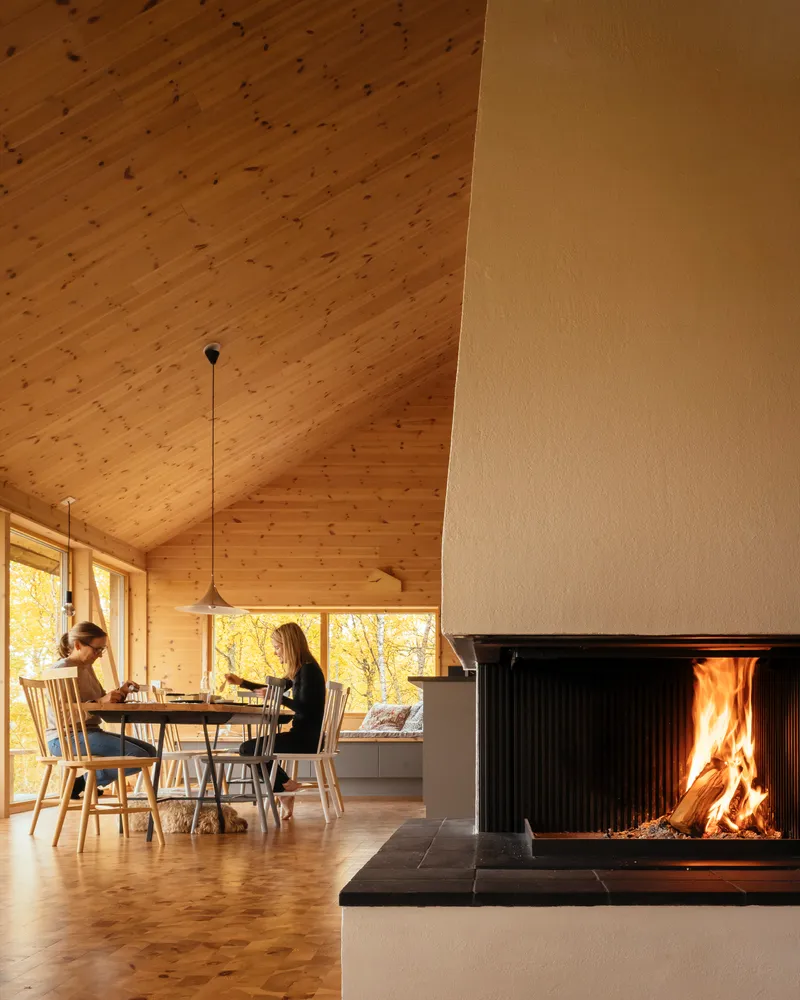
The living and dining areas sit at the lower end of the slope, where the ceiling vaults upward under the gable. Spruce boards line the walls and ceiling, finished in a white-tinted oil that brightens the interior without masking the wood grain. A horizontal window at the dining table frames the yellow birch canopy at eye level, turning autumn foliage into something close to a mural. The black metal fireplace anchors the space, providing both heat and a vertical counterpoint to all the horizontal timber lines.
What is notable here is restraint. The palette is limited to wood, linen, and a few pieces of simple furniture. There is no visual competition between materials. The end-grain spruce block flooring, a surface with real texture and warmth underfoot, is one of those quiet details that separates a considered cabin from a generic one.
Layered Living in Section

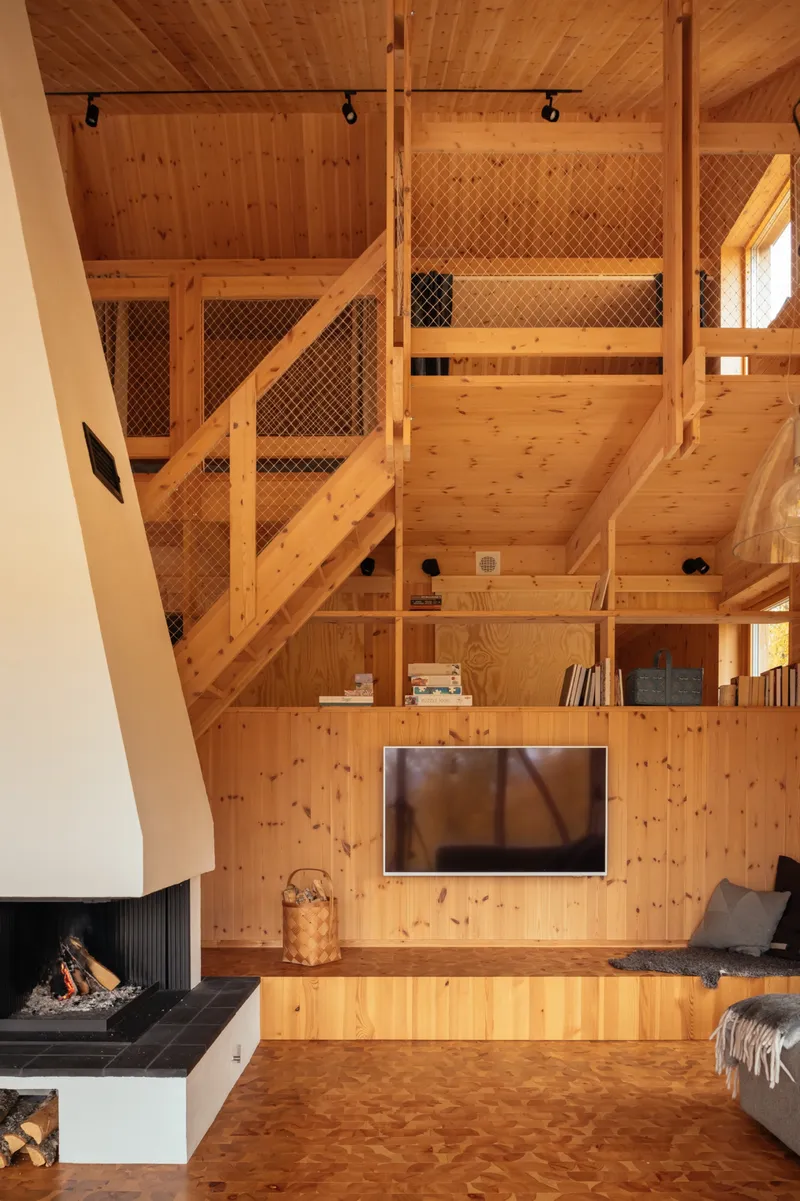
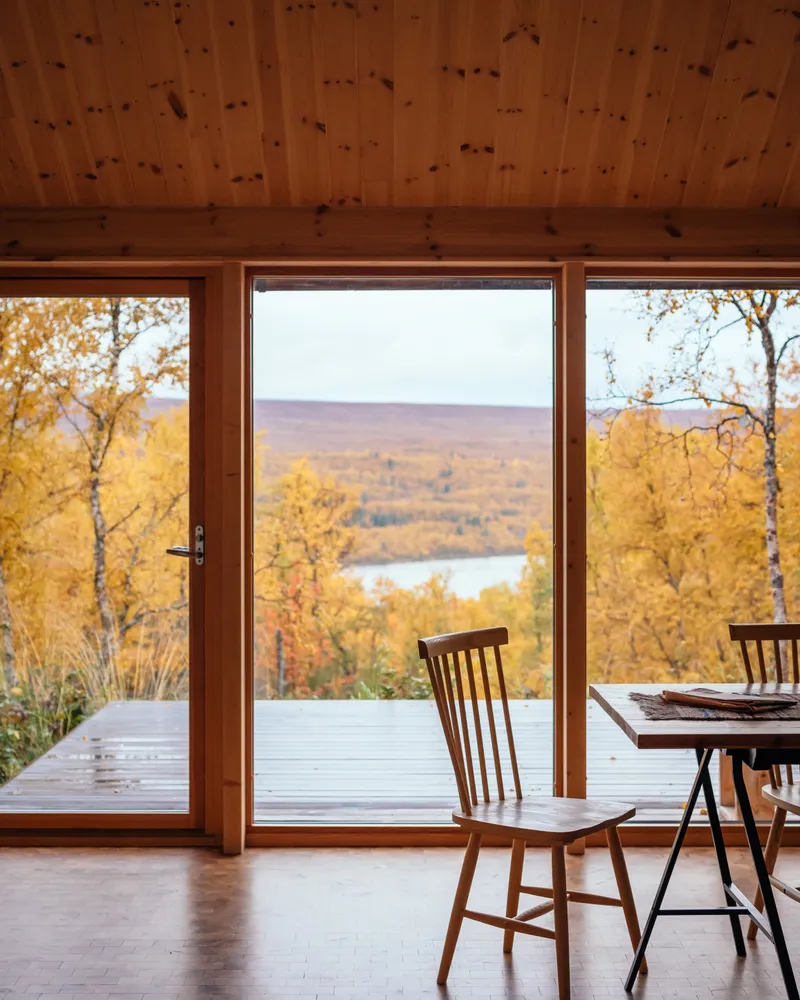
The section is where Bergman extracts the most from the hat-shaped envelope. A mezzanine level with diamond mesh safety barriers hovers above the kitchen, creating a double-height volume that makes the 95-square-metre floor area feel substantially larger. Integrated storage shelving is tucked into every available wall, and the layered timber platforms step with the terrain, so movement through the house is always a gentle ascent or descent. The timber-framed glass door opening onto the deck is the climactic moment: the interior wood grain extends outward to the decking, and the lake valley beyond becomes the final room.
Sleeping Under the Roof

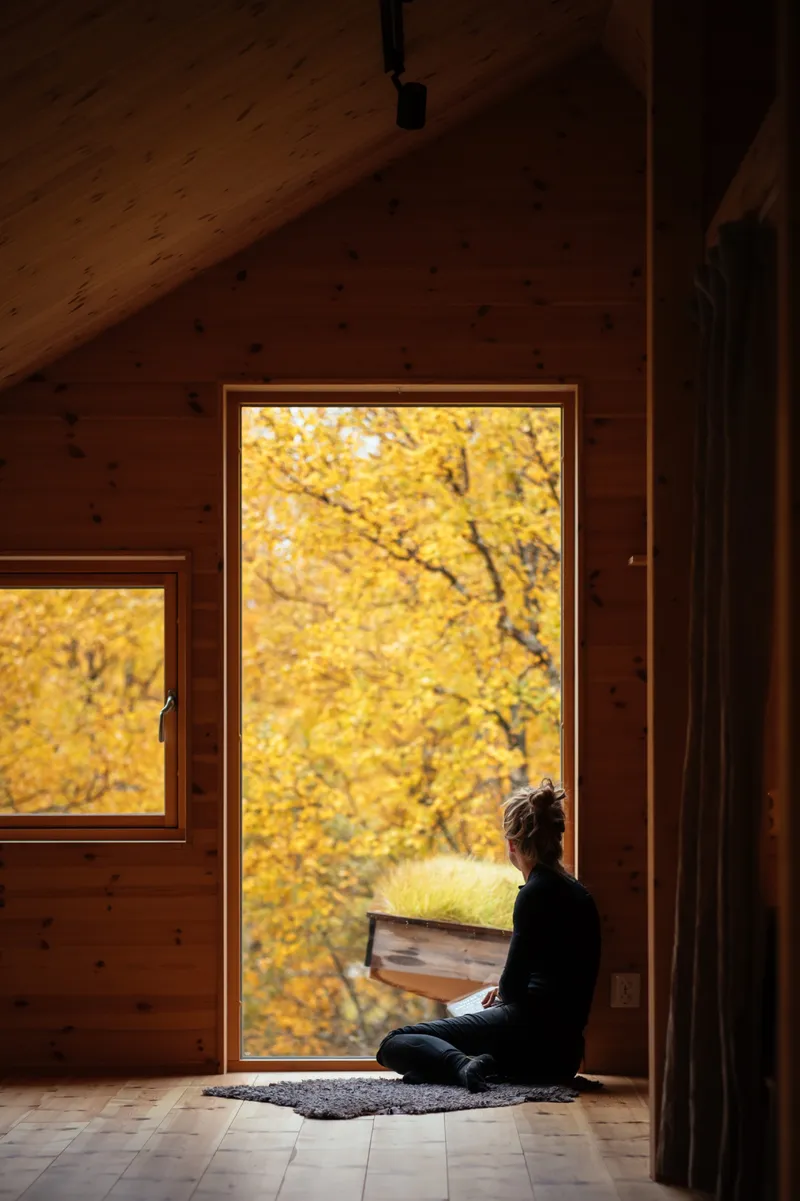
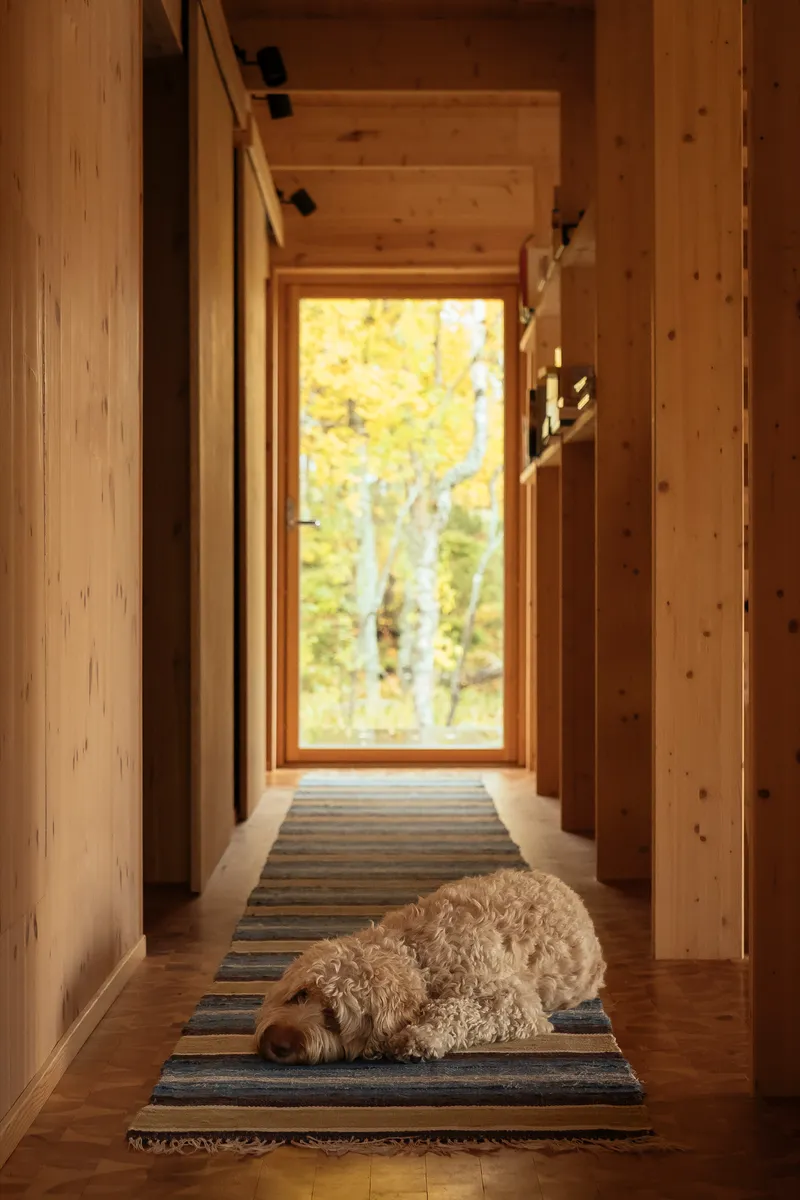
The sleeping areas occupy the upper reaches of the gable, where the ceiling slopes close enough to feel sheltering without feeling cramped. Linen curtains partition alcoves along a timber-lined corridor, giving each family member a private nook while keeping the space open enough to share light and air. One alcove doubles as a window seat, a perch where a person can sit framed by knotty spruce and watch the birch leaves turn. The dog, evidently, has claimed the hallway rug.
This arrangement, sleeping niches rather than bedrooms, is a deliberate compression. It allows the communal spaces downstairs to be proportionally generous and keeps the upstairs intimate. It is also, of course, the fairytale logic made literal: five people nestled under a peaked hat, close together, looking out.
Threshold and Entry


The entryway is a practical compression point: a knotty pine wall fitted with a mirror, coat hooks, and space for boots. It is not a grand foyer. It is the place where wet jackets come off and the transition from mountain weather to interior warmth happens in a single step. Seen from outside at dusk, the illuminated windows among the birch trunks confirm what the entry suggests: this is a house made for arrival, for the specific pleasure of coming in from the cold.
Plans and Drawings
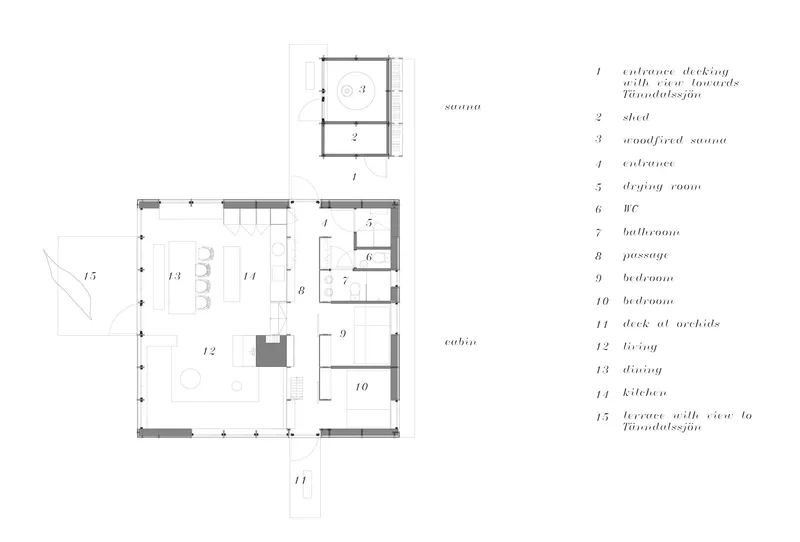


The floor plans reveal a compact organization that reads more like a boat than a conventional house. The ground floor wraps sauna, bathroom, and bedroom into the narrower northern end while opening the living, dining, and kitchen areas toward the south-facing deck and the lake valley beyond. Upstairs, sleeping niches line a central passage that terminates at a small terrace, the only moment where the upper level touches the outdoors directly.
The section drawing is the most instructive of the three. It shows how the steep gable generates usable volume at the mezzanine while keeping the ridge low enough to sit below the treeline. The stepped floor plates follow the terrain's natural slope, so the cabin never requires the kind of heavy foundations that would scar the meadow. Bath at the base, gathering in the middle, sleep at the peak: the vertical hierarchy is legible and inevitable.
Why This Project Matters
The Hat House is a useful corrective to the idea that small cabins need to be minimal in personality or maximal in spectacle. Bergman found a third position: specific, materially grounded, and organized around a narrative that gives the building an identity without turning it into a gimmick. The fairytale reference explains the form, but the form also explains itself through section, climate response, and the careful calibration of views. That double legibility, story and logic reinforcing each other, is what keeps the project from tipping into kitsch.
For architects working under tight size regulations, the lesson here is less about shape and more about sectional ambition. Ninety-five square metres accommodates five people, a dog, a sauna, and a double-height living space because the section was the primary design tool. The hat is charming. The section is the real achievement.
Hat House, designed by Tina Bergman Architect, Tänndalen, Sweden. 95 m². Completed 2020. Photography by Jim Stephenson.
About the Studio
Share Your Own Work on uni.xyz
If projects like this are the kind of work you want to make, uni.xyz is a place to publish your own, find collaborators, and enter design competitions.


Popular Articles
Popular articles from the community


Extended Shell: Retrofitting Kolkata's Balconies as Living Urban Thresholds
A modular retrofit system recovers the social and environmental intelligence of Kolkata's historic verandas for contemporary Park Street residents.

Opera on the Sea: Driftwood Logic Shapes a Timber Opera House on Estonia's Coast
Trevor Orgill's opera house translates the entangled drift of floating timber into a civic building where wood, water, and music converge.

Manzana Morphosis: Stretching Barcelona's Grid into a Living Landscape for 2050
A radical reworking of the Eixample manzana turns density into a tool for generous public space, vertical ecology, and environmental performance.

Singing Woman: An Opera House That Performs Before the Curtain Rises
Ovidiu Cristian Pavel's conceptual opera house translates Estonia's choral identity into a sculpted waterfront landmark facing the Baltic Sea.

Similar Reads
You might also enjoy these articles

Pixel Gardens: One Repeated Module Stacked Into a Terraced Social Housing Tower for Famagusta
Salem Bader's shortlisted housing tower builds a vertical neighbourhood from one repeated module, offsetting units to carve terraces, light and air.

Bao Huynh Watercolor Atelier: A Serene Art Retreat in Hội An
Bao Huynh Watercolor Atelier in Hội An blends multifunctional art spaces, sustainable design, local materials, and family-friendly living in a serene environment.

Atelier Macri Concept Store Interior Design by CASE-REAL
Atelier Macri store features a "ko" counter, walnut wood details, cork displays, blending retail, gallery, and seamless customer experiences.

Manuel Vargas Izquierdo Stadium and High-Performance Sports Center: Architectural Excellence in Jalpa de Méndez
The Manuel Vargas Izquierdo Stadium blends sustainable design, inclusive sports facilities, and cultural-inspired architecture, revitalizing Jalpa de Méndez’s public spaces.

Explore Tree House Competitions
Discover active competitions in this discipline

Challenge to design a portable theatre

Challenge to design a portable music platform

Challenge to design an open learning module for the elderly

Challenge to design mud housing for contemporary communities
Comments (0)
Please login or sign up to add comments
No comments yet. Be the first to comment!