

Tini Drops a 23-Square-Metre Charred Timber Cabin into a Madrid Olive Grove
A prefabricated steel-framed retreat near Madrid proves that radical downsizing does not have to sacrifice craft or comfort.


There is a particular tension in prefabricated architecture between speed of delivery and specificity of place. Most modular cabins look like they were designed for nowhere in particular, and that is exactly how they feel once they arrive. The Tini S, a 23.5-square-metre cabin by tini sited among olive and oak trees outside Madrid, manages to avoid that trap. Its blackened timber skin, corner glazing, and deliberate orientation toward the landscape suggest a building that was thought through for this hillside, even though the entire structure was fabricated offsite and trucked in.
What makes the project worth studying is not its smallness per se but its argument about proportion. At under 24 square metres, every decision about where to place a window, how deep to make a threshold, and which walls to leave opaque becomes architecturally consequential. Tini treats the cabin not as a shrunken house but as a single, carefully tuned room with zones defined by light, material, and view.
Black Skin, Bright Threshold
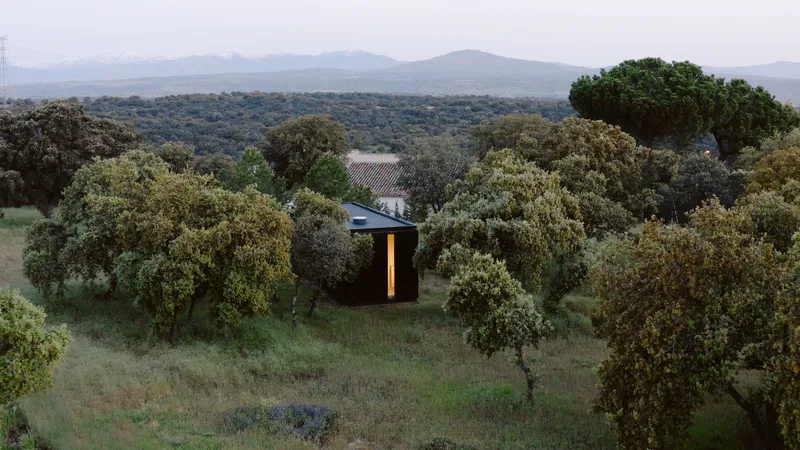

The exterior reads as a single dark object: charred or heat-treated timber cladding wraps the volume in a tone that shifts between deep brown and near-black depending on the hour. At dusk the cabin almost disappears into the silhouettes of the surrounding trees, save for the illuminated doorway that punches a warm rectangle into the facade. That contrast between opaque mass and glowing aperture is the building's primary architectural gesture, and it works precisely because the palette is so restrained.
The long elevation visible in afternoon light reveals how the corner glazing is set back behind a recessed entry, creating a shallow porch zone that mediates between inside and out. It is a small move, but it gives the cabin a sense of depth that most prefab boxes lack. The cladding joints are tight and disciplined, reinforcing the reading of the cabin as a monolithic piece of furniture placed in the landscape rather than a conventional building assembled on it.
Framing the Grove
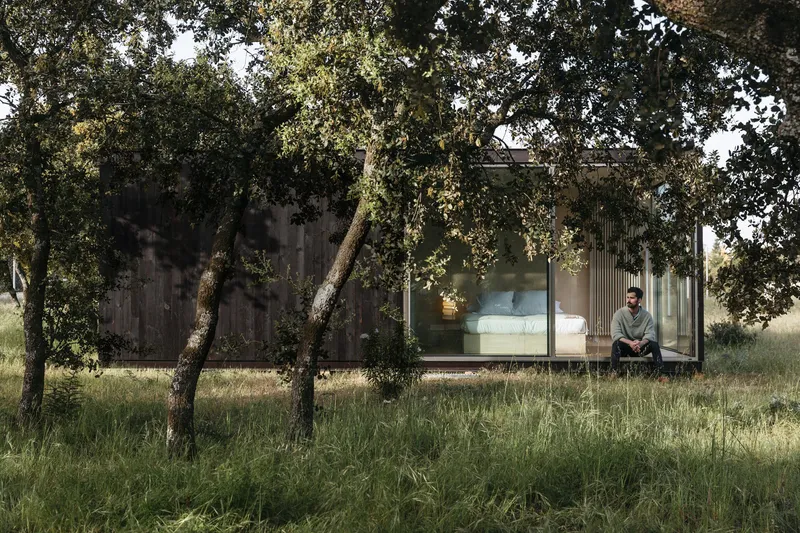
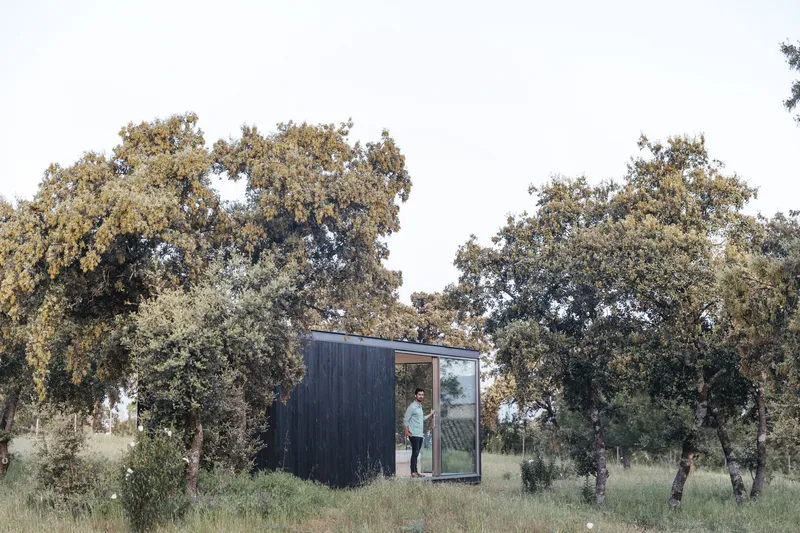
Two large corner windows open the cabin's sleeping and living zones to the olive grove. The glazing runs floor to ceiling and wraps around the corner, dissolving the wall plane and pulling the gnarled trunks and meadow grass into the interior composition. From outside, the effect is almost theatrical: a figure seated on the bed appears framed by the landscape like a subject in a Hockney painting. The glass uses low-emissivity and solar-control coatings, so the expansive openings do not come at the expense of thermal performance.
The strategic placement of these windows matters as much as their size. The opaque facades face directions where privacy or solar control is needed, while the glass is oriented to capture the deepest views and prevailing breezes for cross ventilation. Existing vegetation and the porch overhang provide passive shading, meaning the cabin can remain comfortable through Madrid's aggressive summers without heavy reliance on mechanical cooling.
Plywood Warmth Against a Tight Plan
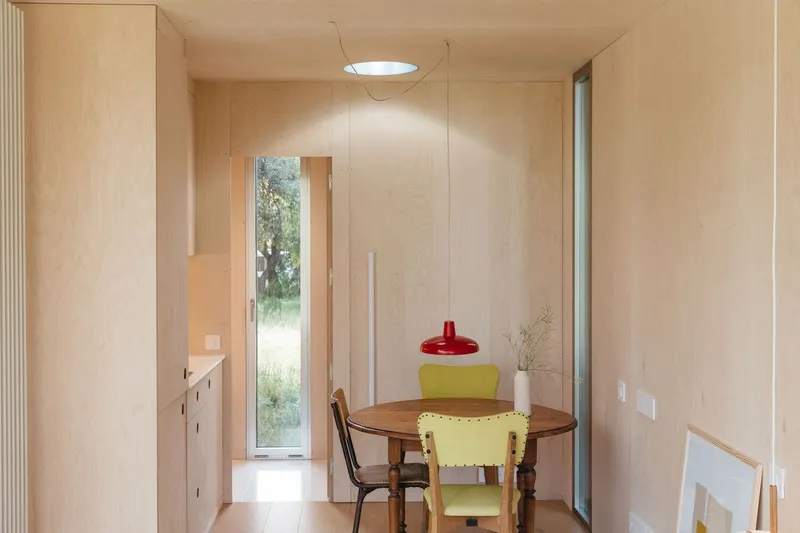
Inside, the material language flips. Where the exterior is dark and closed, the interior is lined in light poplar oriented strand board and plywood, giving the space a warm, almost Nordic quality. The dining alcove captures this duality well: a round table sits beneath a narrow horizontal window that slices the wall like a letterbox, offering a controlled slice of landscape rather than a panoramic wash. It is a reminder that selective framing can be more powerful than total transparency.
The galvanized steel frame is hidden within the wall assembly, which packs 12 centimeters of recycled cotton insulation plus a reflective thermal layer into a surprisingly slim profile. Oak floors and pine furniture complete the interior, and because the cabin arrives fully assembled, the joinery and finish quality can be controlled in a workshop environment rather than improvised on a remote site. The result is a level of craft that belies the 60-day timeline from concept to move-in.
Prefab Logic, Site Sensitivity
Tini's broader system offers cabins from the 12-square-metre XS to configurations of up to 102 square metres by linking two or three modules. The S model sits in a middle ground: large enough to function as a genuine dwelling with a sleeping zone, kitchen alcove, and bathroom, yet small enough to arrive on a single truck and touch the ground at only a few foundation points. The structure slopes with the terrain rather than demanding a leveled pad, which means the olive grove's root systems and topsoil remain largely undisturbed.
The self-sufficient option bundles a septic tank, solar panels, and a water tank, all installable in two to three days. A rainwater capture system can feed a small pond for garden irrigation and evapotranspiration cooling. These are not radical technologies, but their integration into a deliverable package lowers the barrier to building in landscapes that lack conventional infrastructure, which is exactly the kind of terrain most worth inhabiting carefully.
Why This Project Matters
The tiny-house movement has produced an enormous volume of product design masquerading as architecture. What distinguishes the Tini S is that it takes site, orientation, and material consequence seriously. The charred cladding is not a cosmetic choice; it is a durable, low-maintenance response to central Spain's sun and temperature swings. The corner glazing is not a lifestyle image; it is a calculated opening calibrated to view, ventilation, and solar gain. These are architectural decisions, not catalog options.
For designers interested in how prefabrication can coexist with specificity, the cabin offers a useful case study. Its modular bones allow replication, but the siting, material expression, and environmental strategy are tuned to a particular landscape and climate. That dual identity, reproducible yet particular, is exactly where small-scale prefab architecture needs to operate if it wants to be taken seriously as more than a lifestyle accessory.
Tini S Cabin by tini, Madrid, Spain. 23.5 m². Photographs by Paco Marín.
About the Studio
Share Your Own Work on uni.xyz
If projects like this are the kind of work you want to make, uni.xyz is a place to publish your own, find collaborators, and enter design competitions.




Popular Articles
Popular articles from the community


Co-Life: Senior Housing Design That Reconnects Older Adults With the City
Co-Life reimagines senior housing design through healing gardens, shared streets, workshops, and a sustainable community across generations.

The Ocean Hive: Sustainable Architecture for a Self-Sufficient Civilization at Sea
The Ocean Hive imagines sustainable architecture at sea, where modular habitats, algae, wave power and ocean waste sustain a growing colony.

The Musturak Paradise: Senior Living Architecture for a Connected Future in Temara, Morocco
The Musturak Paradise reimagines senior living architecture in Temara via private homes, social spaces, culture, community, and shared care.

Conexión: Biophilic Design Reimagines High-Rise Living in Hong Kong
Conexión reimagines high-rise living in Hong Kong through biophilic design, green facades, shared spaces, daylight, water and nature within.


Similar Reads
You might also enjoy these articles


Hodi-Mandai Geram
Project Function: Preservation and revitalization of the Intangible heritage and socio-spatial identity of the Hodi by Housing, Cultural Memory Center, Sacred Grove, landscape, local tourism economy


Olio Towers: A Mid-Rise for Performers That Fuses Housing, Rehearsal, and Stage
Located blocks from Houston's Theater District, this modular tower stacks living units around a central performance atrium.

Oasis: Modular Green Housing Carved into Dhaka's Urban Fabric
A shortlisted Plugin Housing entry reclaims unauthorized settlements in Dhaka with stepped concrete volumes, green roofs, and ventilation-driven design.

Black Hole: A Floating Megastructure for the Post-Physical Era
Emiliano Mazzarotto envisions a spherical, self-scaling arena where e-sports, digital hotels, and holographic stadiums replace traditional public space.


Explore Housing Competitions
Discover active competitions in this discipline



Challenge to reimagine the Iron Throne


Photograph architecture without architects


Illustrate the lost glory of Angkor Wat - Render Challenge


Design challenge to reuse E-waste
Comments (0)
Please login or sign up to add comments
No comments yet. Be the first to comment!