
YounghanChung Architects Builds a Modern Sarangbang on a 58-Square-Meter Plot in Seoul
Tiny Forest House reinterprets the traditional Korean guest room as a steel-framed retreat overlooking Inwang Mountain in Jongno-gu.


In the historic center of Seoul's Jongno-gu district, the parcels left behind by demolished hanoks are often so small that conventional architecture simply cannot fit. YounghanChung Architects took one such plot, just 58 square meters, and stacked two rotated steel-framed volumes on top of it to produce a 71-square-meter retreat for a retired university lecturer. The brief was personal and specific: a place apart from the client's main home where he could read, host friends, drink wine, and look out at Inwang Mountain. The result, Tiny Forest House, is less a house in the conventional sense and more a contemporary rereading of the sarangbang, the room in a traditional Korean home where the patriarch studied, entertained, and cultivated his inner life.
What makes the project genuinely interesting is how it resolves the tension between a cultural idea of spatial openness and the brutal reality of a site hemmed in by neighbors, height limits under eight meters, and a mandatory cultural-properties survey that preceded construction. Rather than treat constraints as problems to mitigate, YounghanChung treated them as the design itself. The two floors are each conceived as single flexible rooms with services tucked to the rear, while the steel structure, a slender-ratio frame with an 89-millimeter CFT column, is exposed and celebrated rather than hidden. Nothing about the building pretends it is bigger than it is. Everything about it suggests that smallness, handled precisely, can feel generous.
Two Volumes on a Hanok Footprint


From the street, Tiny Forest House reads as two container-like masses: a lower box clad in ash thermowood and an upper one wrapped in white corrugated metal, slightly rotated so that each floor claims different sightlines. The container aesthetic is deliberate but deceptive. These are not prefabricated modules; they are built from a steel frame with transfer beams that allow the upper volume to cantilever toward the alley. The result is a facade that announces its structural logic without turning it into spectacle. Timber warmth at eye level, industrial crispness above, and a single projecting window box at the northwestern corner that locks onto the mountain view like a scope.
Between the building and its brick neighbors, the gap is barely wide enough for a person to pass. Yet the architects turned even this residual space into an asset, using vertical metal slats and planted bamboo to screen the side stair and filter light into the ground floor.
Navigating the In-Between
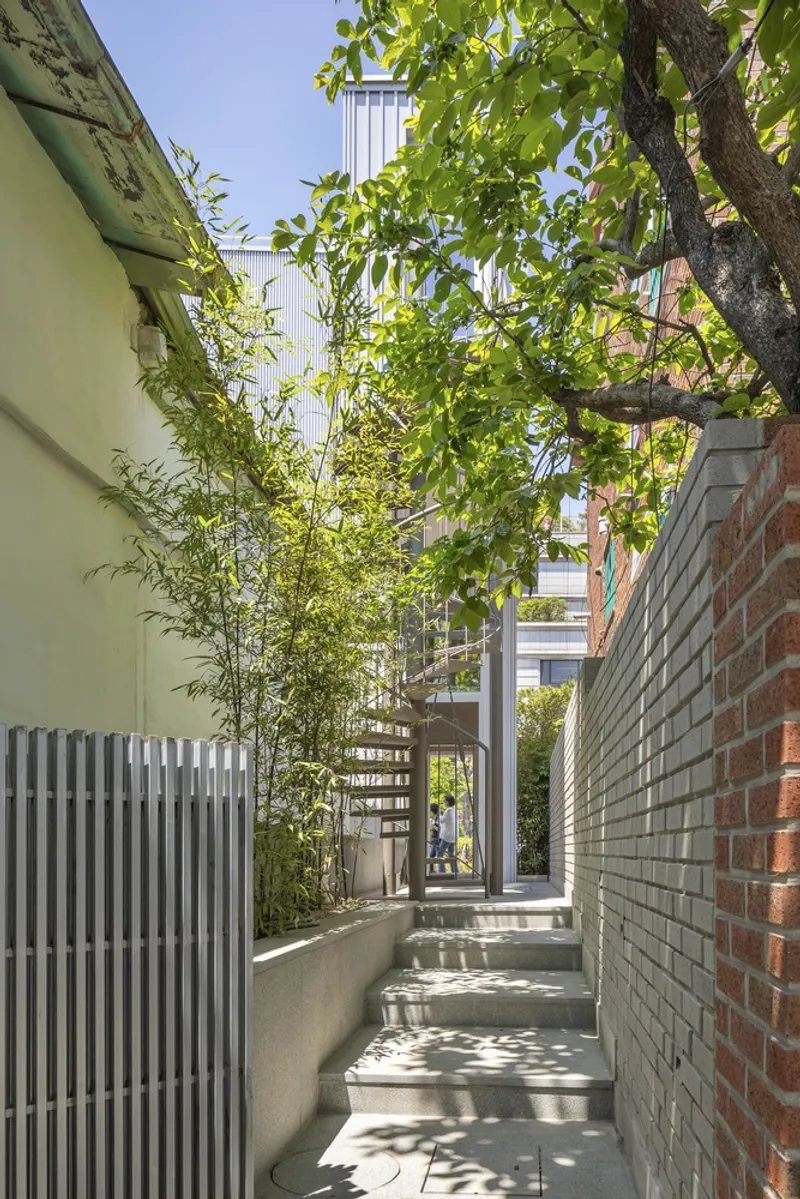

The side passage and exterior stair reveal how tightly the building negotiates its boundaries. Flanked by metal slats on one side and a neighbor's wall on the other, the circulation path doubles as a planted threshold that slows your approach and frames the transition from street to interior. The bamboo here is not decorative filler; it creates a green buffer that softens the alley edge and offers the ground floor a degree of privacy it would otherwise lack.
An overhead view shows a spiral stair tucked beside a preserved tree, its branches pressing close to the clay tiles of a surviving hanok roof. The juxtaposition is not accidental. Jongno-gu's fabric is a patchwork of old and new, and Tiny Forest House sits within that grain rather than against it. The two-story height limit and the small-parcel geometry are inheritances from the hanok era, and the building's massing respects both without imitating historical form.
A Single Room, Many Uses


Step inside and the strategy becomes clear. Each floor is essentially one room. The ground level, with its exposed steel structure painted white and birch plywood surfaces finished in transparent varnish, reads as a bright, neutral volume that the occupant can claim for whatever purpose the day requires. White partition volumes contain the bathroom and storage at the rear, while overhead, exposed timber ceiling joists and skylights pull daylight deep into the plan. There are minimal fixings and fittings because the architect deliberately refused to dictate a single use. The space is a frame; the client fills it.
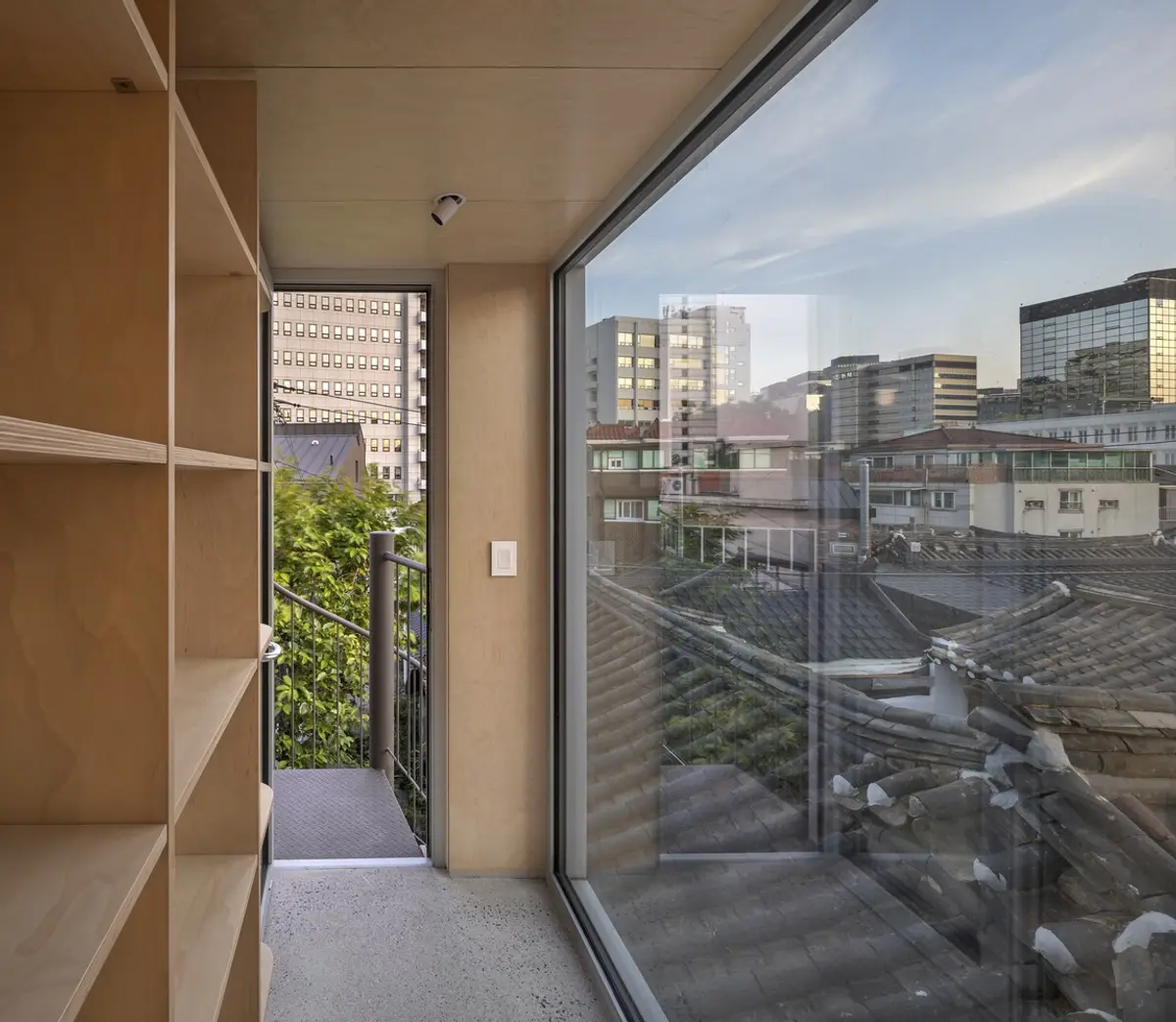
Upstairs, the mood shifts. The wood-lined room with built-in desk and bookshelves along one wall operates as a study, a lounge, or a reception room depending on the occasion. A threshold opens onto a balcony with a metal railing, and from there the eye travels over greenery to the ridgeline of Inwang Mountain. This is the sarangbang moment: the host, surrounded by books and friends, gazing at a landscape that generations of Seoul's scholars contemplated before him. The architecture does not insist on that narrative, but it makes the narrative available.
Rooftops as Borrowed Landscape
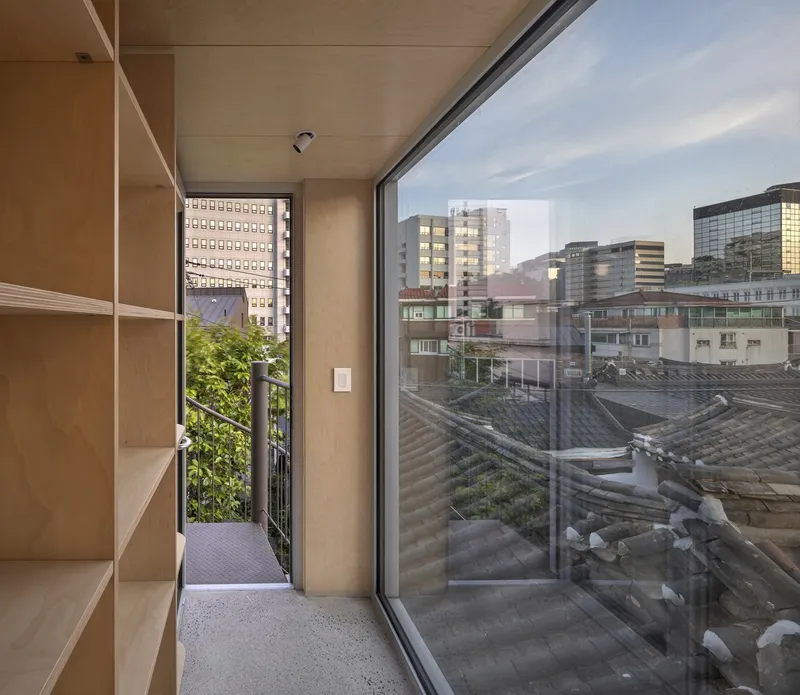
The plywood-lined balcony, photographed at dusk through full-height glazing, may be the building's most evocative space. From here, the neighboring hanok tile roofs spread out like a maze of interconnected rooms, and the small scale of the surrounding buildings means the sky is always present. YounghanChung Architects did not need to build height to capture a view; they simply rotated the upper volume a few degrees and opened a generous window where it mattered most.
The cantilevered window box, supported by a single 89-millimeter CFT column, extends roughly three meters toward the alley. Structurally, this is the move that gives the upper floor its feeling of suspension, as though the room is leaning out to meet the mountain. Visually, it makes the building legible from the street as something more than a stacked pair of boxes. It is a small gesture with outsized effect, and it exemplifies the project's operating principle: precision over size.
Why This Project Matters
Tiny Forest House matters because it refuses the two easiest responses to extreme site constraints: resignation to mediocrity or overcompensation through formal gymnastics. YounghanChung Architects chose a third path, one rooted in structural clarity, material restraint, and cultural memory. The sarangbang concept is not a nostalgic footnote here; it is the organizational logic that allows 71 square meters to serve as study, gallery, wine bar, and guest room without any of those functions requiring dedicated partitions or fixed furniture.
As Seoul's land prices continue to climb and its hanok-scale parcels are increasingly developed, projects like this one offer a credible model for how density can coexist with dignity. The building proves that a slender steel column, a rotated volume, and a well-placed window can produce an experience of spaciousness that has nothing to do with square meters. For anyone designing on leftover urban land, that is a lesson worth studying.
Tiny Forest House by YounghanChung Architects. Jongno-gu, Seoul, South Korea. 71 m². Completed 2022. Photography by Yoon Joon-hwan.
About the Studio
YounghanChung Architects
Share Your Own Work on uni.xyz
If projects like this are the kind of work you want to make, uni.xyz is a place to publish your own, find collaborators, and enter design competitions.


Popular Articles
Popular articles from the community


Juan García Correa, John González and Claudia Rueda Sink a Circular Amphitheater into a Manizales Engineering Building
On the La Nubia campus in Manizales, Colombia, the S1 Building folds labs and offices into a hillside of ramped lawns that double as a campus route.

Jaramillo Van Sluys Arquitectura and Urbanismo Turn a Demolished Registry Lot in Quito into an Orchard Plaza
In Quito's Centro Histórico, a 2,800 m² plaza exposes the San Agustín convent wall and redraws its lost Augustinian orchard in volcanic stone.

David Ortega Stacks a Two-Story Mexico City Penthouse Around a Steel Stair and a Pergola-Shaded Roof Terrace
In Colonia Roma, a 300 m² penthouse uses oak joinery, a planted steel stair and a slatted roof pergola to make a new-build apartment feel like a house.

Architekt Andreas Gruber Scatters 23 Dark Timber Chalets Across a South Tyrolean Forest Edge
In Molini di Tures, Amonti Chalets breaks a resort into a hamlet of gabled timber houses, with parking, storage and services pushed into the slope.

Similar Reads
You might also enjoy these articles


Hodi-Mandai Geram
Project Function: Preservation and revitalization of the Intangible heritage and socio-spatial identity of the Hodi by Housing, Cultural Memory Center, Sacred Grove, landscape, local tourism economy


Olio Towers: A Mid-Rise for Performers That Fuses Housing, Rehearsal, and Stage
Located blocks from Houston's Theater District, this modular tower stacks living units around a central performance atrium.

Oasis: Modular Green Housing Carved into Dhaka's Urban Fabric
A shortlisted Plugin Housing entry reclaims unauthorized settlements in Dhaka with stepped concrete volumes, green roofs, and ventilation-driven design.

Black Hole: A Floating Megastructure for the Post-Physical Era
Emiliano Mazzarotto envisions a spherical, self-scaling arena where e-sports, digital hotels, and holographic stadiums replace traditional public space.

Explore Tiny House Competitions
Discover active competitions in this discipline

Challenge to reimagine the Iron Throne

Photograph architecture without architects

Illustrate the lost glory of Angkor Wat - Render Challenge

Design challenge to reuse E-waste
Comments (0)
Please login or sign up to add comments
No comments yet. Be the first to comment!