
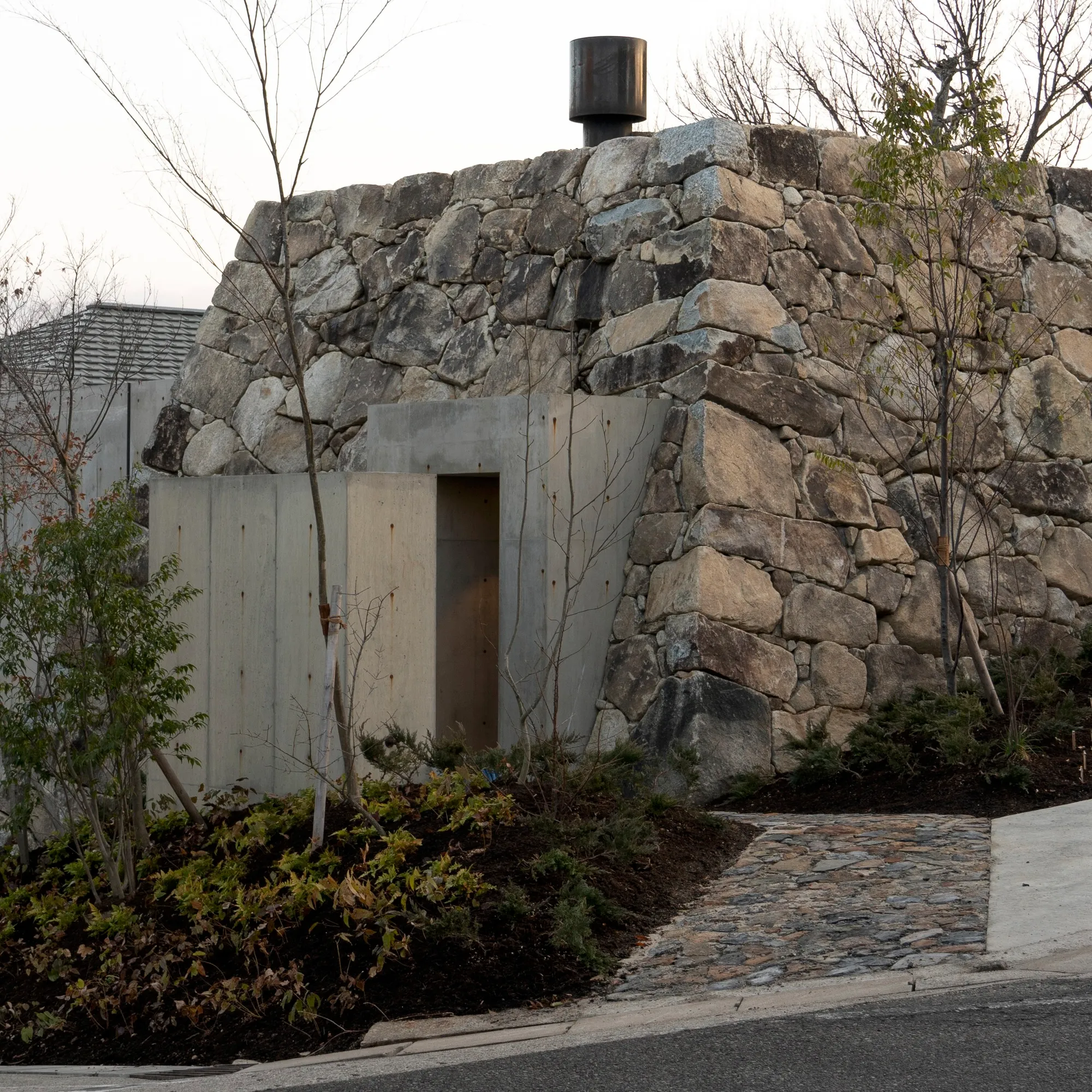
Tomoaki Uno Architects Builds an Aztec-Inspired Stone Pyramid House in Nagoya
A truncated stone pyramid and concrete volume create an introverted domestic refuge in one of Nagoya's leafy university districts.


There are not many residential projects that cite an Aztec pyramid as a primary reference without the result feeling absurd. Takamine-cho House, designed by Tomoaki Uno Architects and completed in 2021 on a sloped corner site in Nagoya, is one of them. The 189 square meter house is organized as two interlocking volumes: a truncated stone pyramid built using traditional Japanese field masonry and a board-formed concrete block, each sheltering different parts of the domestic program. The pyramid contains a study; the concrete volume holds everything else. Between them, two gardens (a water garden and a courtyard) pull light and air into a building that otherwise turns a nearly windowless face to the street.
What makes the project genuinely interesting is the collision of references. The formal cue comes from the Pyramid of Tenayuca in the Valley of Mexico. The construction method is Japanese dry stone masonry, a technique historically reserved for castle foundations and defensive walls. The material palette is concrete, stone, iron, and timber. None of these things should cohere, and yet the house reads as singular, almost geological, as though it has always occupied this hillside in Nagoya's upscale university district, a half-hour drive from Nagoya Station.
A Boulder on the Street

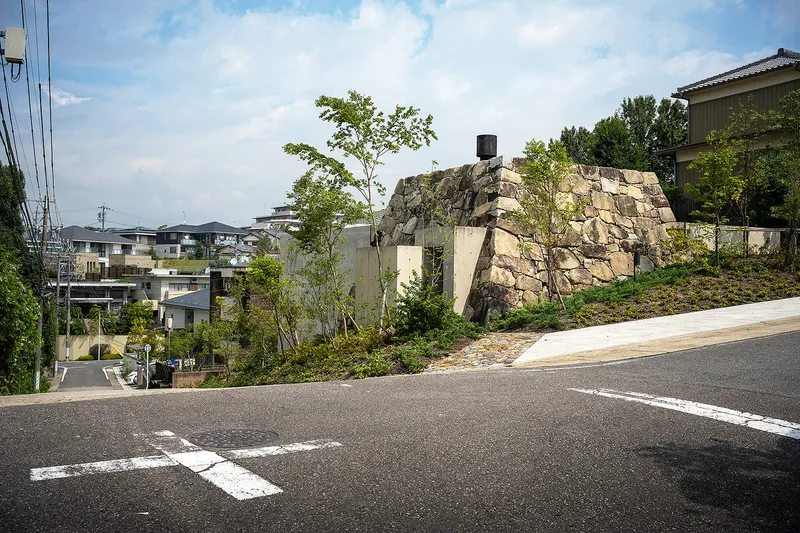
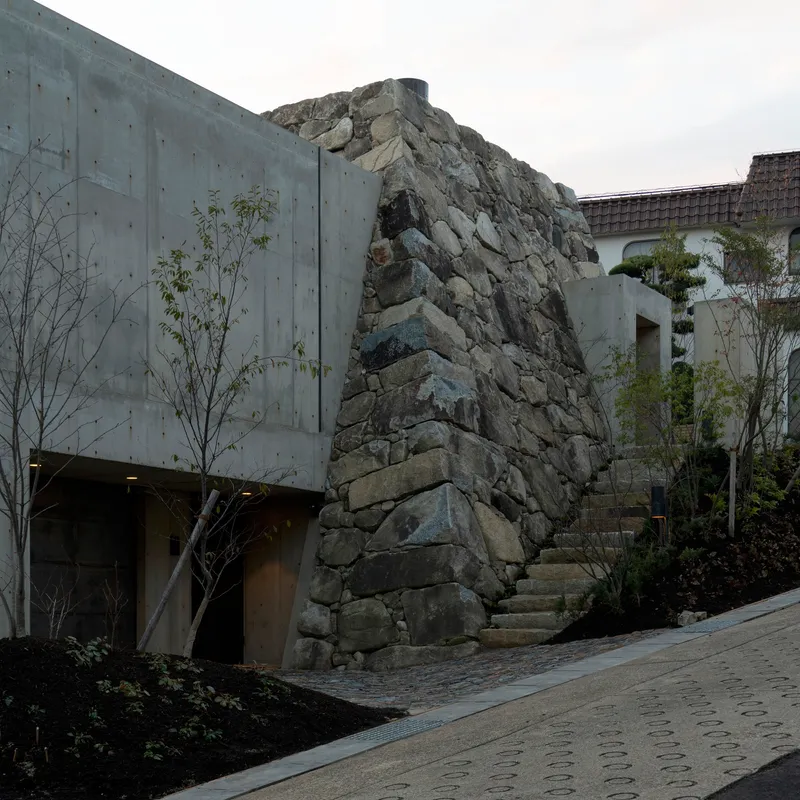
From the street, Takamine-cho House barely registers as a house at all. The stone pyramid sits on a graded hillside among young trees, looking more like an excavated geological formation than a piece of architecture. Two street-facing elevations carry no windows whatsoever: privacy is total. The Japanese field masonry technique, which warps gradually as it is built up, gives the stone surfaces a lived-in irregularity that reinforces the impression of something unearthed rather than constructed.
The decision to use dry stone construction at this scale for a private house is unusual even by Japanese standards. Tomoaki Uno describes the pyramid as the first built in Japan using traditional Japanese masonry methods. The technique demands patience: each stone is set without mortar, relying on friction and gravity alone, the same principles that have held castle walls in place for centuries.
Concrete and Stone in Dialogue


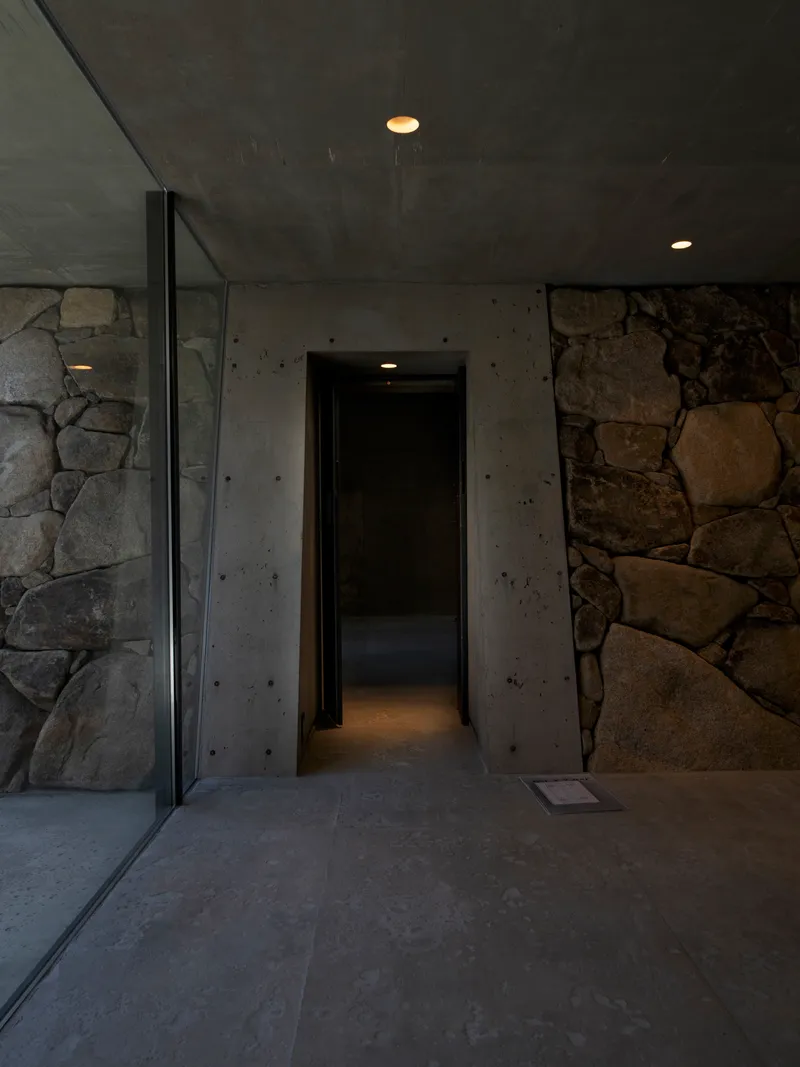
Where the concrete volume meets the stone pyramid, the house reveals its threshold. The entrance is a portal carved between these two masses: board-formed concrete on one side, raw boulder on the other. At dusk, warm interior light spills through the glazed gap, turning the entry into a lantern. A black chimney cap crowns the composition above, hinting at the fireplace within the pyramid study.
The material contrast is deliberate and sustained. Board-formed concrete carries the texture of wood grain and the rhythm of tie-hole patterns across its surfaces, while the stone walls remain rough and unevenly coursed. Iron sashes, originally planned in copper but changed during construction, provide a third register: dark, thin, deliberately industrial against the weight of the other two materials.
The Inverted Section


The program is flipped. Bedrooms occupy the lower level, arranged around a garage, while the living, dining, and kitchen functions are elevated to the upper floor. The study inside the pyramid can be reached from the living space or directly from the street via an external staircase, giving it a semi-autonomous character. It functions as a room between the public and private realms, a threshold space with its own skylight and a view over the water garden.
Moving through the entry corridor, rough stone walls compress the space before the concrete staircase with its black steel handrail leads upward. The sequence is architectural compression followed by release: from tight stone passage to the open, skylit social spaces above.
Courtyards and Controlled Light


The upper floor's L-shaped plan wraps around a private courtyard, and the glass curtain walls that face it are the primary source of daylight for the living and dining areas. Because the street elevations are blank, all visual and luminous connection to the outside happens through these inward-facing gardens. The effect is monastic: the world outside the walls is irrelevant; only the sky, the courtyard tree, and the stone surfaces matter.


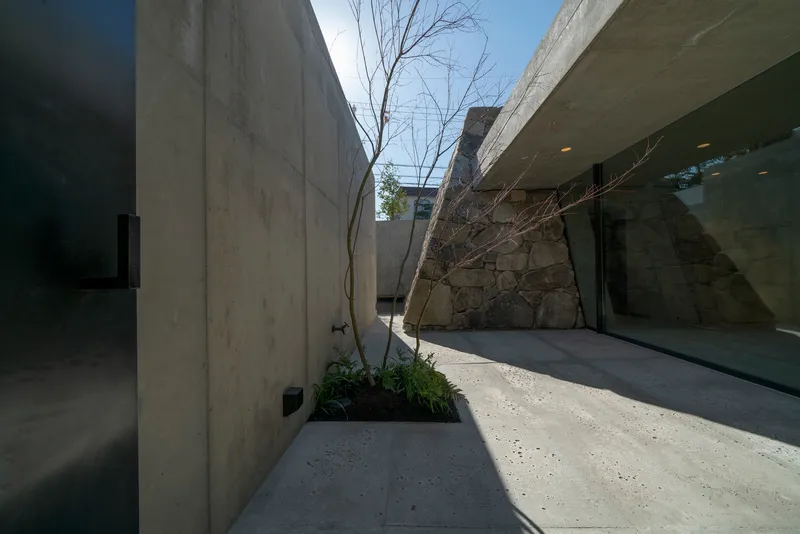
The water garden occupies one corner, visible from the pyramid study. A narrow exterior passage between the concrete walls and the stone mass accommodates a young birch tree, its pale bark a precise counterpoint to the dark materials surrounding it. Even in these tight interstitial spaces, Uno has been careful to compose views. Nothing feels leftover.
The Pyramid Study and Its Fireplace

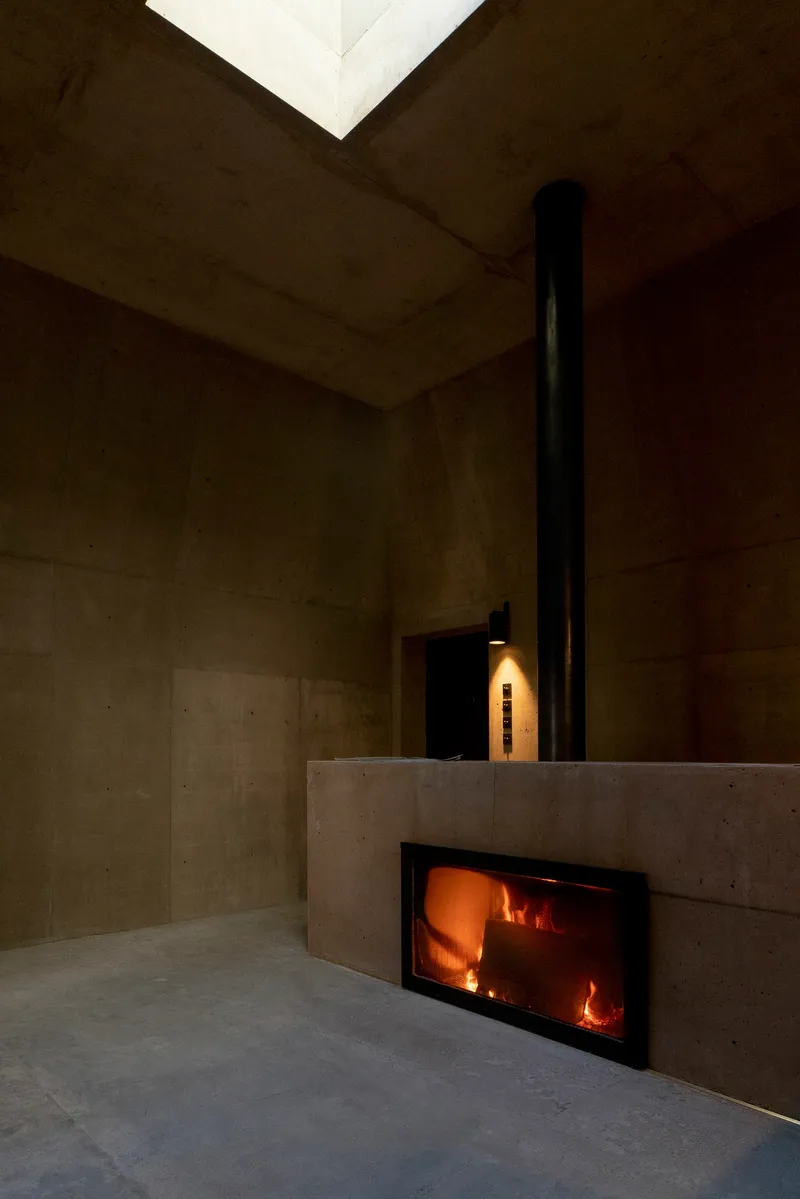

The most atmospheric room in the house is the study inside the pyramid. Its interior is lined with concrete panels, and a concrete fireplace with a black metal flue anchors one wall. A skylight overhead washes the rough surfaces with shifting daylight. At dusk, with the fire lit, the room takes on a cave-like quality that is both primordial and deliberately refined. The horizontal window carved into the board-formed concrete provides a controlled slice of brightness against the heavy enclosure.
There is a temptation to read this room as theatrical, but its proportions and materiality keep it grounded. The fireplace is not a decorative object; it is the spatial anchor. The skylight is not a gesture; it is how you read in this room without turning on a lamp. Uno has calibrated each element to serve the space rather than to perform.
Timber, Skylights, and the Kitchen


Against the dominant palette of stone and concrete, the kitchen and dining area introduce warm timber cabinetry that softens the upper floor considerably. Series of small skylights punched through the exposed concrete ceilings send narrow beams of light across the wood surfaces, creating a shifting pattern throughout the day. The effect is domestic in the best sense: these are rooms that clearly want to be inhabited, cooked in, lingered over.


The living room, lined with plywood, has a corner skylight and a framed window looking onto the courtyard. The close-up of the board-formed concrete reveals the wood grain texture and tie-hole pattern that give these walls their tactile depth. Uno's detailing is consistent but never monotonous; every surface rewards close inspection.
Plans and Drawings


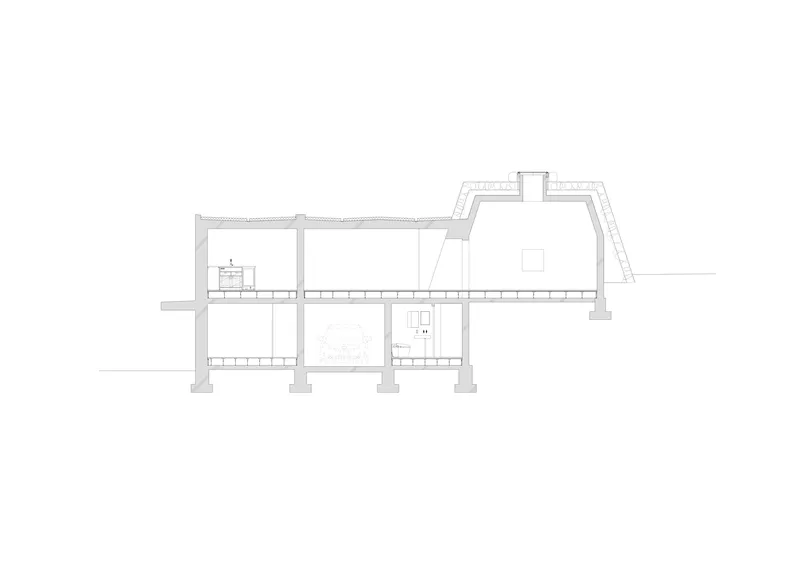
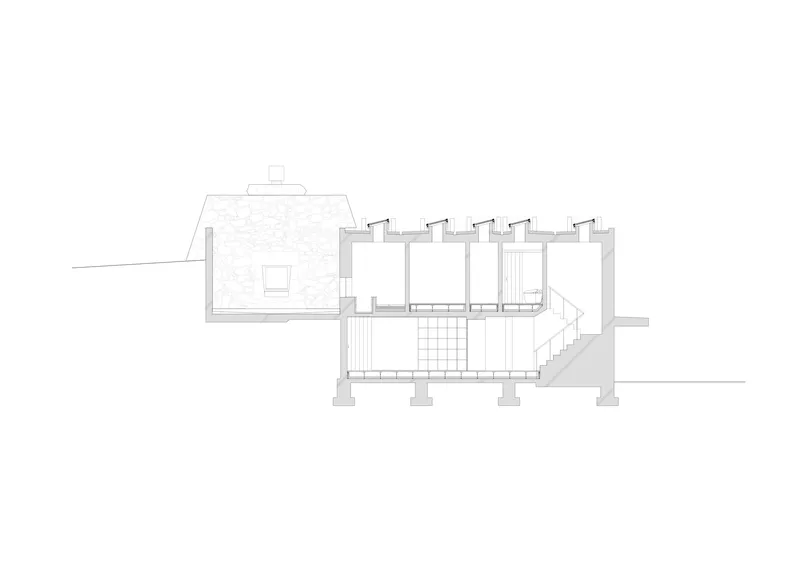


The ground floor plan reveals how the garage and five bedrooms (one primary, four smaller) pack tightly around the pyramid's triangular footprint, while the upper floor plan shows the L-shaped living spaces wrapping the courtyard with an exterior stair reaching the pyramid study from the street. The sections are revealing: they expose the two-story vertical relationship and the way the pyramid's sloped profile generates the study's distinctive ceiling geometry. The four elevations confirm the project's fortress-like character, with the chimney, horizontal window band, and sloping stone walls composing different silhouettes depending on the approach.
Why This Project Matters
Takamine-cho House is a provocation wrapped in masonry. By grafting Mesoamerican formal logic onto Japanese construction traditions and placing the result in a leafy Nagoya suburb, Tomoaki Uno has produced a house that resists easy categorization. It is not revivalist, not brutalist, not minimalist. It is a private world made of old techniques and heavy materials, calibrated for the specific conditions of its sloped corner site.
The project matters because it demonstrates that material commitment still counts. In an era of thin skins and digital renders, Uno built a truncated pyramid out of dry-stacked stone using a method as old as Japan's castles. The house is a reminder that architecture's most powerful moves are often the most physically direct: stack stone, pour concrete, cut a skylight, light a fire.
Takamine-cho House by Tomoaki Uno Architects (lead architect: Tomoaki Uno), Nagoya, Japan. 189 m², completed 2021. Photography by Yasuo Hagiwara.
About the Studio
Share Your Own Work on uni.xyz
If projects like this are the kind of work you want to make, uni.xyz is a place to publish your own, find collaborators, and enter design competitions.



Popular Articles
Popular articles from the community


The Ocean Hive: Sustainable Architecture for a Self-Sufficient Civilization at Sea
The Ocean Hive imagines sustainable architecture at sea, where modular habitats, algae, wave power and ocean waste sustain a growing colony.

The Musturak Paradise: Senior Living Architecture for a Connected Future in Temara, Morocco
The Musturak Paradise reimagines senior living architecture in Temara via private homes, social spaces, culture, community, and shared care.

The Earth Pod: 3D Printed Homes for Resilient Refugee Communities
The Earth Pod reimagines refugee housing through 3D printed homes made from clay, combining resilience, self-sufficiency, and rapid shelter.

Co-Life: Senior Housing Design That Reconnects Older Adults With the City
Co-Life reimagines senior housing design through healing gardens, shared streets, workshops, and a sustainable community across generations.

Similar Reads
You might also enjoy these articles

Bao Huynh Watercolor Atelier: A Serene Art Retreat in Hội An
Bao Huynh Watercolor Atelier in Hội An blends multifunctional art spaces, sustainable design, local materials, and family-friendly living in a serene environment.

Atelier Macri Concept Store Interior Design by CASE-REAL
Atelier Macri store features a "ko" counter, walnut wood details, cork displays, blending retail, gallery, and seamless customer experiences.

Manuel Vargas Izquierdo Stadium and High-Performance Sports Center: Architectural Excellence in Jalpa de Méndez
The Manuel Vargas Izquierdo Stadium blends sustainable design, inclusive sports facilities, and cultural-inspired architecture, revitalizing Jalpa de Méndez’s public spaces.

KAKR Buluh Awar Hall: Revitalizing Community and Ecology Through Bamboo Architecture
Community built bamboo hall revitalizes Buluh Awar village, empowering youth, restoring ecology, celebrating vernacular craftsmanship through sustainable architecture and culture.




Comments (0)
Please login or sign up to add comments
No comments yet. Be the first to comment!