
Blocher Partners India Stacks Toy Block Volumes into a Kindergarten Built Around Courtyards
A Reggio Emilia-inspired school in India organizes terracotta-clad classroom blocks around planted courtyards and sky-lit interiors.


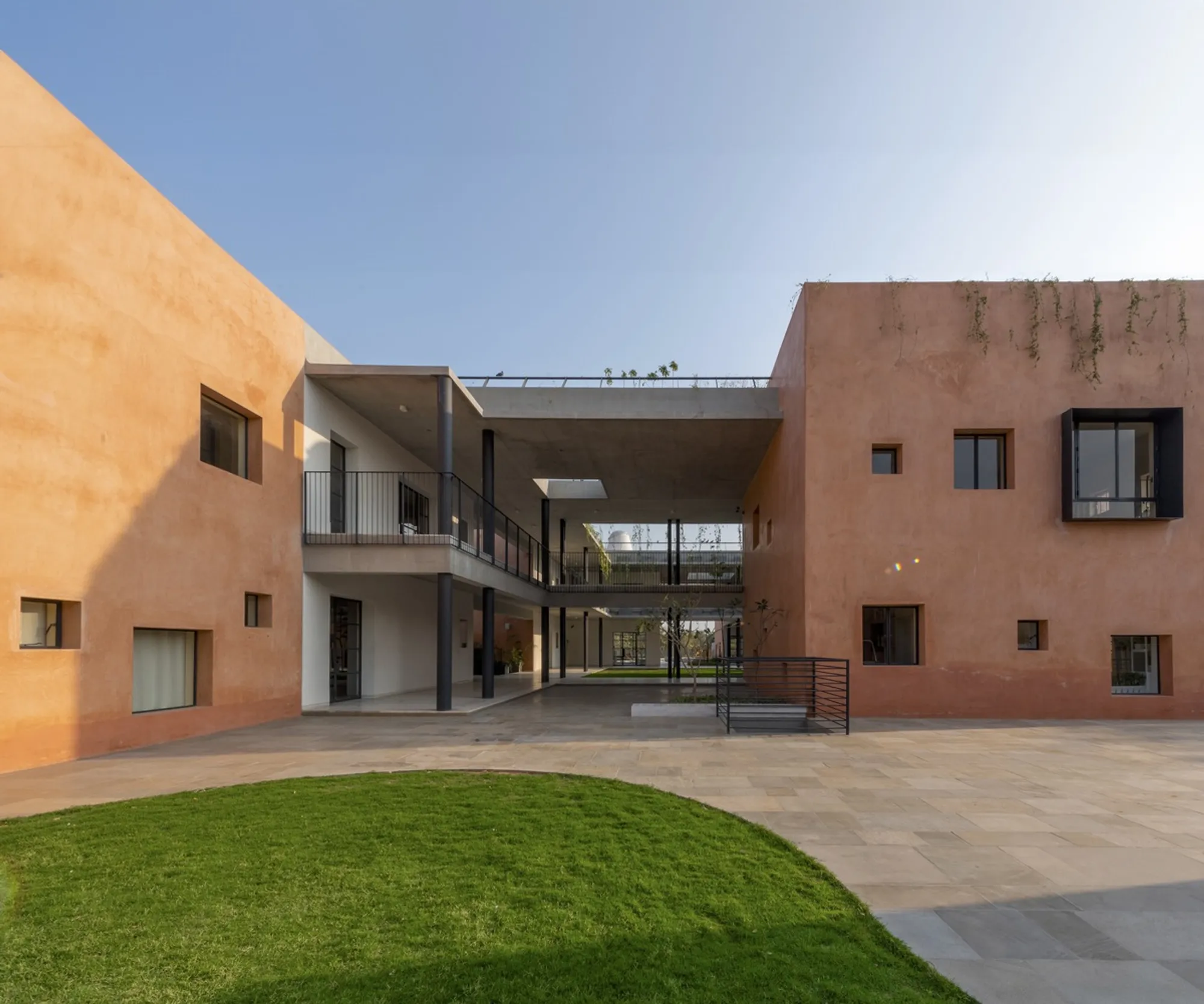
The name says it all. Blocher Partners India conceived this kindergarten as a collection of stacked volumes, each one scaled to a child's sense of proportion and arranged with the playful logic of building blocks. The result is a campus that reads simultaneously as a single institution and as a cluster of discrete rooms, each oriented toward a shared courtyard. Terracotta plaster unifies the exterior, while exposed concrete and black steel provide structural legibility that children can intuitively follow from ground level up through elevated walkways.
What makes this project genuinely worth studying is the discipline with which the architects translate Reggio Emilia pedagogy into spatial terms. Rather than relying on bright paint and signage to signal "child-friendly," the building does the work through section: rooms open upward into oval skylights, corridors frame courtyard views, and every classroom has a distinct ceiling treatment that gives it identity. The environment is the third teacher, as the saying goes, and here that idea is taken literally in concrete, timber, and mosaic.
Courtyard as Organizing Principle
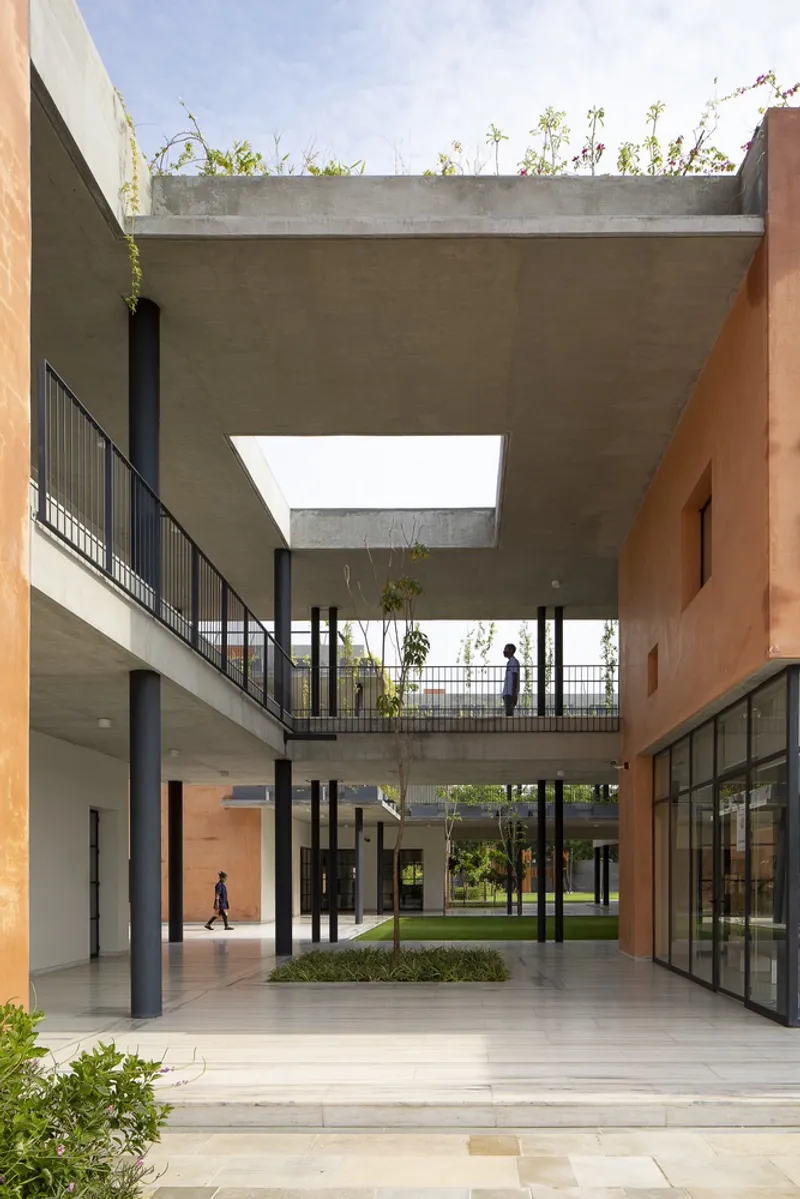
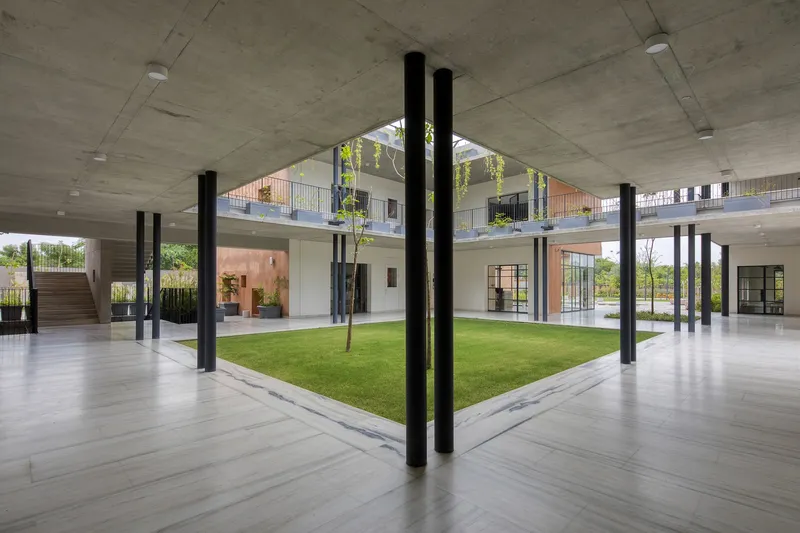
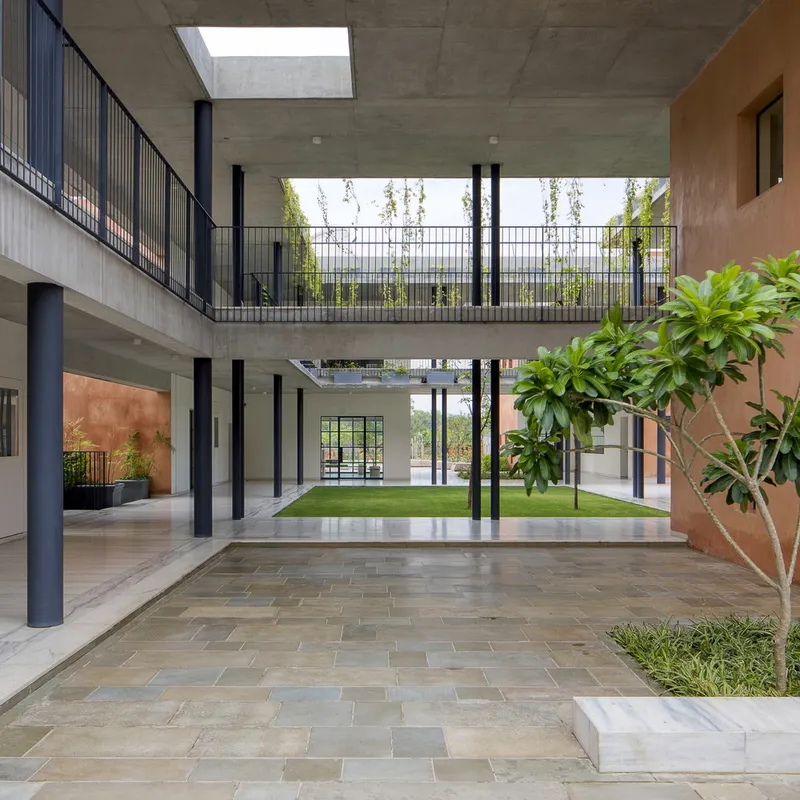
The campus is organized around a series of courtyards that serve as both circulation spine and outdoor classroom. Grass, young trees, and concrete planters populate the ground plane, while covered walkways at multiple levels allow children and teachers to observe the courtyard from above. The effect is something closer to a small village than a monolithic school building, with sightlines that encourage curiosity and a sense of spatial orientation even for very young children.
Black steel columns at the ground floor keep the perimeter porous, letting air and light move freely through the building's lower register. This open ground condition means that even on covered days, natural ventilation pulls through the corridors. The courtyard lawns are generous enough for unstructured play but compact enough that a teacher standing at any balcony can survey the entire space.
Terracotta Skin and Concrete Bones
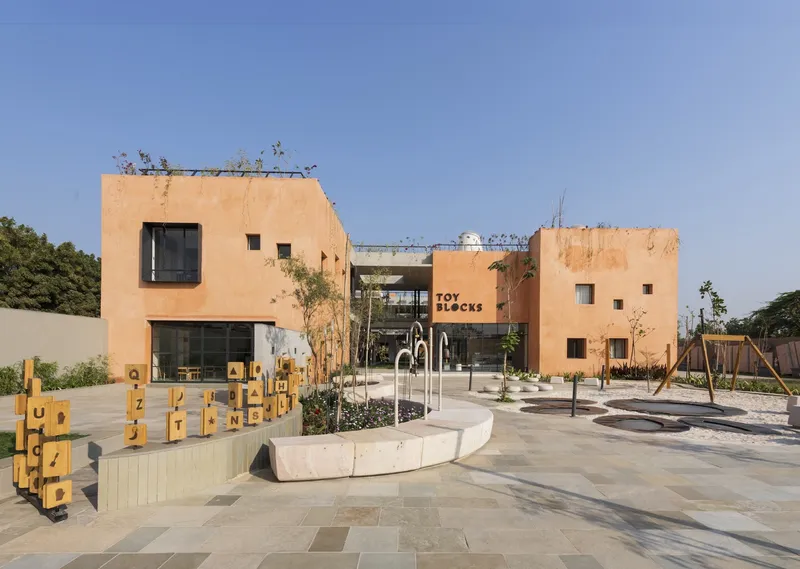
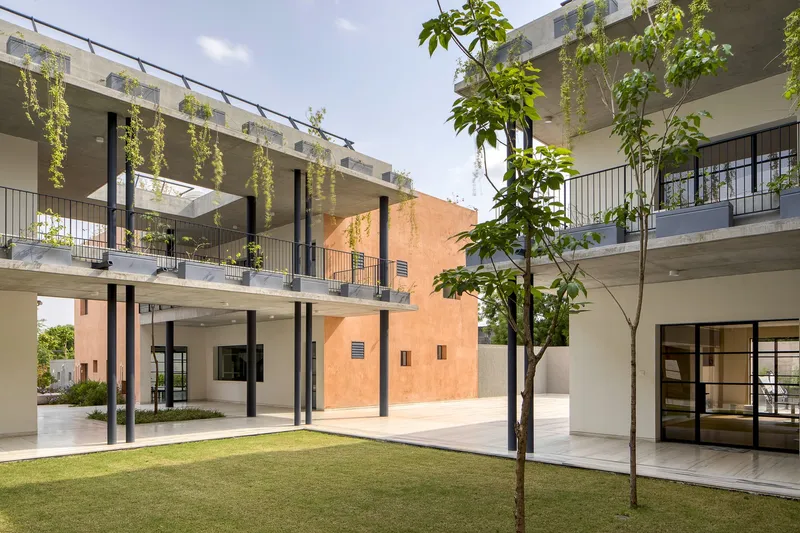
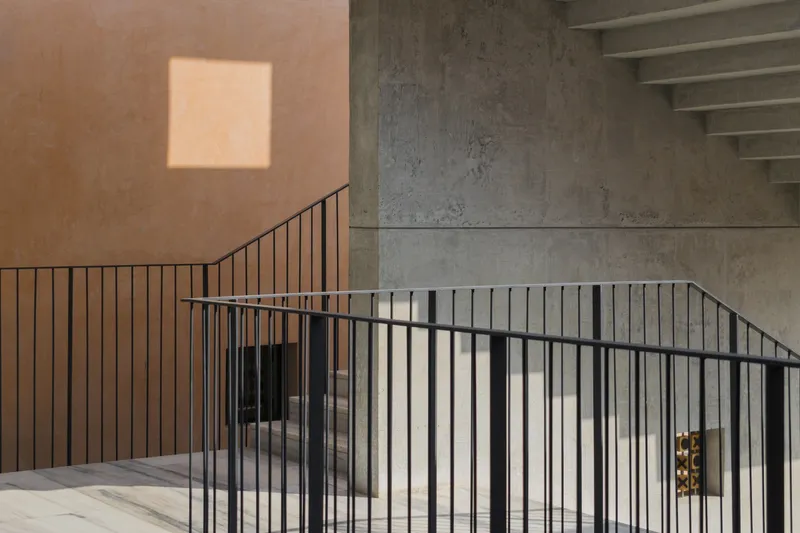
The palette is restrained to the point of stubbornness: terracotta plaster walls, exposed concrete structure, and black painted steel. There is not a single material here that pretends to be something else. The terracotta reads warm and earthy from the courtyard, aging gracefully in a way that vinyl-clad schools never will. Against that warmth, raw concrete stair cores and walkway soffits provide a cooler counterpoint, and the black steel railings draw clean graphic lines across each elevation.
The stairwell captured in afternoon light is particularly telling. Where many architects would have enclosed or decorated these transition spaces, Blocher Partners India leaves the junction between plaster and concrete fully visible. Children passing through can literally see how the building is put together, a detail that aligns neatly with the Reggio Emilia emphasis on transparency and process.
Elevated Walkways and Vertical Connection
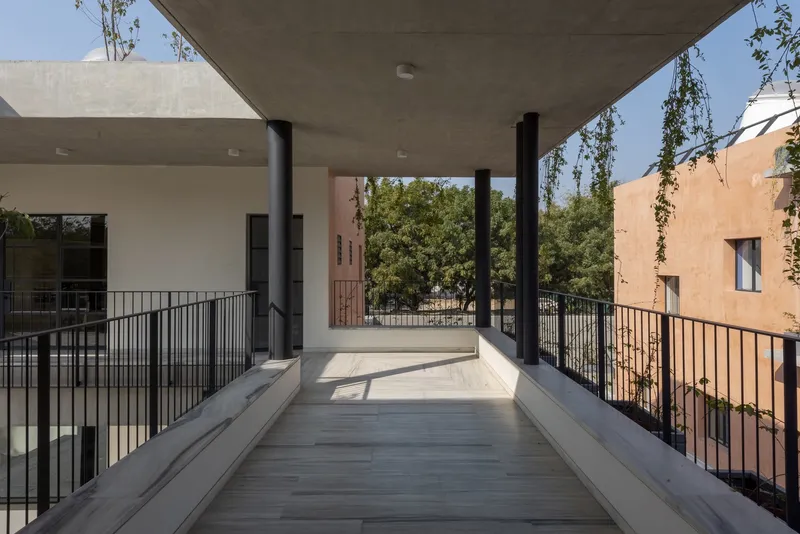
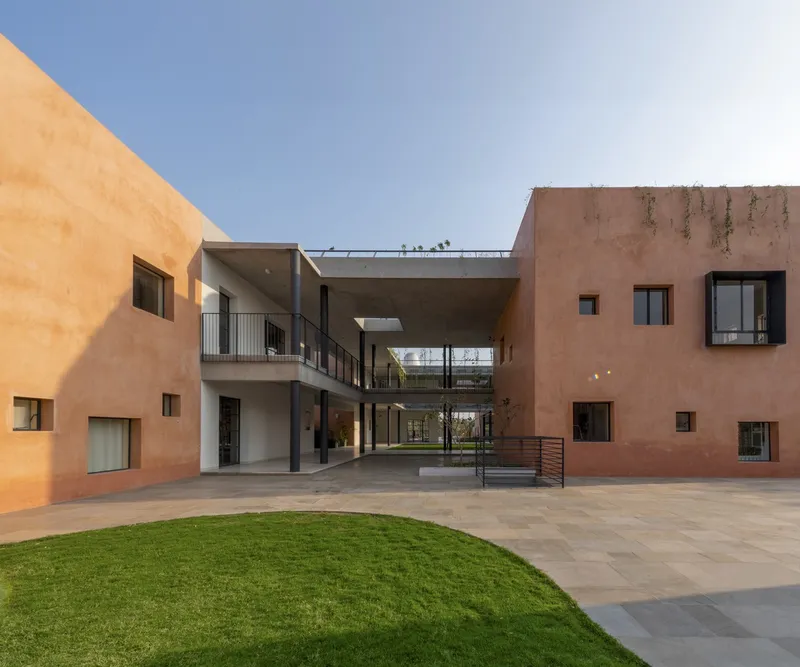
Bridges and elevated walkways stitch the separate volumes together at upper levels, turning what could be a disjointed cluster into a continuous loop. These connections double as covered outdoor spaces with views down into the courtyard, giving children a vantage point they rarely get in conventional schools. The steel railings are scaled tightly enough for safety without feeling cage-like, and the walkways are wide enough that two groups of children can pass each other comfortably.
From the courtyard floor, these bridges create a layered section that changes character as you look up: lawn, then colonnade, then balcony, then sky. It is a rich spatial sequence compressed into just a few stories, and it gives the campus a sense of vertical generosity that belies its modest height.
Ceilings That Teach
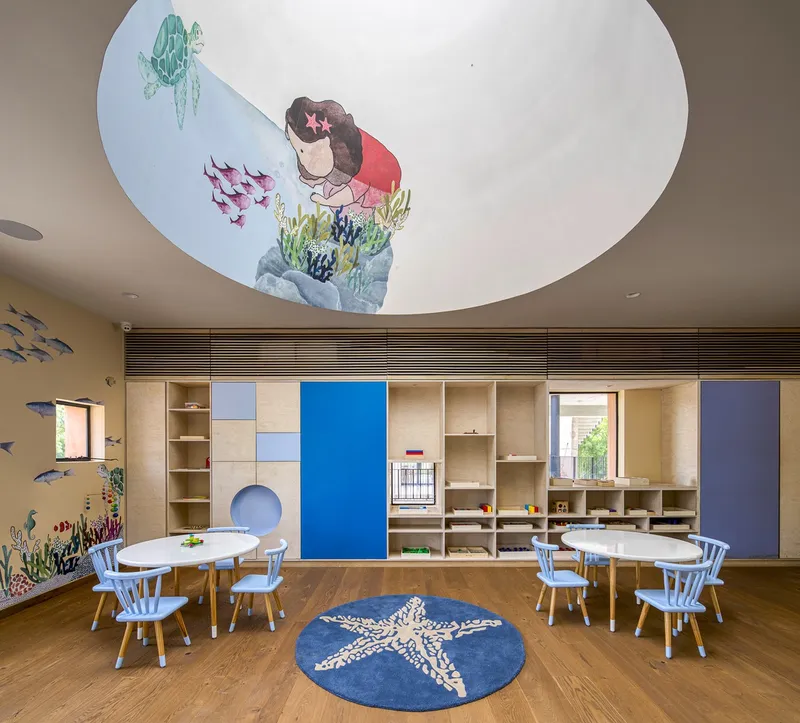
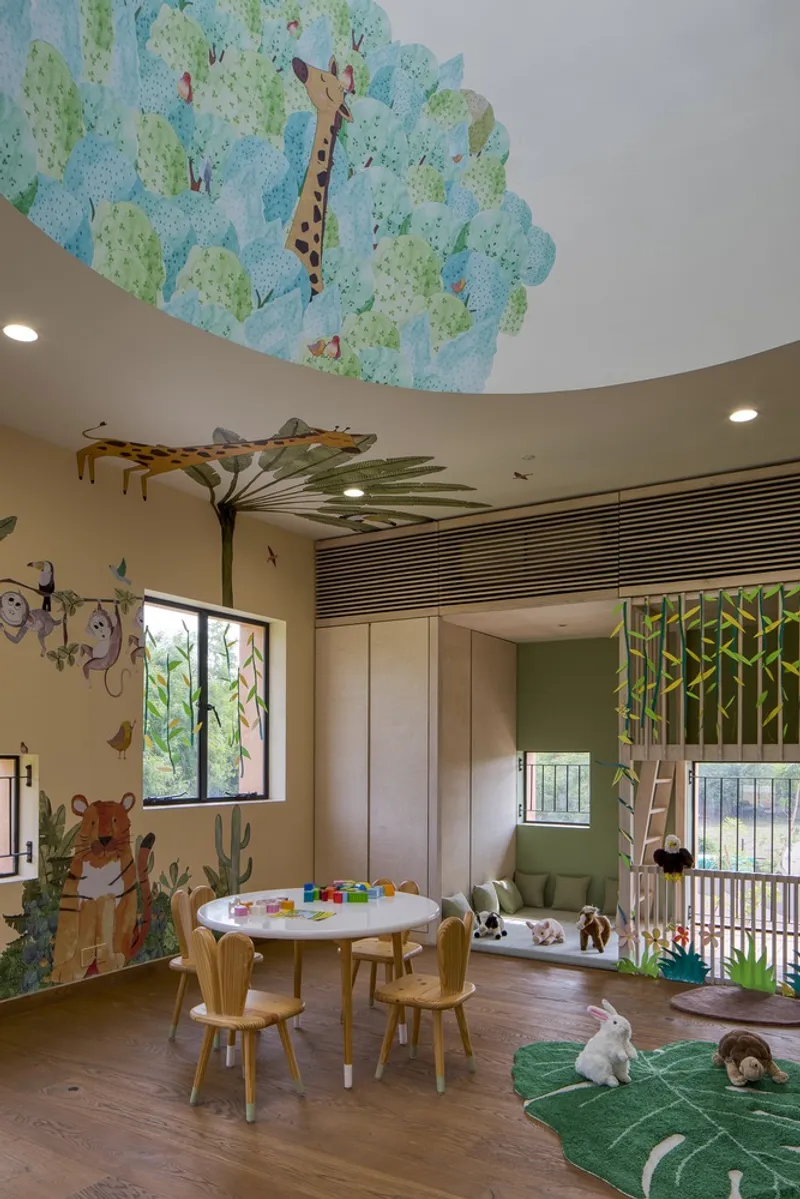
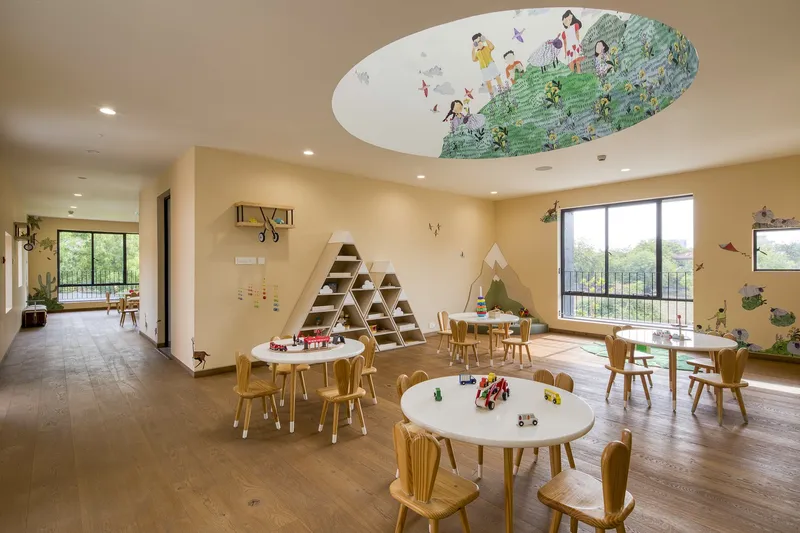
Each classroom is crowned with a hand-painted ceiling mural that defines the room's personality. One depicts an underwater scene above a modular plywood storage wall; another features a jungle canopy rendered in loose brushwork; a third shows children at play beneath an oval skylight. These are not decorative afterthoughts. In a space designed for users who spend a great deal of time looking up, the ceiling becomes the most important surface in the room.
The skylights are the real move here. By cutting oval and circular openings into the roof slab and painting the surrounding ceiling, the architects create a kind of inhabitable illustration. Diffused daylight washes across the murals throughout the day, subtly changing the mood of each room. It is a low-tech strategy with a high payoff, and it eliminates the need for uniform fluorescent lighting during school hours.
Rooms Designed for Small Bodies
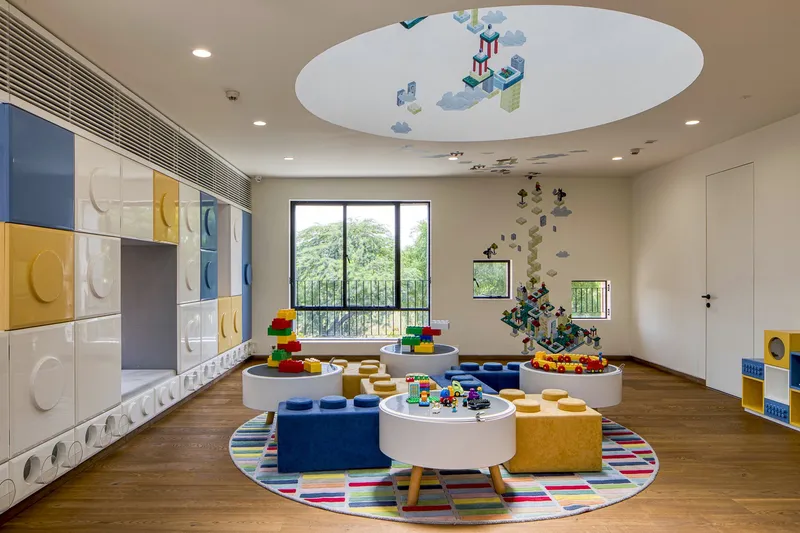
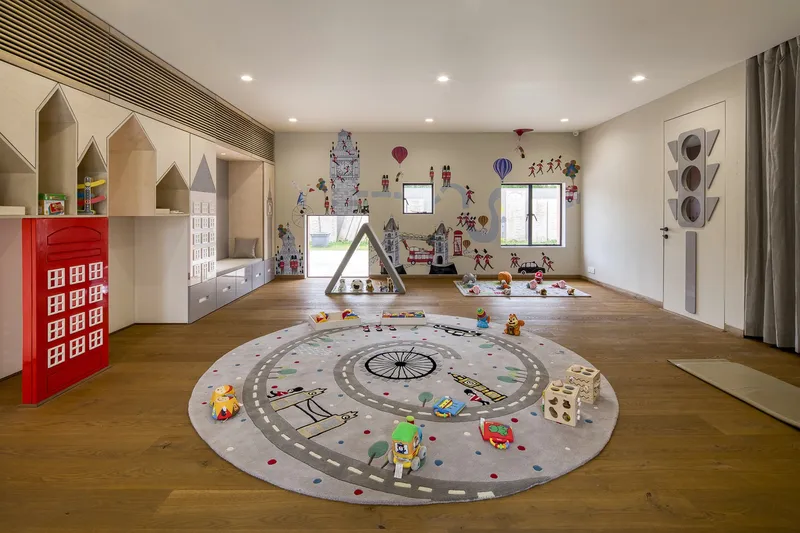
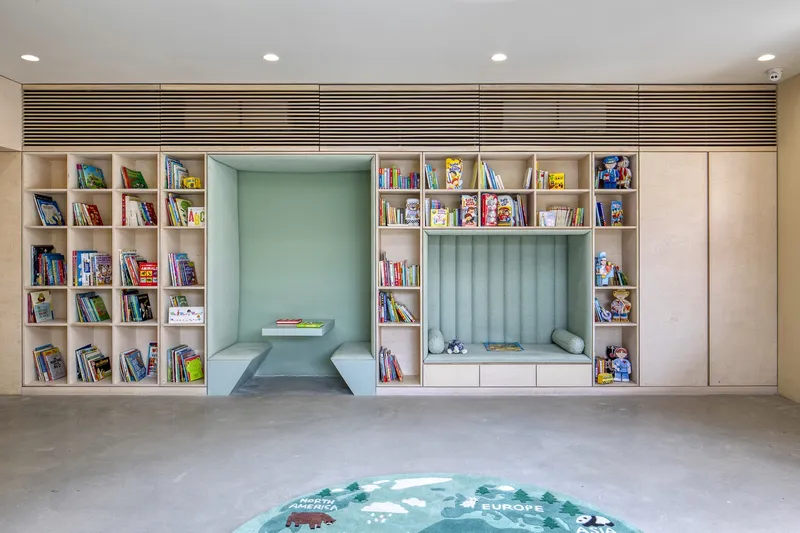
The interior detailing throughout the kindergarten is scaled to children without being condescending. Reading nooks are tucked into a built-in bookshelf wall, upholstered in mint green fabric and sized so that an adult would have to fold themselves in half to use them. House-shaped storage niches line one play area, offering both organizational logic and imaginative framing. Tactile wall panels in the circular playroom invite touch, a material strategy that treats the wall as a learning surface rather than a boundary.
Round tables, circular floor mats, and cushioned seating pods replace the rigid rows of conventional classrooms. The furniture is lightweight enough for children to rearrange, reinforcing the Reggio Emilia principle that the learner should have agency over the learning environment. Nothing here is fixed in place except the architecture itself.
Thresholds and Character Details
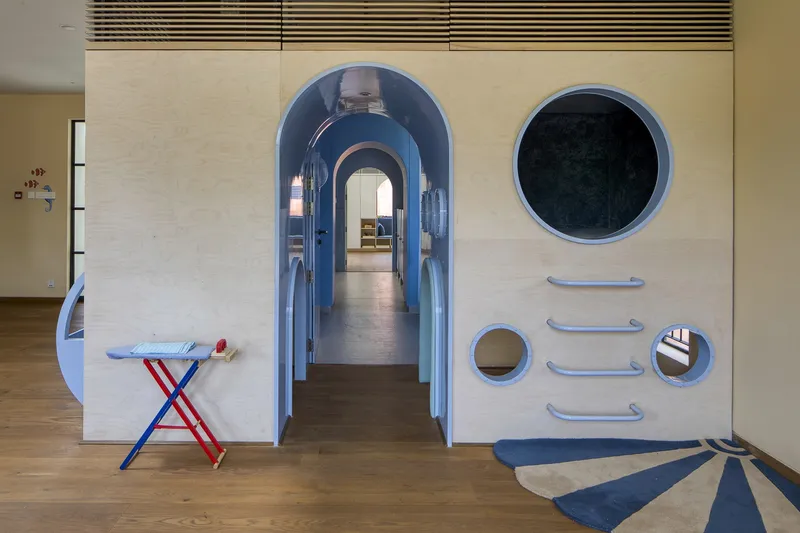
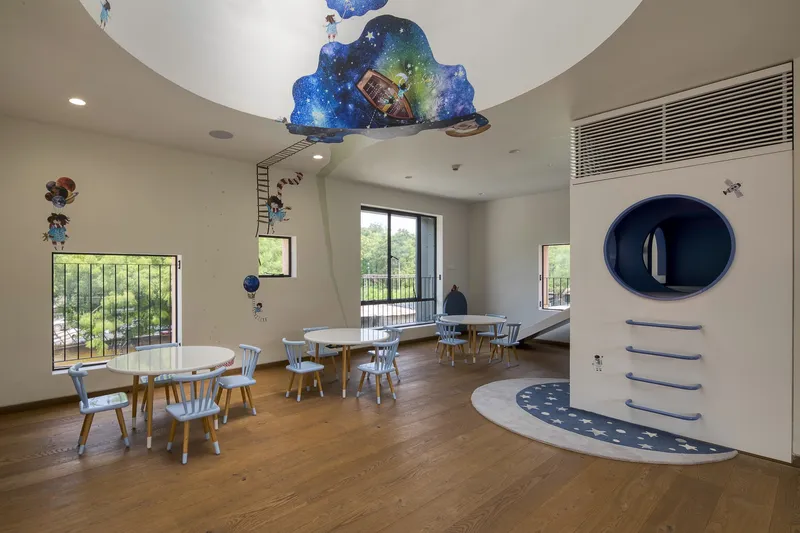
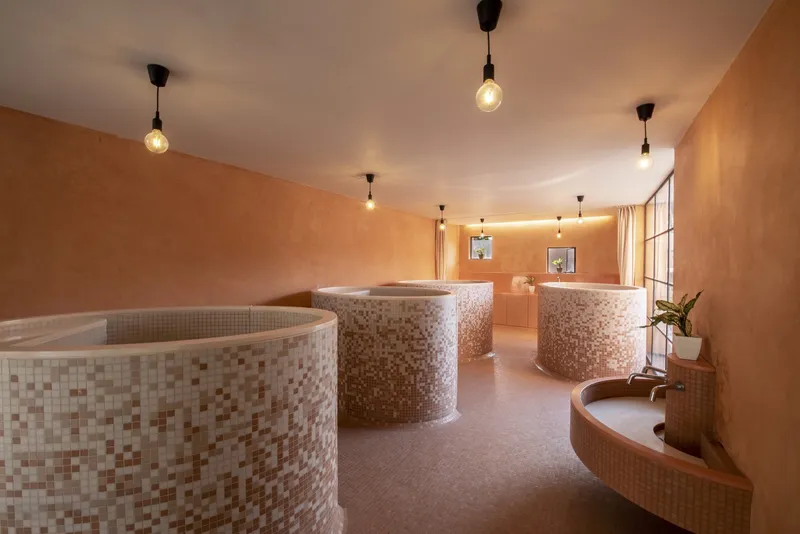
Transitions between rooms are given careful attention. An arched blue corridor portal with circular cutouts and horizontal bar details on a plywood panel acts as a gateway between zones, announcing a shift in program without the need for a door. Another activity room is entered through curved blue steps beneath timber batten grilles, turning the threshold itself into a piece of play equipment. Even the bathrooms receive considered treatment: curved mosaic tile partitions and peachy plaster walls create an environment that feels warm and domestic rather than institutional.
These threshold moments accumulate across the campus to produce a building that is constantly offering small discoveries. A child moving through the school encounters a different material, color, or spatial condition every few meters, a rhythm that sustains attention and rewards exploration.
Dining and Gathering Spaces
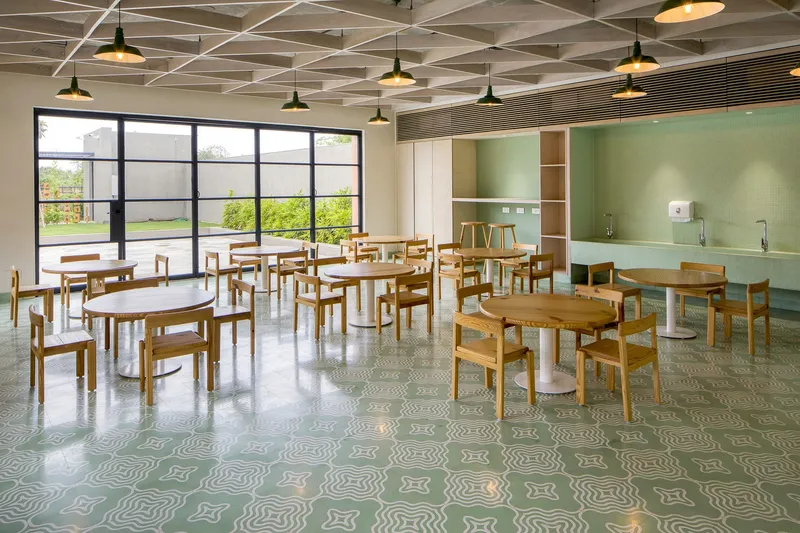
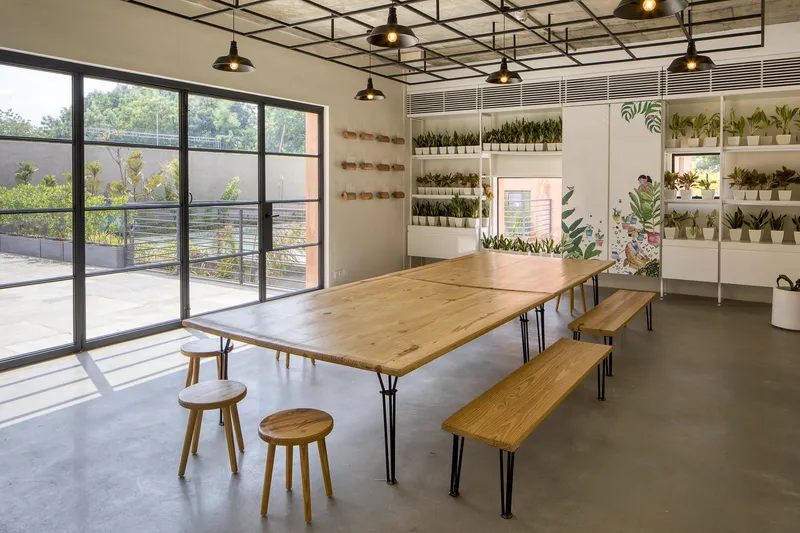
The dining hall anchors the communal life of the school. A patterned terrazzo floor gives the room visual weight, while pendant lights hung from an exposed ceiling grid provide a rhythm overhead. Timber tables and benches are simple and robust, designed to withstand years of spilled juice and crayon marks. A second, more intimate dining setup pairs timber tables with stools and potted plant shelves, offering a quieter alternative for smaller groups.
These shared spaces avoid the canteen aesthetic that plagues many schools. By using honest materials and careful proportions, the architects create rooms where eating together feels like a social event rather than a logistical exercise.
Plans and Drawings
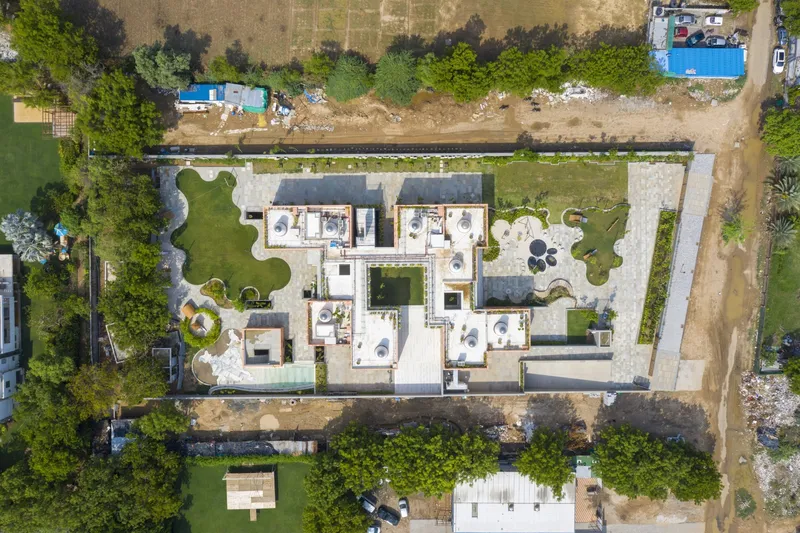
The aerial view reveals the full organizational logic of the campus: flat-roofed volumes of varying size are clustered around central courtyards, with skylights punctuating the roof plane to bring daylight into the classrooms below. The building's footprint is compact relative to its programmatic richness, and the courtyard voids prevent the plan from reading as a single mass. Trees along the perimeter and within the courtyards soften the geometry and promise future canopy cover as the campus matures.
Why This Project Matters
Kindergarten design is often treated as an exercise in applied color theory: take a generic building and paint it bright. Blocher Partners India rejects that formula entirely. Every spatial decision here, from the courtyard organization to the oval skylights to the child-scaled reading nooks, derives from a pedagogical conviction that environment shapes learning. The materials are tough, the colors are restrained, and the architecture does the heavy lifting that stickers and murals usually get asked to do.
The result is a school that takes children seriously as inhabitants. It gives them complex spaces to navigate, honest materials to touch, and overhead daylight to study. It also gives their teachers a building that works as a teaching tool rather than a backdrop. For a profession that too often confuses child-friendly with childish, this kindergarten offers a clear, buildable alternative.
Toy Blocks Kindergarten by Blocher Partners India. Photography by Atik Bheda and Umang Shah.
About the Studio
Share Your Own Work on uni.xyz
If projects like this are the kind of work you want to make, uni.xyz is a place to publish your own, find collaborators, and enter design competitions.




Popular Articles
Popular articles from the community


The Musturak Paradise: Senior Living Architecture for a Connected Future in Temara, Morocco
The Musturak Paradise reimagines senior living architecture in Temara via private homes, social spaces, culture, community, and shared care.

Riyadh For All: Intergenerational Urban Design for Active Aging in Rabat
Riyadh For All reimagines urban design in Rabat with intergenerational co-living, adaptive courtyards, and Moroccan cultural exchange today.

Co-life: Sustainable Architecture for Age-Friendly Community Living
Co-life reimagines sustainable architecture for seniors through courtyards, rammed earth, shared gardens, and spaces designed for belonging.

Conexión: Biophilic Design Reimagines High-Rise Living in Hong Kong
Conexión reimagines high-rise living in Hong Kong through biophilic design, green facades, shared spaces, daylight, water and nature within.


Similar Reads
You might also enjoy these articles


Hodi-Mandai Geram
Project Function: Preservation and revitalization of the Intangible heritage and socio-spatial identity of the Hodi by Housing, Cultural Memory Center, Sacred Grove, landscape, local tourism economy


Olio Towers: A Mid-Rise for Performers That Fuses Housing, Rehearsal, and Stage
Located blocks from Houston's Theater District, this modular tower stacks living units around a central performance atrium.

Oasis: Modular Green Housing Carved into Dhaka's Urban Fabric
A shortlisted Plugin Housing entry reclaims unauthorized settlements in Dhaka with stepped concrete volumes, green roofs, and ventilation-driven design.

Black Hole: A Floating Megastructure for the Post-Physical Era
Emiliano Mazzarotto envisions a spherical, self-scaling arena where e-sports, digital hotels, and holographic stadiums replace traditional public space.


Explore Educational Building Competitions
Discover active competitions in this discipline



Challenge to design public laboratory


Challenge to reimagine the Iron Throne


Photograph architecture without architects


Illustrate the lost glory of Angkor Wat - Render Challenge
Comments (0)
Please login or sign up to add comments
No comments yet. Be the first to comment!