
Transforming Landscapes: An Archaeological Architecture at Keeladi That Grows With the Dig
Namrata Narendra's UnIATA '19 proposal for Keeladi phases architecture over a decade, letting shelters, paths and platforms follow the excavation.


Most museums built at archaeological sites arrive with their conclusions already drawn: a monumental volume, a ceremonial axis, a story fixed in concrete before the trenches have finished speaking. Transforming Landscapes: Architecture of Archaeology starts from the opposite premise. At Keeladi, the architecture is designed to emerge from the excavation rather than sit on top of it. It reveals history gradually, holds collective memory in place and keeps cultural narratives embedded in the ground where they were found.
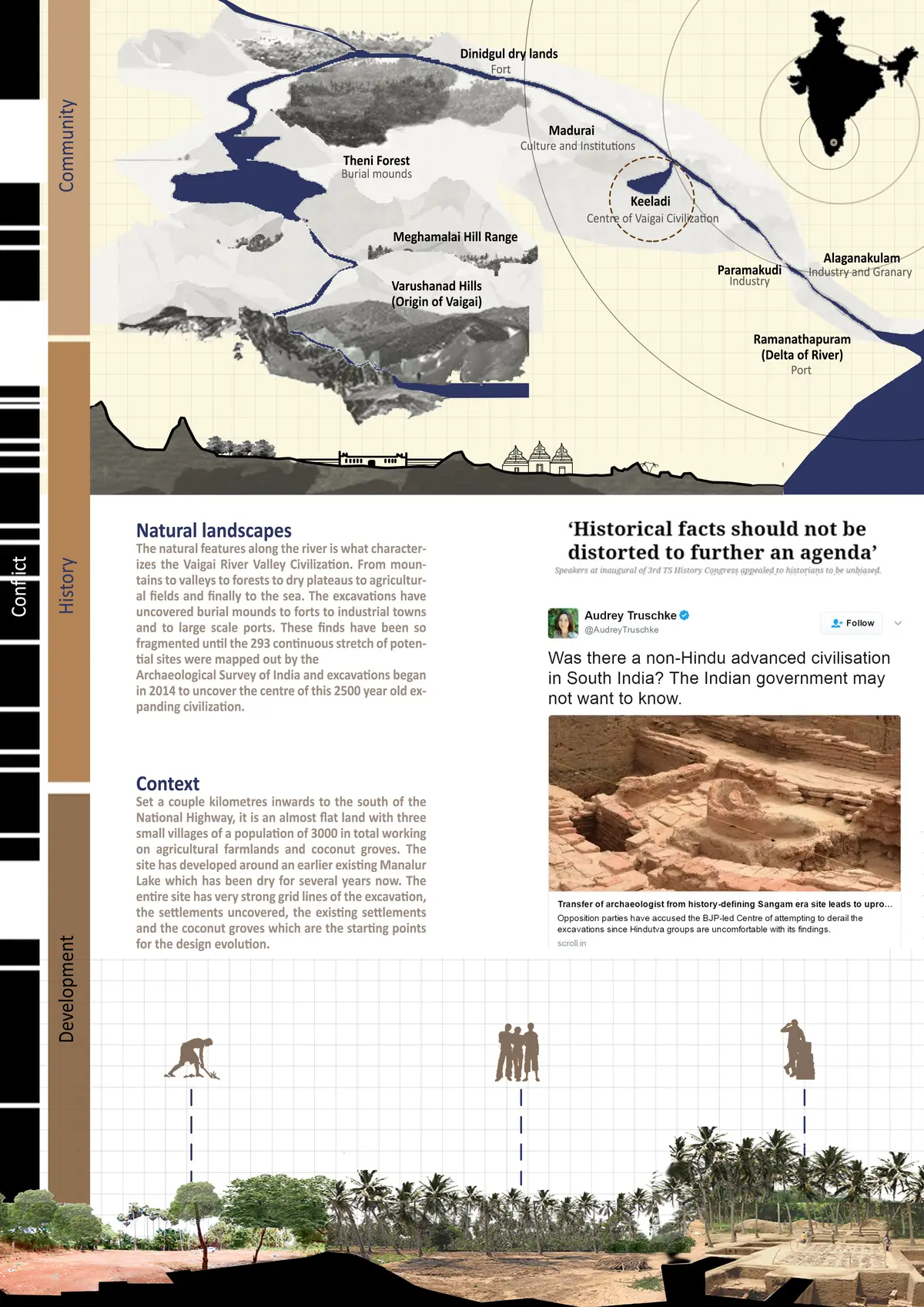
Submitted by Namrata Narendra to UnIATA '19, the project takes on Keeladi in Tamil Nadu, a site of considerable historical weight linked to the Sangam-era Vaigai civilization. Narendra does not treat the dig as an isolated object. She reads it as one node in a territorial system along the Vaigai River basin, where excavations from the Varushanad Hills and Meghamalai ranges down to Madurai and Ramanathapuram trace a continuous cultural network shaped by water, trade and settlement.
Stratigraphy as a Design Method
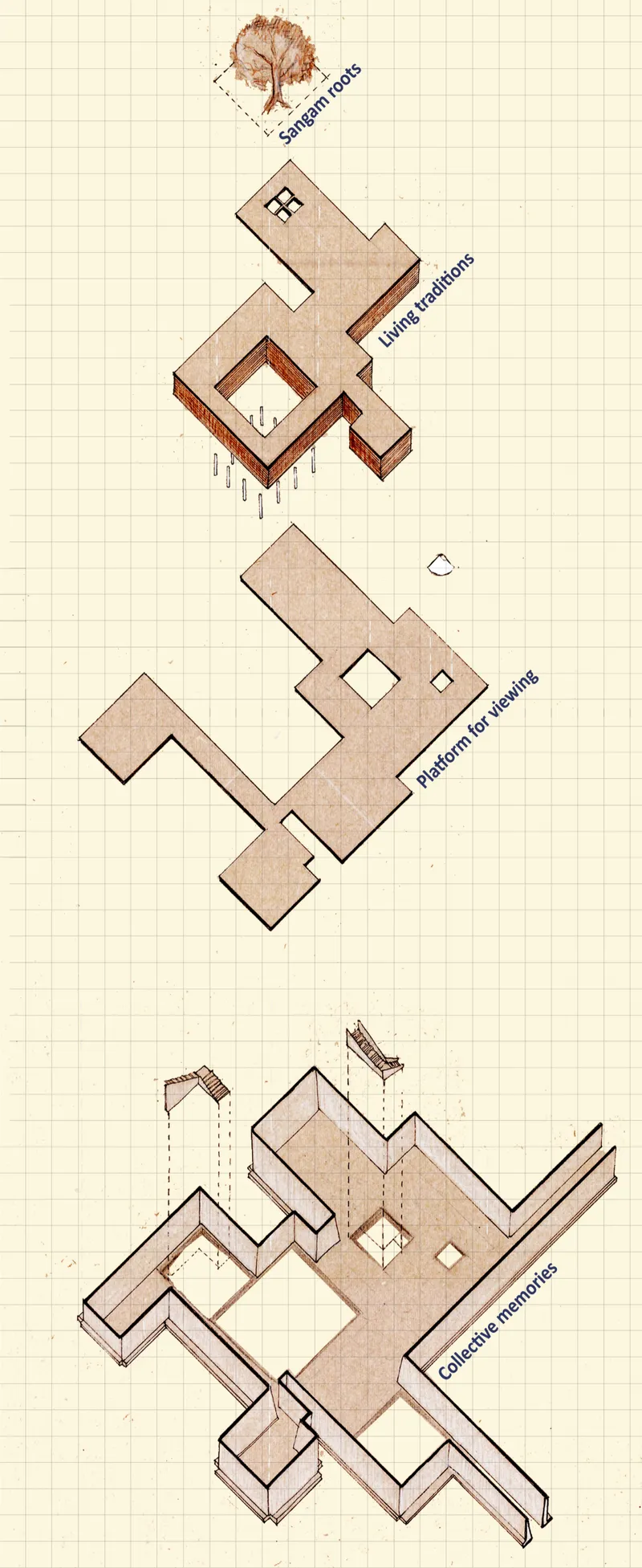
The exploded axonometric explains the project's logic better than any manifesto could. The walled courtyard plan, the viewing platform and the lower walls are pulled apart as discrete strata, the way an archaeologist separates layers of deposit. This is the central idea: architecture and archaeology share the principle of stratigraphy, so the building is organised as a sequence of transitions, thresholds and pauses rather than as a single object. The small tree sketched above the stack is a fitting touch, since landscape is treated as one more layer in the composition and not as a backdrop.
Narendra describes the stance as non-monumental, adaptive and process-driven. In her account, archaeological architecture should be temporary yet enduring, informal yet spatially rigorous, multi-directional rather than axial, and open-ended rather than fixed. The drawing shows that these are not just slogans. No layer dominates, and the composition invites movement in several directions at once.
A Ten-Year Site Plan That Waits for Evidence
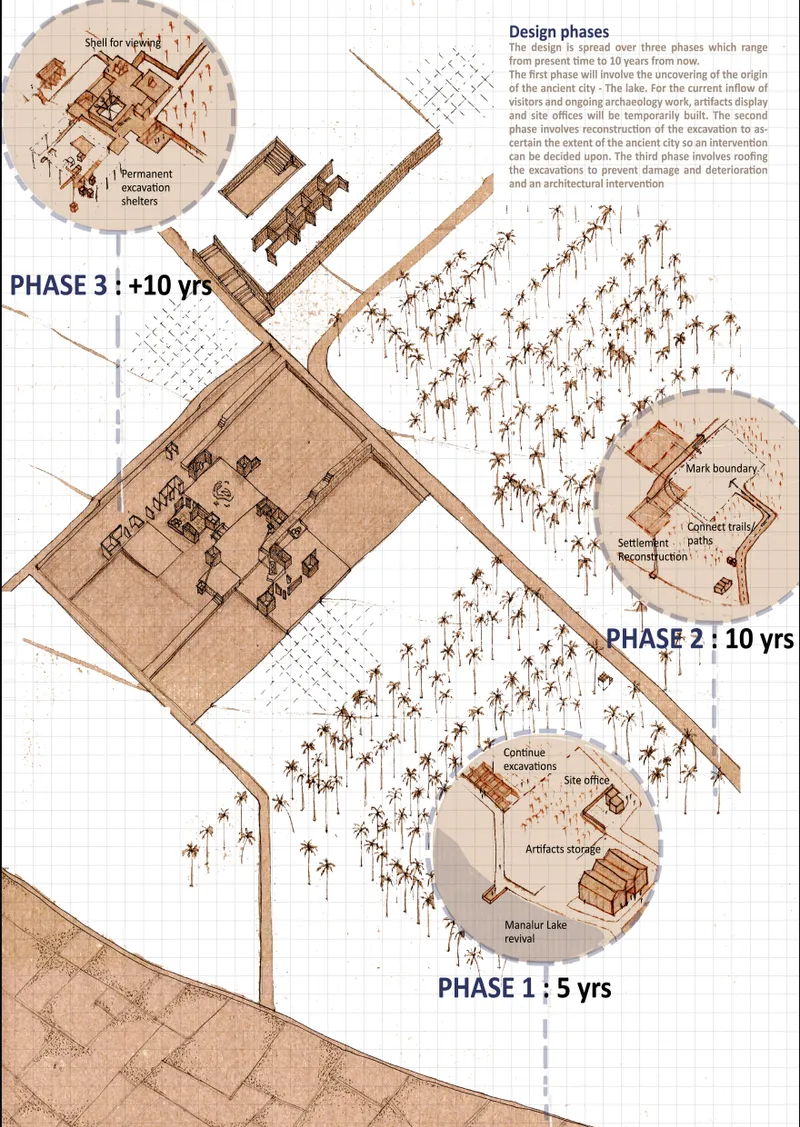
The phased site plan is the project's strongest argument. Archaeology unfolds over decades, so Narendra structures the intervention in three phases across roughly ten years and beyond, each captured in a circled inset beside the rows of palms. In Phase 1 (0 to 5 years), temporary excavation shelters, site offices, artifact storage and dig infrastructure arrive alongside the revival of the dry Manalur Lake. In Phase 2 (5 to 10 years), settlement fragments are reconstructed, archaeological boundaries are marked, and visitor pathways stitch the excavation zones together. Only in Phase 3 (10+ years) do permanent shelters, protective interventions over exposed ruins and viewing platforms appear.
The sequencing matters because it refuses to pre-empt knowledge. The architecture only becomes permanent once the ground has told its story. Reviving the lake in the first phase is also a sharp move. It reconnects the site to the water systems that once sustained the Vaigai settlements before any visitor experience is built.
Courtyards Laid Along the Trench Grid

In the floor plans and long sections, the site's forces become legible. The courtyards follow the grid patterns that emerge from the archaeological trenches, a central tree anchors the composition, and the excavation edge runs alongside the existing coconut groves. The sections show how the scheme works with natural land gradients rather than levelling them, so visitors look into the dig from shifting heights instead of from one controlled vantage point.
This is also where the Sangam literary landscapes come in. Narendra overlays the five landscapes of the poems, kurinji (hills), mullai (forests), marutham (fertile plains), neithal (coastal regions) and palai (arid lands), onto the site as spatial zones. Each zone shifts in scale, materiality and enclosure. Text, terrain and tectonics become one route, and the visitor discovers spaces gradually, much as an excavation exposes history layer by layer.
Brick Walls, a Planted Roof and the Human Scale
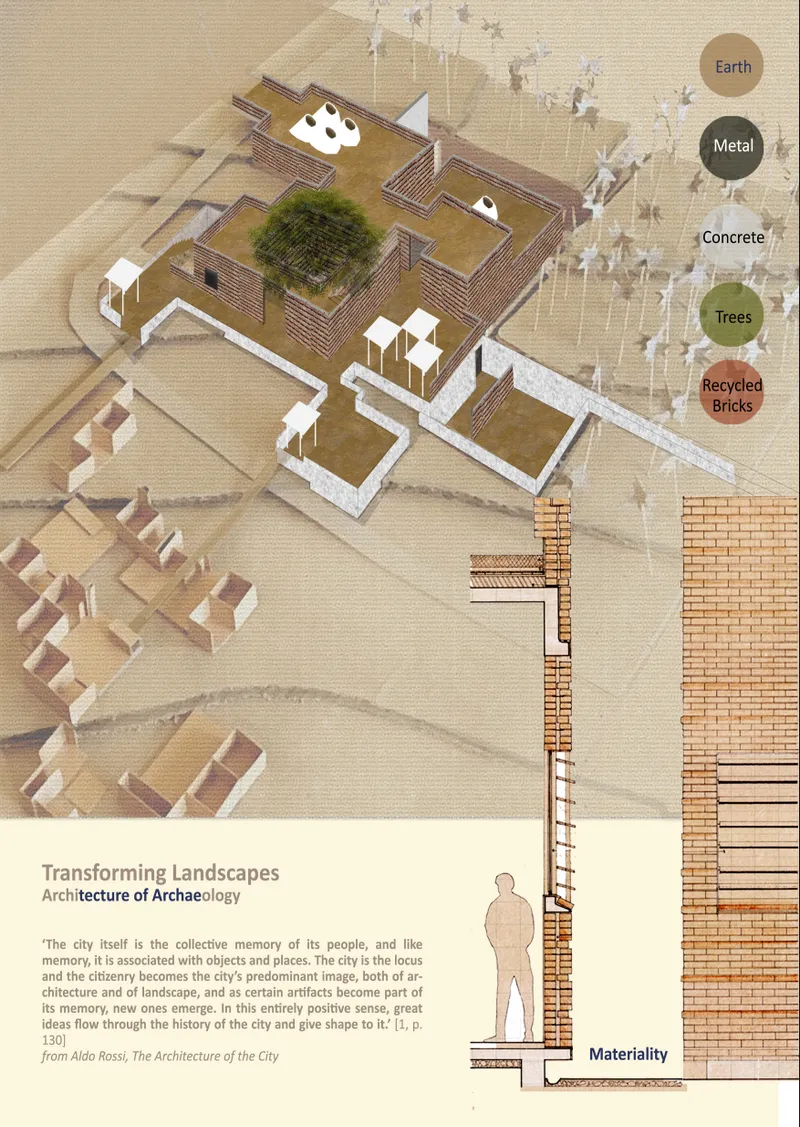
The aerial axonometric pulls the strategy into built form: a cluster of brick-walled courtyard volumes with a tree growing from a planted roof. The volumes stay low and grouped, closer to a settlement fragment than a monument, which suits a site whose significance lies in everyday Sangam-era life. The tree breaking through the roofline repeats the earlier drawings, where vegetation and architecture share the same layered section.
The wall section beside it, with a single standing figure, is a modest drawing that carries a lot of weight. It confirms that the project has been calibrated to the body. The intimacy and curiosity the brief promises are tested at the scale of one person standing against one wall, not in an aerial gesture.
Why This Project Matters
Heritage architecture often treats a site as finished business, a sealed past to be framed and displayed. Narendra's proposal argues that an active excavation is a process in motion, and that architecture's job is to keep pace with it. Phasing the work over a decade, deriving the plan from trench grids and land gradients, and organising space through stratigraphy turns uncertainty into a design asset instead of a problem to engineer away.
The proposal is equally valuable for how it joins scales. It moves from the Vaigai basin to the Manalur Lake, from Sangam poetry to a brick wall beside a human figure, and it holds those threads together without letting any single gesture take over. For students working on sensitive historic ground, it is a clear model of restraint: build less, build later, and let the landscape keep the authority it has earned.
View the Full Project
About the Designers
Designer: Namrata Narendra
Enter a Design Competition on uni.xyz
uni.xyz runs architecture and design competitions year-round that reward proposals with spatial conviction and real site intelligence.
Project credits: Transforming Landscapes: Architecture of Archaeology by Namrata Narendra UnIATA '19 (uni.xyz).


Popular Articles
Popular articles from the community


David Macias Steps a Doorless Stone and Plaster House Down a Tropical Colombian Hillside
In the humid hills of Colombia, Threshold House replaces the front door with an open void and terraces its 850 m² down the slope instead of fighting it.

longwave studio Reorganizes a 112 m² Tainan Apartment Around the Daily Routines of a Family and Two Cats
In Tainan, Taiwan, birch plywood, rust-red furniture and a freestanding plaster wall link arrival, storage, work and family life in one apartment.

David Ortega Stacks a Two-Story Mexico City Penthouse Around a Steel Stair and a Pergola-Shaded Roof Terrace
In Colonia Roma, a 300 m² penthouse uses oak joinery, a planted steel stair and a slatted roof pergola to make a new-build apartment feel like a house.

GROUP A Strips a 1969 Rotterdam Harbor Headquarters to Its Frame and Wraps It in Timber Louvers
In Rotterdam's M4H harbor district, Ferro Offices reuses a 1969 frame, adds one timber storey and reaches BREEAM-NL Outstanding.

Similar Reads
You might also enjoy these articles
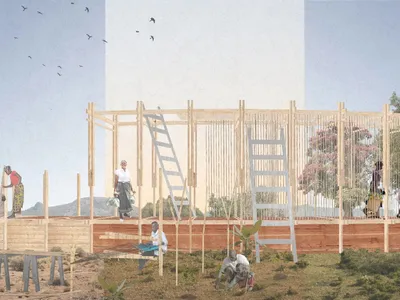
Healing Façade: A Modular Chapel System That Restores Ethiopia's Sacred Forests
Winner of the Eco-Chapel competition, this circular timber façade collects water from air to rebuild soil and reforest degraded Ethiopian landscapes.
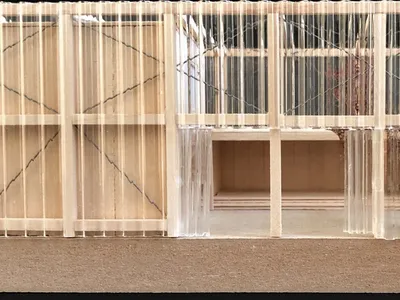
Kaffeebühnen: Where Coffee Shop Architecture Becomes a Civic Stage in Vienna
A linear sequence of timber boxes, transparent shells, and open yards turns the Viennese café tradition into a public performance space.
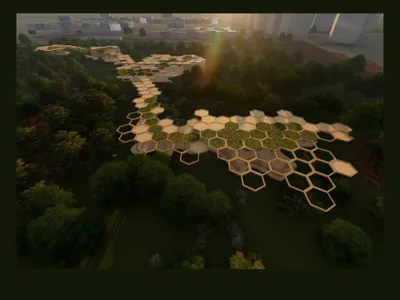
Eco Chapel: A Modular Forest Pavilion That Grows Like the Landscape It Protects
Hexagonal timber modules weave through existing trees, turning a chapel into a living system for prayer, education, and reforestation.


Urban Forest: A Vertical Ecosystem for 5,000 Workers in Singapore's Changi Business Park
Radially stacked pods and layered green decks turn a 7-acre plot into 47 acres of ecological workspace projected for 2040.

Explore Landscape Architecture Competitions
Discover active competitions in this discipline

Challenge to illustrate the ruins of Petra

Challenge to design mud housing for contemporary communities

Challenge to reimagine the Iron Throne

Photograph architecture without architects
Comments (0)
Please login or sign up to add comments
No comments yet. Be the first to comment!