
Jonathan Tuckey Design Converts a 1940s Cod Liver Oil Factory into an Arctic Hotel on Norway's Lofoten Islands
Trevarefabrikken transforms an abandoned industrial shell in Henningsvær into a handcrafted hospitality destination above the Arctic Circle.


Four friends bought a derelict cod liver oil factory on a rocky island of 510 people inside the Arctic Circle. A decade later, that concrete shell is a hotel, restaurant, yoga studio, and ocean sauna, all threaded through 1,500 square meters of board-formed concrete that still bears the grain of the timber moulds poured in the 1940s. Jonathan Tuckey Design was brought on in 2019 to solve a specific problem: how to carve bedrooms, corridors, and social spaces out of an open-plan factory floor without killing its atmosphere. The answer, completed in 2023, is a study in restraint, where every new intervention reads as a warm, timber-lined insert placed inside the rough industrial host.
What makes Trevarefabrikken genuinely compelling is not the adaptive reuse itself but the economy of means behind it. Curved wardrobe doors were shaped on site by the owners and a shifting crew of builders, volunteers, and off-season travellers living at the hotel. Communal dining tables, five meters long, were milled from larch trees sourced on a nearby island. Bricks from the factory's demolished chimney became steps into guest rooms. The project is less a conventional commission than a sustained, collective act of construction, and that spirit is legible in every detail.
Framing the Fjord
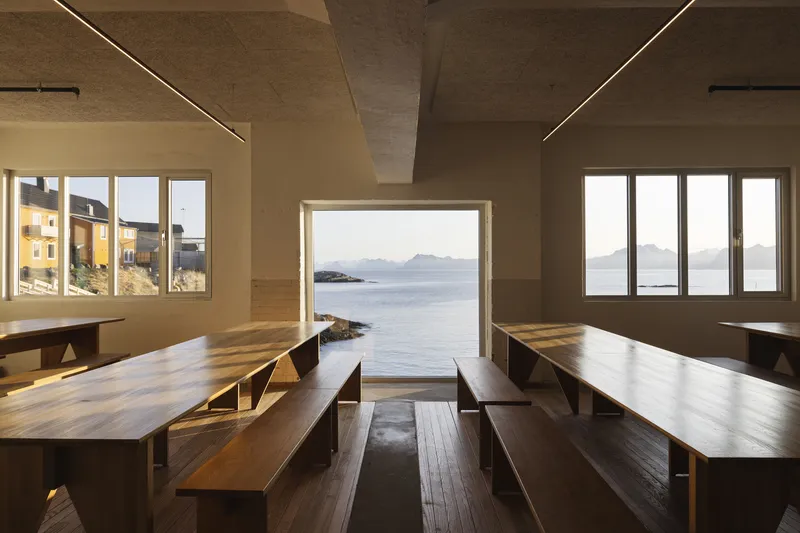
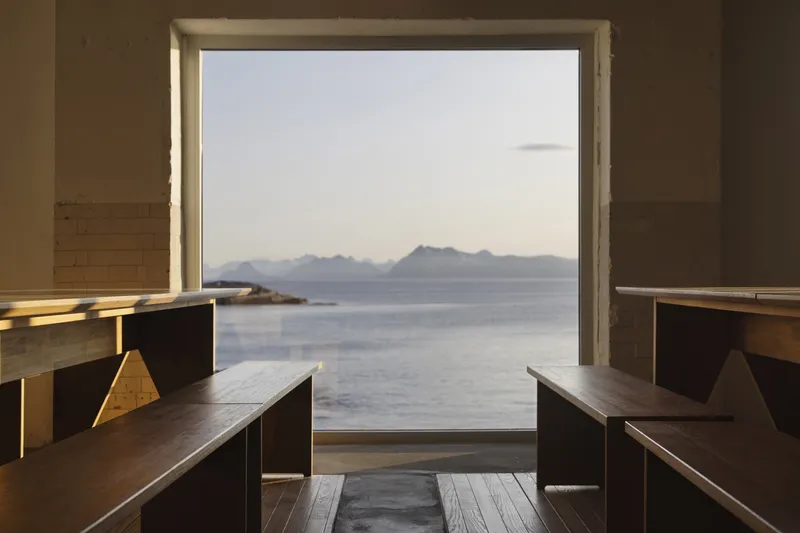
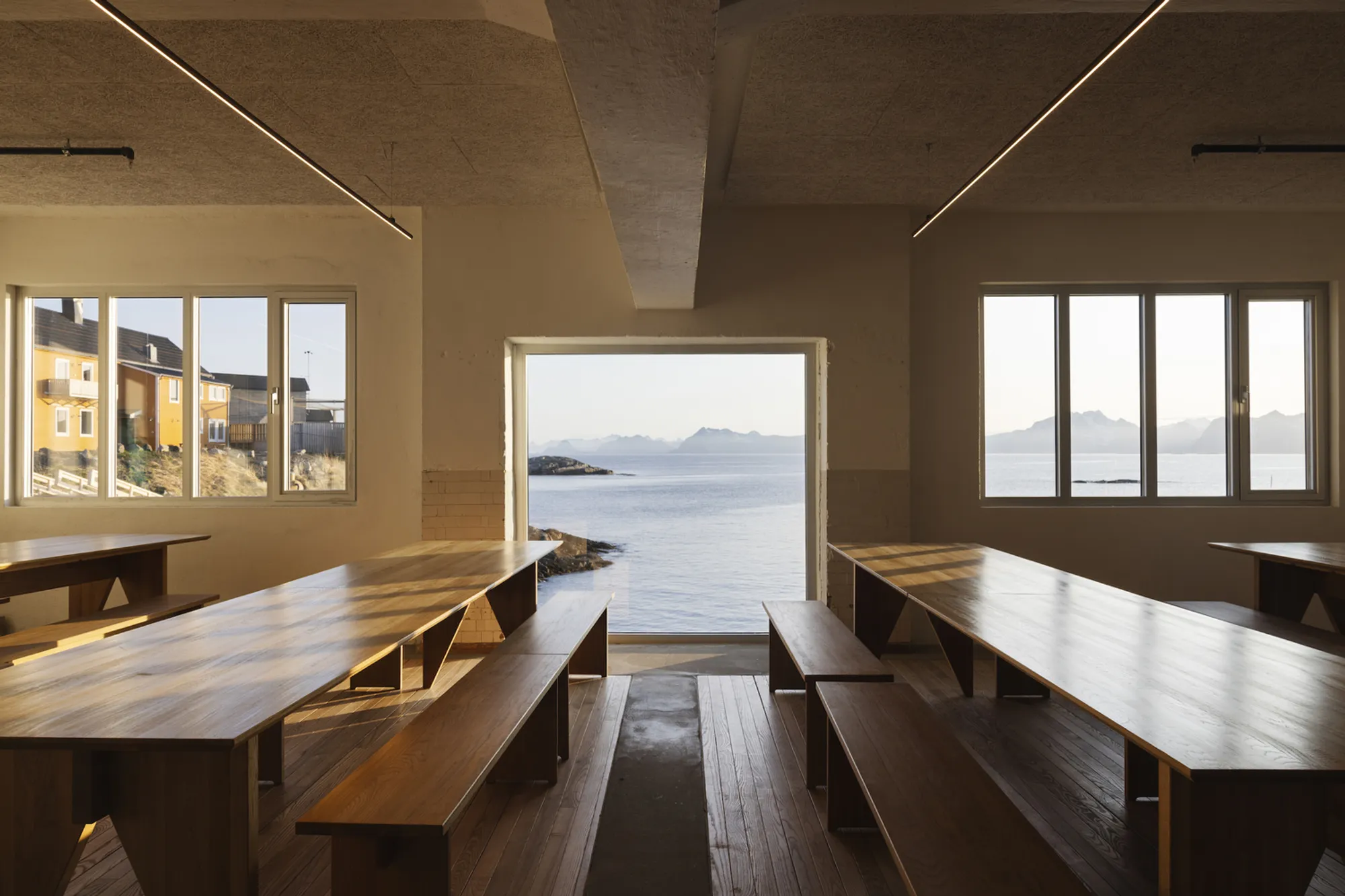
The factory's existing apertures were never elegant. They were punched through concrete to serve ventilation and loading, not to compose views. Tuckey's team left them largely as found, adding triple glazing and deep timber-shuttered reveals that double as insulation. The result is a series of powerful frames: the Vestfjorden sea, distant mountain ridges, and the slow drift of Arctic light all enter the building on the factory's terms, not through picture windows but through openings that recall their industrial origin.
Built-in timber benches flank the largest windows, turning circulation areas into pause points. The interior hall on the upper floor aligns a central doorway directly with the water, creating a telescopic view that pulls the landscape deep into the plan. It is a simple move, but its effectiveness depends on everything around it being deliberately restrained.
Timber Inserts Against Raw Concrete
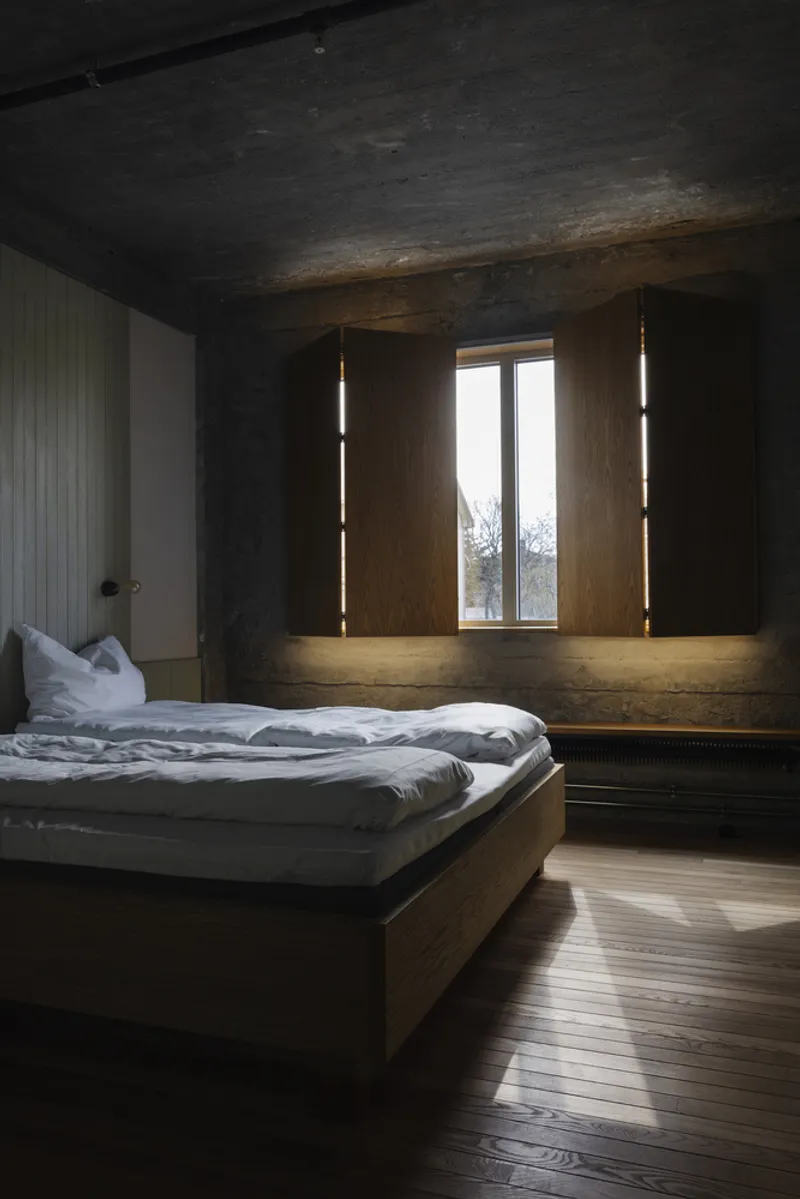
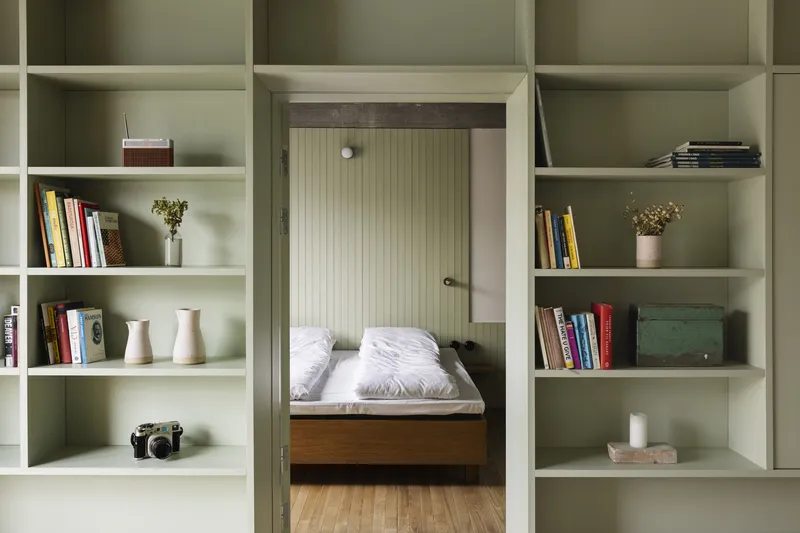
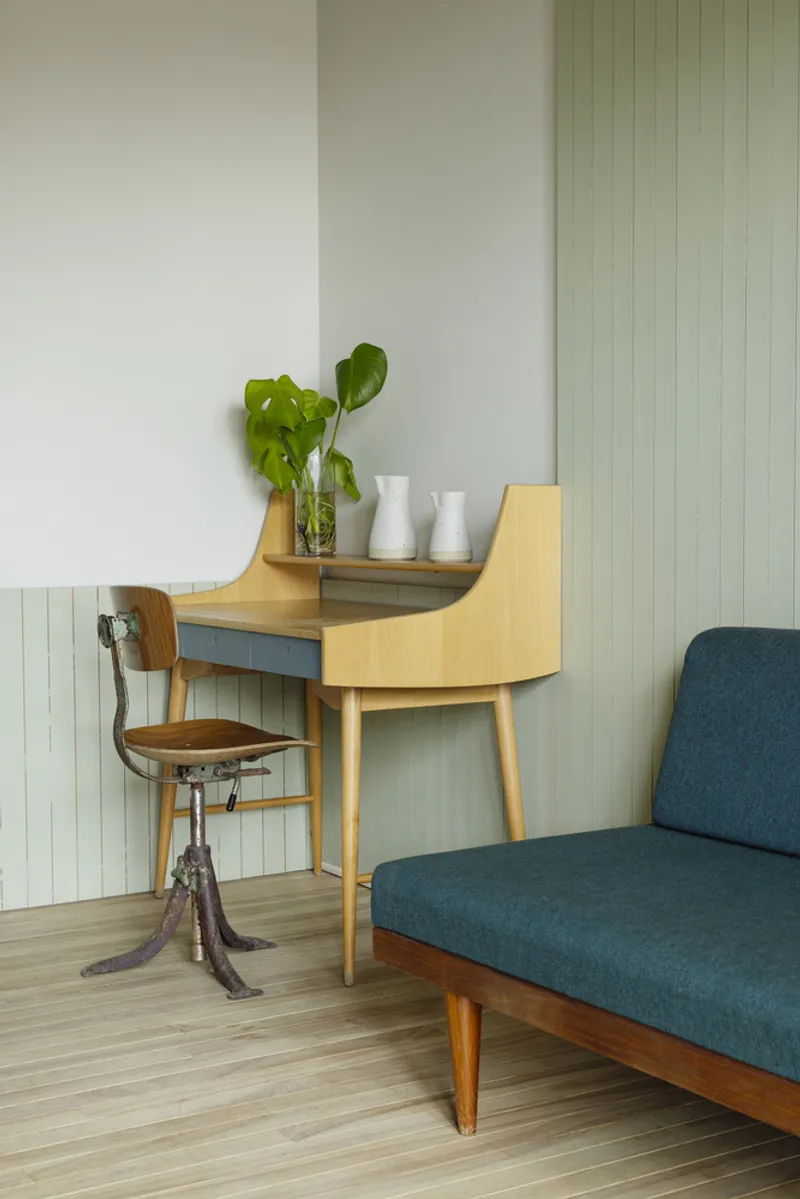
The guest rooms operate on a consistent logic: a timber-lined capsule placed inside the concrete skeleton. Bedside panelling conceals new services while existing pipes and conduits remain exposed elsewhere, establishing a clear legibility between what belongs to the factory and what belongs to the hotel. Vertical light strips flanking the bed in each room create a lantern-like glow that contrasts with the dark, moody corridors outside. This transition from shadow to warmth is deliberate, mirroring the extreme seasonal light swings on an island that receives zero sunlight in December.
The palette is narrow and precise: seafoam green panelling (NCS S2010-G60Y, sourced locally), cream surfaces, and the honey tone of Lofoten larch. Curved wardrobe doors, shaped by hand on site, introduce a softness that the orthogonal concrete frame never had. There is no attempt to disguise the insertion as original; the joint between old and new is always visible, always honest.
The Social Core
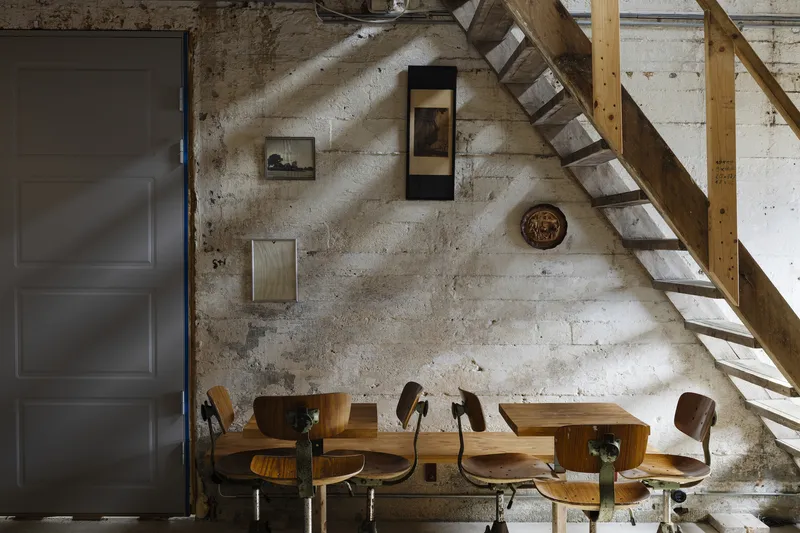
Trevarefabrikken was conceived as a gathering place first and a hotel second. The dining area on the first floor, occupying the former cod liver oil production space, pairs those five-meter larch tables with timber stairs that climb along a board-marked concrete wall still showing its formwork texture. Dappled sunlight reaches even these interior zones, filtered through deep reveals. It is a room that encourages long meals and conversation, not quick turnover.
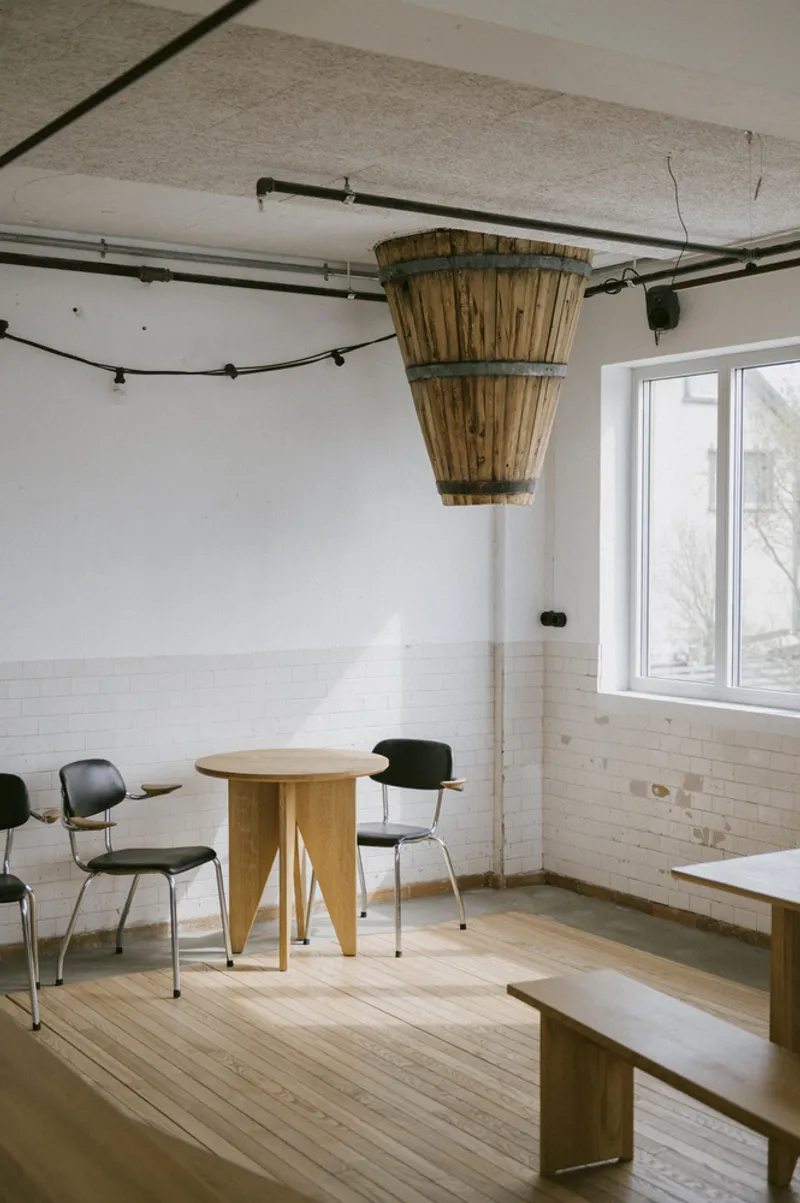
A common room on the same level takes a different tonal register: a round timber table sits beneath a wicker basket lamp suspended from an exposed concrete ceiling. The furniture is deliberately domestic in scale, intended to make a 1,500-square-meter industrial building feel like someone's living room. The fact that much of this furniture was built by the people who would eventually use it gives the space an authenticity that commissioned joinery rarely achieves.
Light, Darkness, and the Arctic Threshold
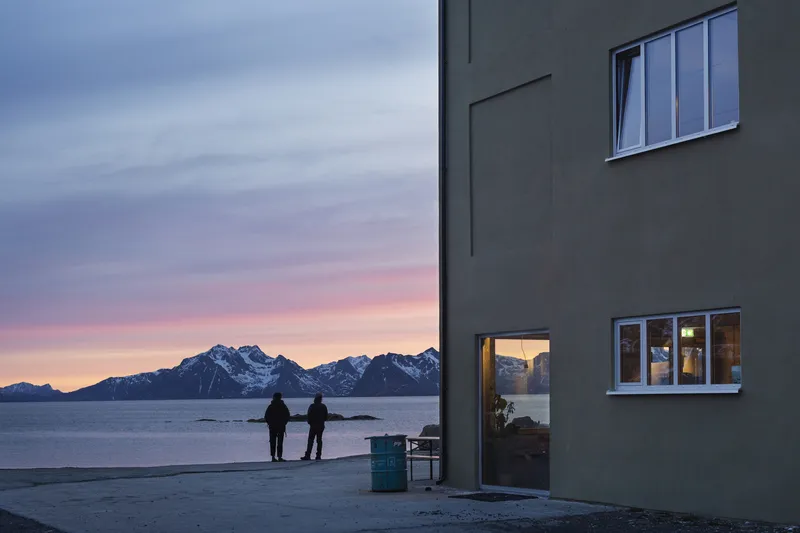
The dark grey facade at dusk reveals how the building sits in its landscape: low, heavy, and unapologetic. The exterior was re-rendered with insulated render so that the internal concrete could stay exposed, a smart inversion that keeps the thermal envelope on the outside and the architectural character on the inside. Glazed doors and windows glow against the twilight, drawing figures toward the water's edge. It is an industrial silhouette that has learned to be hospitable without changing its posture.
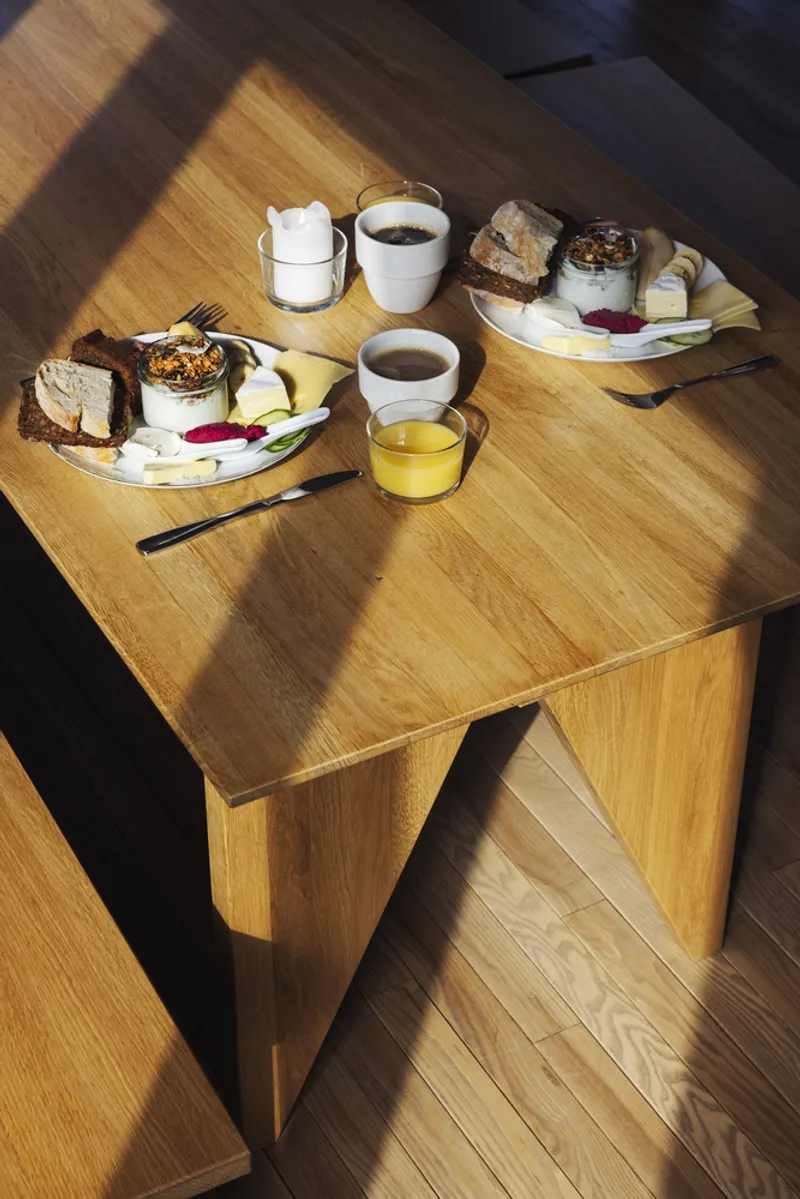
Inside, morning light hits a breakfast table at a sharp angle, catching plates and cups in a wash of gold. The corridors, by contrast, are kept deliberately dark, with natural light arriving only through transom windows above guest room doors. This oscillation between brightness and shadow is not a flaw of the plan but the organizing principle of the experience. In a place where daylight is either perpetual or absent depending on the season, the architecture stages every hour of sun as an event.
Why This Project Matters
Adaptive reuse projects often fall into one of two traps: either they embalm the original building in reverential minimalism, or they hollow it out and fill it with something unrecognizable. Trevarefabrikken avoids both. The concrete shell is not precious here; it is a working framework that accepts timber inserts, new insulation, and reclaimed chimney bricks without losing its character. Jonathan Tuckey Design understood that the factory's roughness was the asset, not the problem, and every design decision flows from that conviction.
Equally significant is the construction model. A project built over years by owners, friends, local craftspeople, and itinerant volunteers produces a different kind of architecture than one delivered by a general contractor on a fixed schedule. The hand-shaped wardrobe doors, the locally milled tables, the repurposed bricks: these are not just sustainable gestures but evidence of a community investing its own labour in a shared place. In a fishing village of 510 people above the Arctic Circle, that investment is both the method and the meaning of the work.
Trevarefabrikken, designed by Jonathan Tuckey Design. Henningsvær, Lofoten, Norway. 1,500 m² (700 m² by JTD). Completed 2023. Photography by Gjestvang and Elin Fröderberg.
About the Studio
Share Your Own Work on uni.xyz
If projects like this are the kind of work you want to make, uni.xyz is a place to publish your own, find collaborators, and enter design competitions.



Popular Articles
Popular articles from the community


Conexión: Biophilic Design Reimagines High-Rise Living in Hong Kong
Conexión reimagines high-rise living in Hong Kong through biophilic design, green facades, shared spaces, daylight, water and nature within.

Co-life: Sustainable Architecture for Age-Friendly Community Living
Co-life reimagines sustainable architecture for seniors through courtyards, rammed earth, shared gardens, and spaces designed for belonging.

AL-JANNAH: Sustainable Architecture and Permaculture for Afghan Widows
AL-JANNAH uses sustainable architecture and permaculture to create resilient oasis of housing, learning, work and renewal for Afghan widows.

Hill & Cross Opera: Sculptural Opera House Architecture Shaped by Tallinn’s Landscape and Identity
Hill & Cross Opera reimagines opera house architecture in Tallinn through its sculptural hill, civic plaza, glass wave and a luminous cross.


Similar Reads
You might also enjoy these articles


Hodi-Mandai Geram
Project Function: Preservation and revitalization of the Intangible heritage and socio-spatial identity of the Hodi by Housing, Cultural Memory Center, Sacred Grove, landscape, local tourism economy


Olio Towers: A Mid-Rise for Performers That Fuses Housing, Rehearsal, and Stage
Located blocks from Houston's Theater District, this modular tower stacks living units around a central performance atrium.

Oasis: Modular Green Housing Carved into Dhaka's Urban Fabric
A shortlisted Plugin Housing entry reclaims unauthorized settlements in Dhaka with stepped concrete volumes, green roofs, and ventilation-driven design.

Black Hole: A Floating Megastructure for the Post-Physical Era
Emiliano Mazzarotto envisions a spherical, self-scaling arena where e-sports, digital hotels, and holographic stadiums replace traditional public space.


Explore Hospitality Building Competitions
Discover active competitions in this discipline



Challenge to reimagine the Iron Throne


Photograph architecture without architects


Illustrate the lost glory of Angkor Wat - Render Challenge


Design challenge to reuse E-waste
Comments (0)
Please login or sign up to add comments
No comments yet. Be the first to comment!