
triPLAY
An eco-friendly playground in Warsaw.
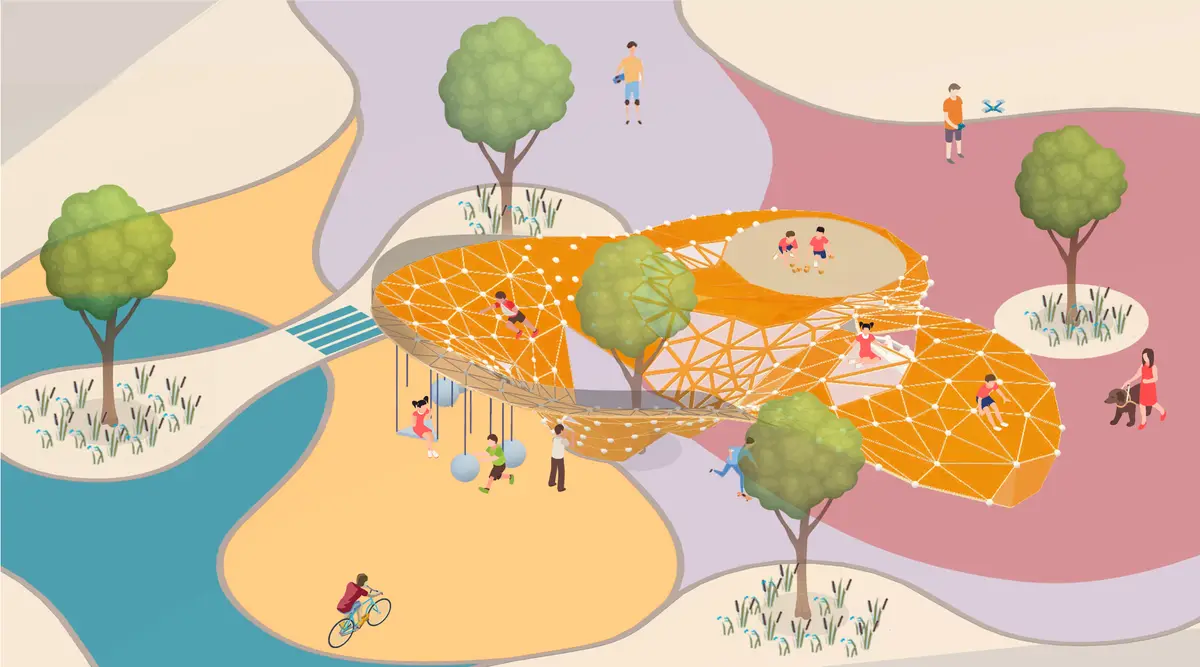
The imagination of children encourages them to create games from anything. At this point, we aimed to design a supportive tool for their play as a playground which is a whole system based on 4 main design principles. Multifunctional parts of the structure can be organized according to different games. While children play their games, a common space for their parents and also for the community was created consisting of different types of plants.
Firstly, research was conducted about play types. There are several play types yet we have chosen 4 of these play types that can be translated into physical design objects as follows: creative play, active play, social play, and sensory play. Creative play includes activities that are related to imagination. Thus, we have used basic shapes as interchangeable modules to allow flexible creations. Some of these modules can be opened or combined with other modules by children. Active play includes activities such as running, jumping, and climbing. These activities ought to sustain in a safe environment to avoid injuries. Therefore anthropometrics of children were considered in every phase of the design for safe exploration. The measurements of the structure were decided based on the heights that different age groups can reach, besides the gaps on the structure were limited to avoid injuries. Spatial reciprocity of social play needs spaces that can be used commonly, allow interaction. The main idea of creating a monocoque structure is to gather everyone in one shared space. Yet the structure contains differentiated spaces with level enrichment, allowing surprises and small group gatherings. Sensory play activities can be defined as touching, smelling, hearing, seeing, and tasting. To enhance the senses, the design consists of rich perspective views within the amorphous shell structure and different colors. Besides edible plants were used in the landscape design and an agricultural area was created. We hope to enhance children's senses and improve their respect for nature.
Triangle is a form that is stable, flexible in use, and durable. Hence we chose triangle as the shape of our modules to start with. The reason behind the idea of a modular design is to create a structure that is flexible, re-organizable, and repairable. On the other hand, modular design will help us minimize fabrication and logistic costs. To create a modular design, we used computational design tools like Grasshopper. After deciding on a border and support on the plan, according to the predetermined main axes, we played with the elevation of the structure at some parts. The result which is the whole surface was then given to Grasshopper to proceed to the triangulation part. The logic behind the modulization was to create smaller modules on steep slopes and bigger ones on lower angles. Once the main structural system was formed, fine adjustments were made to create new types of games around the structure. These adjustments consist of emptying some modules from frames, adding a net to some frames or completely removing some solid surfaces, adding swings, ropes, and sandboxes. Also, level differentiation of the amorphous structure and combination of different modules creates various light and shadow zones that can be turned into a creative sun and shadow game. After the design of the structure is done landscape was organized. Under the structure, different colors were used to emphasize different axes and games.
After the design process is done, the fabrication part will be handled with 3D printers. To do the fabrication process faster, easier, and at minimum cost, it is decided to use nearby institutions, the University of Warsaw and Technology University of Warsaw, as a part of fabrication. With 3D printers located at these locations, the fabrication process will turn into a collective process and the cost of logistics will be minimized. The main material, PLA is a recyclable and upcyclable eco-friendly material. The main reason for choosing PLA is not only its eco-friendly chemistry but also its ability to create smooth surfaces to prevent small injuries. Besides, it's a convenient material to create different variations of triangle modules. The main structure consists of 380 PLA surfaces, 65 PLA frames, 97 soft balls of the same size, to help climb on surfaces. After the first installation, the weakened parts of the structure can be produced by a 3D printer again.
To conclude, triPLAY is a project that aims to enhance children's imagination while playing in a safe environment. To achieve our goal we have used flexible modules that allow children to create their games in a collaboration with other children. We hope to increase their social skills, creativity, and their awareness of nature.

Popular Articles
Popular articles from the community


The Amber Palace Opera: A Geological Fiction Surfaces on Tallinn's Baltic Waterfront
Pierre Brillard reimagines a Baltic legend as a public landscape, opera house, and waterfront promenade rooted in Tallinn's coastal identity.


David Ortega Stacks a Two-Story Mexico City Penthouse Around a Steel Stair and a Pergola-Shaded Roof Terrace
In Colonia Roma, a 300 m² penthouse uses oak joinery, a planted steel stair and a slatted roof pergola to make a new-build apartment feel like a house.

Cube Design Draws an Ecological Corridor Between Two Shenzhen Hills with the Nankai Building
Beside Shenzhen's container docks, the Nankai Building pairs stacked balconies with a climbing green screen to connect two hillsides across its height.

FCC Arquitectura Expands a Portuguese Granite House with a Board-Marked Concrete Wing
In Portugal, JV House pairs a cleaned-up whitewashed and granite dwelling with a timber-shuttered concrete extension, courtyards and a garden pool.

Similar Reads
You might also enjoy these articles

The Rhythm of Seasons
A Farmers' Market Connecting Nature and the City

More Than a Building-Designing a Living System
More Than a Building-Designing a Living System
Base Beyond
DESERT COMPOUND ARID: TOURISM OF ABSENCE AND ABUNDANCE

Explore Playground Competitions
Discover active competitions in this discipline


Challenge to reimagine the Iron Throne

Photograph architecture without architects

Illustrate the lost glory of Angkor Wat - Render Challenge

Design challenge to reuse E-waste
Comments (0)
Please login or sign up to add comments
No comments yet. Be the first to comment!