
Cecchi Millan Plants a 70-Square-Meter Pavilion on the Sands of a Bahian Beach
Palco House in Algodões Beach, Maraú, distills tropical living into an elevated timber pavilion built for a young artist.


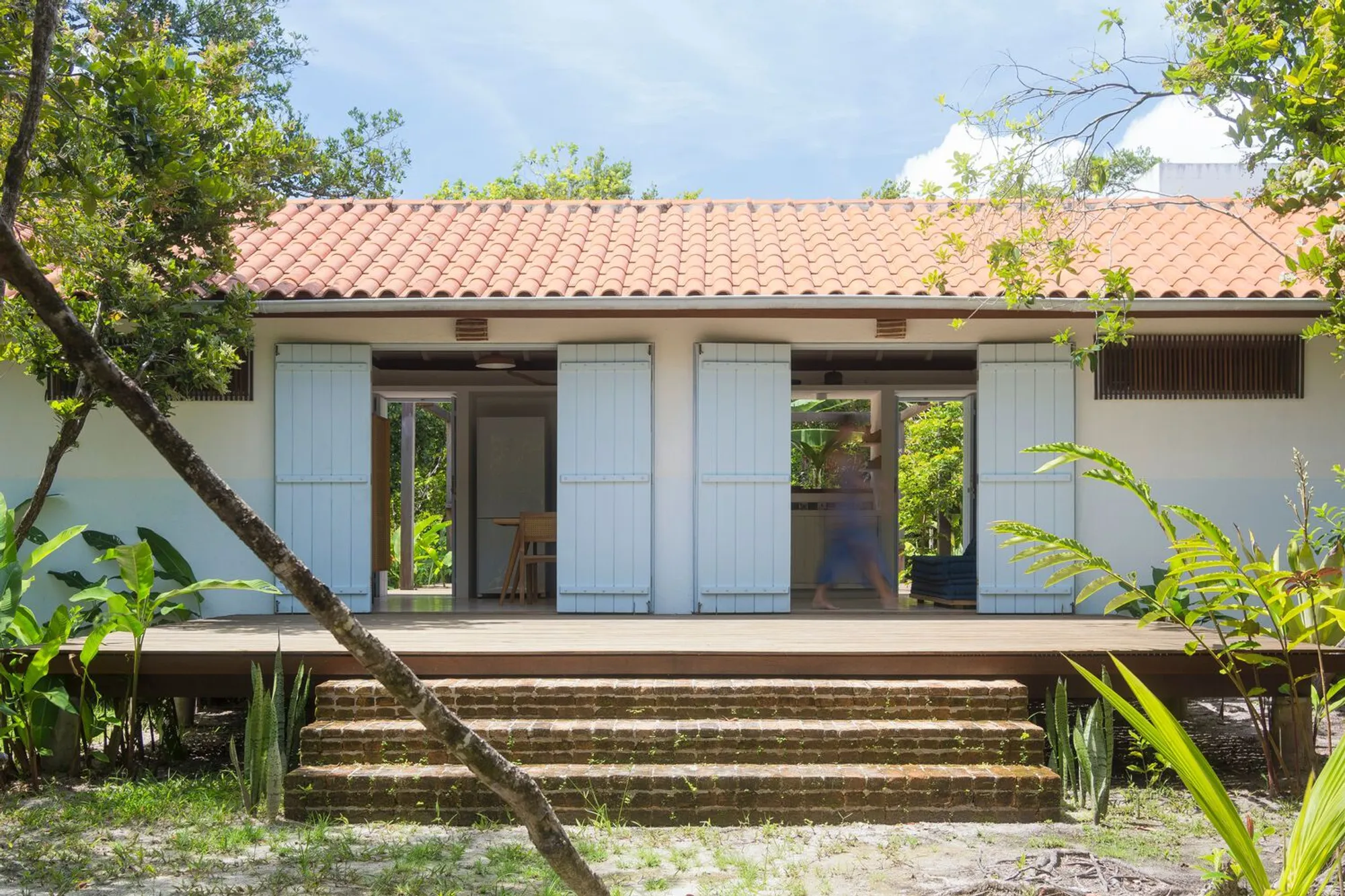
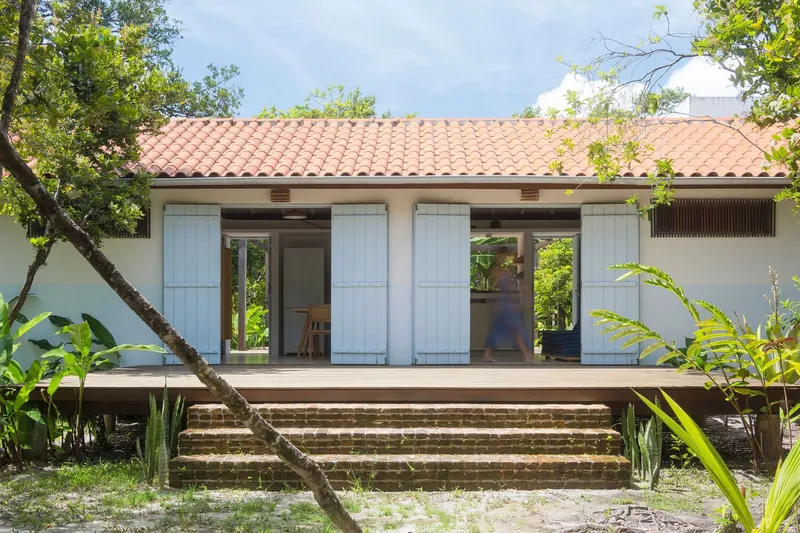
Seventy square meters is not much room. Most architects, given that constraint and a beachfront site on the coast of Bahia, would either pack the plan tight or apologize for the modesty. Cecchi Millan did neither. Palco House, completed in 2021 for a young artist on Algodões Beach in Maraú, treats its compact footprint as a virtue, stretching a single pavilion volume into a linear sequence of living room, integrated kitchen, and two suites that opens at both ends to the landscape. Raised on stilts above the sand, capped with terracotta tiles, and wrapped in pale blue folding shutters, the house reads less as a permanent dwelling and more as a stage set for coastal life, which is fitting given that "palco" means "stage" in Portuguese.
What makes the project worth studying is not its minimalism per se but the discipline with which that minimalism is executed. Every decision, from the elevated structure that lets air circulate beneath the floor to the perpendicular deck that nearly doubles usable outdoor space, serves a climatic or spatial purpose. Nothing is decorative, yet nothing feels austere. The house is simply tuned to its environment with the kind of precision that a larger budget often obscures rather than enables.
A Pavilion Lifted Off the Sand
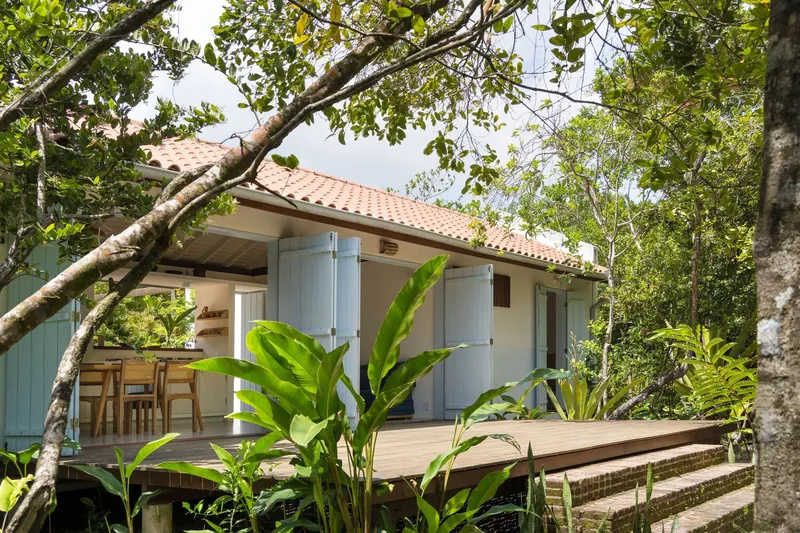
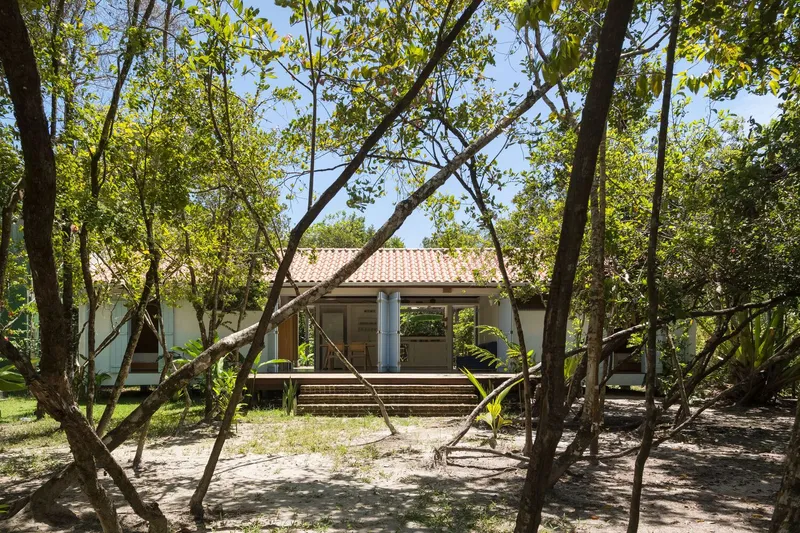
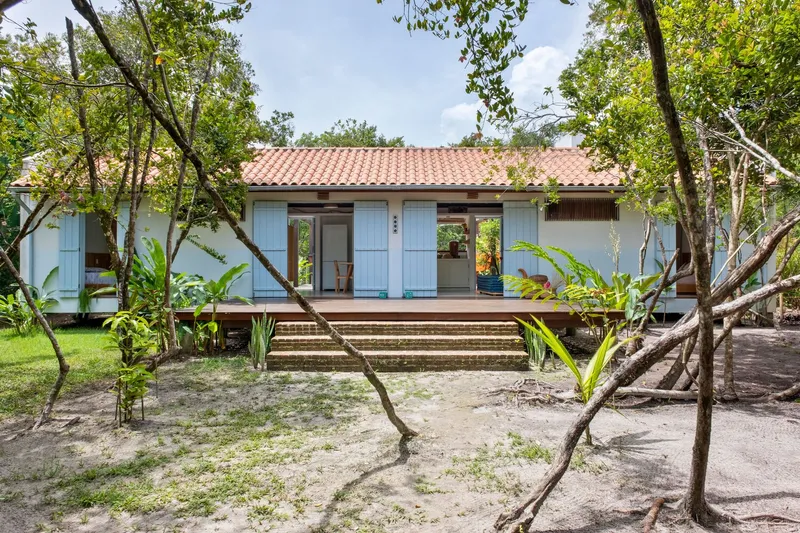
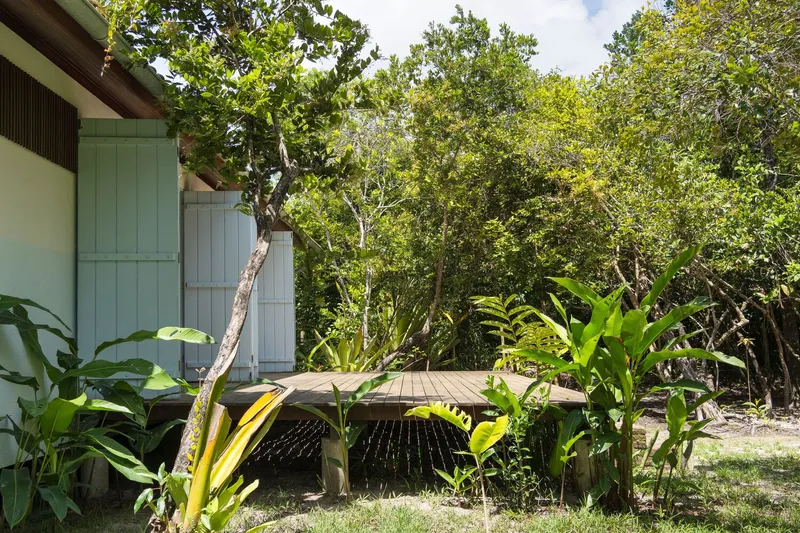
Elevating a beach house is common sense in tropical coastal construction, but Cecchi Millan makes the gesture do more than one job. Raising the volume reduces soil disturbance on a fragile sandy site, promotes airflow underneath the structure for passive cooling, and gives the building a visual lightness that keeps it from competing with the banana palms and deciduous canopy surrounding it. The result is a structure that hovers among the trees rather than displacing them.
The terracotta tile roof, pitched simply and carried on exposed timber trusses, anchors the pavilion to a regional building tradition without resorting to pastiche. Seen through scattered trunks and dappled sunlight, the house has an almost provisional quality, as if it could be disassembled and the beach would barely remember it was there.
Pale Blue Shutters as Climate Control
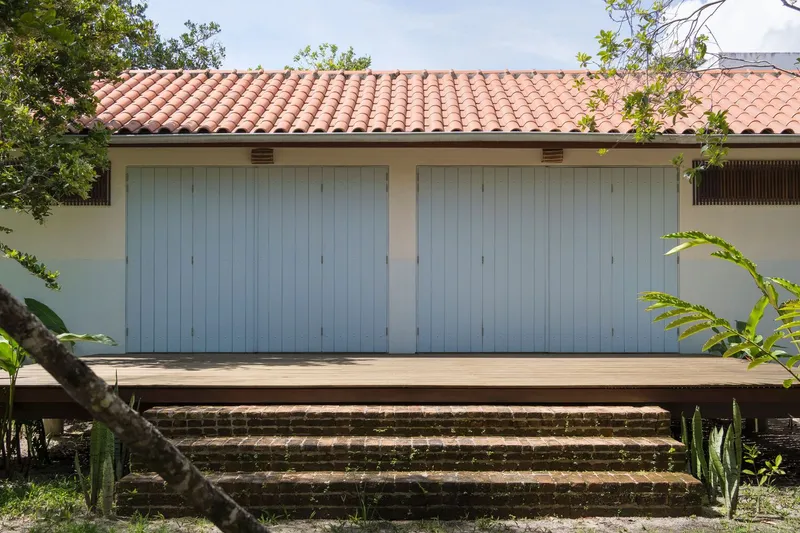
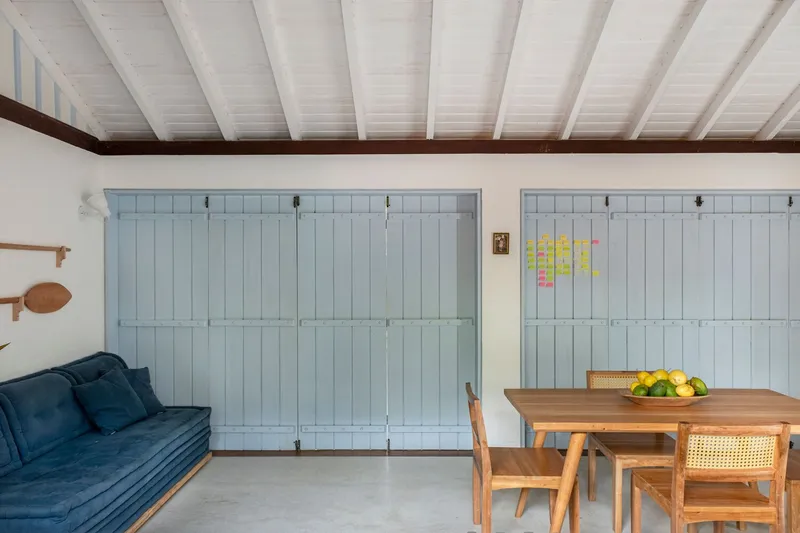
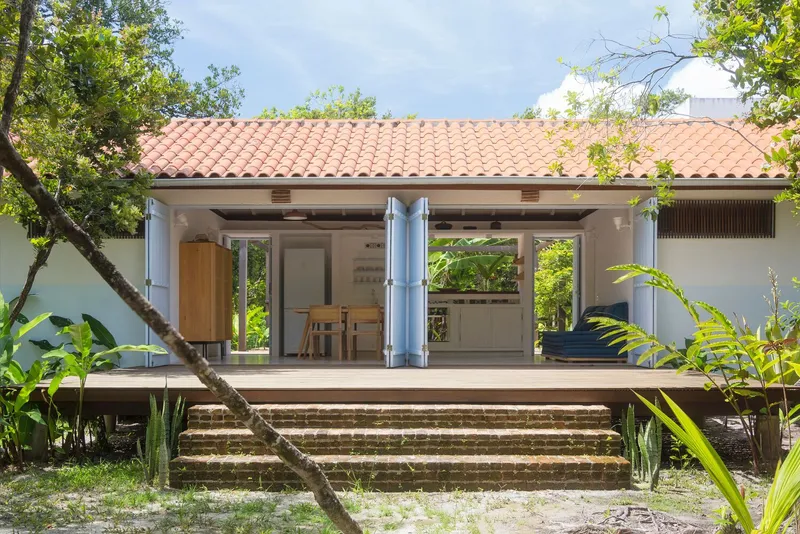
The pale blue folding shutters are the most conspicuous element of the facade, and they earn their prominence. In the open position they dissolve entire walls, turning the interior into an extension of the deck and garden. Closed, they provide security, shade, and rain protection while still allowing ventilation through gaps in the vertical timber slats. The color, unexpected against the green foliage and red clay roof, gives the house an identity without relying on formal complexity.
Inside, the same pale blue reappears as folding partition walls that subdivide the linear plan. These panels let the artist reconfigure the interior depending on the season, the number of guests, or simply the mood of the day. It is a smart move for a house this small: rather than fixing every room in place, the partitions make the plan negotiable.
Exposed Structure as Interior Character
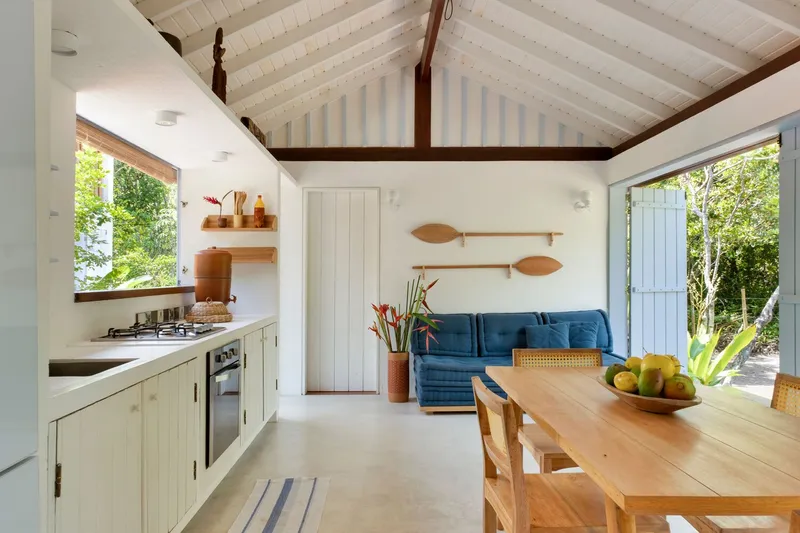
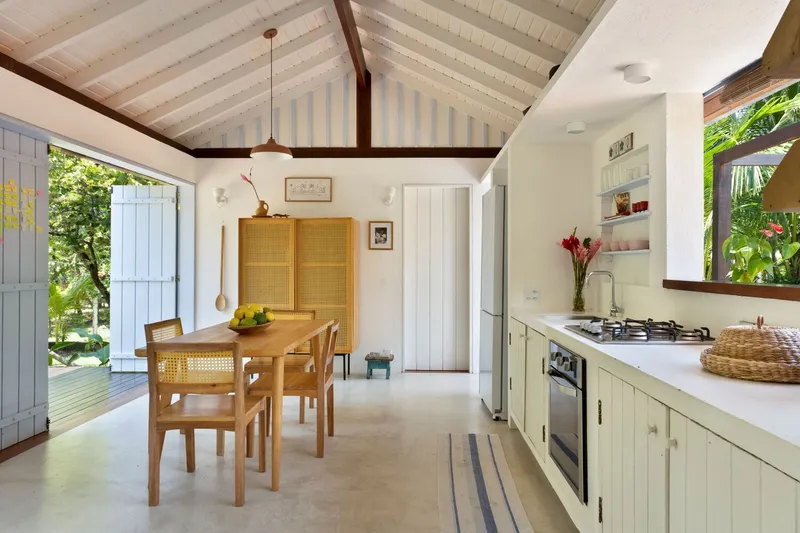
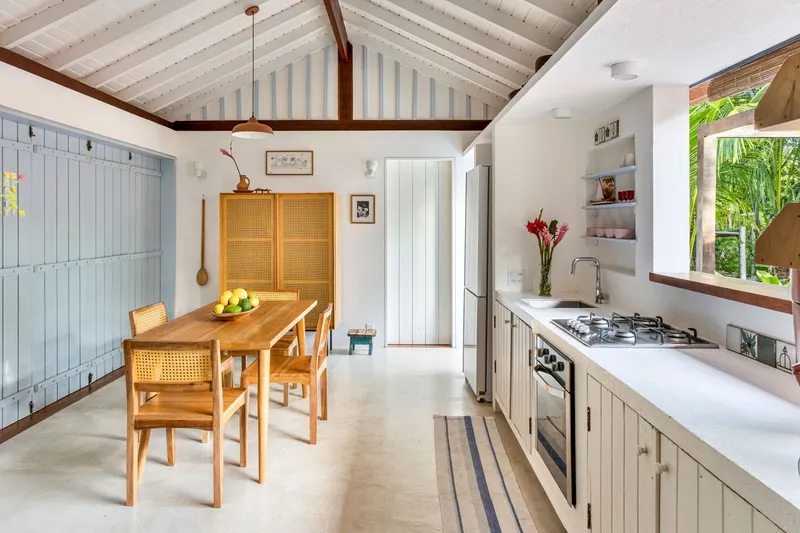
The vaulted ceiling, constructed from painted timber beams and tongue-and-groove board paneling, is the interior's dominant feature. By leaving the roof structure fully exposed and painting it white, Cecchi Millan creates a sense of volume that belies the house's modest area. The rhythmic spacing of the rafters introduces pattern and scale without decoration, and the white finish bounces daylight deeper into the plan.
Beneath this ceiling the kitchen and dining area sit on a polished concrete floor, a material durable enough for sandy feet and easy to maintain in a humid climate. The palette is deliberately restrained: concrete underfoot, timber overhead, and only a few carefully placed objects, like the cane-fronted cabinet and terracotta pendant light, to add warmth and texture.
Indoor-Outdoor Thresholds
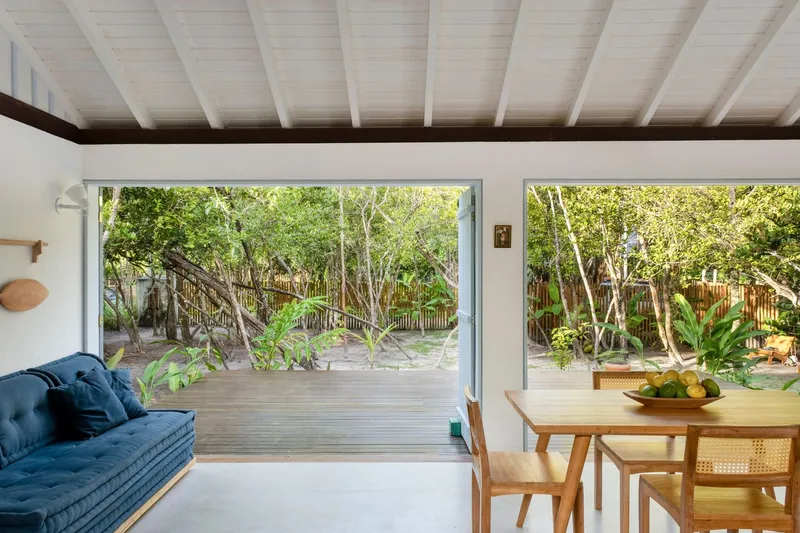
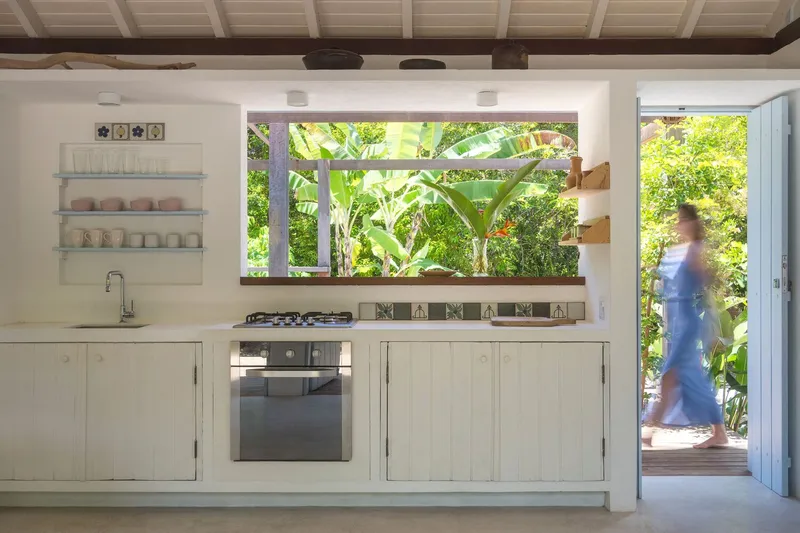
Every room in Palco House maintains at least one direct opening to the outside. Sliding doors in the living area pull back to reveal the timber deck and garden beyond, collapsing the threshold entirely. A horizontal window in the kitchen frames banana palms at eye level, turning food preparation into a moment of contact with the landscape. These are not picture windows designed for contemplation from a distance; they are apertures that invite the outdoors in, physically and sensorially.
The perpendicular deck, extending from the main volume into the garden, is arguably the most important room in the house. At 70 square meters of enclosed space, the interior can only do so much. The deck absorbs the overflow: dining, reading, socializing, or simply watching the light change through the tree canopy. It is outdoor space treated with the same architectural intention as the rooms behind it.
Material Economy and Craft
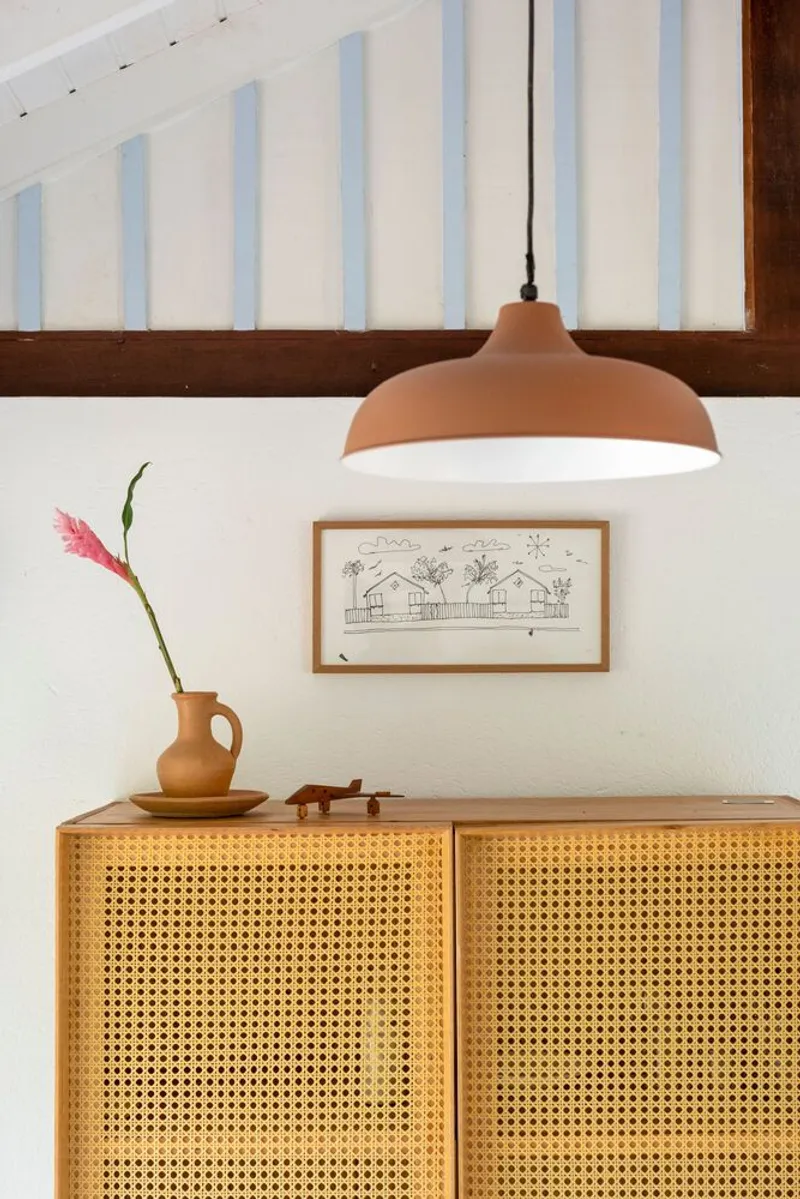
The material list is short: timber decking and structure, concrete floors, terracotta roof tiles, glass, and painted wood paneling. Each material is used honestly, with joints and connections visible rather than concealed. The cane-fronted cabinet and woven textures throughout the interior suggest a deliberate engagement with local craft traditions, adding tactile richness to a palette that could otherwise feel clinical.
Structural engineer Marlon Vivas and construction firm Art's Construções e Consultoria deserve credit for the execution. In a remote coastal location, getting details right with simple materials requires coordination and care that no rendering can guarantee. The clean lines and precise joinery visible in every photograph speak to a build quality that matches the design intent.
Plans and Drawings
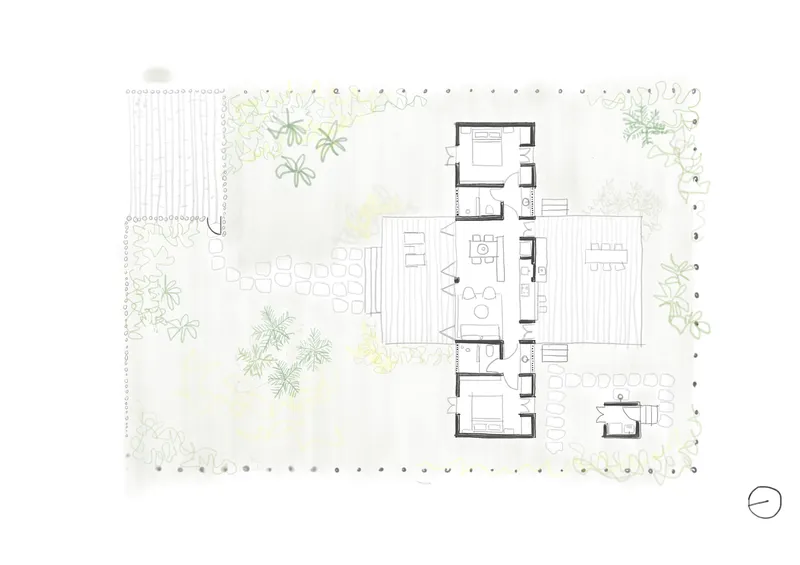
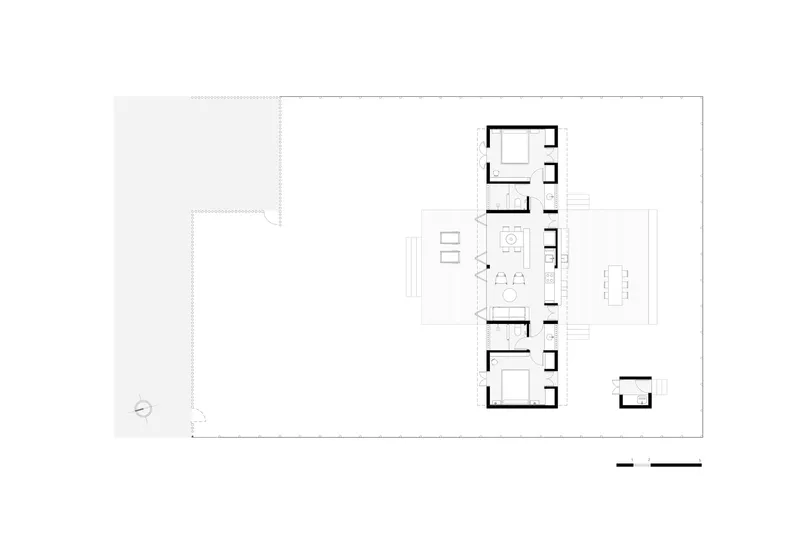
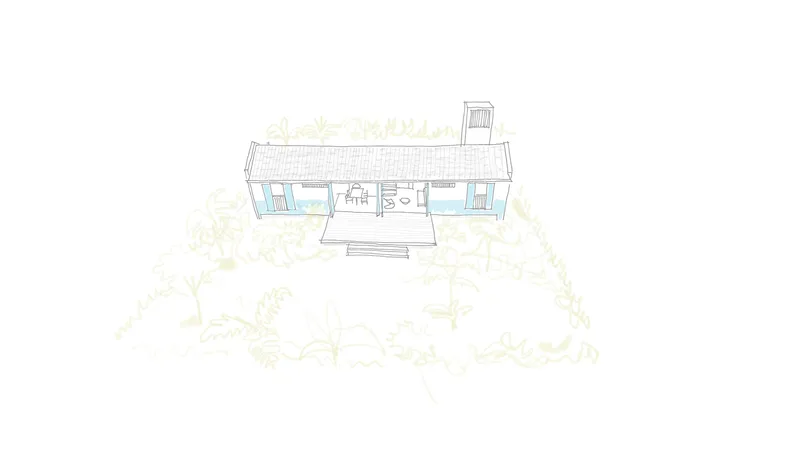
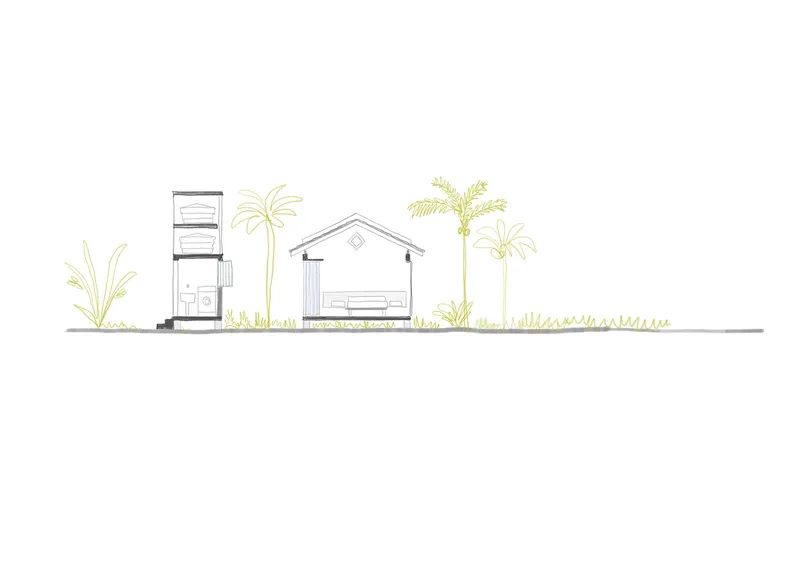
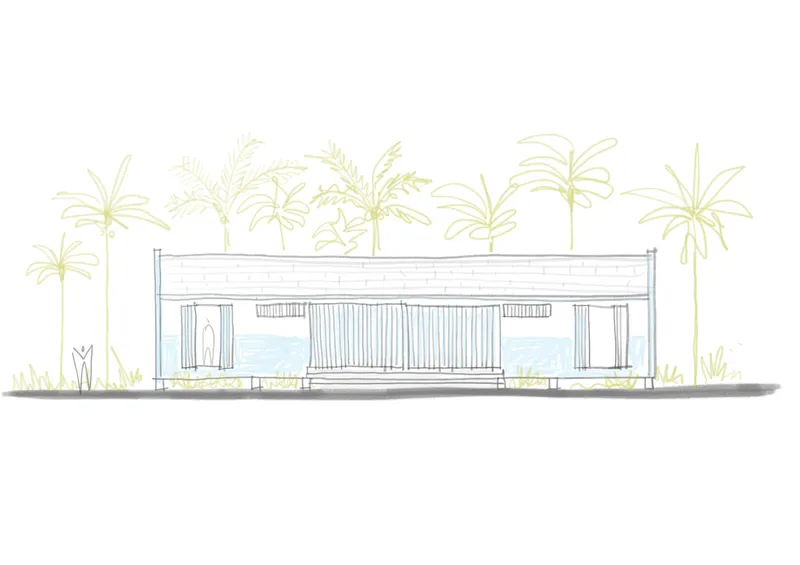
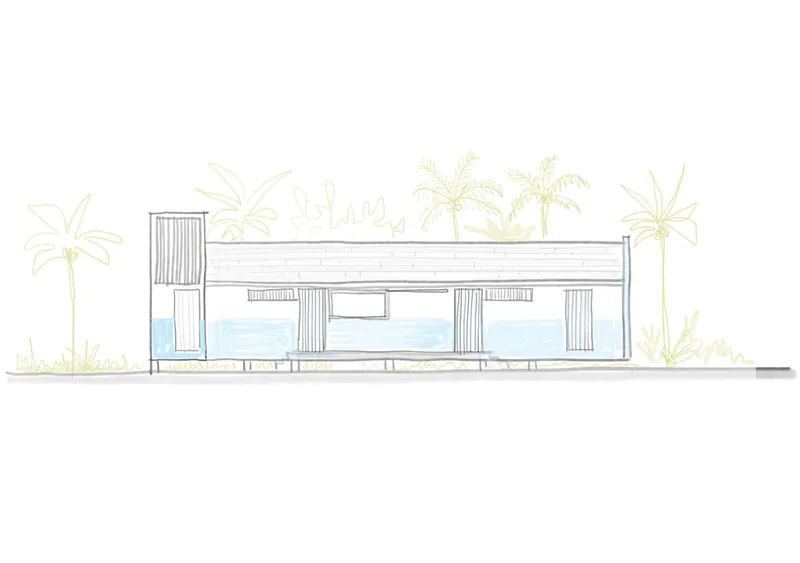
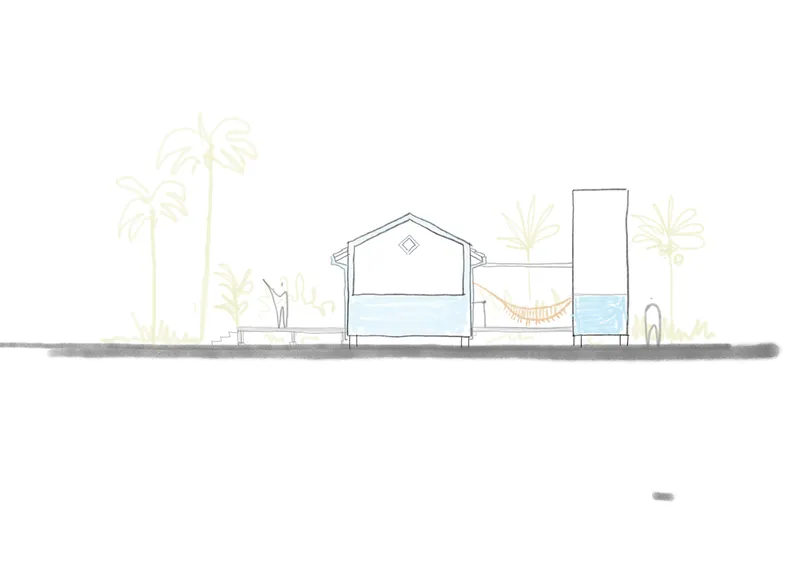
The floor plans confirm the linear logic of the layout: a central living volume flanked by bedrooms, with outdoor terraces and a small pool extending the habitable area into the garden. The axonometric drawing reveals the courtyard strategy, showing how the pavilion wraps around planted space to create a sense of enclosure without closing off ventilation or views.
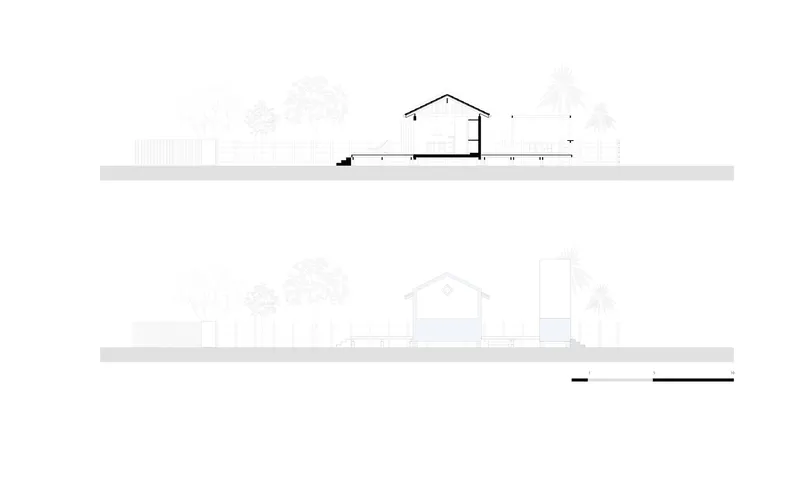
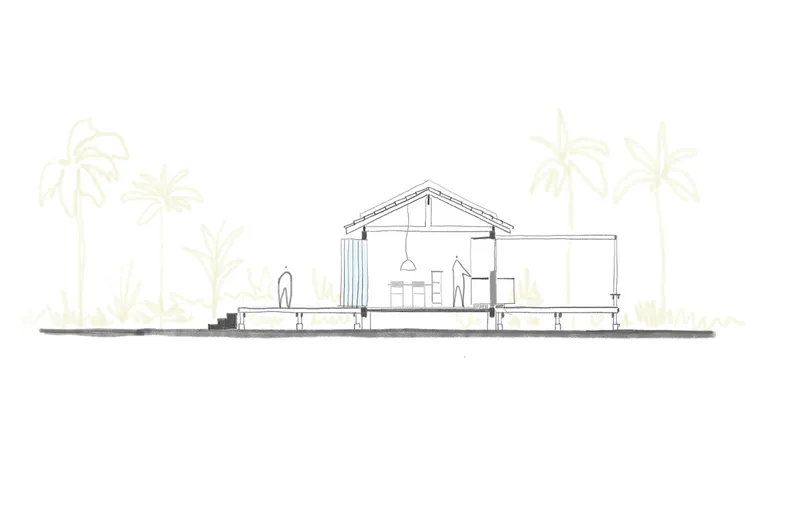
Sections and elevations are equally revealing. The gabled roof profile, modest in height, keeps the building well below the tree canopy. A service tower punctuates the horizontal volume, adding vertical storage and utility space without disrupting the pavilion's low-slung proportions. The elevation drawings with slatted screens show how the facade modulates between opacity and transparency depending on which shutters are deployed, giving the house a different character at every hour of the day.
Why This Project Matters
Palco House is a reminder that architectural ambition and square footage are unrelated. In 70 square meters, Cecchi Millan delivers a house that addresses climate, context, craft, and spatial generosity with a coherence that many projects five times its size fail to achieve. The decisions are legible: elevate the structure, open the walls, extend the deck, keep the materials honest. None of these moves are novel in isolation. Together, calibrated for a specific beach on a specific stretch of the Bahian coast, they produce a house that feels inevitable.
For anyone designing small tropical dwellings, the project offers a useful template: treat outdoor space as architecture, let the climate strategy generate the aesthetic, and resist the urge to add. The young artist who commissioned the house got something better than a retreat. They got a framework for living that defers to the landscape while remaining unmistakably designed. That balance, between presence and humility, is the hardest thing in architecture to get right, and Palco House gets it right.
Palco House by Cecchi Millan. Algodões Beach, Maraú, Bahia, Brazil. 70 m². Completed 2021. Photography by Oka Fotografia.
About the Studio
Share Your Own Work on uni.xyz
If projects like this are the kind of work you want to make, uni.xyz is a place to publish your own, find collaborators, and enter design competitions.




Popular Articles
Popular articles from the community


The Musturak Paradise: Senior Living Architecture for a Connected Future in Temara, Morocco
The Musturak Paradise reimagines senior living architecture in Temara via private homes, social spaces, culture, community, and shared care.

AL-JANNAH: Sustainable Architecture and Permaculture for Afghan Widows
AL-JANNAH uses sustainable architecture and permaculture to create resilient oasis of housing, learning, work and renewal for Afghan widows.

Riyadh For All: Intergenerational Urban Design for Active Aging in Rabat
Riyadh For All reimagines urban design in Rabat with intergenerational co-living, adaptive courtyards, and Moroccan cultural exchange today.

The Earth Pod: 3D Printed Homes for Resilient Refugee Communities
The Earth Pod reimagines refugee housing through 3D printed homes made from clay, combining resilience, self-sufficiency, and rapid shelter.


Similar Reads
You might also enjoy these articles


FAMM Arquitectura Organizes Ten Villas Around Courtyards and Jungle in Nosara, Costa Rica
El Molino pairs two elongated volumes with deep overhangs and timber louvers to build a compact coastal community five minutes from the beach.
Oscar Niemeyer's Ibirapuera Park Pavilions Define São Paulo's Cultural Identity in Concrete and Curve
A constellation of modernist volumes set within São Paulo's most important urban park, conceived for the city's 400th anniversary in 1954.
How Henri Picq's 1889 Paris Pavilion Traveled 11,000 Kilometers to Become Santiago's Artequín Museum
A prefabricated iron and glass pavilion built for the Paris Universal Exposition found a second life as a children's art museum in Chile.
Sanjay Puri Architects Wraps a Jaipur Office Tower in Capsule-Shaped Green Buffers
A nine-level climate-responsive workplace near Jaipur Airport uses stacked planter terraces and aluminium screens to fight 40°C heat.


Explore Architecture Competitions
Discover active competitions in this discipline



Challenge to reimagine the Iron Throne


Photograph architecture without architects


Illustrate the lost glory of Angkor Wat - Render Challenge


Design challenge to reuse E-waste
Comments (0)
Please login or sign up to add comments
No comments yet. Be the first to comment!