
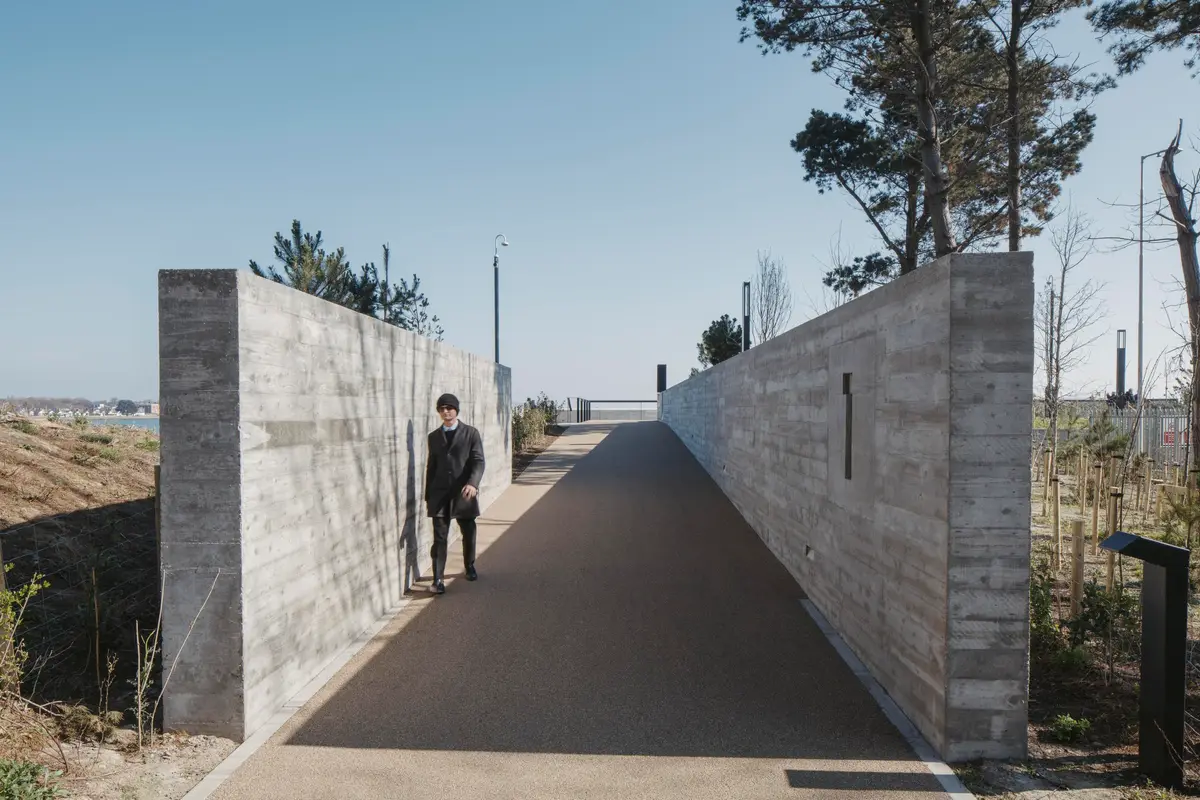
TTT and Darmody Architecture Carve a 2.2km Public Greenway Through Dublin's Working Port
A board-marked concrete promenade along the Tolka Estuary reclaims a former city dump as Dublin Port's first public landscape.


Dublin Port receives up to 5,000 trucks a day. It is not the kind of place you expect to find a public promenade, much less one that feels considered, generous, and deliberately monumental. Yet the Tolka Estuary Greenway, a collaboration between TTT and Darmody Architecture, does exactly that: it opens 2.2 kilometres of previously inaccessible port land along Dublin's northern estuary edge, establishing a civic spine on ground that once served as a city dump and was more recently occupied by industrial yards.
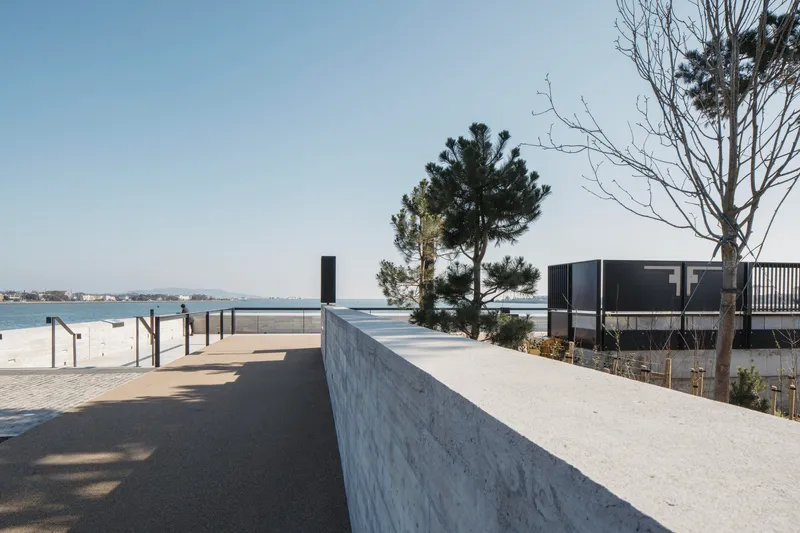
What makes the project interesting is the refusal to domesticate the site. Instead of softening the port's industrial character, the architects lean into it. Board-marked concrete walls 400mm thick, black metalwork gates and screens, salvaged material repurposed as paving and seating: the material vocabulary is heavy, direct, and calibrated to hold its own against the container cranes and chimney stacks on the horizon. The greenway is part of Dublin Port's "Distributed Museum" initiative, and the three discovery points along the route treat the working port itself as the exhibition.
Industrial Scale as Design Language
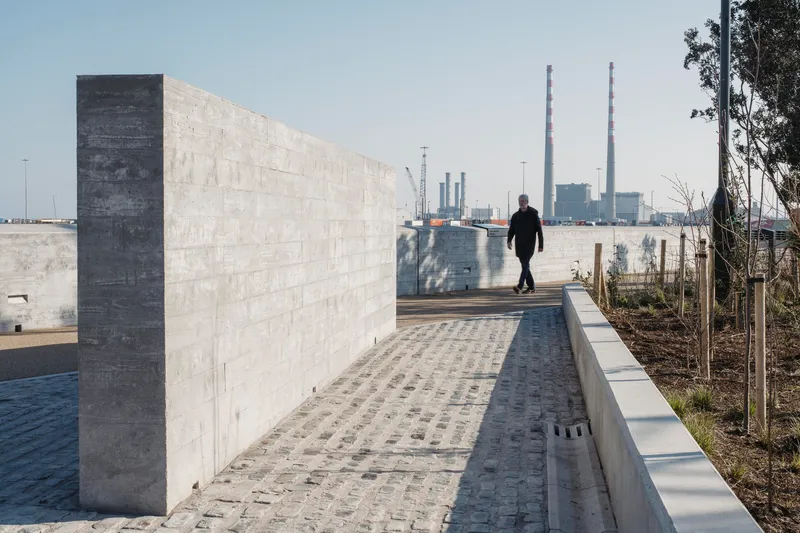
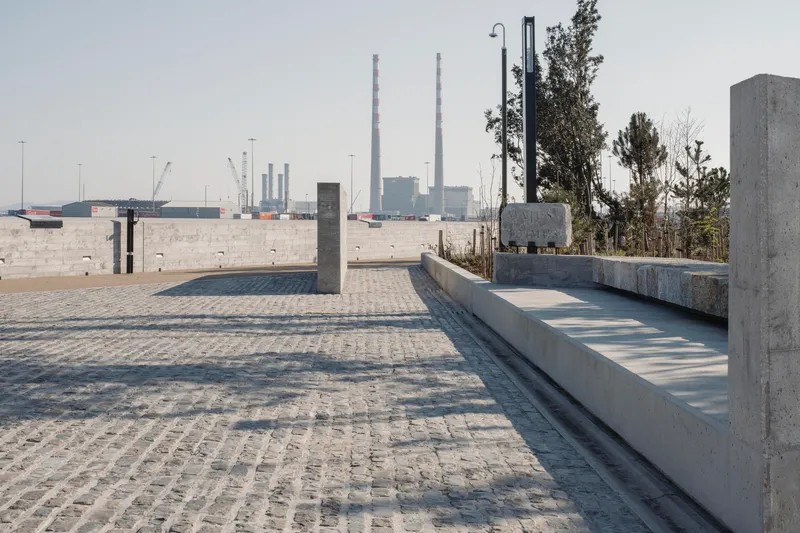
The most consequential decision here is scale. The concrete parapets and retaining walls are thick enough to register against the port's gantry cranes and fuel stacks visible in the middle distance. Granite block paving and cobblestone pathways feel robust, not decorative. When you walk this promenade, you are always aware that you are a guest on working infrastructure, and the architecture never pretends otherwise.
Salvaged materials embedded in the paving and seating ground the project in the site's layered history. These are not heritage gestures; they are practical acts of reuse that give texture to surfaces that would otherwise be anonymous. The effect is a landscape that reads as accumulated rather than designed from scratch.
Three Discovery Points, Three Turns
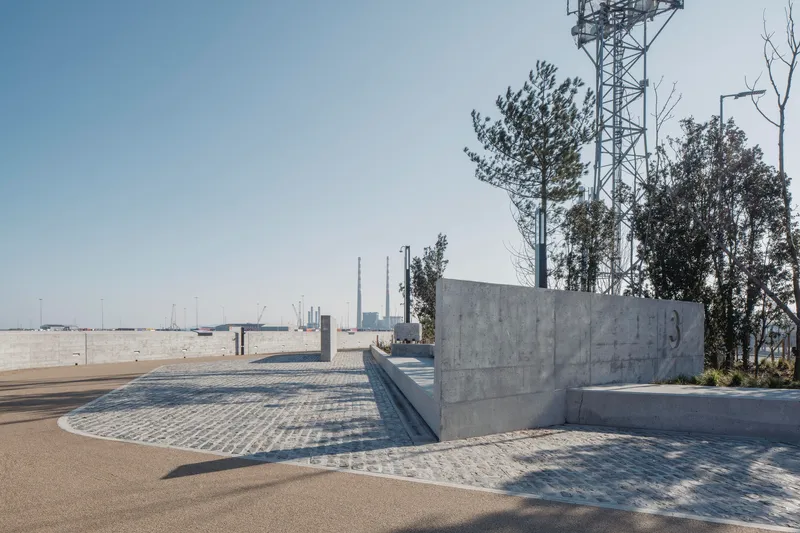
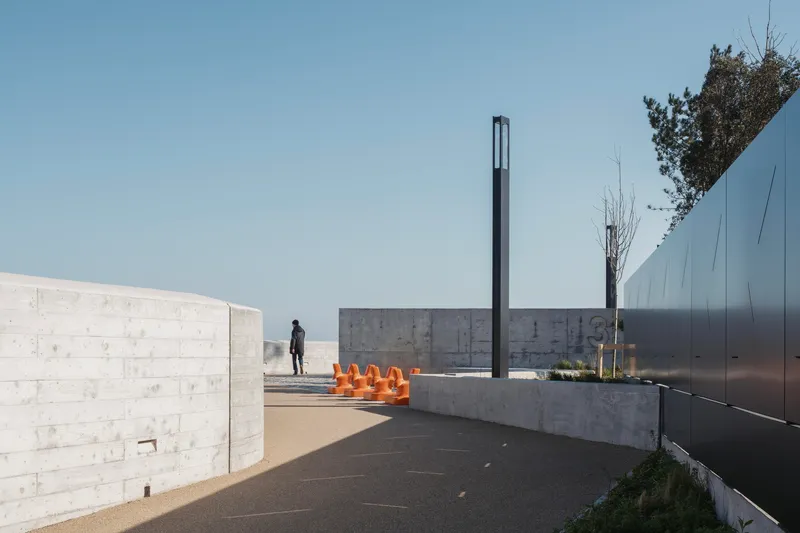
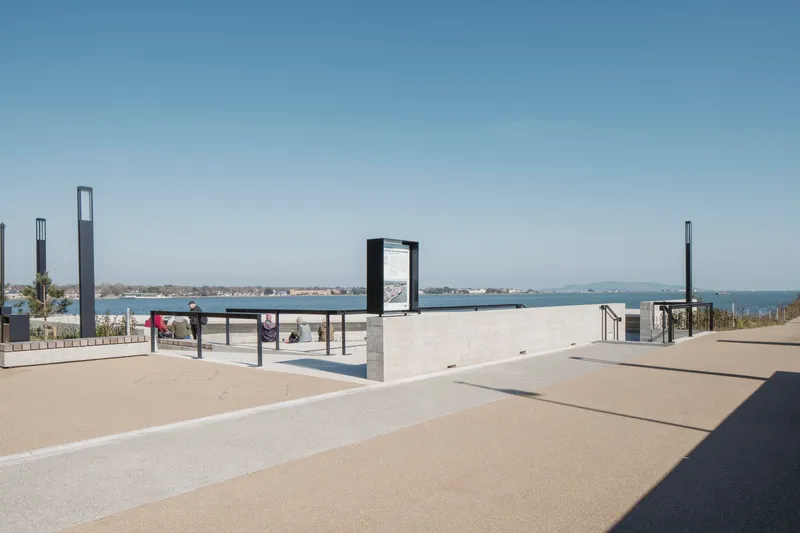
The greenway's route bends through three hard right angles, and each turn becomes a plaza. These plazas house the project's discovery points, where information kiosks, sculptural elements, and seating clusters slow the pace and redirect attention outward toward the estuary and bay. The curved concrete seating walls at one plaza cradle a view of the distant shoreline; at another, orange sculptural objects and young trees introduce a different register of colour and form.
The angular geometry works because it matches the operational logic of a port. Roads bend at right angles here not for aesthetic reasons but because trucks need clearance. Adopting that geometry for a public path is a smart alignment of civic ambition and infrastructural reality.
Board-Marked Concrete and the Weight of Enclosure
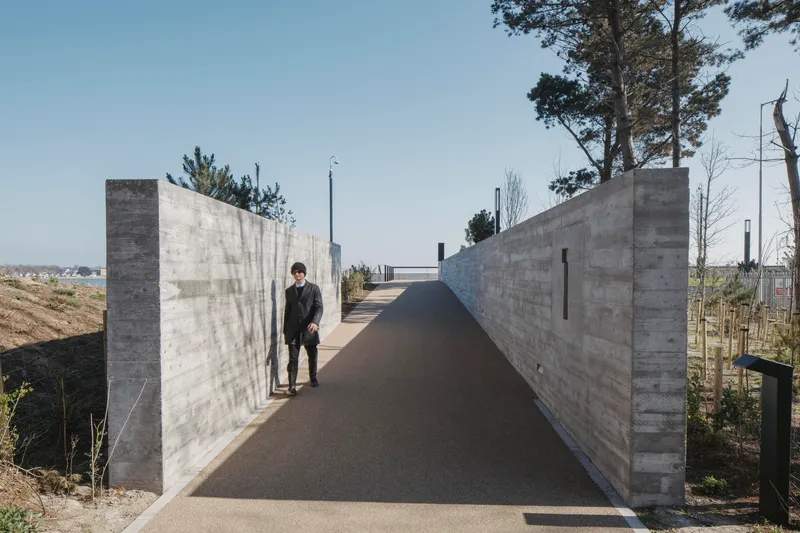
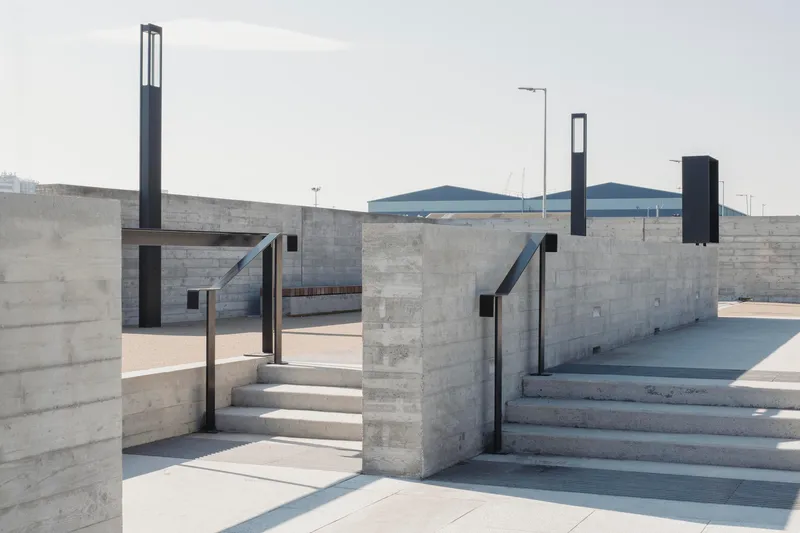
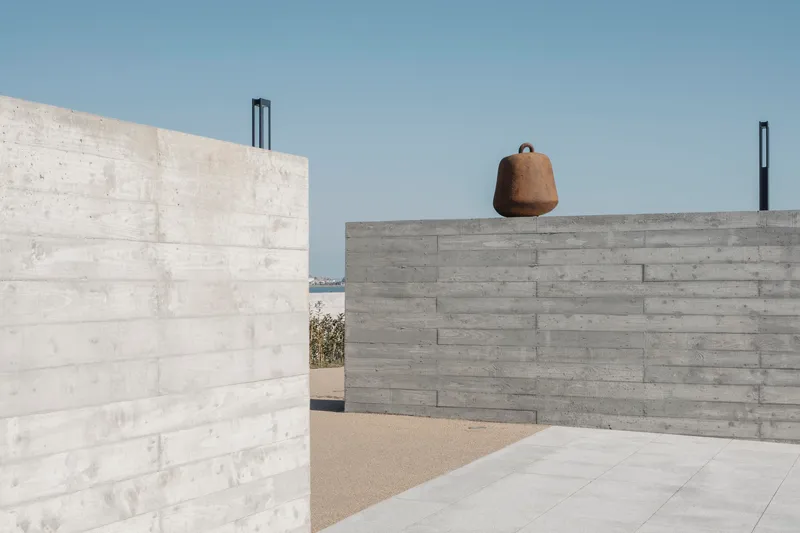
The board-formed concrete is the project's signature material. In a narrow passage flanked by tall walls, the timber imprint of the formwork catches raking light and creates a warm, almost textile quality on surfaces that are otherwise uncompromisingly hard. A weathered bell suspended from an upper parapet in one courtyard adds an unexpected note of found-object poetry.
Staircases descend between perpendicular concrete walls with black metal railings, creating threshold moments that shift you between the promenade's upper level and the estuary edge. These transitions are handled with a directness that avoids theatrical ramps or gratuitous level changes. You go down because the ground goes down.
Waterfront Edge and Ecological Care
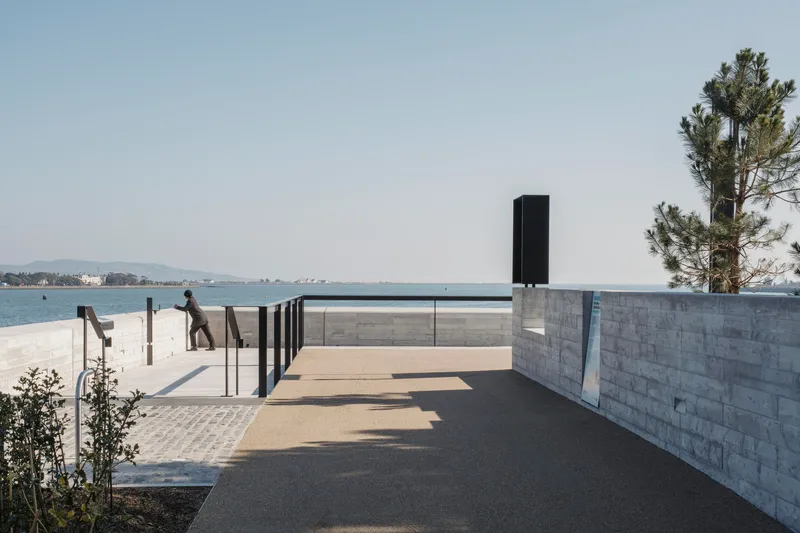
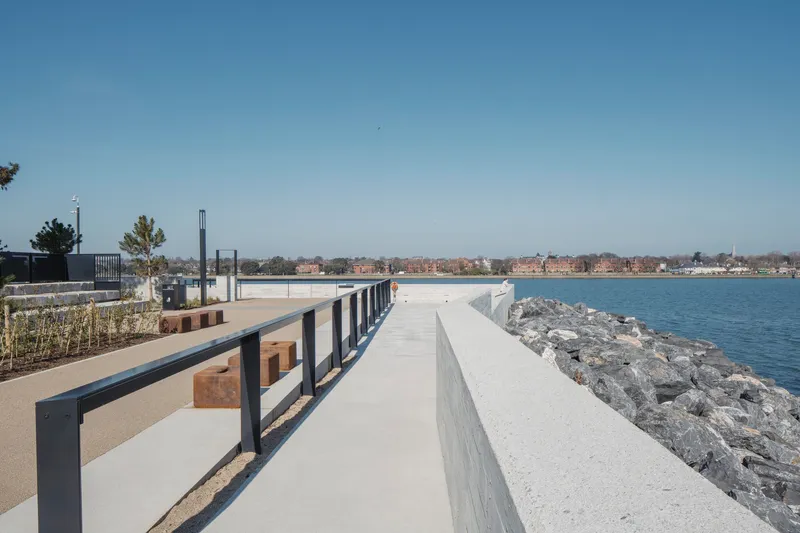
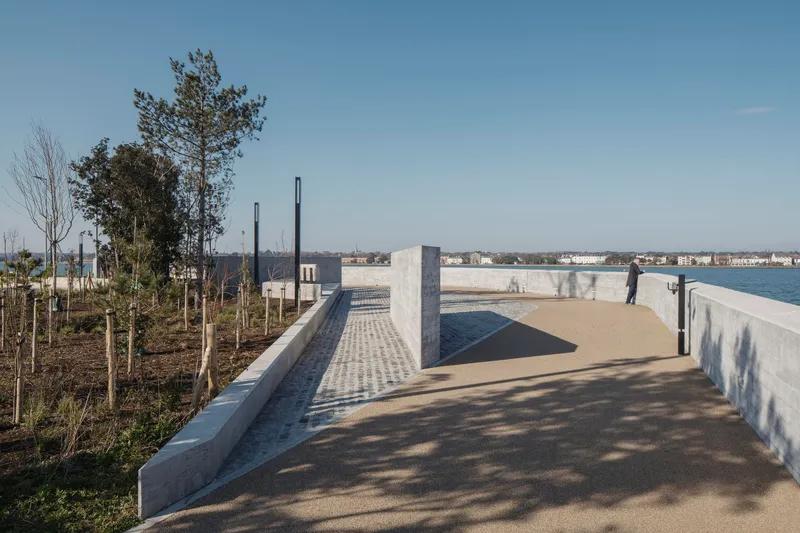
The greenway's alignment was carefully plotted to preserve existing mature pines, willows, and sycamores along the route. Rather than clearing and replanting, the designers threaded the path around these established trees, and the result is a promenade that already feels rooted. Native species are blended into planted beds that border the pathway, offering a softer counterpoint to the concrete and stone.
Weep holes at the base of every sea wall channel surface water run-off into planted verges, a straightforward drainage strategy that doubles as irrigation. The lighting system deserves mention: designed in BIM and validated with 3D simulation software, it uses energy-efficient LEDs calibrated specifically to minimise disturbance to wildlife along the estuary. In a port that never stops moving, protecting the ecology of a tidal edge requires precisely this kind of technical attention.
Seating, Texture, and the Pace of Walking
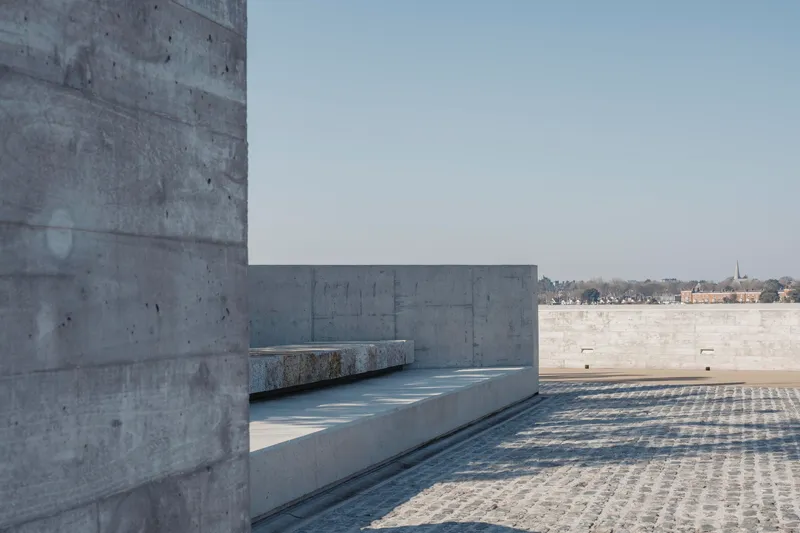
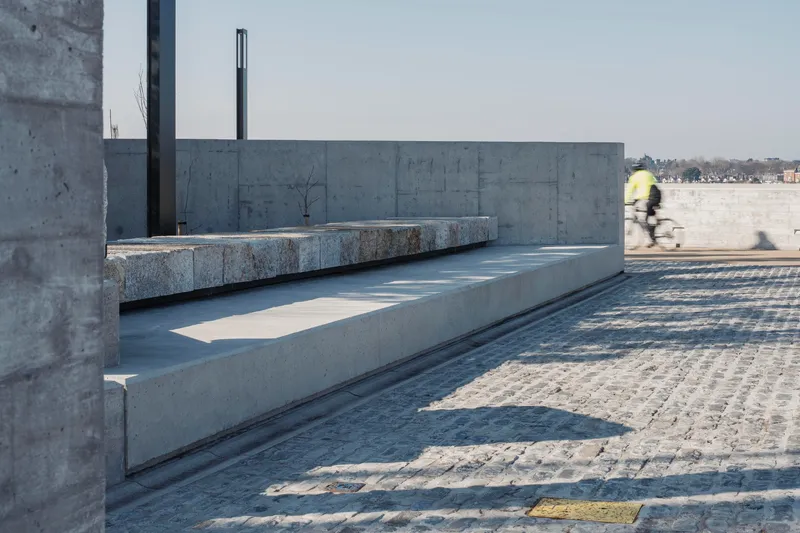
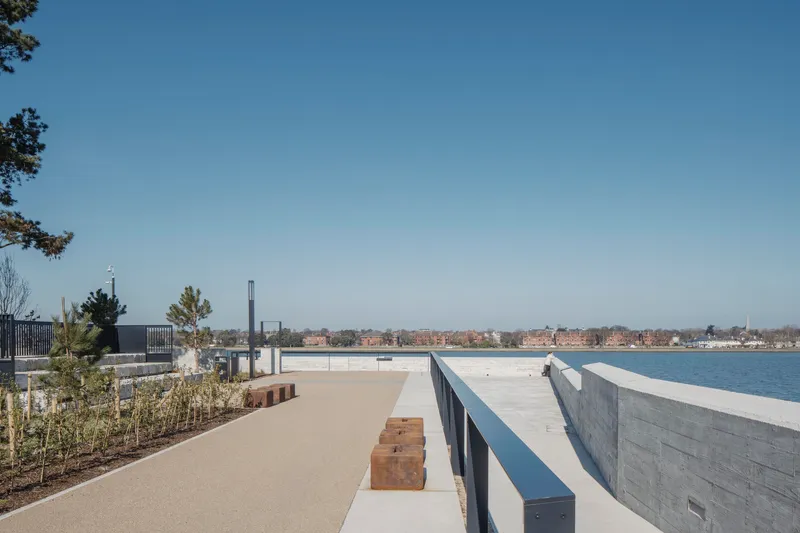
Granite benches built into curved concrete walls, timber seats set between parapets, salvaged stone ledges: the greenway provides a density of seating that encourages people to stop. A cyclist caught in motion blur against one of these benches captures the dual tempo the project supports. You can move through it quickly or sit for an hour watching the tide.
The boardwalk terrace at the water's edge, with its timber benches framed by concrete walls, is the kind of space that looks better on a grey Dublin afternoon than it does in sunshine. The material palette was chosen for overcast skies, and the warmth of the wood reads strongest when the light is flat. That's a mark of designers who understand their climate.
The Gateway Moments
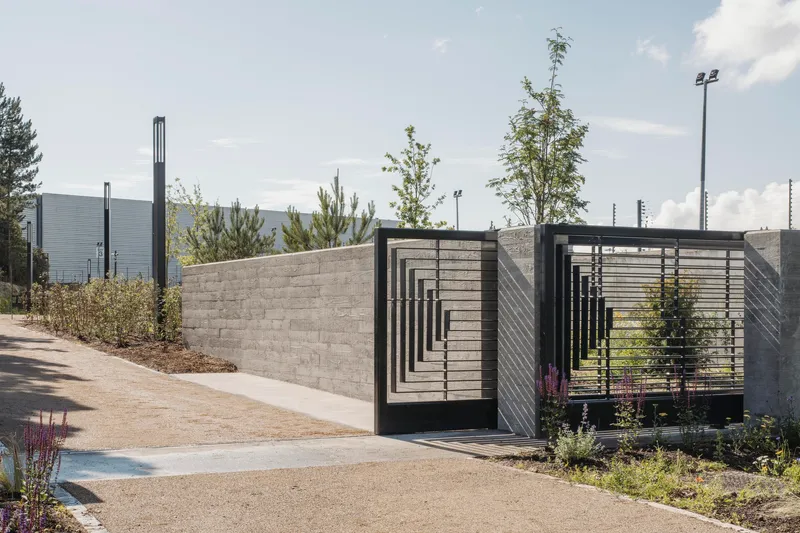
Black metalwork gates punctuate the route, framing transitions between the greenway's three character zones. These gates are not barriers; they are visual markers that tell you something about the space is about to change. The contrast of dark iron against pale concrete gives each threshold a graphic sharpness that photographs well but, more importantly, orients you on a long linear route where repetition could easily lead to disorientation.
Plans and Drawings
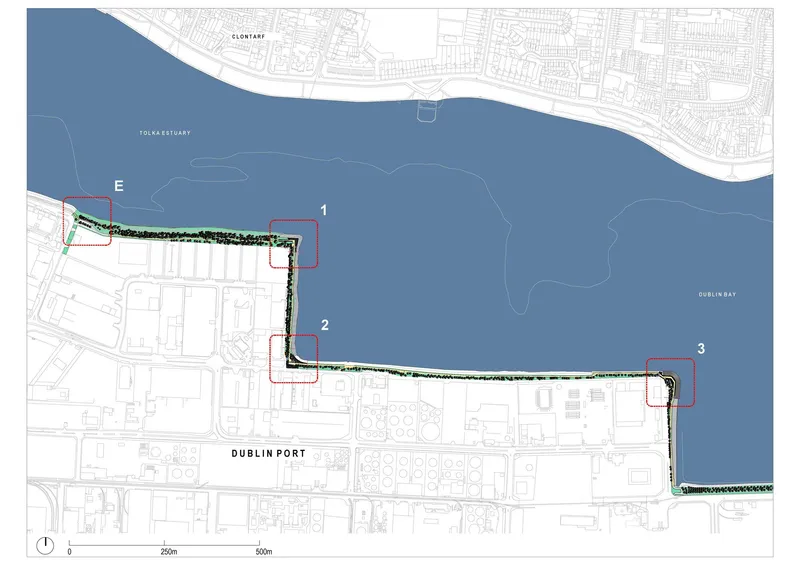
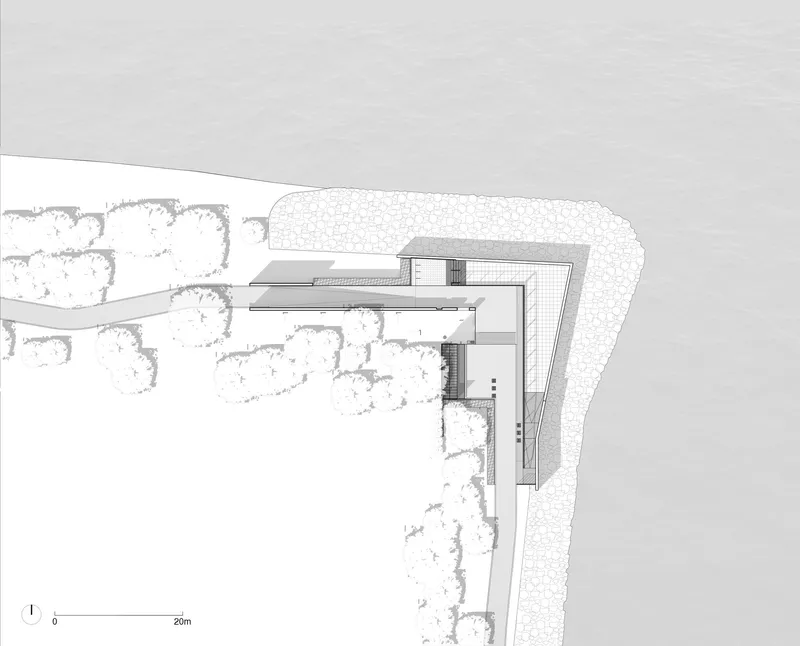
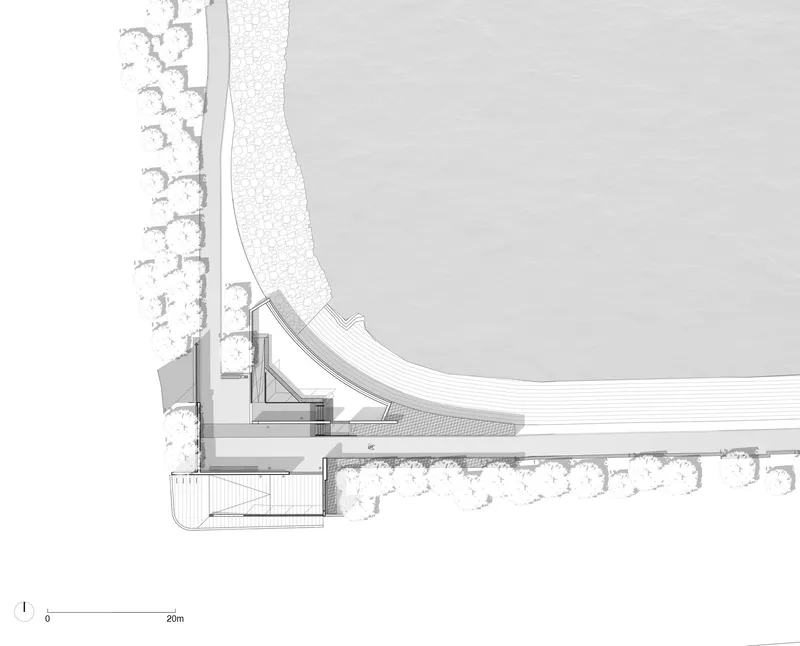
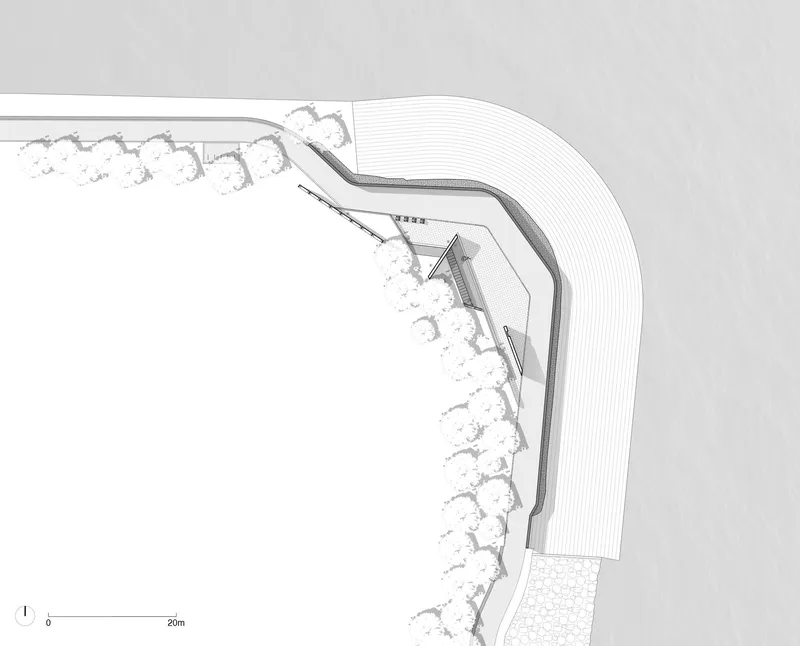
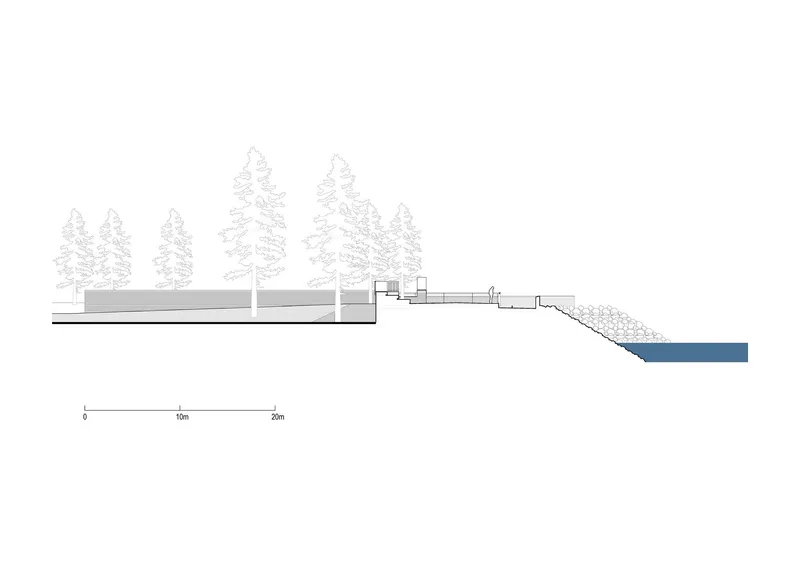
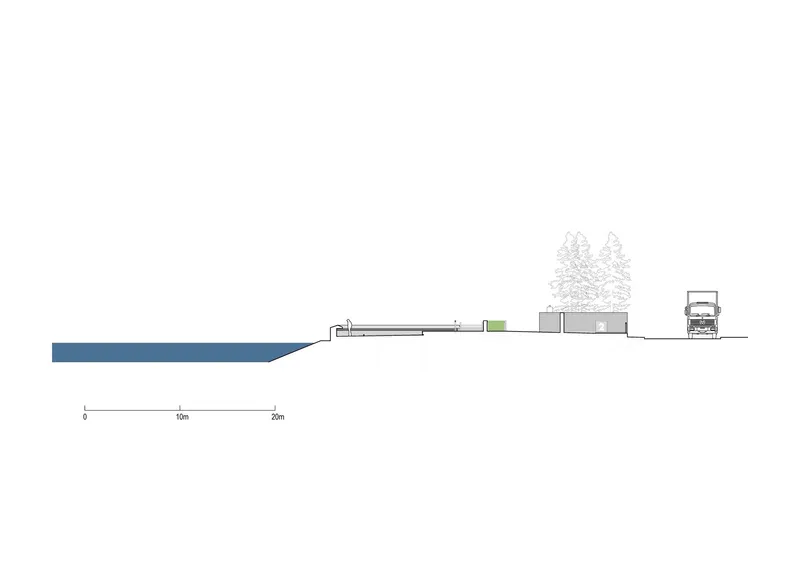
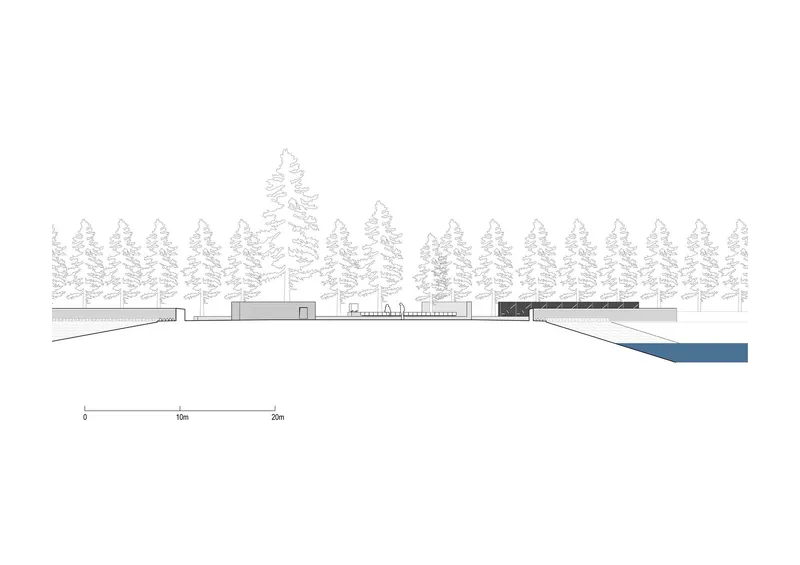
The site plan reveals the full sweep of the 2.2-kilometre route, hugging the curved bay edge with three distinct sections that correspond to the discovery points. Detail plans at each pavilion show how angular roof forms, planted landscapes, and courtyard configurations respond to specific site conditions, whether a dense stand of conifers or an open cobblestone plaza. The sections are particularly telling: low-lying structures nestle into sloping terrain between existing trees, maintaining a modest profile that defers to the estuary's horizontal expanse.
What the drawings make clear is the degree to which the sea wall at Discovery Point 3 was integrated into an existing revetment ring beam. This is infrastructure layered onto infrastructure, not a blank-slate landscape project. The elevation drawings confirm the restrained height of built elements relative to the mature tree canopy, a proportion that keeps the architecture subordinate to the natural features it was designed to protect.
Why This Project Matters
Ports are among the last large-scale urban territories to be considered as sites for public life. They are loud, polluted, secured, and optimised for throughput. The Tolka Estuary Greenway does not romanticise that condition, but it proves that a working port and a public landscape can coexist on the same strip of ground. The key is material honesty: by building in the same heavy concrete and steel that defines port infrastructure, TTT and Darmody Architecture made a greenway that doesn't feel like an apology for its surroundings.
The project also demonstrates that "public access" is not a design concept; it is a precondition for one. Opening 2.2 kilometres of previously sealed port land is a political act. What the architects did with that opportunity, preserving mature trees, directing water into planted verges, calibrating light to protect wildlife, building seating that invites you to stay, is what transforms access into inhabitation. Dublin now has a piece of landscape infrastructure that takes its industrial context seriously and treats its citizens like adults. More port cities should be paying attention.
Tolka Estuary Greenway, designed by TTT and Darmody Architecture. Dublin, Ireland. 10,000 m². Completed 2024. Photography by Fionn McCann.
About the Studio
Share Your Own Work on uni.xyz
If projects like this are the kind of work you want to make, uni.xyz is a place to publish your own, find collaborators, and enter design competitions.


Popular Articles
Popular articles from the community


Manzana Morphosis: Stretching Barcelona's Grid into a Living Landscape for 2050
A radical reworking of the Eixample manzana turns density into a tool for generous public space, vertical ecology, and environmental performance.


Cube Design Draws an Ecological Corridor Between Two Shenzhen Hills with the Nankai Building
Beside Shenzhen's container docks, the Nankai Building pairs stacked balconies with a climbing green screen to connect two hillsides across its height.

David Ortega Stacks a Two-Story Mexico City Penthouse Around a Steel Stair and a Pergola-Shaded Roof Terrace
In Colonia Roma, a 300 m² penthouse uses oak joinery, a planted steel stair and a slatted roof pergola to make a new-build apartment feel like a house.

Singing Woman: An Opera House That Performs Before the Curtain Rises
Ovidiu Cristian Pavel's conceptual opera house translates Estonia's choral identity into a sculpted waterfront landmark facing the Baltic Sea.

Similar Reads
You might also enjoy these articles

LAVA Architecten Gives Vocational Education a Sawtooth-Roofed Face on a Mechelen School Campus
In Mechelen, Belgium, a 2,053 m² STEM school on a 6×6 m grid turns workshops and classrooms into rooms that can be rearranged as teaching changes.

KEMA Studio Turns a Derelict Marvila Attic into a 60 m² Lighthouse Apartment Above Lisbon
In Lisbon's Marvila district, a rebuilt roof, four skylights and two plywood volumes turn an unlivable attic into a bright home facing the Tagus.

Pixel Gardens: One Repeated Module Stacked Into a Terraced Social Housing Tower for Famagusta
Salem Bader's shortlisted housing tower builds a vertical neighbourhood from one repeated module, offsetting units to carve terraces, light and air.

Bao Huynh Watercolor Atelier: A Serene Art Retreat in Hội An
Bao Huynh Watercolor Atelier in Hội An blends multifunctional art spaces, sustainable design, local materials, and family-friendly living in a serene environment.


Comments (0)
Please login or sign up to add comments
No comments yet. Be the first to comment!