
TURF Student Housing Design Challenge
Student housing Design Challenge in Manila

Manila. Busy, crowded, and full of history. Many of the country’s top universities can be found within its borders, creating a community centered around its students. With the numerous institutions bringing in students from all over the country, housing has become a lucrative business for developers and landowners, and to reflect the city, densely packing individuals together to maximize the capacity of their accommodation. With the background of being students in Manila, the team approached the project through personal experience, aided by the knowledge gained from research and observation through the years of living within the city.
Before delving into design, the first step taken was discussing key problems and areas of concern, sharing experiences in living in student dormitories in Manila, the facilities, establishments, and areas dedicated to satisfying student needs. After exchanging insight, the team then asked the questions of what can be improved, and what are changes that needed occur to improve the quality of life for students living away from home. There was a distinction between the difference of a house and a home. What makes a home? Answering that it is the people, a sense of safety and comfort in a place. And so, the team arrived at the key concept behind the project: “Interconnecting Paths: Converging and forming healthy communities.”
The idea behind the project is connecting individuals, within the student population coming from different universities, and creating a relationship between the students and the community, interconnecting their paths, and forming a new community within an already built neighborhood, representing Filipino history and culture through it. This highlights provision of spaces that encourage interaction, and also creating an atmosphere that brings comfort, deviating from the typical housing buildings with minimal openings that exist today, bringing a feeling of fresh air, with green and open spaces in between.
After a collective agreement on the direction of the project, the next step was assessing the site to determine how to maximize it, looking at its surroundings, to further understand the context and its environment.
The site has two openings to the perpendicular roads, both of which experience heavy traffic, thus bringing noise pollution into the property. There is a gas station in the corner of where the two roads meet, giving the site a somewhat inverted “V” shape. To the left of the site is a school and a church, labeled as “community area.” Given the shape and surrounding of the site, it was then divided into parts best believed to make most of the area, while providing access to the community.
After exploring different site programming according to the analysis, the team landed on figure two, where the divided areas of the site can be seen, bubble A, bubble B, and bubble C. Bubble A was the most accessible part of the site for the community, with close proximity to the labeled community area, and more dense part of the neighborhood, it was determined as the more “intimate” area of access, with the motorbike parking and pedestrian entrance. Bubble B is located in the most private area of the site, with the most area, and least exposure the access points, and so it was assigned as the main entry way to the residential levels. Bubble C is the most detached from the community out of the three areas, and is away from the main road where most of the heavy traffic occurs, and so it is designated for the vehicular parking.
With the ground floor mostly utilized for parking and access, there was a question of how the community can still be integrated in the project. In looking back at the concept, this was an essential part. The team looked at the context and its historical relevance, in Filipino architecture, and found the idea of elevating the structure. A podium style design was decided, to accommodate the community areas, and act as extra safety and security precautions.
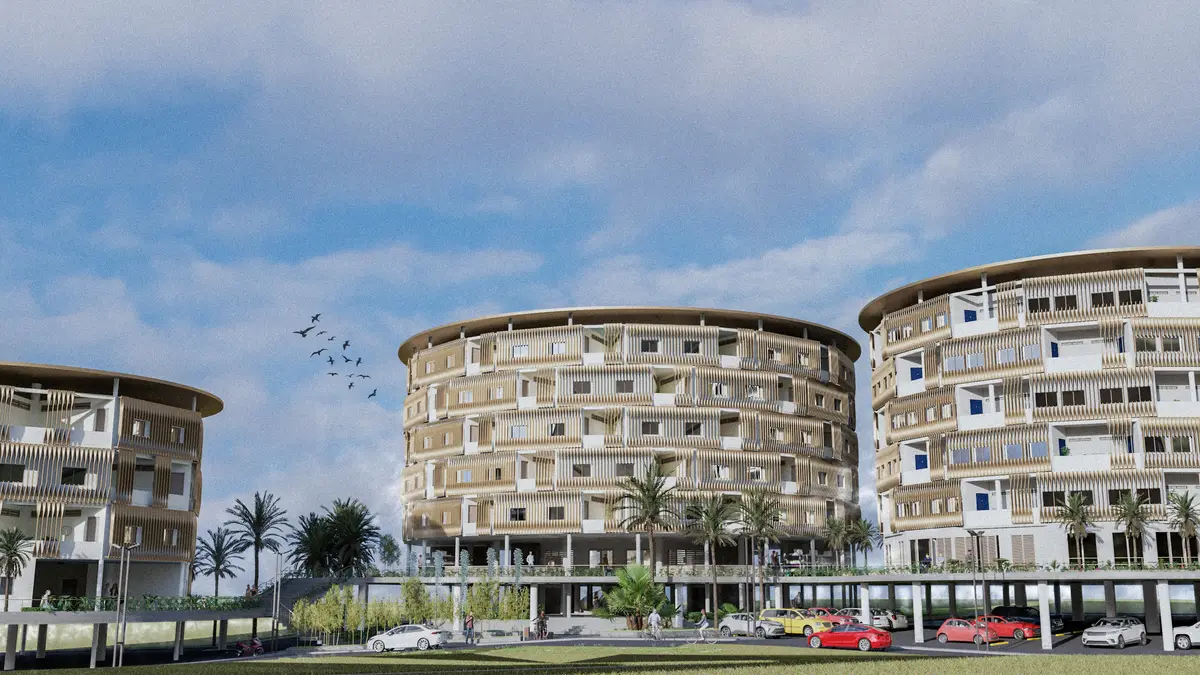
Once the initial form of the lower half of the project was determined, it was then time to look at how to maximize the remaining 5 floors available to build vertically, while at the same time keeping in check the ideas of open spaces, and the environment. The direction of referencing Filipino and tropical architecture was already underway, thus the question of “what?” was answered by passive light and ventilation, with the question of “how?”
An air and light well that goes though the center of the building was ideal in bringing the outside in, and from there came the idea of not only having one massive building, but three, on top of the podium. This would allow each unit to have equal access to natural light and air. To make the project inclusive, with equal units, the modular room system was followed, arranging each tower in a circular manner. Since the center was hollow due to the shape created by the room configuration, the shared spaces and means of access were placed there. This not only reiterates the previous point made of equal access to ventilation and light, it encourages interaction as residents walk up the stairs, going through the different common spaces of each floor.
The unit interiors were designed to be functional, but comfortable for its users. Convertible fixtures were integrated, to maximize the space provided per unit. An example would be how the exterior contributes to this by having movable panels on the balconies that can be folded inward to act as hanging racks for drying clothes.
The materials used are intended to be locally sourced and produced, using recycled materials, minimizing import expenses and carbon emissions in transportation. A more neutral color palette was applied, to avoid alienating the surrounding, and to highlight the texture of the façade, and greeneries.
In conclusion, the project aims to be a home for the students, to rest, to expand their networks, and to let their creativity flow, in a place that considers both physical and mental needs. The openness gives way for them to breathe, and also welcome the community in the neighborhood they have moved into. Providing solutions to prioritize function, psychological needs, diversity, and context. Looking at it in the lens of the future, the team hopes the design influences surround developments to consider, and prioritize he wellbeing of all stakeholders, integrating open spaces and greeneries, and mixing different people to help bring back life into Manila.

Popular Articles
Popular articles from the community


Lunar Spiral: Space Architecture Shaped by the Mathematics of the Universe
Lunar Spiral reimagines space architecture through Fibonacci geometry, lunar regolith, levitating habitats, and self-sustaining Moon living.

ALGAL REALM: A Bio-Integrated Lunar Habitat Design for Life Beyond Earth
ALGAL REALM reimagines lunar habitat design with algae-powered life support, 3D-printed regolith, and vertical living for a lunar future.

Co-life: Sustainable Architecture for Age-Friendly Community Living
Co-life reimagines sustainable architecture for seniors through courtyards, rammed earth, shared gardens, and spaces designed for belonging.

The Ocean Hive: Sustainable Architecture for a Self-Sufficient Civilization at Sea
The Ocean Hive imagines sustainable architecture at sea, where modular habitats, algae, wave power and ocean waste sustain a growing colony.

Similar Reads
You might also enjoy these articles

The Rhythm of Seasons
A Farmers' Market Connecting Nature and the City

More Than a Building-Designing a Living System
More Than a Building-Designing a Living System
Base Beyond
DESERT COMPOUND ARID: TOURISM OF ABSENCE AND ABUNDANCE


Comments (0)
Please login or sign up to add comments
No comments yet. Be the first to comment!