

Turning Point: A Vision of Sustainable Memorial Architecture for a Changing World
A sustainable memorial architecture that preserves culture, combats climate change, and redefines humanity’s future through adaptive design.


In an era defined by ecological instability and cultural fragmentation, architecture is increasingly tasked with responsibilities beyond shelter and aesthetics. Turning Point, a project by Thomas Edmunds, Ariel Weiss, and Georgios Chatziadam, emerges as a compelling example of sustainable memorial architecture, positioning itself at the intersection of environmental urgency and cultural preservation.
The project proposes more than a monument. It is a system, a repository, and a speculative future where architecture becomes both witness and agent of change. Set within a desert landscape, the design confronts the realities of climate change while offering a resilient framework to safeguard human identity.


Concept: Architecture as a Cultural Stronghold
At its core, Turning Point is conceived as a cultural archive. It responds to a critical question: what remains when humanity is pushed to its limits by environmental collapse?
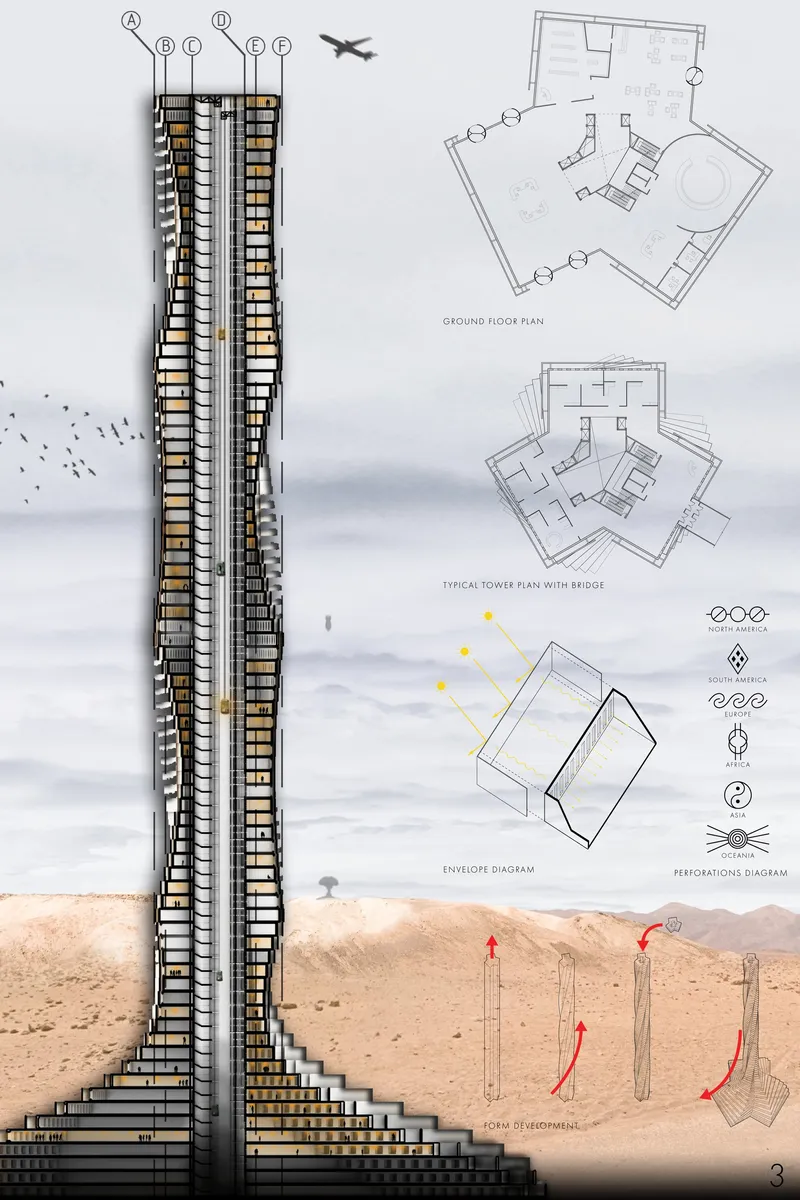
The project envisions a series of monumental towers, each dedicated to the cultural narratives of different continents. These towers act as repositories of artifacts, histories, and identities, preserving the diversity of human civilization across time. The architecture thus transitions from static form to an active cultural infrastructure.
This approach aligns strongly with contemporary discourse in sustainable memorial architecture, where buildings are no longer passive commemorations but dynamic systems that evolve with society.
Environmental Strategy: Designing for Climate Resilience
The project demonstrates a rigorous integration of environmental performance and architectural expression. Several strategies define its sustainable framework:
1. Solar Mirror Energy System
A central tower operates as an ऊर्जा-generating core, supported by a mirror farming system. Elevated solar mirrors capture and redirect sunlight, producing sufficient energy to sustain the entire complex. This transforms the monument into a self-sufficient energy ecosystem.
2. Carbon-Negative Material Innovation
The use of Ferrock, an alternative to traditional concrete, marks a significant material innovation. Composed of recycled industrial waste, Ferrock not only enhances structural strength but also absorbs carbon dioxide during its curing process, contributing to a carbon-negative lifecycle.
3. Passive Climate Control
Perforated copper panels, integrated into the façade, regulate solar heat gain while allowing filtered light into the interior spaces. This reduces dependency on mechanical systems and reinforces passive environmental control strategies.
4. Water and Vegetation Integration
Water features and vegetation layers are embedded within the spatial organization, enhancing microclimatic conditions and creating a balanced ecological system within an otherwise harsh desert context.

Spatial Organization: Modular and Expandable Systems
One of the defining characteristics of Turning Point is its modularity. The towers are designed as expandable units, allowing future generations to contribute to and extend the cultural archive.
The vertical organization includes:
- Exhibition spaces showcasing cultural artifacts
- Archival vaults for long-term preservation
- Circulation cores that guide visitors through a curated narrative journey
- Elevated platforms supporting energy systems
This modular approach ensures adaptability, a key principle in sustainable memorial architecture. It allows the project to remain relevant across generations, accommodating new cultural inputs and technological advancements.
Form and Symbolism: Reinterpreting Monumentality
The architectural language draws inspiration from ancient construction methods, particularly the pyramidal logic of stacking masses. However, this historical reference is reinterpreted through a contemporary lens.
The towers rise as fragmented, twisting forms, symbolizing both growth and instability. Their geometry reflects a state of transition, reinforcing the project’s central theme of a global turning point.
Rather than relying on traditional monumentality, the design achieves symbolic weight through its environmental and cultural functions. It is not merely a structure to be observed, but a system to be experienced and inhabited.
User Experience: A Journey Through Time and Culture
The project is designed as an immersive journey. Visitors navigate through a sequence of spaces that gradually reveal the depth of human culture and the consequences of environmental neglect.
Interior galleries display artifacts and narratives from different continents, creating a global dialogue within a single architectural framework. Light, shadow, and materiality are carefully orchestrated to enhance the experiential quality of the spaces.
The movement through the towers is not linear but exploratory, encouraging reflection and engagement. This reinforces the project’s role as both an educational and emotional catalyst.
Global Relevance: Architecture for a Collective Future
Turning Point addresses a global audience. By representing multiple cultures within a unified architectural system, it emphasizes the interconnectedness of humanity.
The project also highlights a critical paradox: while globalization has brought cultures closer, climate change threatens their survival. By preserving cultural identities within a sustainable framework, the design positions architecture as a mediator between past, present, and future.
This aligns with the broader trajectory of sustainable memorial architecture, where projects are increasingly designed to address global challenges rather than localized histories.
Turning Point represents a significant shift in how memorial architecture is conceived. It moves beyond commemoration to become a proactive system that preserves, sustains, and evolves.
By integrating renewable energy systems, innovative materials, and modular design strategies, the project establishes a new paradigm for sustainable memorial architecture. It demonstrates that architecture can simultaneously address environmental challenges and cultural preservation.
In doing so, it captures the essence of its name. This is not just a monument. It is a moment of decision, a reflection of where humanity stands, and a projection of where it could go.
Project Credits: Thomas Edmunds, Ariel Weiss, Georgios Chatziadam



Popular Articles
Popular articles from the community

AL-JANNAH: Sustainable Architecture and Permaculture for Afghan Widows
AL-JANNAH uses sustainable architecture and permaculture to create resilient oasis of housing, learning, work and renewal for Afghan widows.

EW PARK: Sustainable Architecture Reimagines the Future of Urban Parking
EW PARK reimagines city parking as a modular wooden tower combining automation, solar energy, electric mobility, and adaptable urban design.

The Ocean Hive: Sustainable Architecture for a Self-Sufficient Civilization at Sea
The Ocean Hive imagines sustainable architecture at sea, where modular habitats, algae, wave power and ocean waste sustain a growing colony.

Riyadh For All: Intergenerational Urban Design for Active Aging in Rabat
Riyadh For All reimagines urban design in Rabat with intergenerational co-living, adaptive courtyards, and Moroccan cultural exchange today.

Similar Reads
You might also enjoy these articles

Eco Chapel: A Green Architecture Pavilion Designed in Symbiosis with the Forest
Eco Chapel uses green architecture to weave prayer, learning and reuse into a forest pavilion shaped by modular hexagonal canopies for life.
Kaffeebühnen: Coffee Shop Architecture Designed as a Civic Stage Between Vienna’s City and Park
Kaffeebühnen turns coffee shop architecture into a civic stage, linking Vienna’s park edge, urban life, warm timber yards, and coffee craft.
Healing Façade: Sustainable Architecture for Reforestation, Community, and Sacred Ecology in Ethiopia
Healing Façade reimagines sustainable architecture as a living wall that restores soil, catches water and renews Ethiopia's forest churches.


Urban Forest: A Vertical Ecosystem for 5,000 Workers in Singapore's Changi Business Park
Radially stacked pods and layered green decks turn a 7-acre plot into 47 acres of ecological workspace projected for 2040.


Explore Architecture Competitions
Discover active competitions in this discipline



Challenge to reimagine the Iron Throne


Photograph architecture without architects


Illustrate the lost glory of Angkor Wat - Render Challenge


Design challenge to reuse E-waste
Comments (0)
Please login or sign up to add comments
No comments yet. Be the first to comment!