
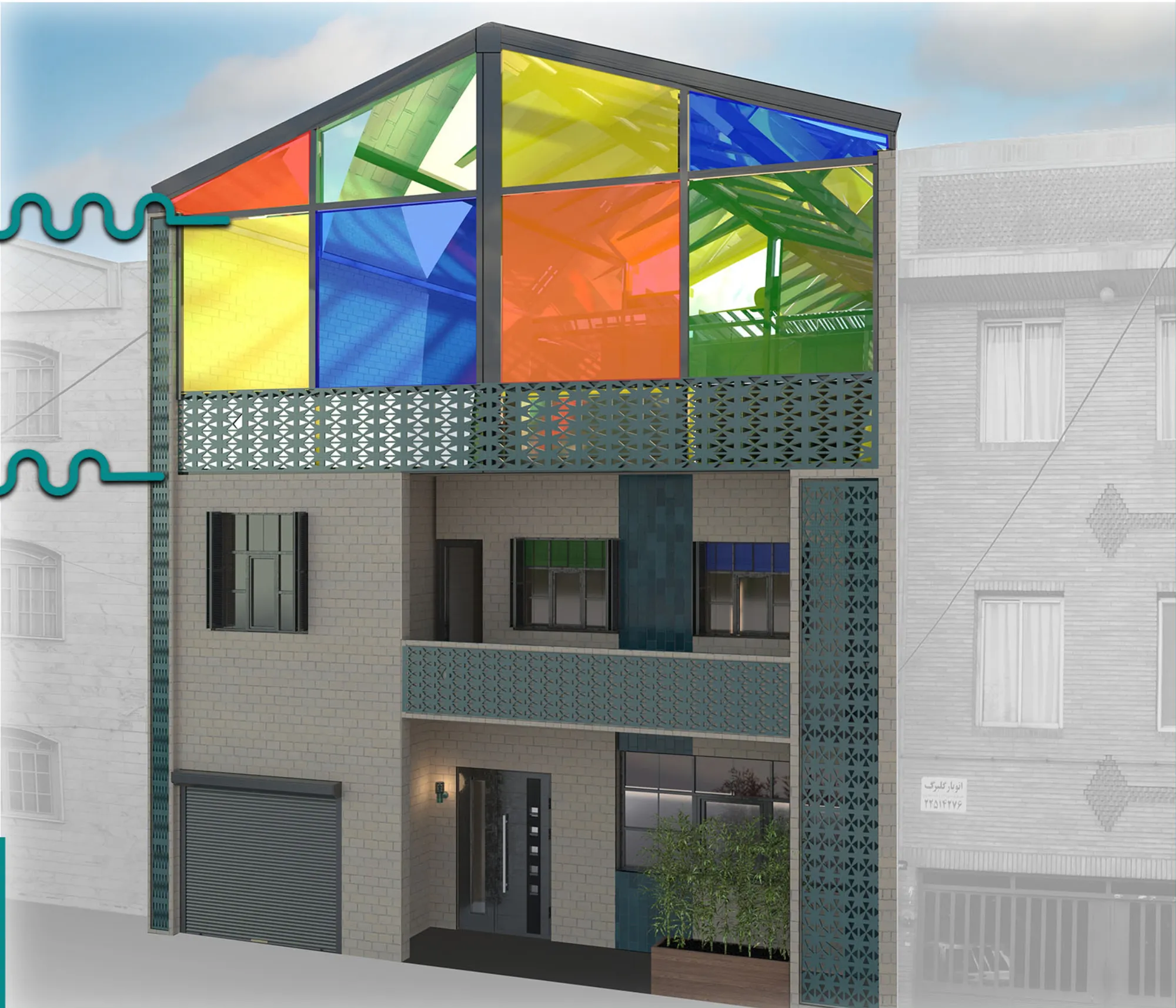
Turquoise House: Rooftop Greenhouses Meet Iranian Courtyard Traditions
A vertically stacked dwelling in Iran layers food production, passive cooling, and traditional spatial logic into a compact urban footprint.


What happens when you take the spatial DNA of an Iranian courtyard house and fold it vertically, stacking food-growing terraces atop living spaces? The Turquoise House answers that question with a compact residential scheme that threads a rooftop greenhouse, cascading planter beds, and colored glass panels into a structure deeply rooted in Persian architectural tradition. The project doesn't treat sustainability as an overlay; it treats it as the organizing principle of the entire section.
Designed by Arezoo Saeedikhah for the Food Connect competition, the Turquoise House takes its name from the turquoise tilework endemic to Iranian mosque and residential architecture. The project proposes a multi-story urban dwelling where every level participates in a food production cycle, from ground-floor courtyards to a steel-framed greenhouse at the roof. It is a serious attempt to reconcile the dense Iranian urban fabric with productive green infrastructure.
A Courtyard Pulled Upward Through the Section
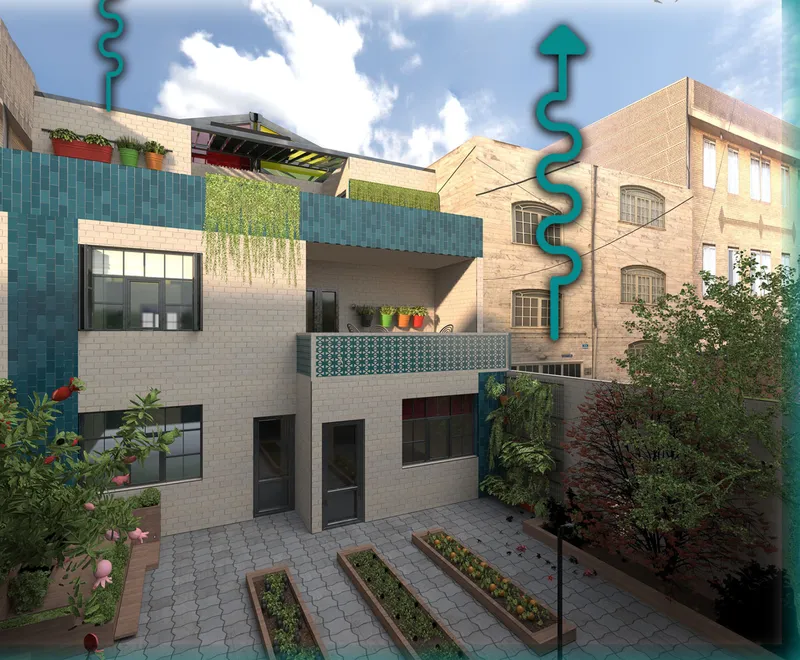
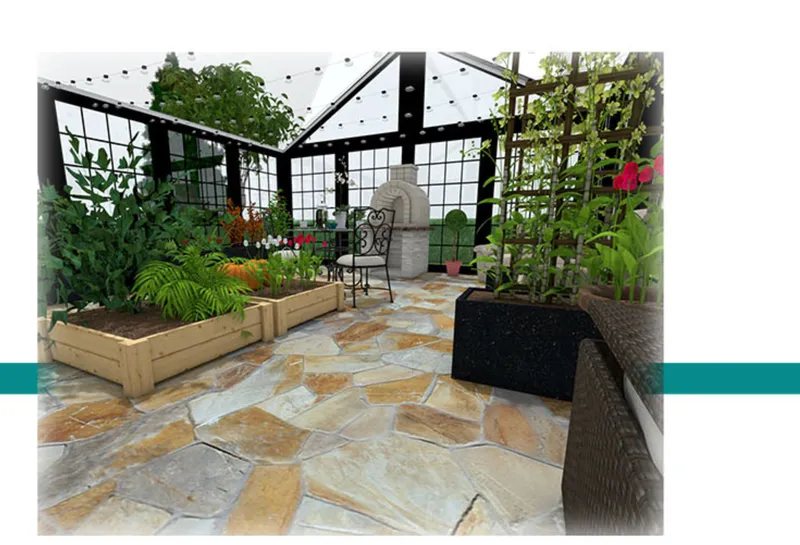
The traditional Iranian courtyard is a ground-level refuge: enclosed, shaded, oriented inward. Here, that logic migrates upward. The ground-floor courtyard retains its paved surface and raised planting beds, but the terraces above carry the same language of greenery and tiled balustrades skyward. At the rooftop level, a generous terrace with steel-framed glass walls, raised timber planters, and irregular stone paving creates an open-air productive garden. The courtyard isn't a single room; it's a sectional condition that repeats and transforms at each level.
Greenhouse as Crown: The Productive Roof
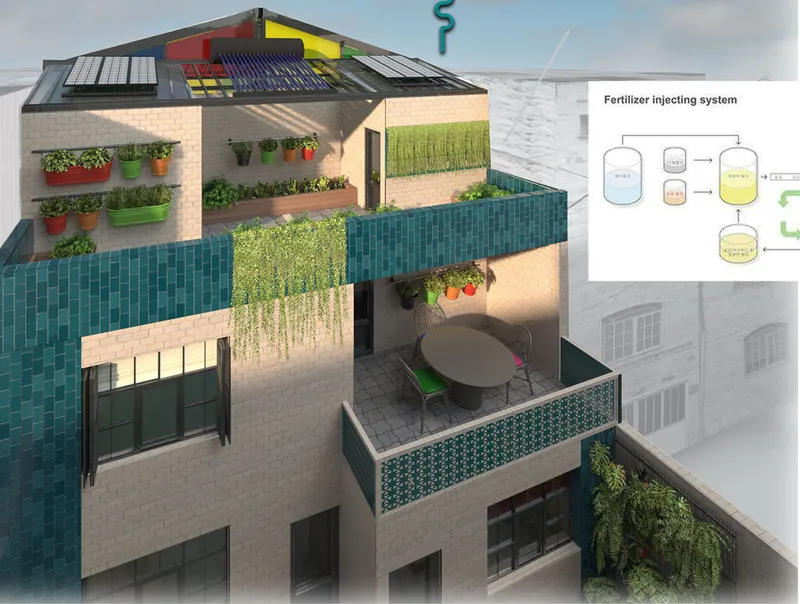
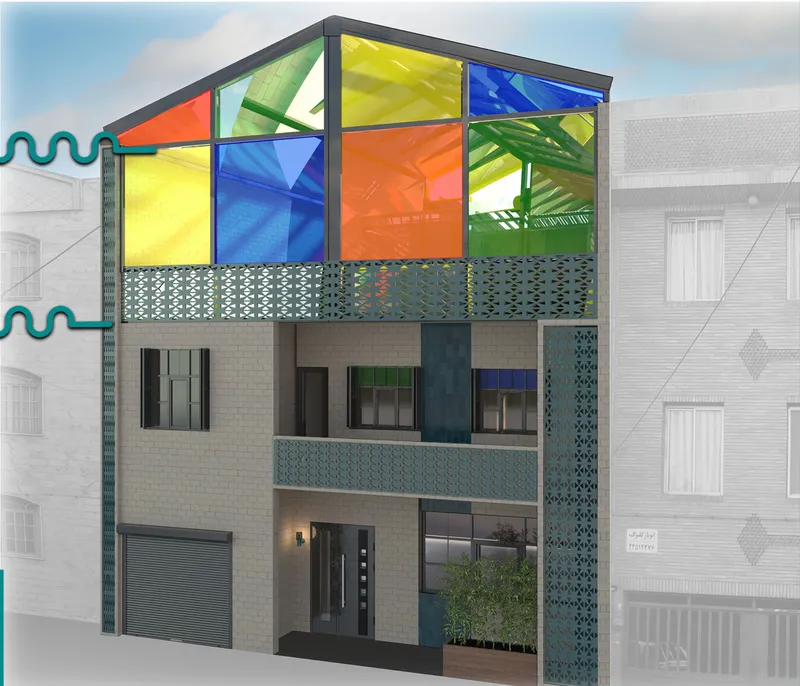
The most striking element is the rooftop greenhouse, visible from the street through multicolored translucent glass panels that nod to the stained glass of traditional Iranian orosi windows. This isn't decorative nostalgia. The colored panels filter light into the growing space while giving the street facade a jewel-like quality that sets the house apart from its neighbors. Solar panels sit alongside the greenhouse on the roof, creating a productive double layer: energy harvesting and food growing occupying the same horizontal plane.
The cutaway view reveals how the greenhouse connects to lower terraces through cascading greenery and a balcony scaled for domestic life, complete with a round table and chairs. Food production here is not industrial or clinical. It is woven into the rhythms of daily living, positioned where a family would naturally gather.
Reading the Section: Three Floors, One System
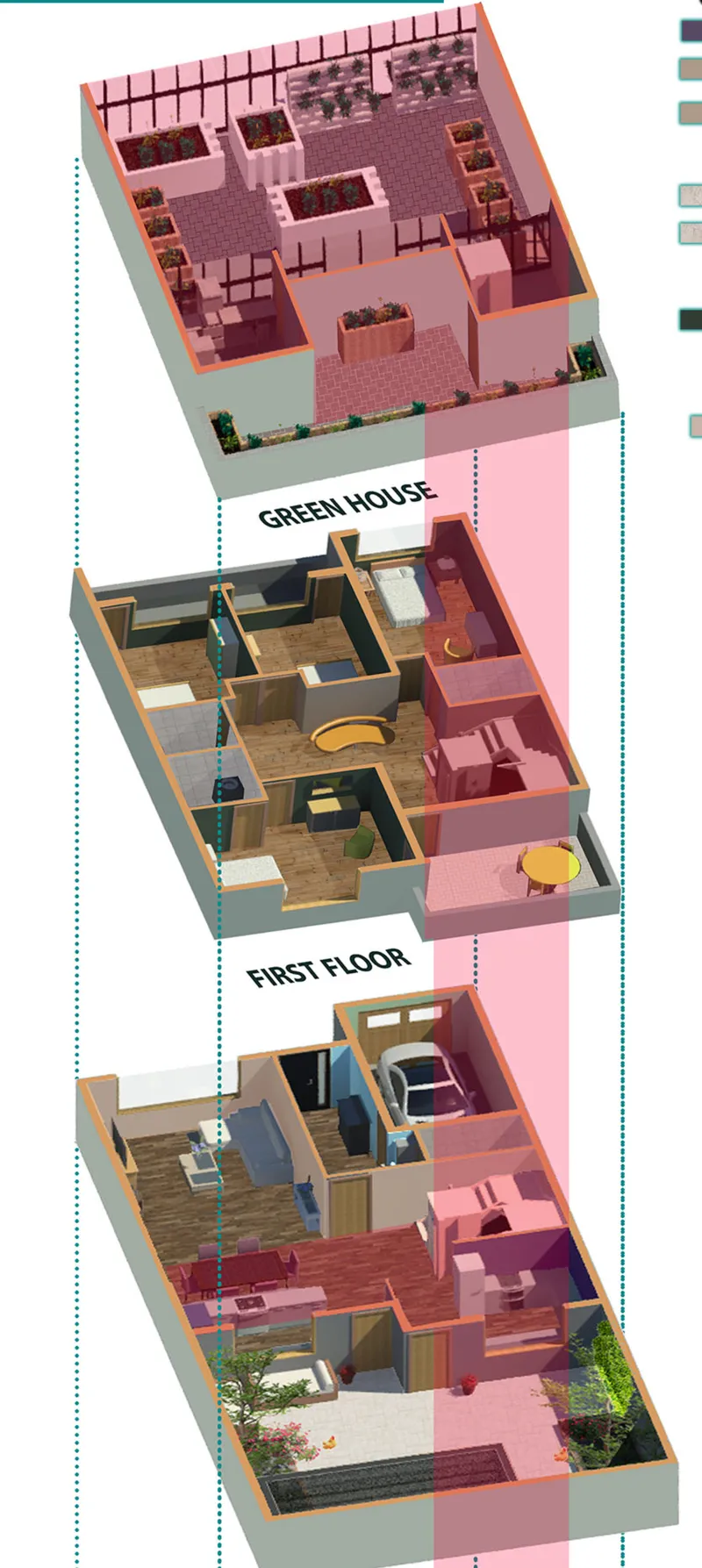
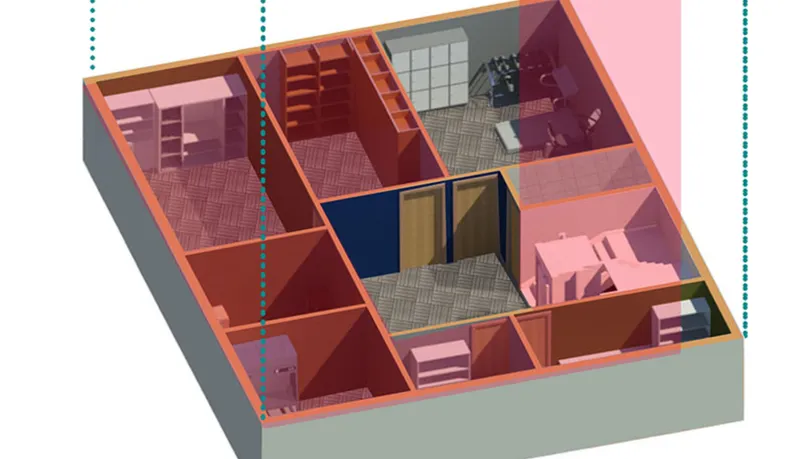
The axonometric drawings lay bare the spatial strategy. Three floors are organized around a central atrium that pulls light and air downward through the section, recalling the wind-catching logic of traditional Iranian architecture. The ground floor handles communal and service functions; the first floor contains private living spaces with corner glazing for cross-ventilation; the greenhouse level operates as both a food-growing zone and an extension of domestic leisure space. Corner glazing under a pitched roof gives the uppermost rooms generous daylight without the heat penalty of a fully exposed facade.
Vertical Circulation as Connective Thread
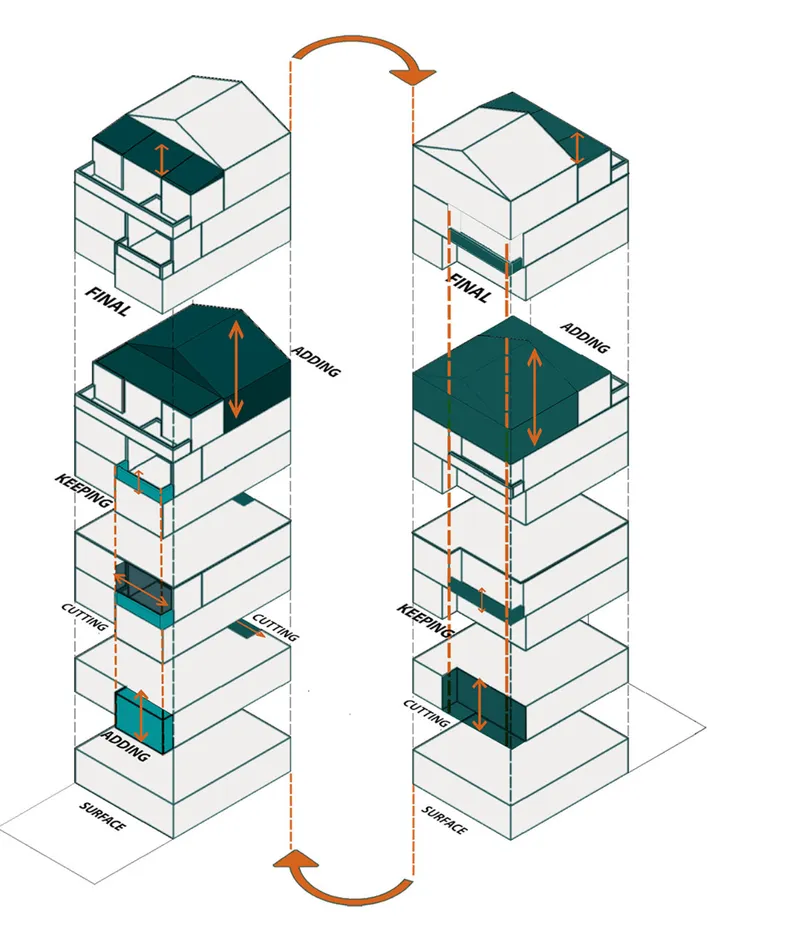
An isometric diagram maps the vertical circulation with directional arrows, showing how movement flows between levels. The staircase doesn't sit in a leftover corner; it occupies a central position that reinforces the atrium as the spatial core of the house. Each floor is accessible but distinct, and the diagram makes clear that the design treats the journey between levels as an experience, not just a functional necessity. You move through microclimates as you ascend: from the cool, shaded courtyard to the warm, light-filled greenhouse.
Why This Project Matters
The Turquoise House resists the common trap of sustainability projects that bolt green technology onto a generic box. Instead, Saeedikhah works from the inside out, using Iranian spatial precedents (the courtyard, the orosi window, the wind-catching atrium) as the starting points for a productive dwelling. The greenhouse isn't an appliance; it's the culmination of a sectional argument that begins at the ground and builds upward through terraces, planters, and filtered light.
For the Food Connect brief, which asks designers to rethink the relationship between dwelling and food production, this entry offers a culturally specific answer rather than a universal prototype. That specificity is its strength. The project argues that food-producing architecture doesn't need to look like a vertical farm; it can look like a house, rooted in a particular climate and building tradition, that simply decides to grow things at every opportunity.
View the Full Project
About the Designers
Designers: Arezoo Saeedikhah and, Arezoo Saeedikhah
Enter a Design Competition on uni.xyz
uni.xyz runs architecture and design competitions year-round that reward proposals with spatial conviction and real site intelligence.
Project credits: Turquoise House by Arezoo Saeedikhah and, Arezoo Saeedikhah Food Connect (uni.xyz).



Popular Articles
Popular articles from the community


The Earth Pod: 3D Printed Homes for Resilient Refugee Communities
The Earth Pod reimagines refugee housing through 3D printed homes made from clay, combining resilience, self-sufficiency, and rapid shelter.

Co-life: Sustainable Architecture for Age-Friendly Community Living
Co-life reimagines sustainable architecture for seniors through courtyards, rammed earth, shared gardens, and spaces designed for belonging.

Conexión: Biophilic Design Reimagines High-Rise Living in Hong Kong
Conexión reimagines high-rise living in Hong Kong through biophilic design, green facades, shared spaces, daylight, water and nature within.

Riyadh For All: Intergenerational Urban Design for Active Aging in Rabat
Riyadh For All reimagines urban design in Rabat with intergenerational co-living, adaptive courtyards, and Moroccan cultural exchange today.


Similar Reads
You might also enjoy these articles

Day and Night Park: A Time-Based Urban Newsstand in Beijing
A temporary urban newsstand in Beijing blending travel, light, and reading through poetic colors, compact form, and community-focused design.

Modernist Patio Renovation in El Masnou, Barcelona by Oliver Segura Arquitectura + Cebrià Arquitectura
Modernist patio renovation blending tradition and innovation with a movable pool, leveled floors, and Catalan materials in El Masnou.

Alto Residencial Coop: Cooperative Housing Development in Santiago de Compostela by Carbajo Barrios Arquitectos
A linear cooperative housing complex blending white volumes and perforated metal façades, enhancing community living, natural light, privacy, and urban integration.
Vil Genis School by BPA ARCHITECTURE – Massy, France
Vil Genis School in Massy, France, features sustainable design, south-facing classrooms, community integration, accessible spaces, and modern educational architecture.

Explore Persian Architecture Competitions
Discover active competitions in this discipline




From Logic to Configurators


Challenge to design mud housing for contemporary communities
Comments (0)
Please login or sign up to add comments
No comments yet. Be the first to comment!