

24 7 Arquitetura Links Three Volumes with Open-Air Squares in a Campinas Residence
The Two Squares House uses a pair of courtyards to bind garage, social, and leisure blocks into a single continuous sequence.


Most houses treat circulation as a leftover: the hallway nobody wants to linger in, the corridor that exists only because rooms need connecting. The Two Squares House in Campinas, Brazil, designed by 24 7 Arquitetura, inverts that hierarchy entirely. Here, the connective tissue between the home's three volumes is the architecture. Two open-air squares, covered above by the bedroom slab but otherwise exposed to sky, wind, and planting, do the work of corridors while performing as the most generous spaces in the house.
Completed in 2019 across 423 square meters, the project by lead architects Giuliano Pelaio and Gustavo Tenca splits the program into a garage block at street level, a central social volume raised one meter above, and a rear leisure block with barbecue and laundry. Rather than stacking these under one roof, the team separated them and used the two squares as spatial joints, stone-paved rooms open to the elements that give the house its name, its logic, and its best moments.
Courtyards as Architecture
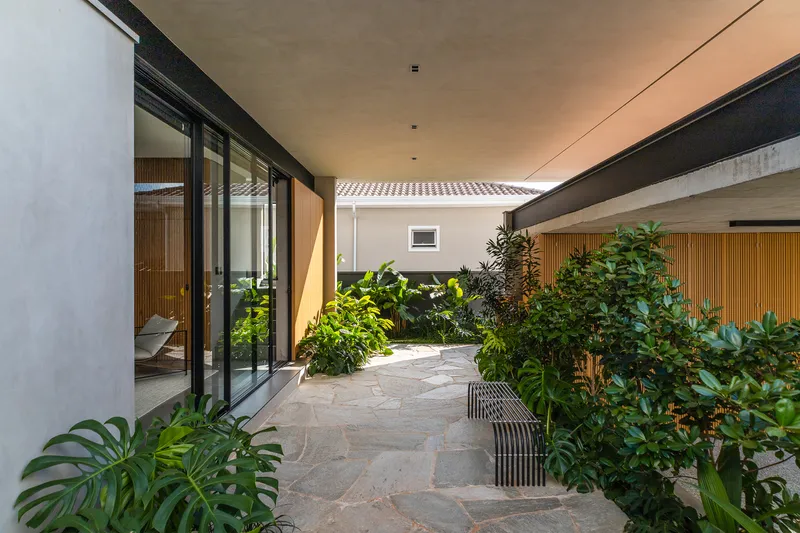
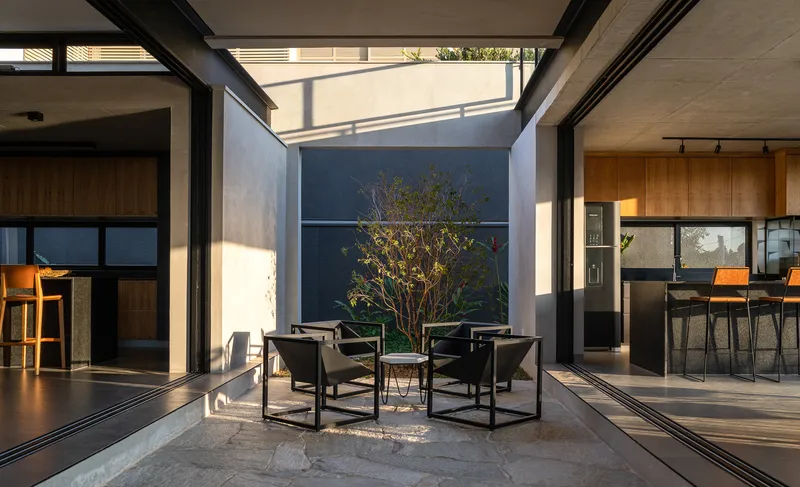
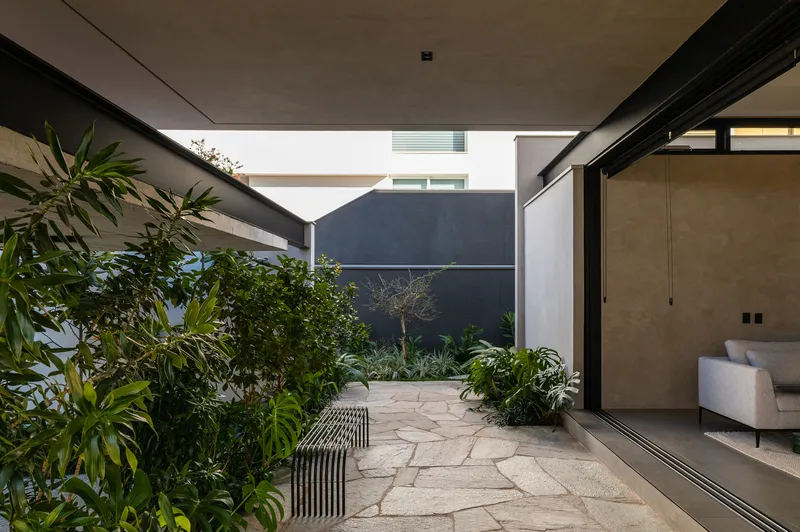
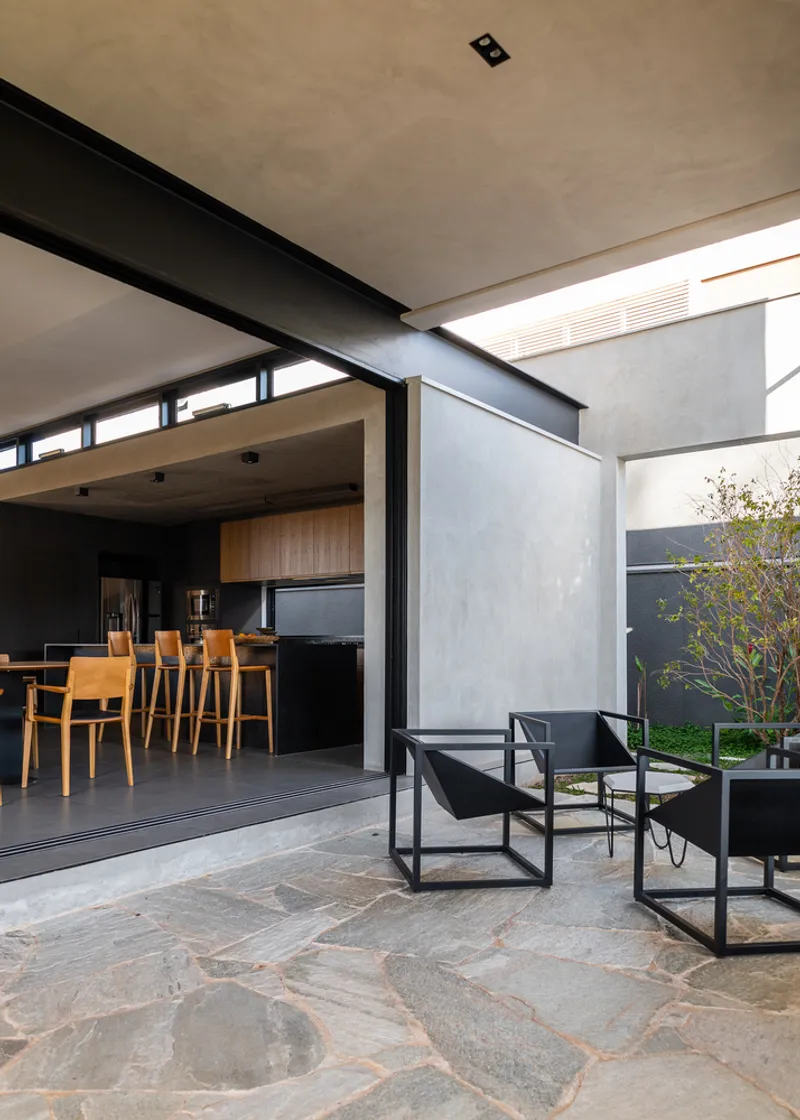
The first square sits between the garage and the social block, functioning as the home's entrance plaza. You arrive by car, step out under an exposed concrete soffit, and immediately find yourself in an outdoor room paved in Goiás stone with tropical plantings framing the view ahead. The second square appears at the opposite end of the social volume, mediating the transition to the leisure block and the pool beyond. Both squares are covered overhead by the bedroom slab, which means they receive shade without sacrificing openness to the sky at their edges.
What makes these spaces work is their material directness. Irregular stone pavers, dark rendered walls, a single tree casting afternoon shadows: the squares are deliberately restrained so that the planting and the light do the heavy lifting. Large sliding glass panels on the adjoining social rooms mean the squares can be absorbed into the interior or closed off, depending on the weather and the season. It is a simple move, but it gives the house a flexibility that monolithic plans rarely achieve.
Reading the Slope
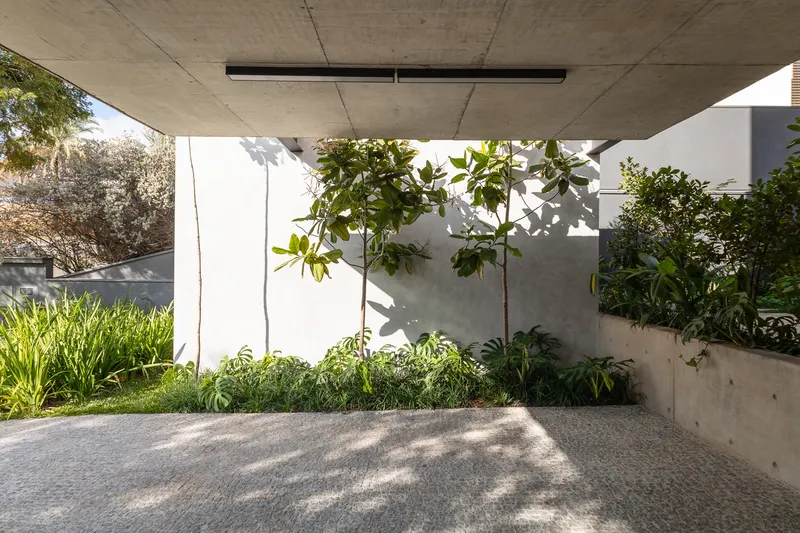
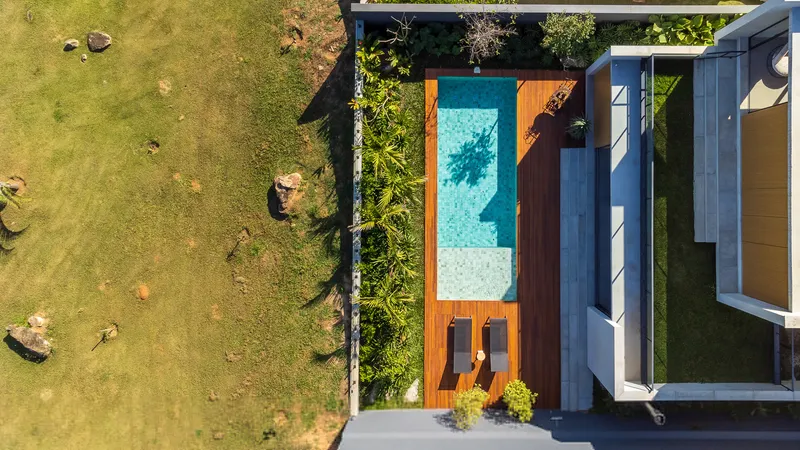
The site falls from the street toward the rear, and the architects read that topography carefully. The garage block meets the road at grade, while the social volume steps up a full meter, establishing a clear threshold between public arrival and private life. At the back, the land drops further, allowing the pool and timber deck to sit naturally below the main living level. The result is a sectional cascade: you move through the house and subtly descend toward the landscape without ever feeling a jarring level change.
An aerial view confirms the logic. The flat-roof volumes read as a sequence of horizontal planes stepping down the hillside, with the pool tucked against the lowest edge and the lawn wrapping around. Privacy from neighboring houses is handled not by high walls but by the raised floor plate of the social areas and by strategic orientation of the glazing toward the open rear view of the condominium.
Structure Without Pillars
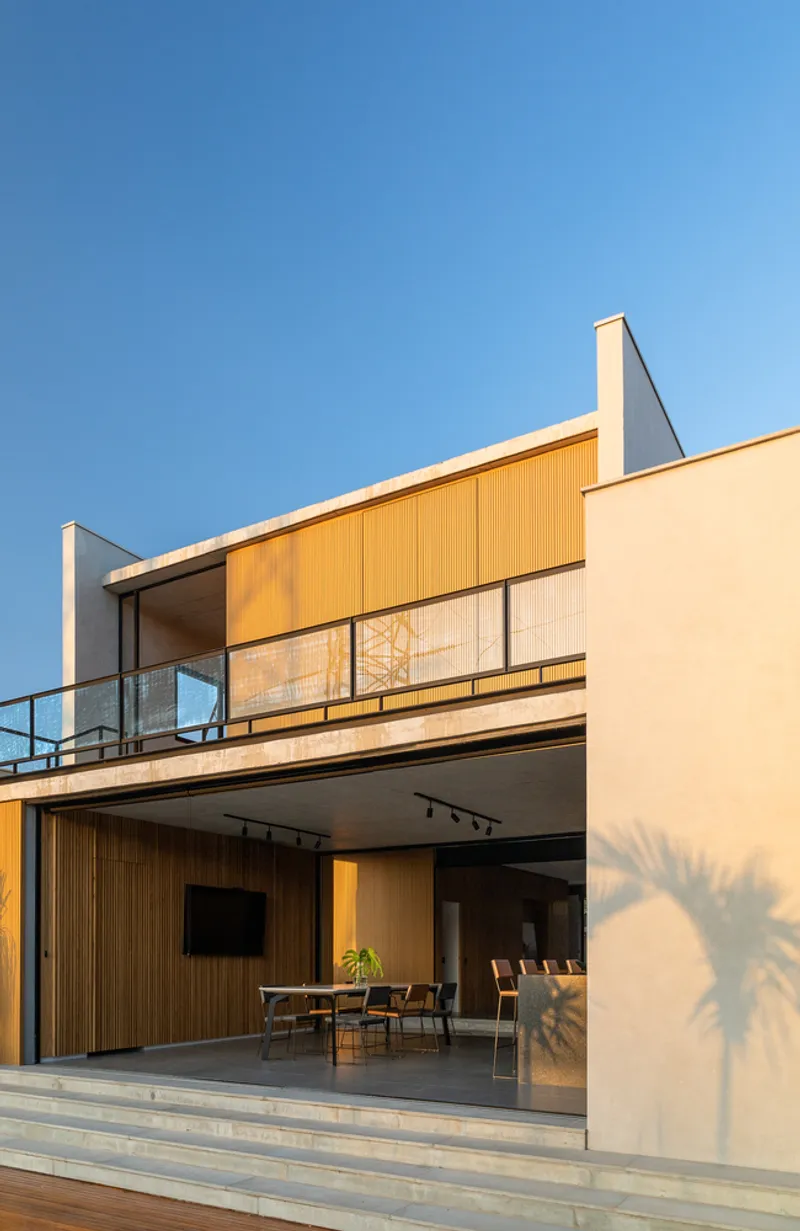
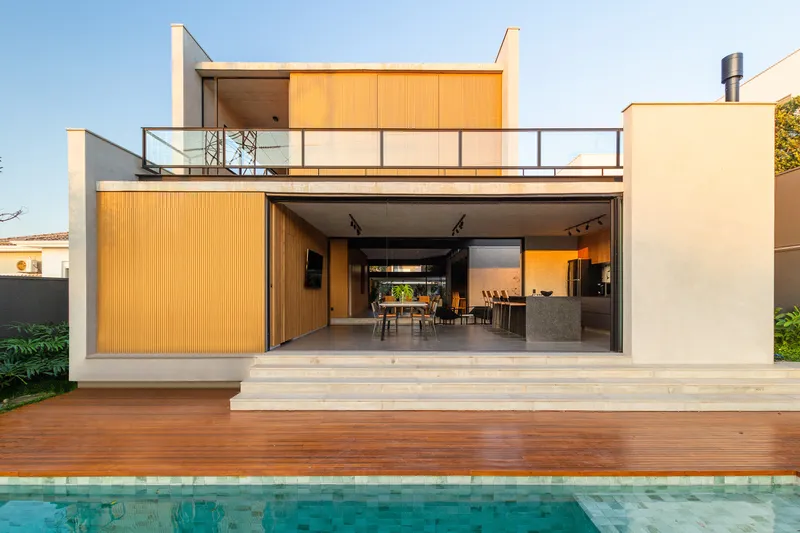
The house relies on a hybrid system of exposed concrete slabs and metal beams, fabricated by MAV do Brasil, to achieve column-free ground-floor volumes. The payoff is visible in every photograph: living and dining spaces run uninterrupted from one glass wall to another, with no structural column breaking the visual axis that the architects carved through the full length of the plan. That axis, which connects front to back without obstruction, is the organizing line of the entire project.
The cantilevered upper slab, clearly visible from the rear elevation, projects over the timber deck and pool to create a deep covered terrace. Vertical timber cladding wraps the exterior volumes and softens what could have been a stark concrete box. The timber reads warm against the raw concrete soffits, and the contrast gives the facades a layered quality that changes character as the sun moves.
Interior Warmth and Transparency
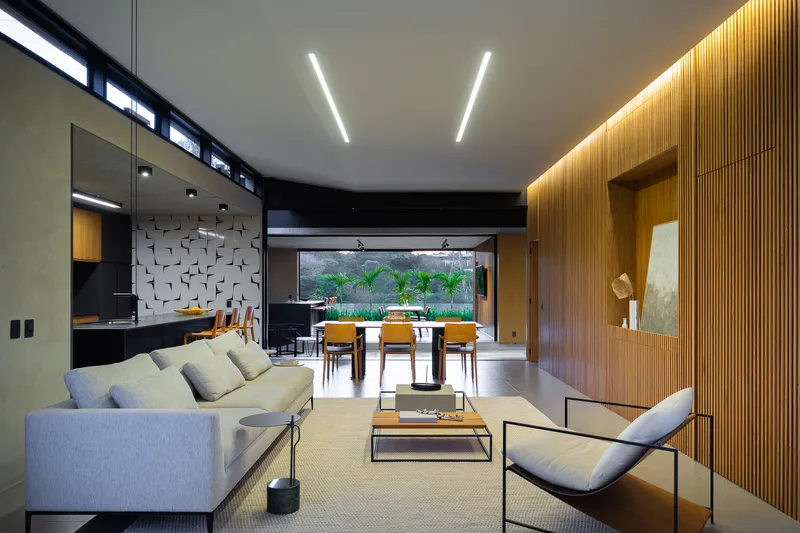
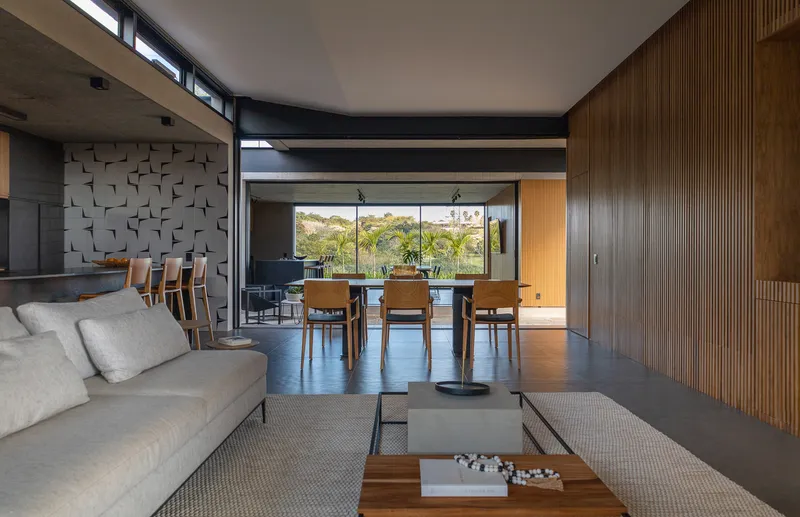
Inside, the interior design team led by Nicolas Meireles and Camila Kuhl built warmth through a limited palette: ribbed vertical timber paneling on walls, textured stone tiles, and linear ceiling lights that reinforce the house's longitudinal axis. Clerestory windows above the timber walls wash the upper portion of rooms with diffused light, reducing the need for artificial lighting during the day and keeping the ground-floor spaces visually connected to the sky even when the sliding doors are closed.
The open-plan living and dining zone is one continuous room, but the material shifts along its length, from timber ribs to stone tile to painted plaster, subtly subdivide it into zones of activity without any physical partition. Furniture sits low, keeping sightlines clear through to the courtyard on either side. It is an interior that trusts its proportions enough to avoid decorative clutter.
Living on the Upper Level
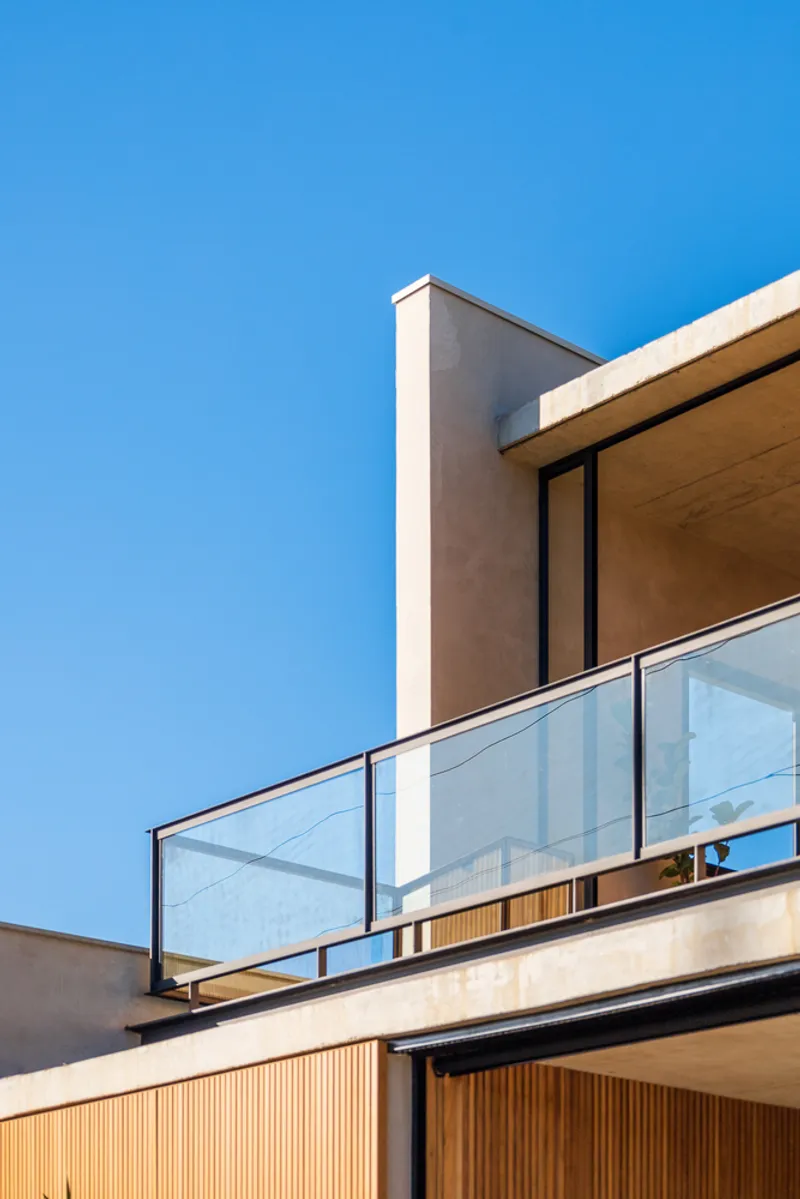
The bedrooms occupy the slab that bridges the two squares below, meaning the private level sits directly above the most public outdoor spaces. A wide lateral corridor doubles as a covered balcony, with a glass balustrade and timber soffit framing views over the pool and the rear garden. At the far end, a garden terrace faces west for sunset views, a deliberate orientation that turns an otherwise utilitarian rooftop edge into a usable social space.
The vertical chimney element visible from the balcony anchors the composition and signals the barbecue below, linking the upper and lower social rituals of the house. Cross ventilation runs through both levels via openings at each end of the plan, a passive strategy that reduces mechanical cooling loads in Campinas's warm subtropical climate.
Why This Project Matters
The Two Squares House is a quiet argument for porosity in residential design. Instead of sealing the program inside a single envelope and punching windows where views happen to be, 24 7 Arquitetura broke the house apart and used the gaps as primary living space. The squares are not voids; they are rooms that happen to have no roof. That inversion changes how the house breathes, how it circulates, and how it relates to the sloping site.
It also demonstrates that structural ambition does not require spectacle. The column-free spans and cantilevered balcony serve a functional purpose, keeping sightlines open and the plan flexible, without calling attention to themselves as feats of engineering. Landscape design by Alexandre Galhego Paisagismo completes the picture, softening edges and grounding the concrete volumes in their suburban context. The result is a house that feels simultaneously rigorous and relaxed, a balance that is harder to achieve than it looks.
Two Squares House by 24 7 Arquitetura. Campinas, Brazil. 423 m². Completed 2019. Lead architects: Giuliano Pelaio, Gustavo Tenca. Photography by Adriano Pacelli.
About the Studio
Share Your Own Work on uni.xyz
If projects like this are the kind of work you want to make, uni.xyz is a place to publish your own, find collaborators, and enter design competitions.


Popular Articles
Popular articles from the community


The Amber Palace Opera: A Geological Fiction Surfaces on Tallinn's Baltic Waterfront
Pierre Brillard reimagines a Baltic legend as a public landscape, opera house, and waterfront promenade rooted in Tallinn's coastal identity.
Temporary Home for Dogs: A Reversed Zoo Rethinks Animal Shelter Architecture
In Bucharest, a sinuous corridor and freed landscape flip the logic of containment, designing a shelter that works to make itself unnecessary.
Tsunami Convergenics: Turning Catastrophic Ocean Forces into Underwater Housing Infrastructure
A speculative underwater settlement off the coast of Onagawa, Japan, treats tsunamis and typhoons as energy sources rather than threats.
Faces of the Soviet Avant-Garde: Turning Moscow's Street Names into an Open-Air Museum
A network of sculptural installations across a Moscow residential district transforms forgotten architect names into spatial encounters with cultural memor

Similar Reads
You might also enjoy these articles


Hodi-Mandai Geram
Project Function: Preservation and revitalization of the Intangible heritage and socio-spatial identity of the Hodi by Housing, Cultural Memory Center, Sacred Grove, landscape, local tourism economy


Olio Towers: A Mid-Rise for Performers That Fuses Housing, Rehearsal, and Stage
Located blocks from Houston's Theater District, this modular tower stacks living units around a central performance atrium.

Oasis: Modular Green Housing Carved into Dhaka's Urban Fabric
A shortlisted Plugin Housing entry reclaims unauthorized settlements in Dhaka with stepped concrete volumes, green roofs, and ventilation-driven design.

Black Hole: A Floating Megastructure for the Post-Physical Era
Emiliano Mazzarotto envisions a spherical, self-scaling arena where e-sports, digital hotels, and holographic stadiums replace traditional public space.

Explore M Square Architectural Design Competitions
Discover active competitions in this discipline

Challenge to reimagine the Iron Throne

Photograph architecture without architects

Illustrate the lost glory of Angkor Wat - Render Challenge

Design challenge to reuse E-waste
Comments (0)
Please login or sign up to add comments
No comments yet. Be the first to comment!