

07BEACH Reinvents the Yaeyama Villa as a Contemporary Retreat on Ishigaki Island
Two vacation rental villas on an Okinawan hilltop weave red-tile roofs, indigo-dyed cedar, and local limestone into a modern island vernacular.


On Ishigaki, the largest of the Yaeyama Islands in Okinawa Prefecture, traditional houses follow a strict logic: stone walls and Fukugi trees line the road, red roof tiles announce the dwelling from a distance, and the garden opens toward the sea. 07BEACH took that framework and rebuilt it from scratch. Two independent vacation villas, one west and one east, sit on a hillside overlooking the East China Sea. Each uses wood structure, coral stone perimeter walls, and terracotta roofing, yet every detail has been rethought with contemporary craft and spatial ambition. The result is accommodation that feels rooted rather than imported, specific to place rather than generically tropical.
What makes the project genuinely interesting is the way it treats tradition not as a style to quote but as a set of environmental and social strategies to extend. The high openness of the timber frames, the eave spacing that lets guests feel passing rain, the gardens positioned on the sea side so interiors connect through to the horizon: these are performative decisions, not decorative ones. Local artisans contributed indigo-dyed cedar floors, tatami woven from island rush grass, and handmade Shisa guardian lions at each entrance. The architecture hosts their work without competing with it.
Reading the Roofline from the Road
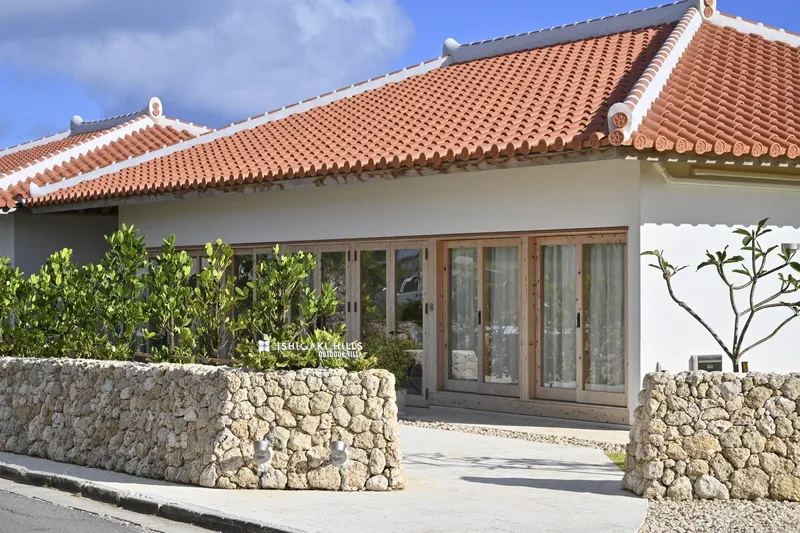
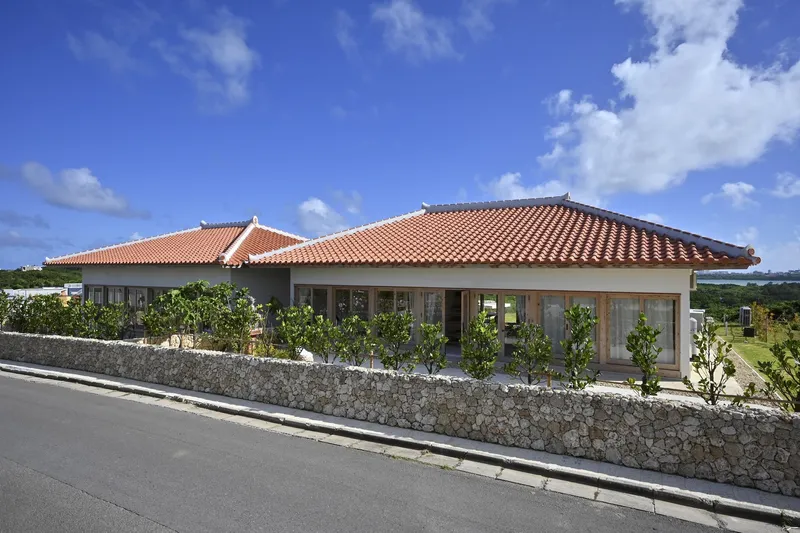
In Yaeyama architectural culture, the roof is the public face of a house. Walls stay hidden behind trees and stone, and the terracotta tile canopy communicates status, care, and belonging. 07BEACH orients both buildings toward the front road precisely so that visitors encounter the roofs first, low-slung and deeply orange against the sky. Coral stone masonry walls define the property edge, their rough texture softened by planting. It is a considered reversal of typical resort logic, where the ocean-facing elevation gets all the attention. Here the street side is the civic gesture, and the ocean side is the private reward.
Timber Frames and Full-Height Glazing
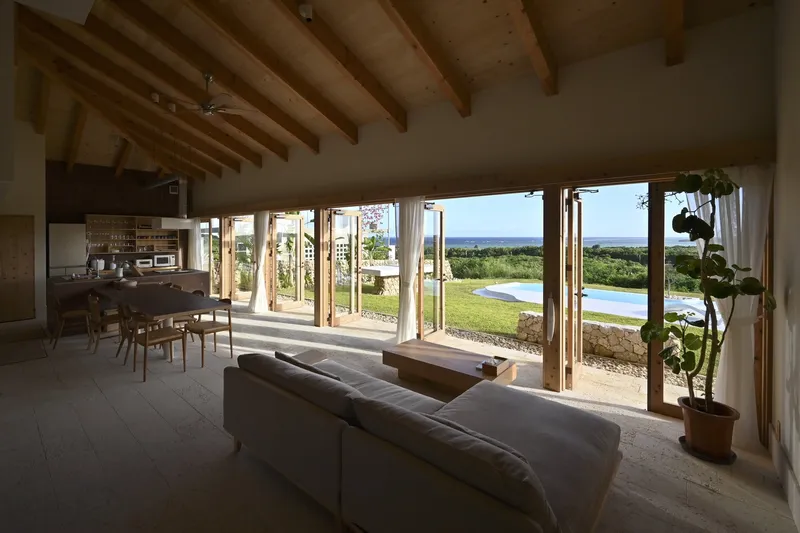
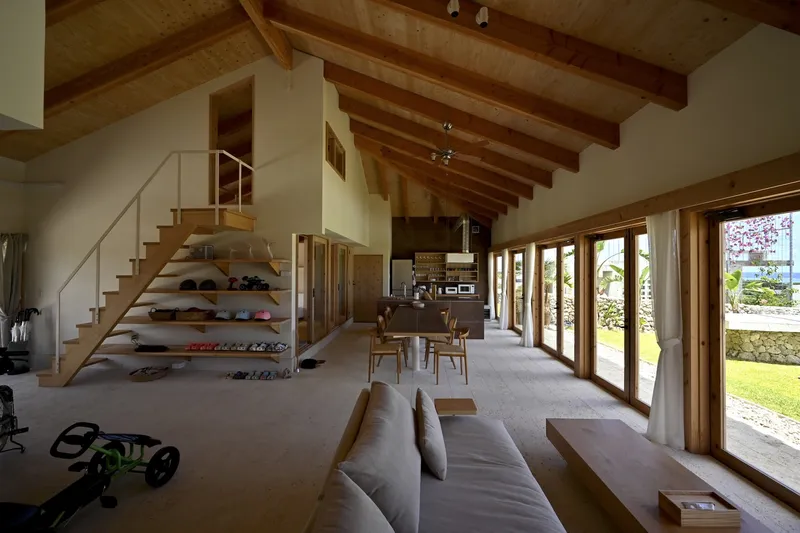
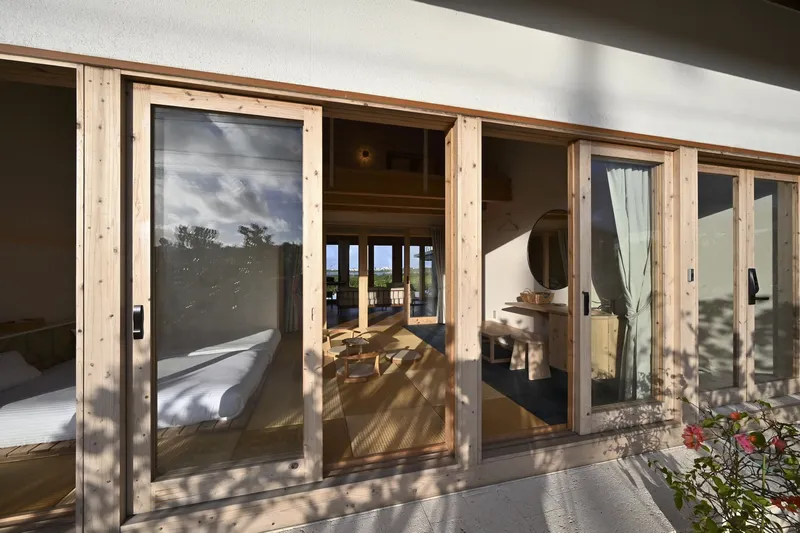
Inside, the wood structural system is left entirely exposed. Columns, beams, and rafters form a rhythmic lattice overhead, and the walls dissolve into full-height glazed doors that fold or slide open. The west villa, designed for larger groups, extends a stone-paved floor from exterior to interior, encouraging bicycles, surfboards, and beach life to spill in without ceremony. The east villa raises its floor in the manner of a traditional house, producing a quieter, more domestic atmosphere suited to families.
Both buildings share the same ambition: to make the boundary between inside and outside feel negotiable rather than fixed. When the doors are open, the living spaces become covered terraces; when closed, the glass preserves the visual connection to the garden and pool. The timber framing gives the interiors a warm, modular scale that prevents the openness from feeling exposed.
The Passageway Between
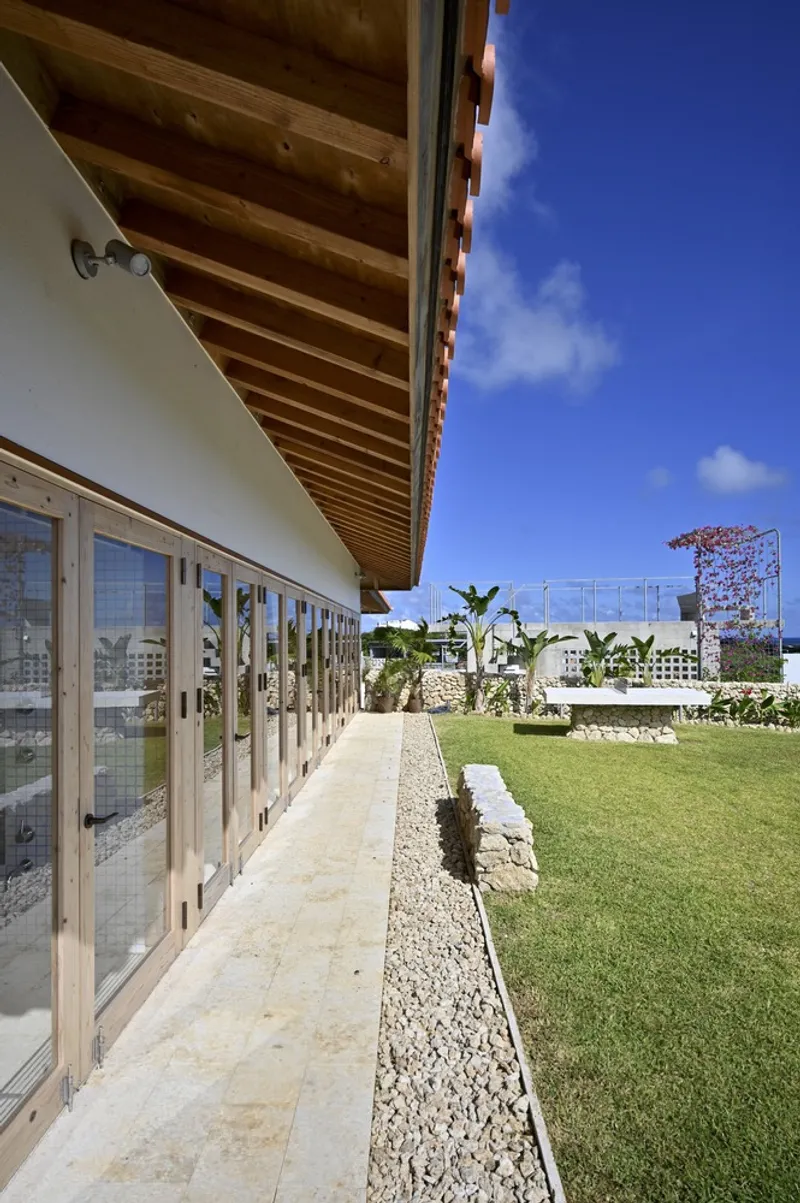
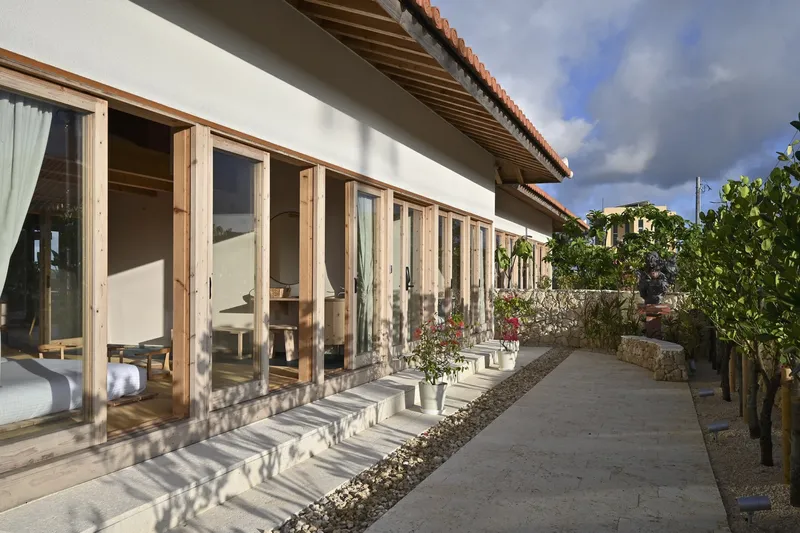
A narrow covered walkway runs between the two villas, its timber rafters casting dappled shadow patterns across the concrete path. The eaves here are deliberately spaced thin, so sunlight filters through and rain becomes audible and visible rather than excluded. It is a transitional space, neither fully indoors nor outdoors, and it sets up the experiential rhythm of the whole project: shelter is always partial, always in dialogue with the climate. The gravel drainage strip along one edge is a practical detail that doubles as a textural counterpoint to the limestone paving.
Bedrooms as Material Studies
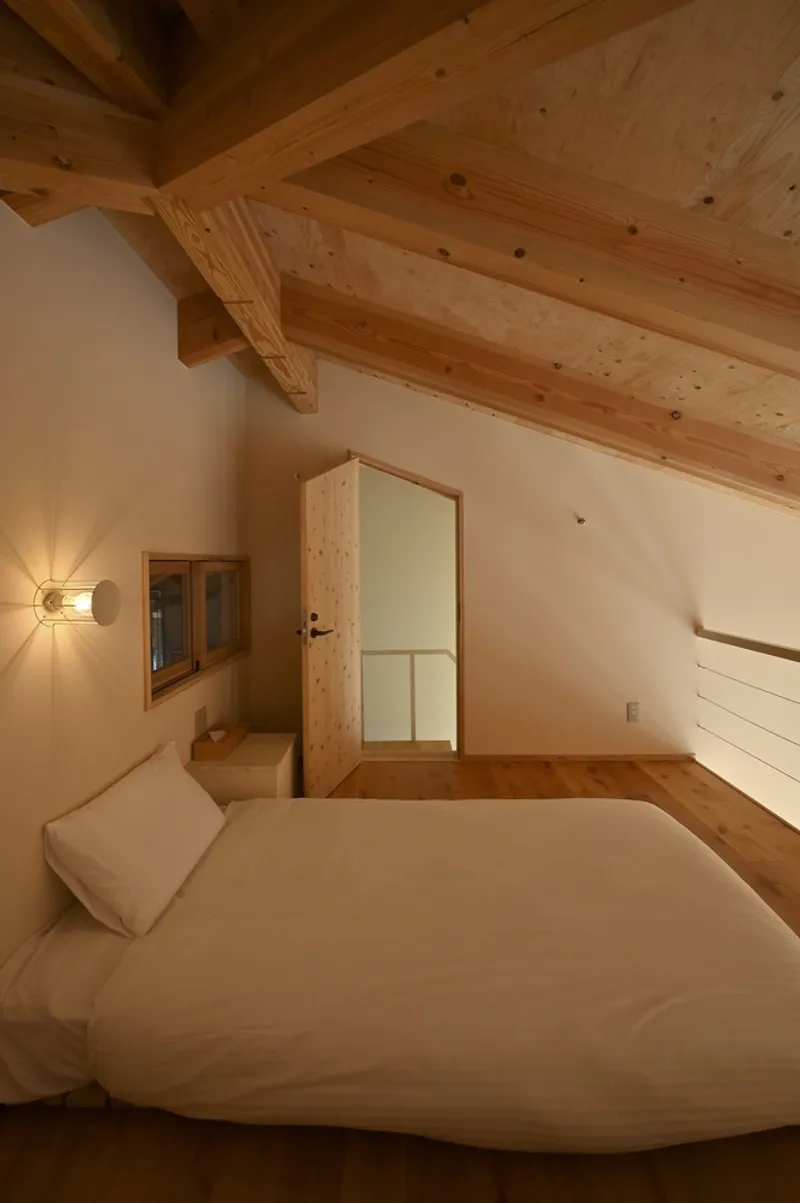
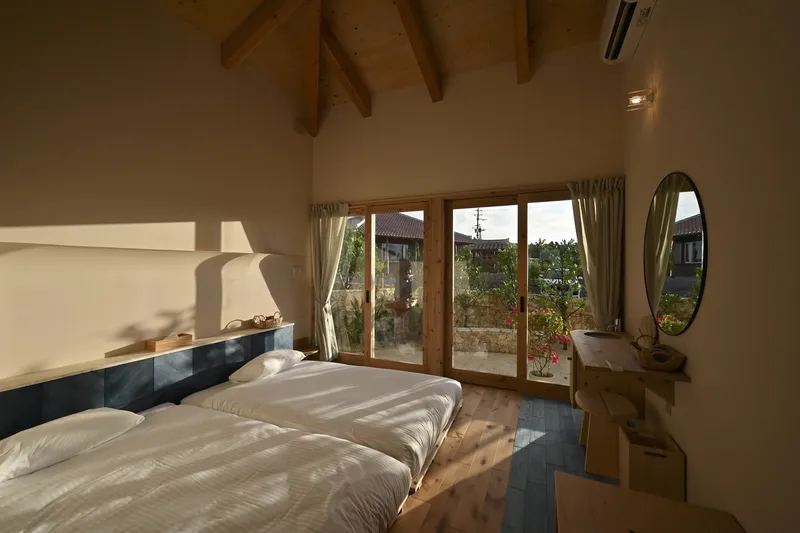
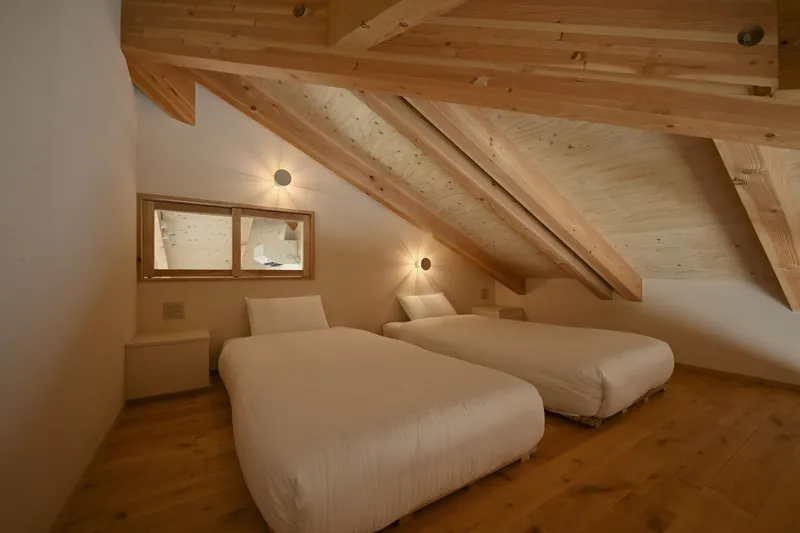
The bedrooms are where local craftsmanship comes closest to the surface. Floors are indigo-dyed cedar, stained by artisans using Okinawan indigo in a process that deepens over time. Tatami mats woven from island rush grass sit alongside the timber, and the rooms carry the faint, grassy scent that only fresh tatami can produce. Ceiling beams slope overhead in the attic rooms, with small transom windows framing sky and treetop.
There is restraint in the material palette. Wall sconces cast warm pools of light at dusk, and the timber-framed doors open directly to courtyard or terrace, so waking up means stepping into the garden within seconds. The east villa's attic bedroom, tucked under the roof pitch with its pair of simple beds, feels like a treehouse stripped of whimsy and given structural clarity instead.
Bathrooms That Open to the Sky
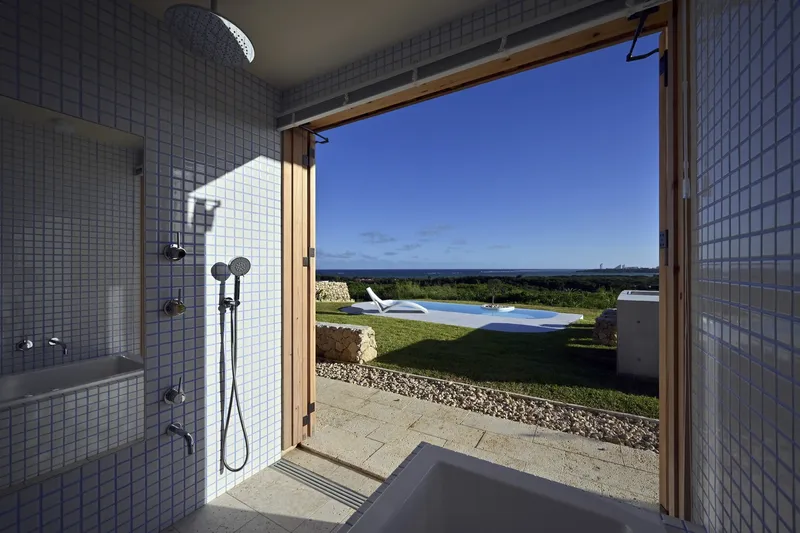
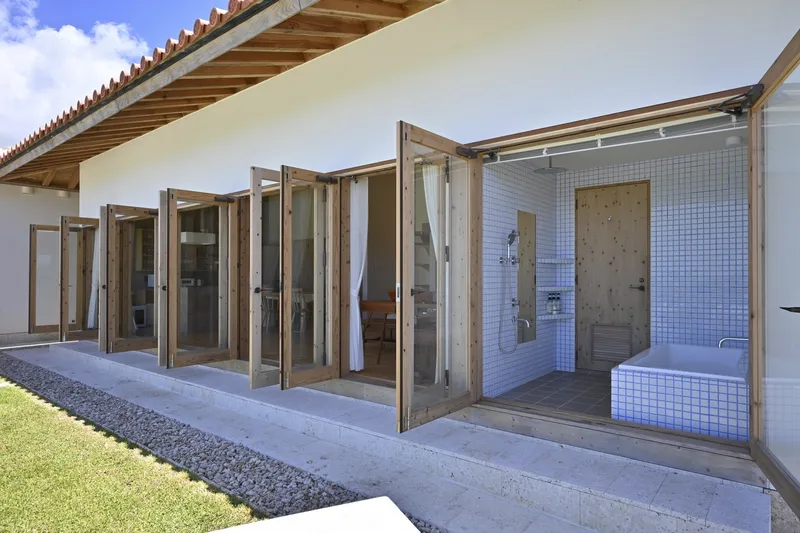
Perhaps the most unexpected gesture is the bathrooms. White mosaic tile lines the walls, and timber-framed glass doors swing open directly onto the lawn and swimming pool. It is a bold move for a rental property, dissolving the most private room in the house into the landscape. The design relies on the stone walls and Fukugi trees to maintain seclusion from the road side, and on the hillside orientation to ensure the ocean-facing garden is screened from neighbors. The effect is exhilarating: bathing becomes an outdoor act framed by architecture rather than enclosed by it.
Rooftop and Terrace: Living on Top of the Landscape
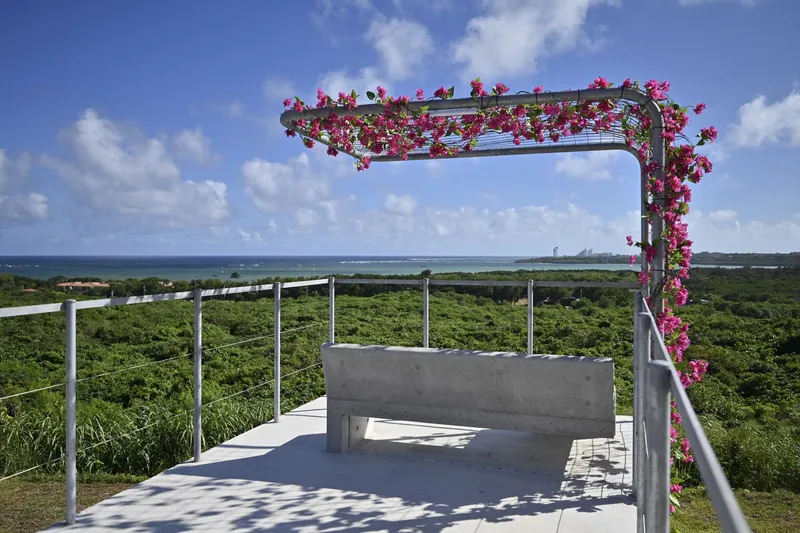
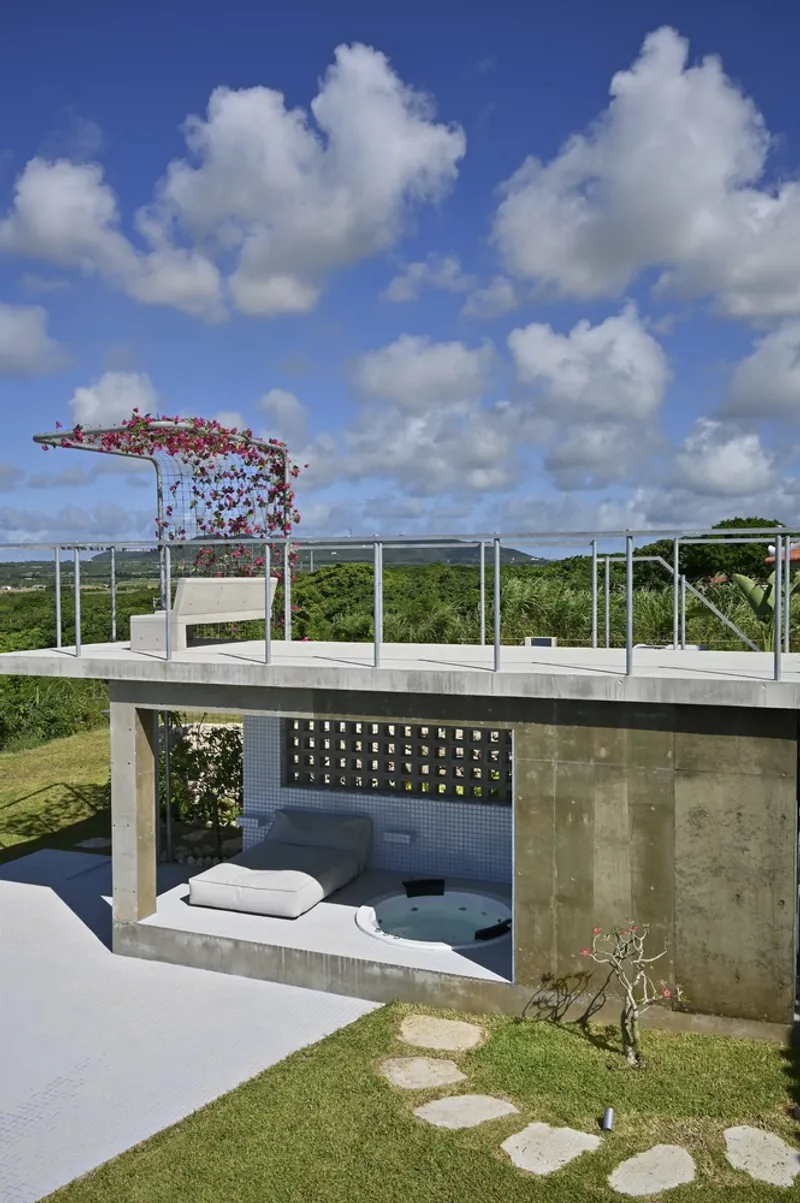
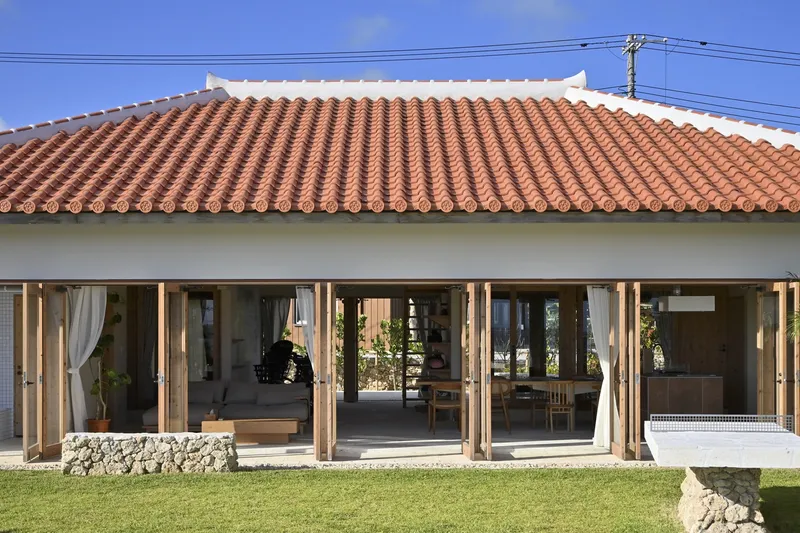
The rooftop terrace is the project's emotional crescendo. A concrete bench sits beneath a pergola already colonized by climbing bougainvillea, and the view stretches over dense subtropical forest to the ocean. Below, a sunken seating area carved from concrete walls provides a sheltered counterpoint, its low vantage framing the distant green landscape at eye level. The terracotta roof overhangs the garden-side elevation, shading the row of glass doors and casting a deep horizontal shadow that anchors the building to the ground.
These outdoor rooms are not afterthoughts. They are as carefully composed as the interiors, and they do the work of connecting guests to the specific qualities of this hilltop: the wind, the salt air, the shifting tropical light. A limestone ping-pong table in the garden, polished and stacked to reveal the stone's natural grain, turns even recreation into a material encounter with the island.
Why This Project Matters
Vacation architecture in Japan's subtropical islands too often defaults to one of two modes: the sealed resort that could be anywhere, or the folksy pastiche that borrows surface motifs without understanding why they existed. 07BEACH sidesteps both. By treating Yaeyama tradition as an operational framework rather than an aesthetic, the firm produces buildings that perform like traditional houses (high openness, typhoon-resistant perimeter, climate-responsive eaves) while reading as genuinely contemporary spaces. The involvement of local artisans in floors, guardian sculptures, and tatami is not a branding exercise; it is a supply chain decision that keeps craft knowledge circulating on the island.
At a combined gross floor area of roughly 253 square meters across two buildings and an outbuilding, the project is modest in scale. Its ambition is cultural rather than volumetric. It argues that tourist accommodation can participate in the architectural traditions of its place, reinforcing them rather than eroding them, and that guests are better served by specificity than by luxury abstracted from context. That argument, made this clearly and this well, is worth paying attention to.
Two Villas on Ishigaki Island by 07BEACH. Ishigaki Island, Yaeyama Islands, Okinawa, Japan. Site area: 1,017 sq.m. West villa: 133 sq.m. (gross floor area); East villa: 107 sq.m. (gross floor area); East outbuilding: 13 sq.m. Design period: January 2022 to December 2022. Construction period: November 2022 to May 2024. Photographs by Joe Chikamori.
About the Studio
Share Your Own Work on uni.xyz
If projects like this are the kind of work you want to make, uni.xyz is a place to publish your own, find collaborators, and enter design competitions.


Popular Articles
Popular articles from the community


Cube Design Draws an Ecological Corridor Between Two Shenzhen Hills with the Nankai Building
Beside Shenzhen's container docks, the Nankai Building pairs stacked balconies with a climbing green screen to connect two hillsides across its height.

GROUP A Strips a 1969 Rotterdam Harbor Headquarters to Its Frame and Wraps It in Timber Louvers
In Rotterdam's M4H harbor district, Ferro Offices reuses a 1969 frame, adds one timber storey and reaches BREEAM-NL Outstanding.

longwave studio Reorganizes a 112 m² Tainan Apartment Around the Daily Routines of a Family and Two Cats
In Tainan, Taiwan, birch plywood, rust-red furniture and a freestanding plaster wall link arrival, storage, work and family life in one apartment.

Architekt Andreas Gruber Scatters 23 Dark Timber Chalets Across a South Tyrolean Forest Edge
In Molini di Tures, Amonti Chalets breaks a resort into a hamlet of gabled timber houses, with parking, storage and services pushed into the slope.

Similar Reads
You might also enjoy these articles


Hodi-Mandai Geram
Project Function: Preservation and revitalization of the Intangible heritage and socio-spatial identity of the Hodi by Housing, Cultural Memory Center, Sacred Grove, landscape, local tourism economy


Olio Towers: A Mid-Rise for Performers That Fuses Housing, Rehearsal, and Stage
Located blocks from Houston's Theater District, this modular tower stacks living units around a central performance atrium.

Oasis: Modular Green Housing Carved into Dhaka's Urban Fabric
A shortlisted Plugin Housing entry reclaims unauthorized settlements in Dhaka with stepped concrete volumes, green roofs, and ventilation-driven design.

Black Hole: A Floating Megastructure for the Post-Physical Era
Emiliano Mazzarotto envisions a spherical, self-scaling arena where e-sports, digital hotels, and holographic stadiums replace traditional public space.

Explore Hospitality Building Competitions
Discover active competitions in this discipline

Challenge to reimagine the Iron Throne

Photograph architecture without architects

Illustrate the lost glory of Angkor Wat - Render Challenge

Design challenge to reuse E-waste
Comments (0)
Please login or sign up to add comments
No comments yet. Be the first to comment!