
UASZ Folds an Entire School into an Infinity Garden Between Shenzhen's Towers
A 73,200-square-meter campus in Futian District stacks courtyards, ramps, and green roofs to give 54 classes of students room to breathe.

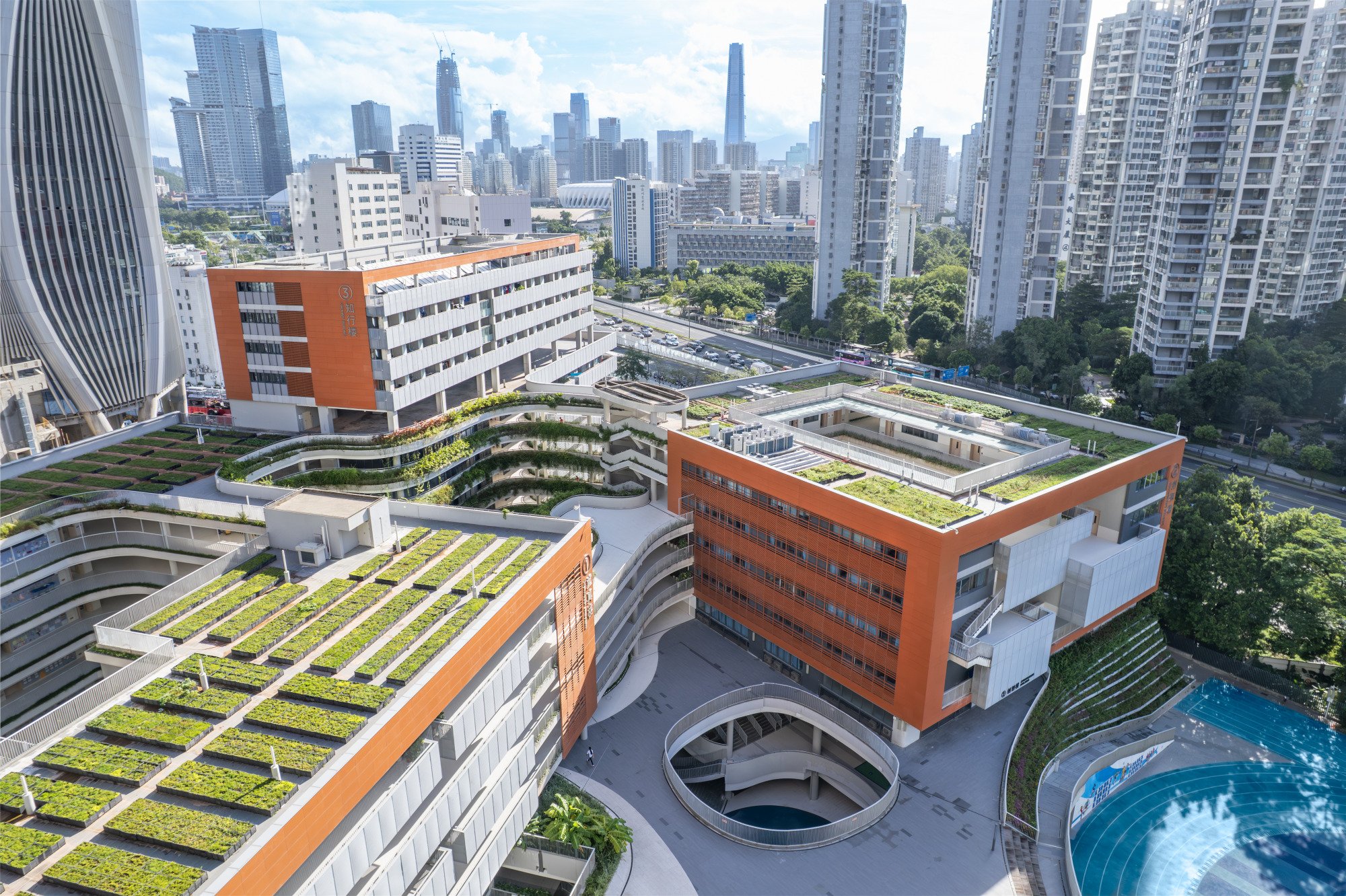
Shenzhen's Futian District is not a place where you expect to find nature. It is a wall of residential towers, commercial podiums, and infrastructure corridors stitched together so tightly that daylight reaches the ground on a negotiated basis. Yet Huafu Village, a community dating back to the 1980s, is undergoing the district's first shantytown redevelopment, and the centerpiece is a nine-year continuous school by UASZ that somehow manages to feel like a terraced hillside garden. The Hongling Education Group Huafu Experimental School, completed in 2024, takes 73,200 square meters of program, stacks it from two basement levels to planted rooftops, and organizes the whole mass around what the architects call an "Infinity Garden": a continuous landscape loop that spirals through the section of the building itself.
What makes the project genuinely interesting is not the ambition of fitting a large school onto a compact urban site. That is a routine problem in Chinese megacities. The interesting move is the refusal to treat landscape as leftover space. Here, the courtyards, ramps, terraces, and sunken gardens are the primary organizational system. Classrooms, libraries, dance studios, and sports facilities plug into a three-dimensional landscape scaffold rather than the other way around. The result is a campus where a student walking from a basement art garden to a rooftop courtyard passes through a continuous gradient of planted space, natural light, and fresh air, never once stepping outside the school boundary.
A Campus Compressed by Context
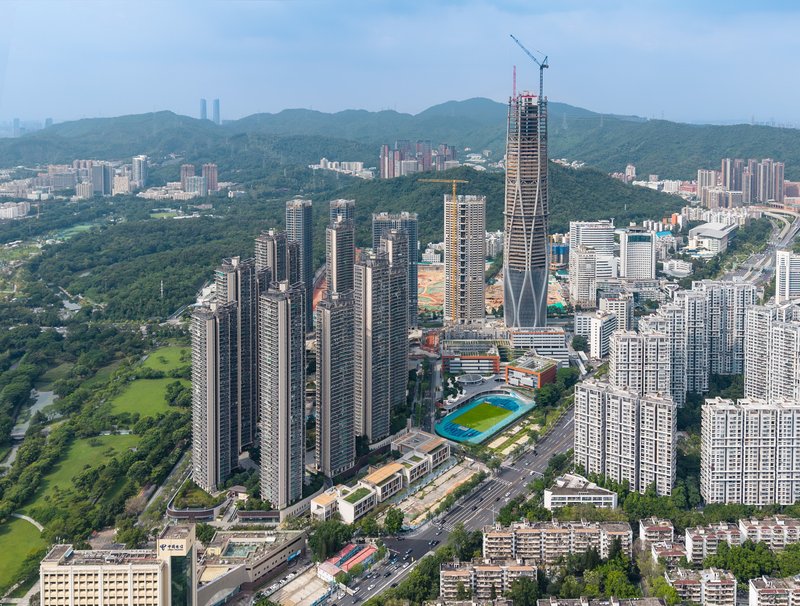
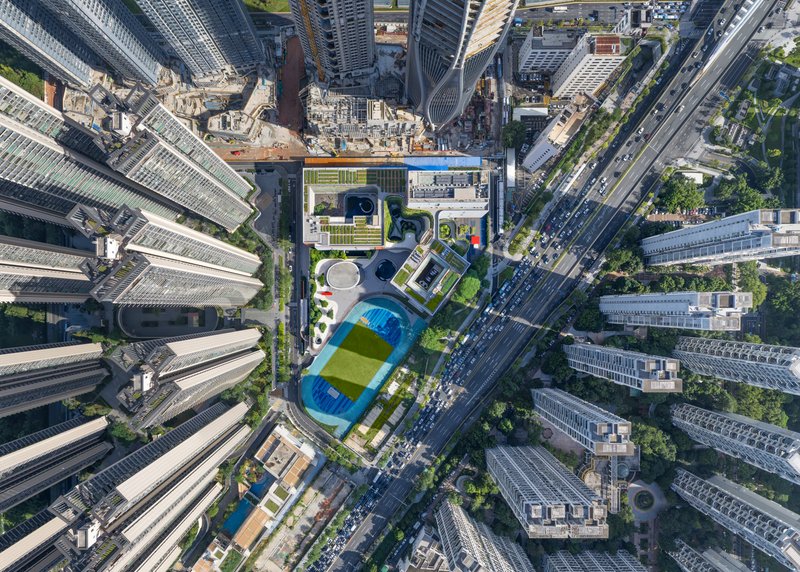
The aerial views tell the story of constraint more clearly than any site plan. The school's landscaped podium sits in a valley of residential towers, hemmed in on every side by structures that easily double its height. Sports fields, a pool, and forested hills appear just beyond the boundary, but the density of the surrounding fabric makes the campus read as a green raft floating in a concrete sea. UASZ responded by concentrating the main building mass on the north side of the site, freeing the south for a spacious playground and uninterrupted activity space. It is a simple organizational gambit, but it guarantees that the majority of outdoor area receives direct southern sunlight, a non-trivial advantage in a subtropical climate where shaded courtyards can turn damp and oppressive.
The Spiraling Garden Section
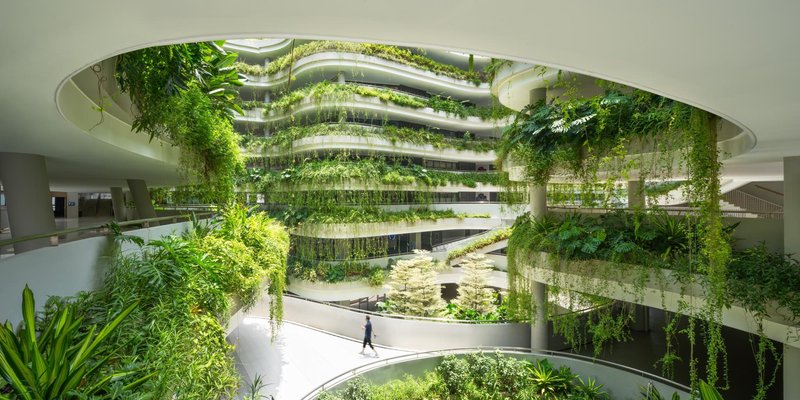
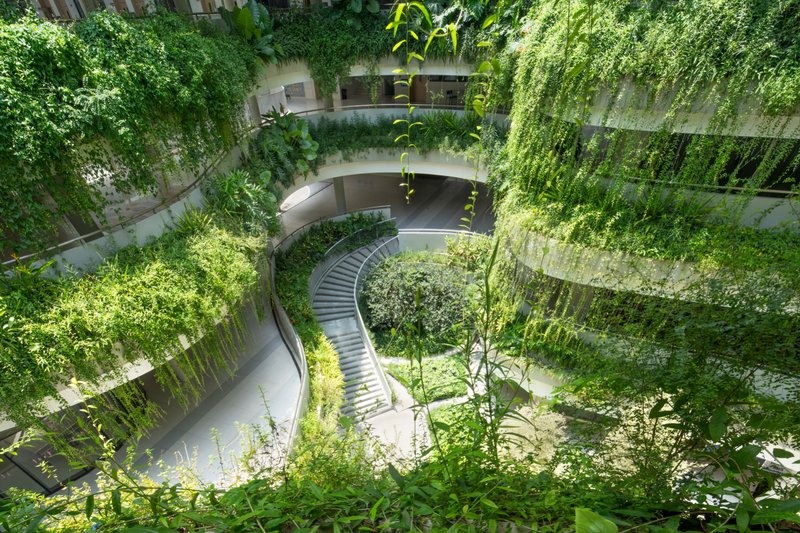
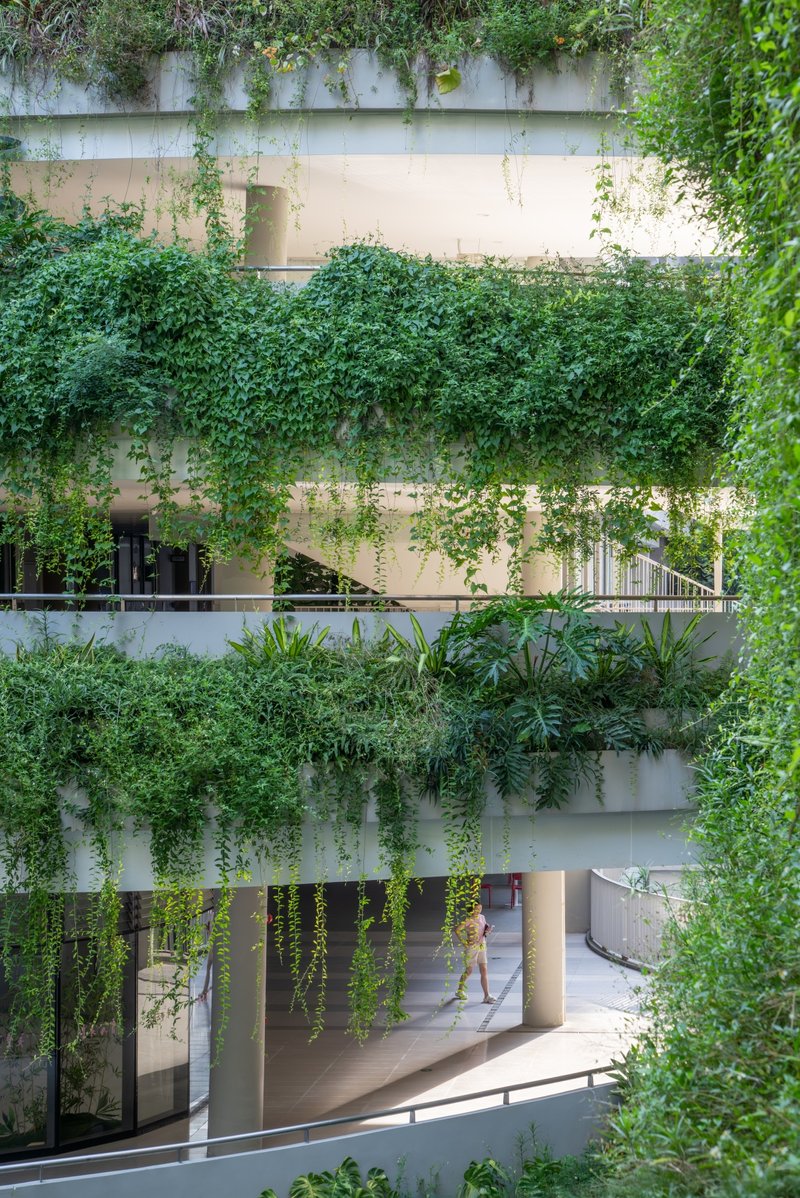
The heart of the project is a spiraling interior atrium where planted terraces cascade downward through multiple levels, connected by curving ramps and bathed in light from a circular skylight overhead. Trailing vines and banana palms soften the concrete structure, and the effect from below is genuinely disorienting: you are inside a building, but the spatial sensation is closer to standing at the bottom of a vegetated canyon. The curving ramps are wide enough to serve as social infrastructure, not just circulation. Students can pause, sit against the planted edges, or simply watch the movement of their peers on levels above and below.
The section through the planted terraces reveals how carefully the architects calibrated the relationship between light wells, green vertical facades, and underground courtyards. Natural light penetrates deep into the basement levels, where the Art Garden consists of activity courtyards surrounded by studios. Light wells do the environmental heavy lifting, pulling ventilation through the lower floors and reducing the mechanical load in a climate where humidity and heat are year-round concerns.
Ground Level: The Covered Plaza
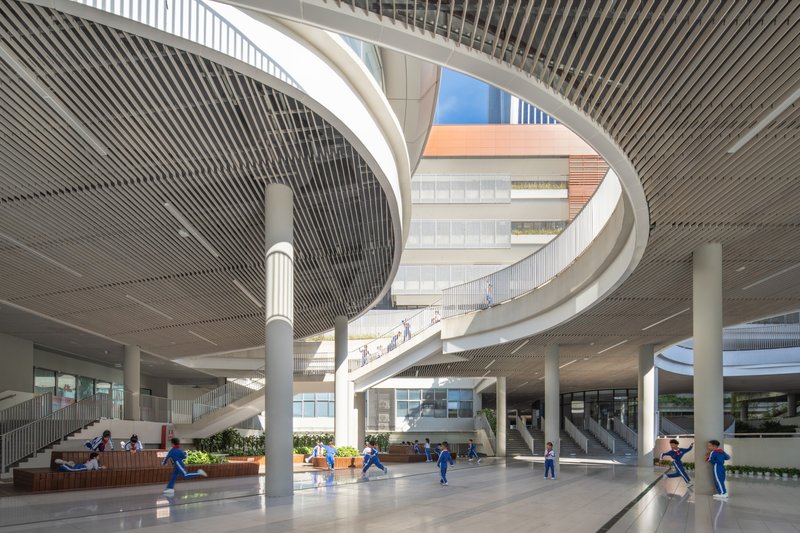
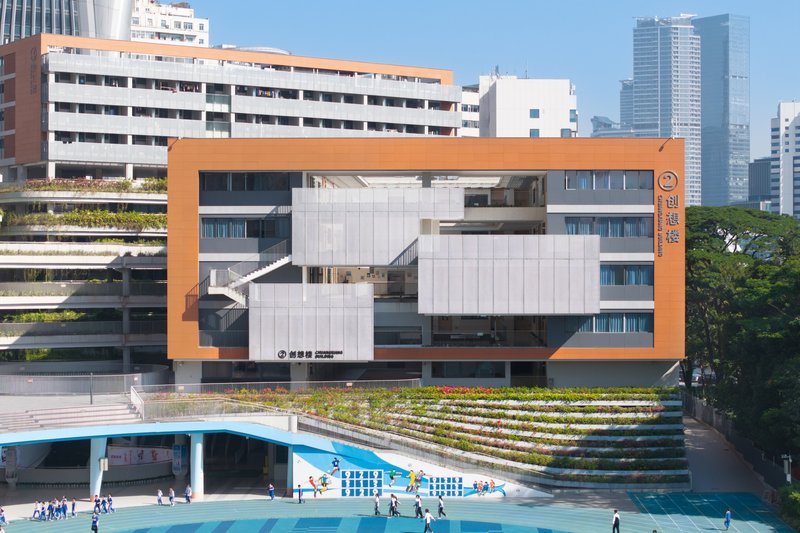
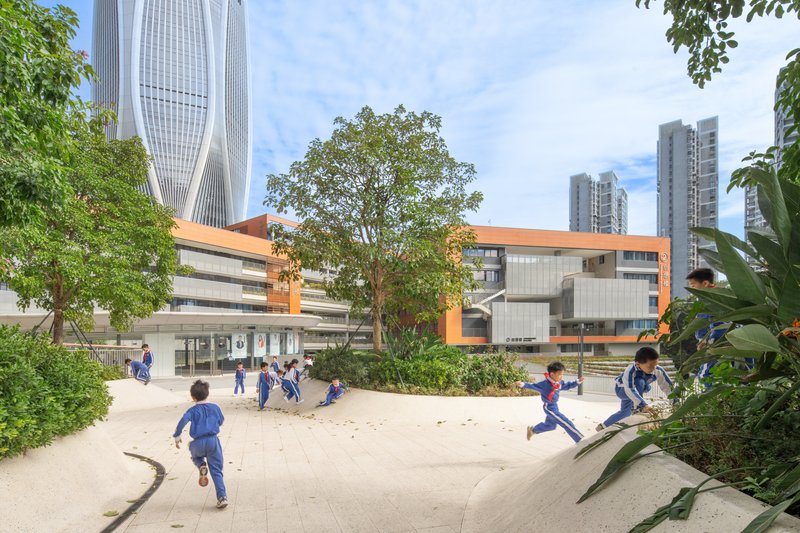
At ground level, the school presents itself as a generous covered plaza rather than a walled institution. White columns support a wood-slatted ceiling, and sweeping curved ramps rise from the plaza floor toward the upper garden terraces. Students in blue uniforms populate the space with the casual disorder of a park rather than the regimented lines of a school corridor. The terraced amphitheater that steps down to a teal-paved courtyard doubles as informal seating for outdoor events, and the sand play area framed by trees on the south side gives younger children a zone that feels genuinely playful rather than institutional.
The orange-framed facade panels and horizontal louvers add a layer of visual warmth that keeps the building from tipping into the cold minimalism that plagues many Chinese public school projects. The color is restrained enough to read as a material decision rather than a decorative gesture, and its repetition across the facade creates a coherent identity when seen from the surrounding towers above.
Facade and Materiality
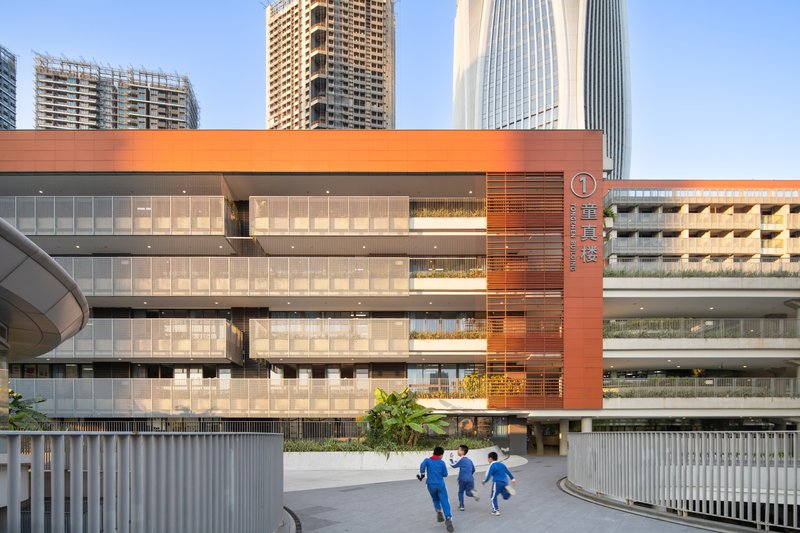
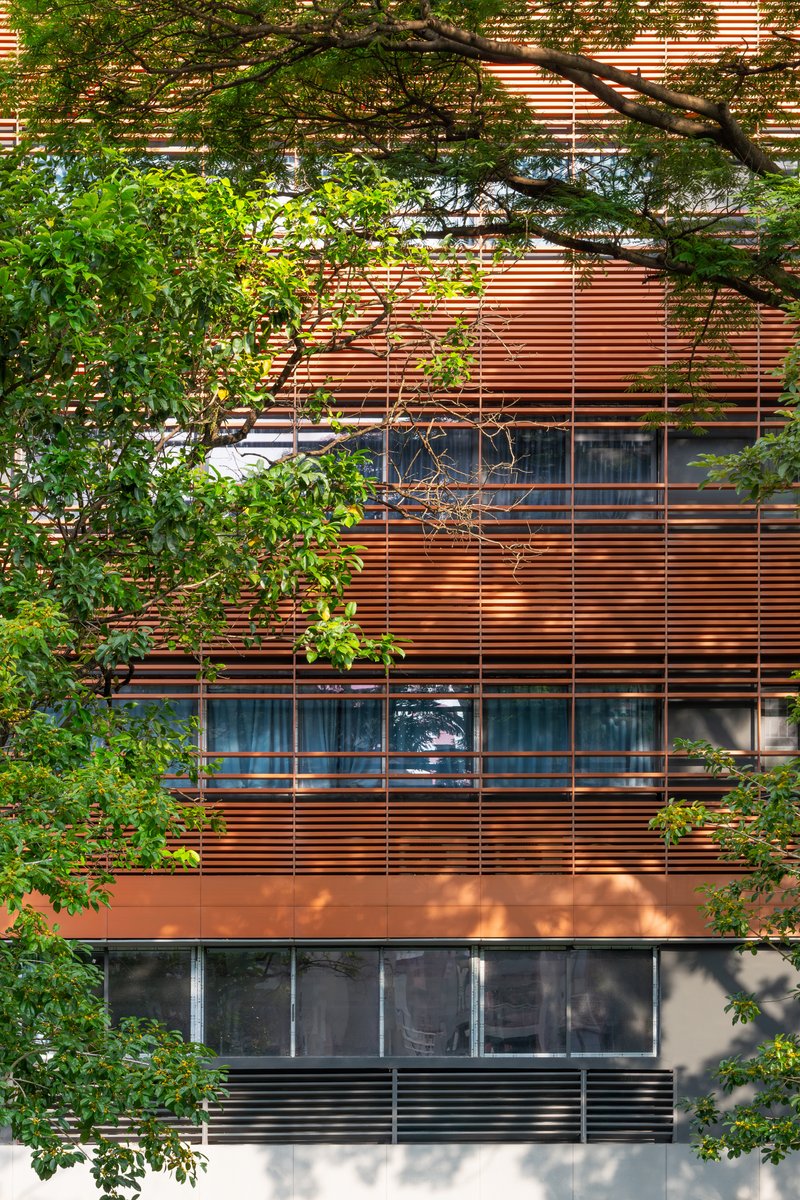
The building speaks two distinct facade languages. The primary elevations use horizontal orange louvers over glazed galleries, creating a layered depth that modulates sunlight and gives the corridors a warm, filtered quality. The secondary faces employ timber louvers set in front of glass, producing a more domestic texture that mediates between the school and the residential towers nearby. Both systems serve as passive solar controls in Shenzhen's subtropical climate, reducing glare and heat gain without resorting to opaque walls.
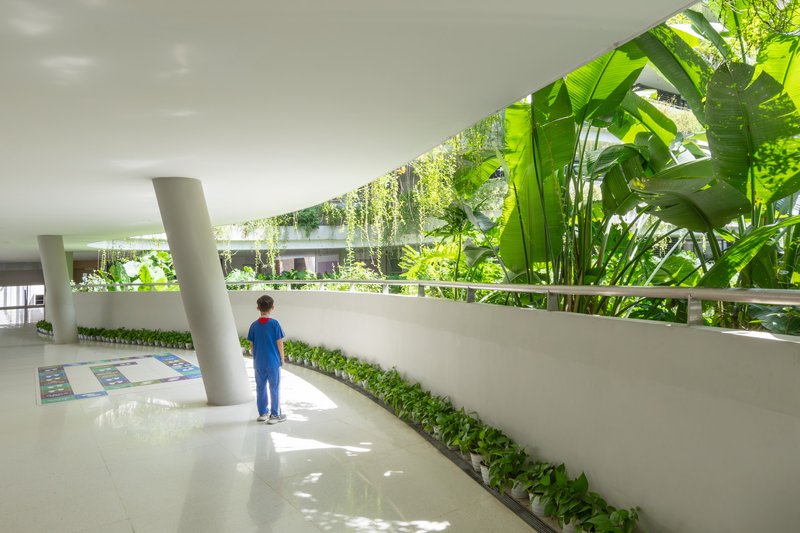
Inside the circulation balconies, white concrete planters overflow with banana palms and trailing vines, turning every corridor into a micro-garden. A child leaning over one of these planters is not admiring an ornamental feature; they are standing in a bioclimatic buffer that cools the air, filters dust, and creates a psychological separation between the intensity of the classroom and the openness of the courtyard beyond. These details are small, but they accumulate into a campus where greenery is structural to the experience, not decorative.
The Rooftop Landscape
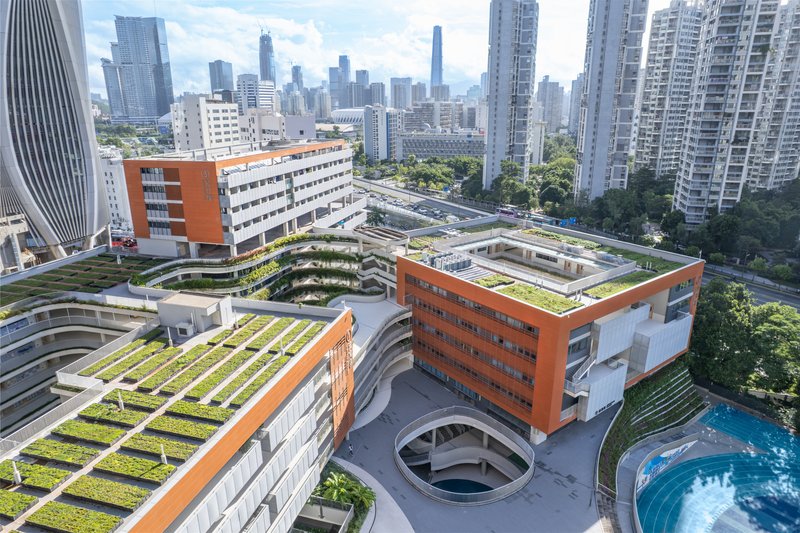
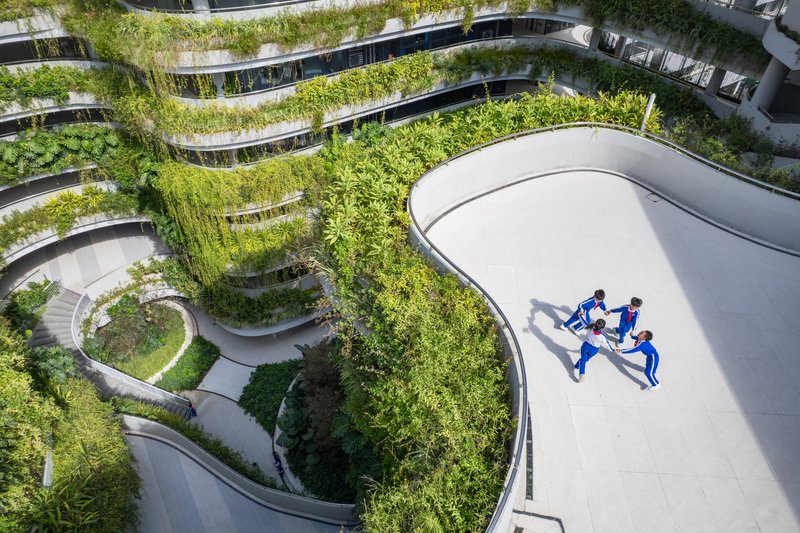
From above, the terraced green roofs read as a topographic map. Curving pathways weave between planted zones, young trees dot the surface, and the orange-clad volumes punch through the landscape like geological outcrops. Two runners crossing a white paved surface in one view give a sense of the scale: these are not token green roofs. They are usable outdoor spaces large enough for running, gathering, and outdoor teaching. Against the skyline of Shenzhen's towers, the rooftop campus registers as a deliberate counterpoint, a horizontal landscape asserting its presence in a vertical city.
Plans and Drawings
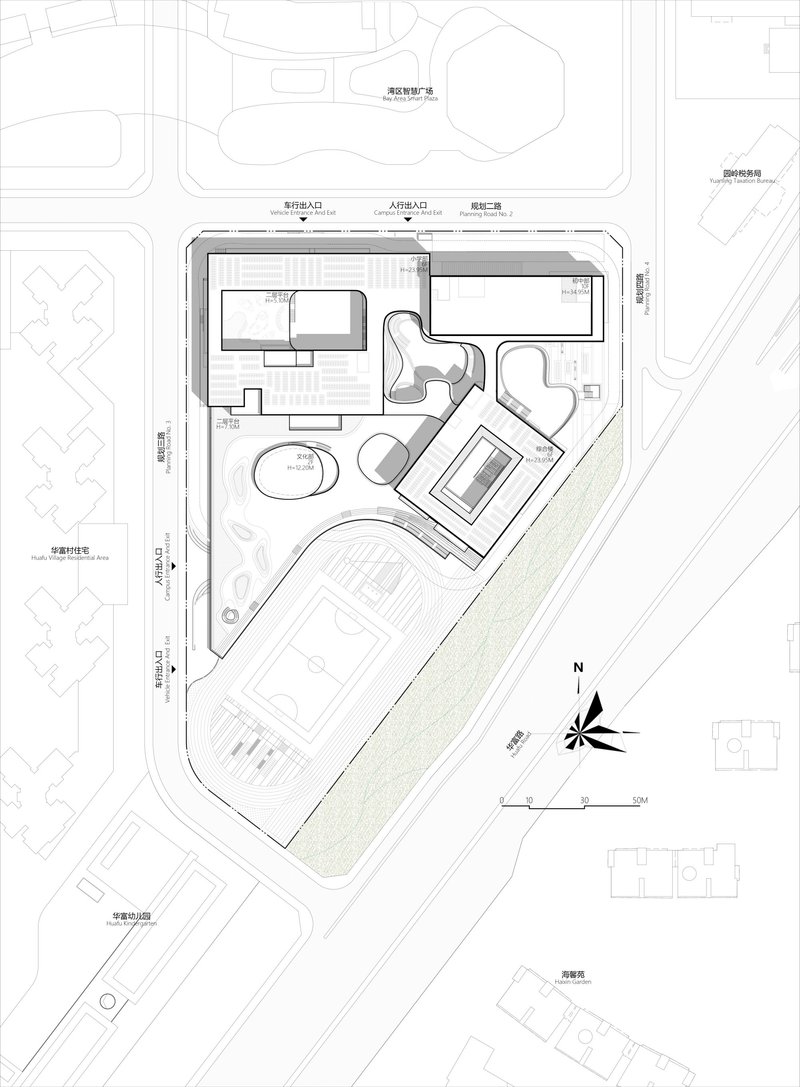
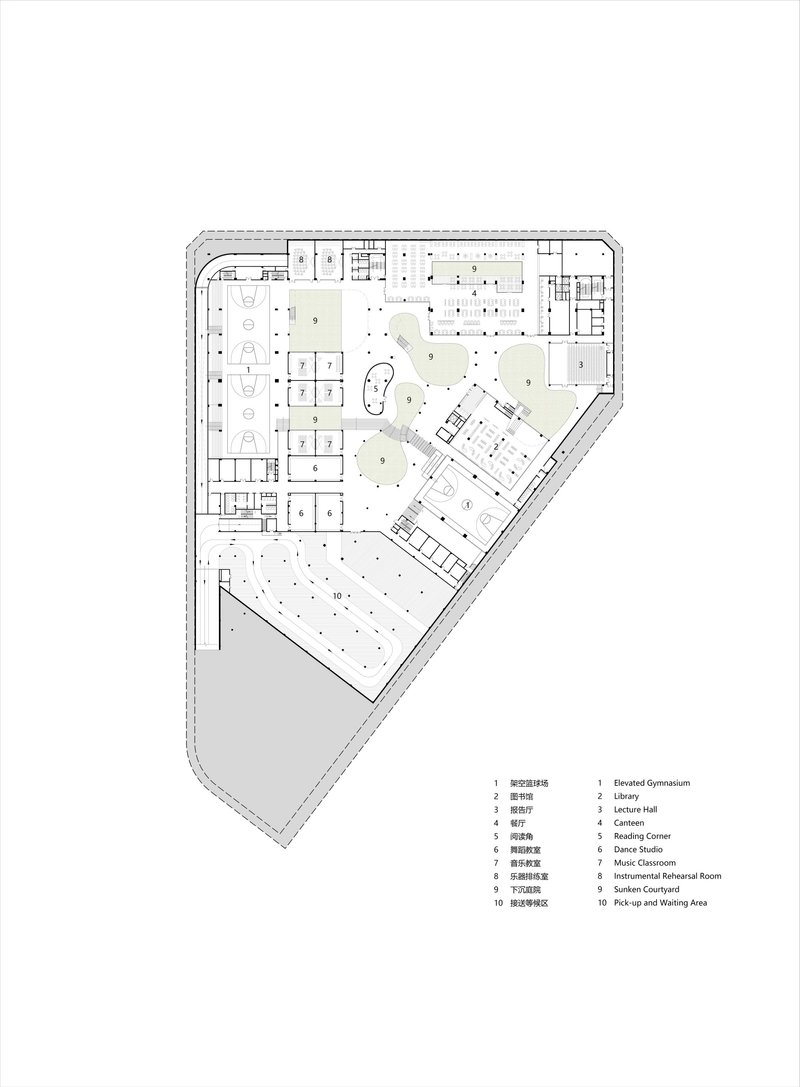
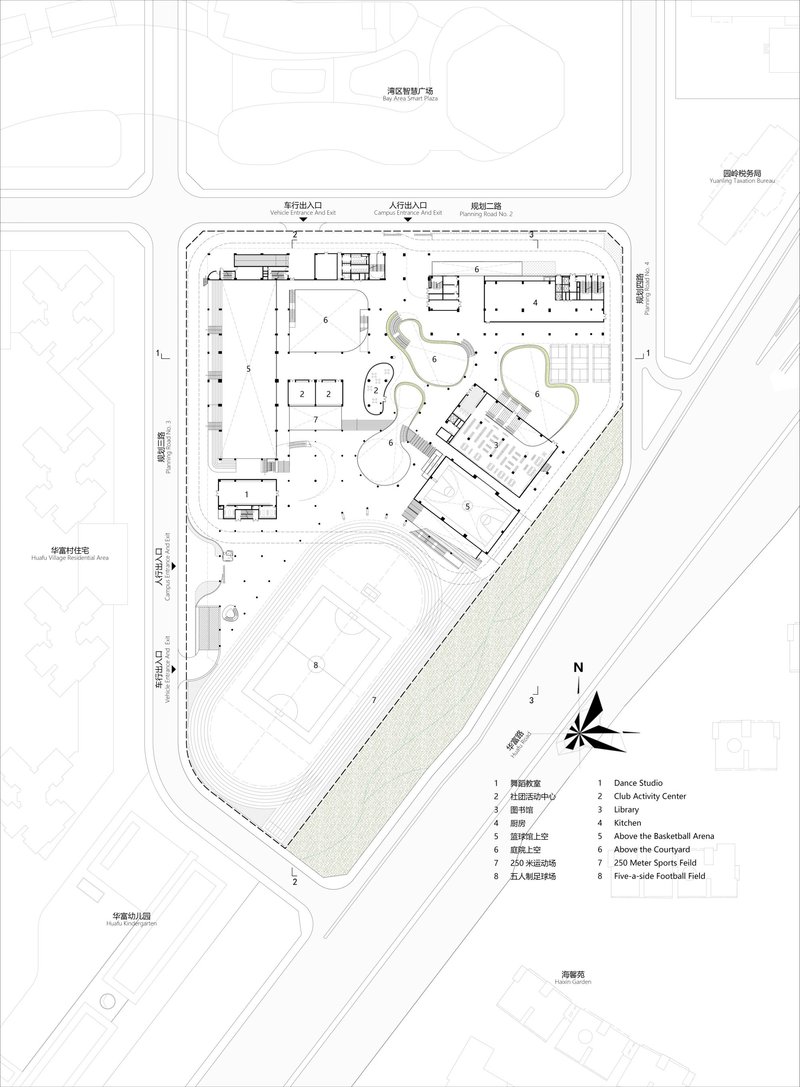
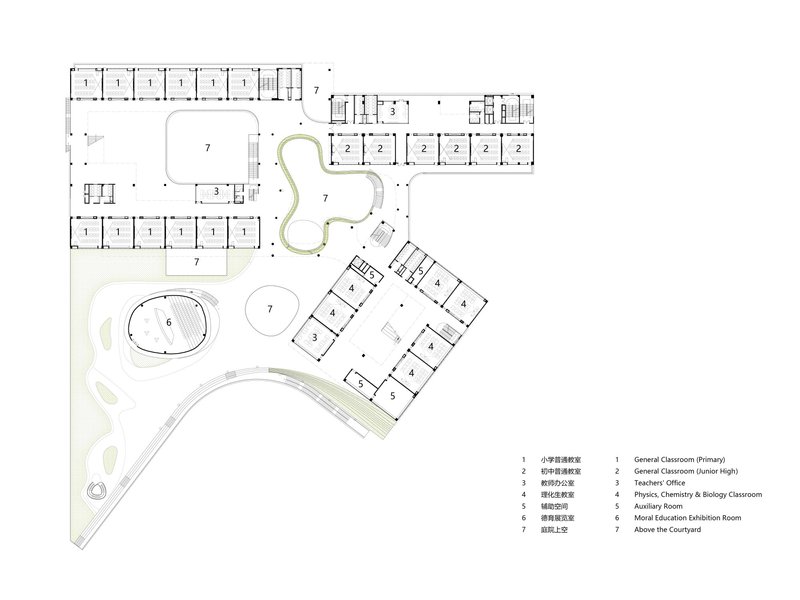
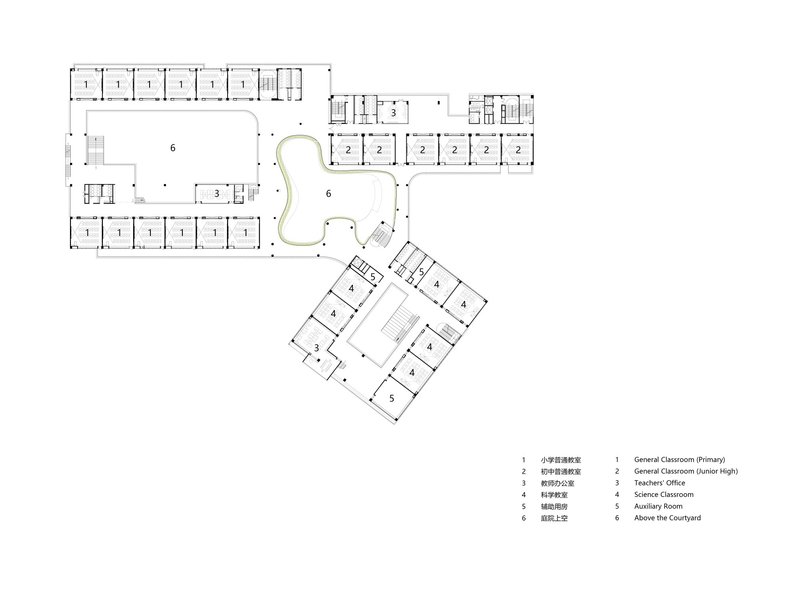
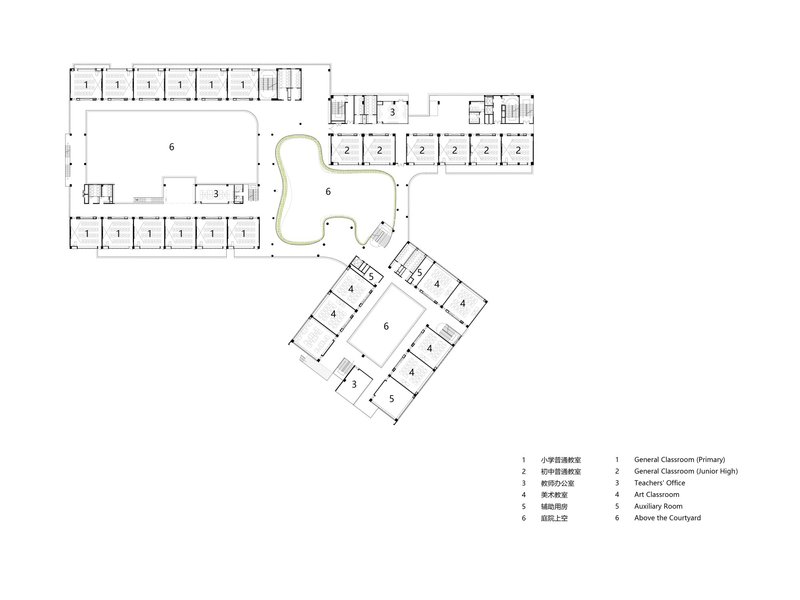
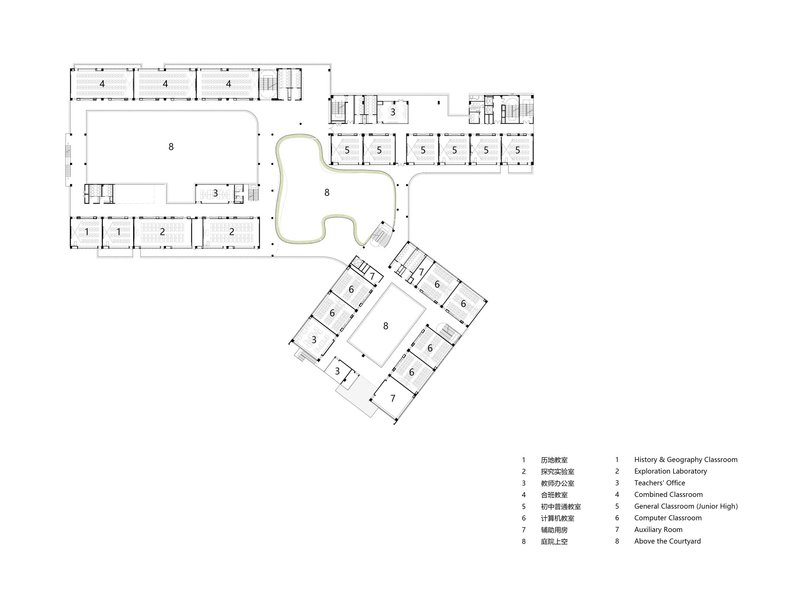
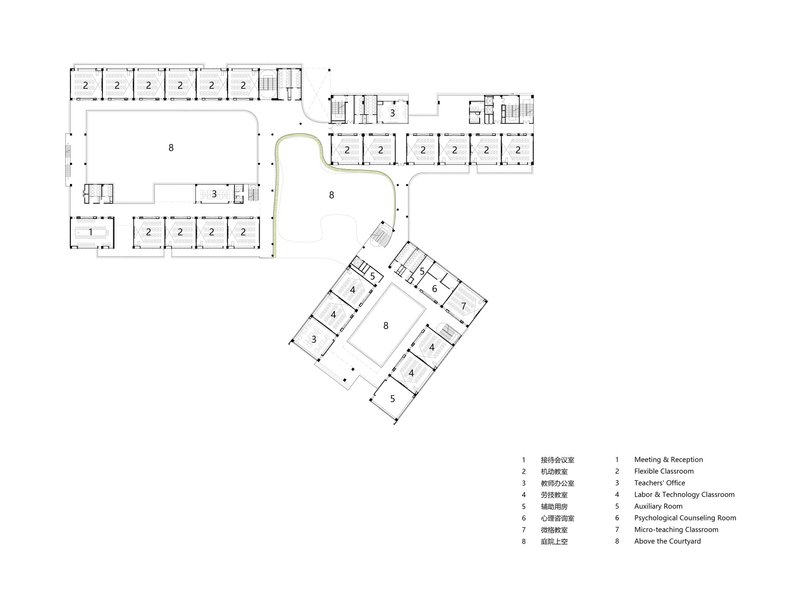
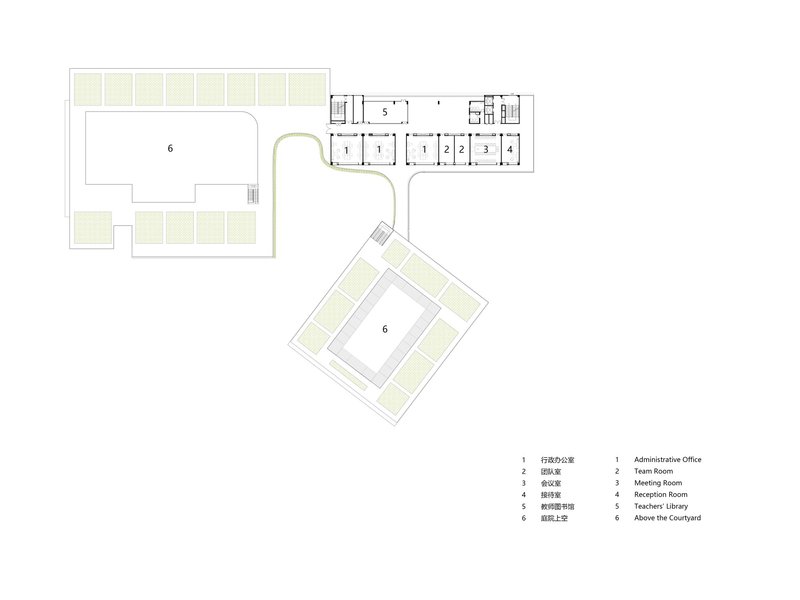
The plan sequence from site level to roof reveals the project's organizational logic with precision. The site plan shows the irregularly shaped footprint responding to surrounding streets and an internal courtyard geometry that is anything but orthogonal. Classrooms are arranged in wings that angle and shift to create varied courtyard proportions at each level. The curved circulation corridor that appears on almost every floor is the Infinity Garden's horizontal trace: it links classroom wings, wraps around courtyards, and ensures that no path through the building is ever a straight dead-end march. The ground floor plan is notably different from the upper levels, housing the library, dance studio, and sports field along the street edge, creating a more public and porous condition at grade.
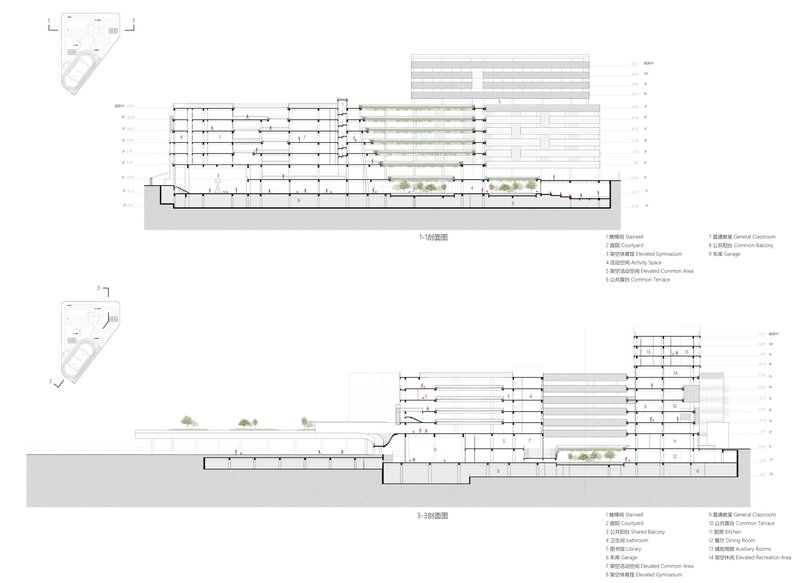
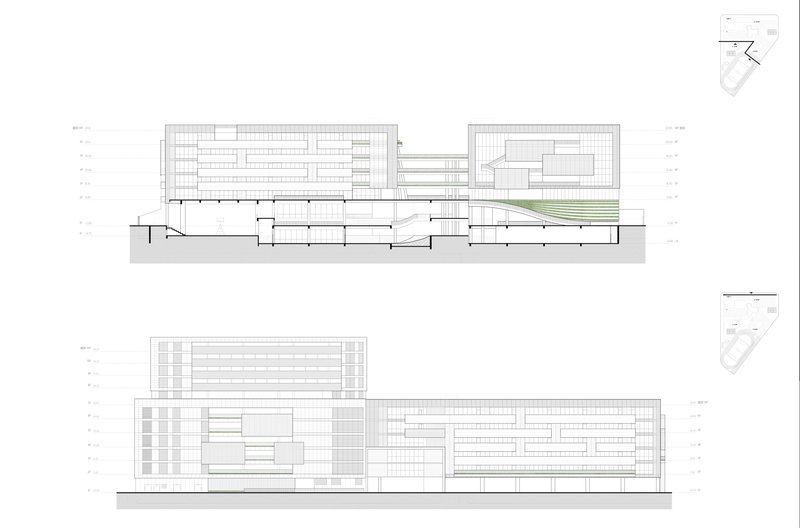
The building sections are the most revealing drawings. They show the full vertical extent of the campus, from the subterranean art courtyards to the planted rooftop, and make visible the light wells, double-height voids, and terraced setbacks that give the lower levels access to daylight and air. The layered facade with its louvers and recessed glazing is legible in the elevation drawings, and the overall section profile steps down toward the south, maximizing solar access to the playground and confirming the north-heavy massing strategy visible in the aerials.
Why This Project Matters
School design in Chinese megacities has, for years, defaulted to a formula: stack classrooms efficiently, attach a running track, and wrap the whole thing in a cheerful facade. UASZ's Huafu Experimental School breaks from that formula by treating the landscape as the school's primary spatial system. The Infinity Garden is not a courtyard that classrooms happen to overlook; it is a continuous three-dimensional environment that organizes circulation, climate control, play, and learning into a single looping experience. That is a fundamentally different proposition, and it produces a campus where students encounter nature, light, and open air as a matter of routine rather than scheduled recess.
The project also matters as a model for urban renewal. Huafu Village's transformation from 1980s shantytown to mixed-use district is a story playing out across dozens of Chinese cities, and the quality of public institutions built during these transitions defines whether renewal serves the existing community or merely increases land value. By investing in a school that is generous, inventive, and deeply attentive to its environmental context, this project sets a standard. Fifty-four classes of elementary and middle school students now attend a campus that would be remarkable in a leafy suburb. That it exists between tower blocks in one of the densest districts on Earth is the real achievement.
Shenzhen Hongling Education Group Huafu Experimental School, designed by UASZ (lead architects Wu Chao and Wang Siwen), with landscape design by Atelier Scale and interior design by ICON STUDIO. Located in Shenzhen, China. 73,200 m². Completed in 2024. Photography by Yu Bai.
About the Studio
UASZ
Share Your Own Work on uni.xyz
If projects like this are the kind of work you want to make, uni.xyz is a place to publish your own, find collaborators, and enter design competitions.




Popular Articles
Popular articles from the community


Cyber Oyster: A Visionary Adaptive Reuse Architecture Project Transforming Abandoned Oil Rigs Through Oyster Bionics
An adaptive reuse architecture concept transforming abandoned offshore oil platforms into self-healing marine ecosystems inspired by oyster bionics.

Constanti Architects Builds a Fortress of Privacy in Nicosia with House 345
A concrete and timber residence in Cyprus reinterprets the traditional introverted courtyard house for a new urban landscape.
BAST Slots a Four-Story Glass House into a Narrow Gap Between Toulouse Townhouses
In the dense Bonnefoy district, a stepped infill building merges home and office while preserving a majestic hackberry tree.
Twobytwo Architecture Studio Towers a Blackened Ski Cabin Above the Trees in Golden, BC
A compact three-storey lookout in the Kootenay mountains trades square footage for 14-foot ceilings and Columbia River Valley views.


Similar Reads
You might also enjoy these articles
127af Flips a Tiny Bagnolet Rowhouse Upside Down with a Handcrafted Roof Extension
A 55-square-meter terraced house on the edge of Paris gains a luminous upper living floor through lightweight timber and steel.
1.61 Design Workshop Wraps a 600-Square-Meter Café in Vietnam in Sculptural Burgundy Drama
Reden Café & Bistro pairs a helical staircase, mosaic floors, and deep red interiors to rethink Vietnamese hospitality space.

The Unbound Brain: A School Shaped by Cognitive Architecture
Cylindrical learning pods radiate like neurons from a central cortex, turning the floor plan into a spatial model of human thought.
Revival Vernacular Architecture: Rammed Earth Settlements for the Sahara
A modular desert community in Mauritania that fuses passive cooling techniques with earthen construction and local craftsmanship.


Explore Educational Building Competitions
Discover active competitions in this discipline




The Global Benchmark for Architecture Dissertation Awards


Challenge to design public laboratory
Comments (0)
Please login or sign up to add comments
No comments yet. Be the first to comment!