
United Colors of Via Padova: Milanese Design Icons Reimagined as Urban Furniture
A multicultural Milan street becomes a testing ground for public furniture drawn from the legacy of Caccia Dominioni, Joe Colombo, and Enzo Mari.


What if the domestic masterpieces of Italy's most celebrated designers left the living room and took up permanent residence on the sidewalk? That is the provocation at the heart of United Colors of Via Padova, a project that reinterprets iconic furniture by Caccia Dominioni, Joe Colombo, Vico Magistretti, and Enzo Mari as public infrastructure for one of Milan's most culturally diverse streets. The premise is disarmingly simple: the city that gave the world industrial design should let that design language serve its most heterogeneous community, not just its galleries and showrooms.
Designed by Ludovico Oldini, Davide Pagano, and Antonio Boeri, the project takes Via Padova in northern Milan as its site. Nearly 20% of the city's population, over 260,000 residents, are foreign-born, and Via Padova concentrates that diversity into a single artery where people from across continents live, work, and share daily life. A 2018 municipal survey catalogued the city's existing urban furniture and found a landscape dominated by bollards, bins, and fences: functional, utilitarian, and largely indifferent to social exchange. United Colors of Via Padova responds to that gap, turning the street into a living museum where design history actively serves communal life.
A Translucent Pavilion That Blurs the Line Between Indoor and Outdoor
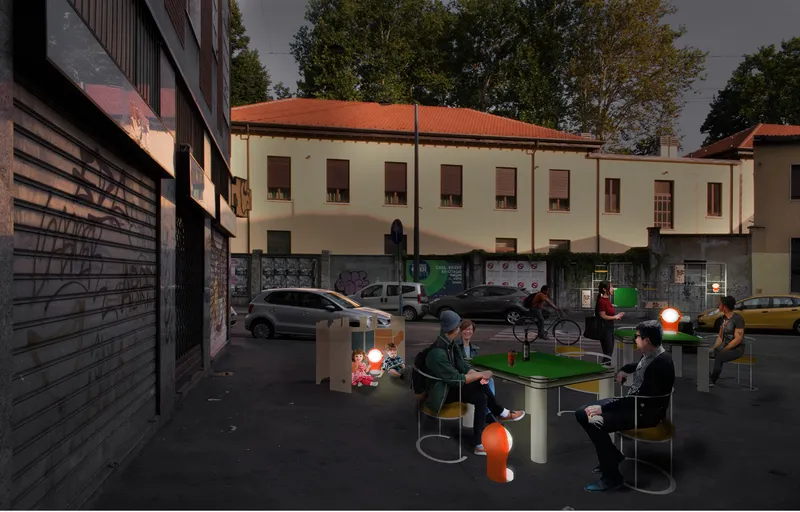
At dusk, the intervention reveals its full character. A translucent pavilion structure anchors the street, drawing visitors into a semi-enclosed zone furnished with reinterpreted seating and tables. The evening views show illuminated surfaces and people clustering naturally around the furniture, eating, talking, lingering. The pavilion does not impose a single program; it creates the spatial conditions for multiple uses to overlap. Lighting plays a critical role here, informed by Vico Magistretti's Telegono lamp (1969) and its ethos of simple, poetic illumination. Rather than flooding the plaza with uniform light, the design fosters pockets of warmth that encourage social encounters rather than merely securing a perimeter.
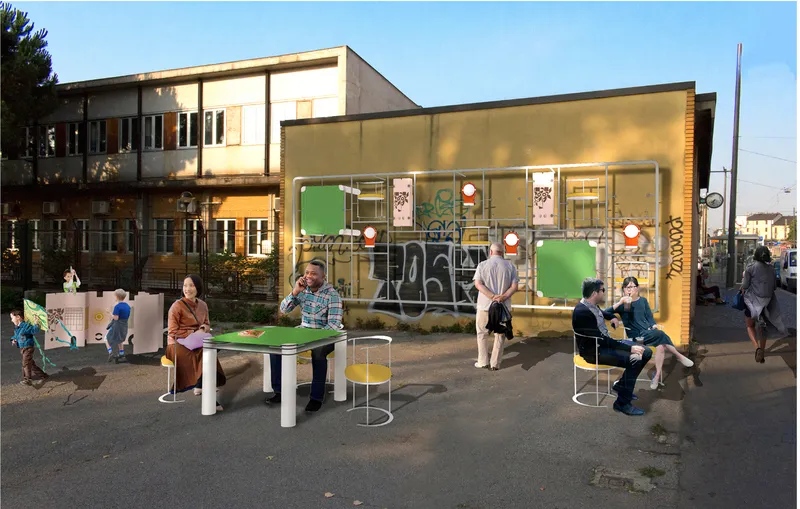
What makes these scenes convincing is the casualness of the occupation. The furniture is clearly scaled and positioned for spontaneous use: a group playing cards at one table, a couple seated on a reimagined Catilina chair nearby. The project does not choreograph behavior; it furnishes possibility.
Domestic Icons Re-Engineered for the Street
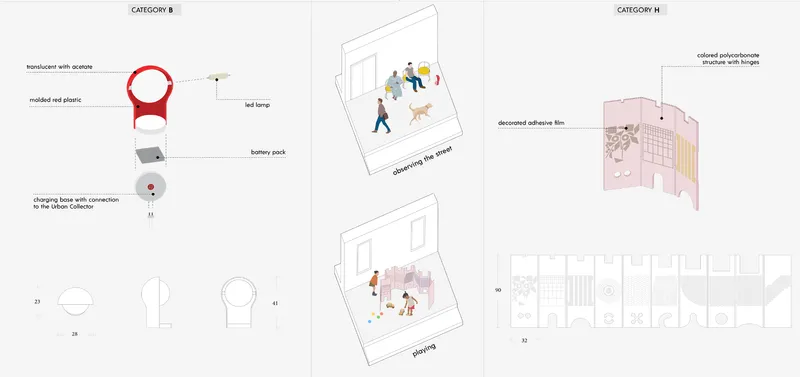
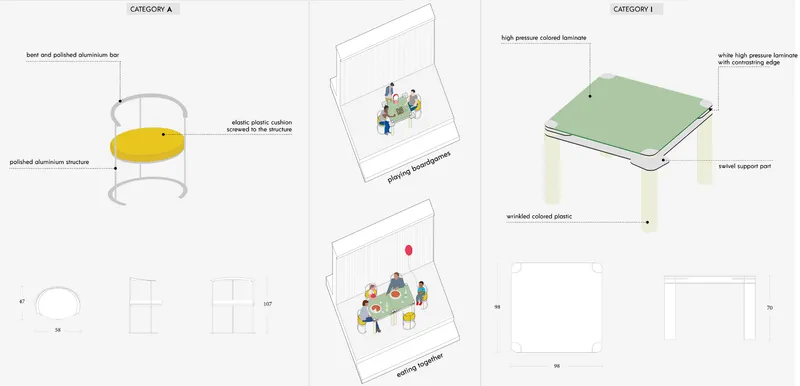
The technical drawings lay out the design logic with precision. Caccia Dominioni's Catilina chair (1957), originally a symbol of refined domestic comfort, is re-engineered by swapping iron for lightweight aluminum frames and elastic plastic seats, making it durable enough for outdoor exposure while retaining its formal elegance. Joe Colombo's Tavolo Poker (1968), a playful fusion of utility and leisure, keeps its high-pressure laminate top but gains hollow plastic legs that reduce weight and allow modular rearrangement across the streetscape. Enzo Mari's Paravento (1967), a foldable, child-friendly screen, inspires the adaptive, reconfigurable elements that let residents reshape their public space according to shifting needs.
The exploded axonometric views and annotated categories make the material strategy legible. Aluminum, elastic plastics, and laminate surfaces are chosen not for novelty but for a specific set of performance criteria: lightness, resilience, and ease of maintenance. Each typology is classified and diagrammed as part of an expanded urban furniture abacus, one that deliberately exceeds the utilitarian catalogue published by Milan's town hall in 2018. Where that survey counted security barriers and waste bins, this project adds social nodes, play surfaces, and communal seating.
Activating the Sidewalk as a Continuous Social Spine
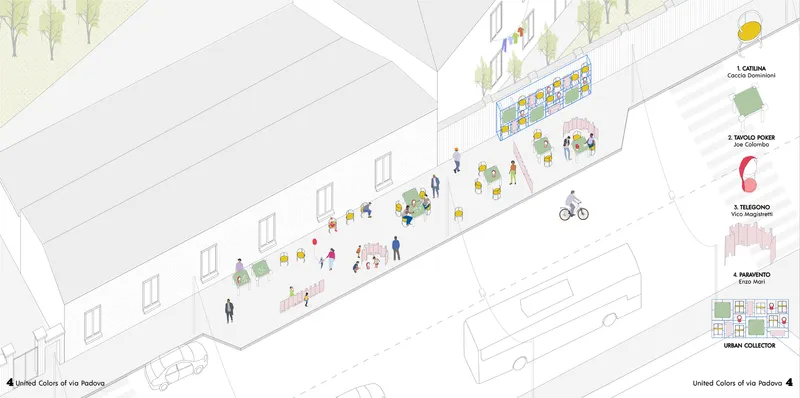
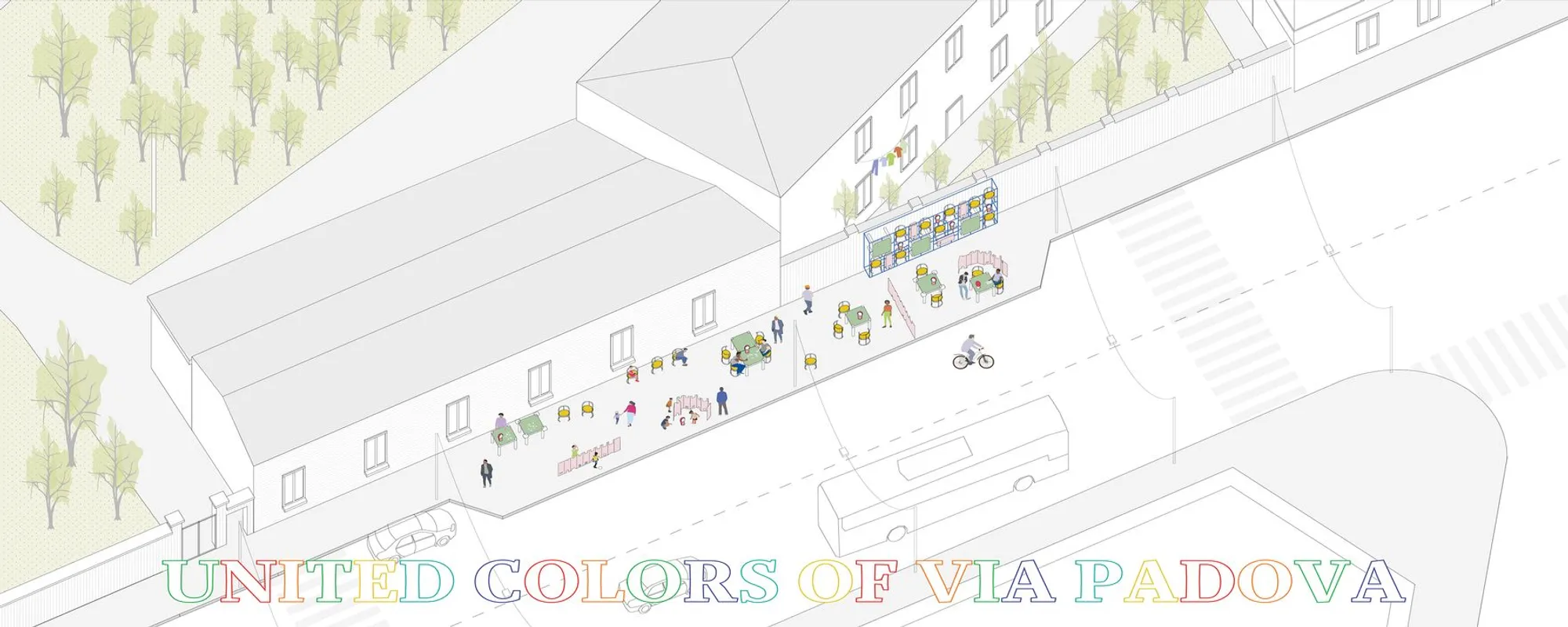
The axonometric street drawing ties the individual furniture pieces back to their urban context. Modular installations line the building facade along Via Padova, creating a rhythmic sequence of activity zones for pedestrians. The drawing shows how the furniture is not scattered arbitrarily but organized into clusters that correspond to the existing building entrances, sidewalk widths, and storefront rhythms. Pedestrians move through and around these clusters, and the effect is a sidewalk that feels inhabited rather than merely traversed.
The strategy is spatial as much as it is cultural. Via Padova's identity as a multicultural corridor means its public spaces must accommodate vastly different patterns of use: lingering, trading, gathering in large groups, playing with children, eating outdoors. By distributing modular, reconfigurable furniture along the street's length, the designers avoid imposing a single programmatic reading. The street remains legible as a thoroughfare while gaining the thickness of a public room.
Why This Project Matters
Too many urban furniture projects treat the street as a blank canvas for formal experimentation. United Colors of Via Padova reverses the equation. It starts with a specific cultural context, a documented gap in the city's existing furniture catalogue, and a deep reading of Milanese design history, then works outward to the object. The result is furniture that carries meaning beyond its immediate function: each piece is a small argument that the city's design heritage belongs to everyone who lives there, not only to those who can afford a Dominioni chair in the living room.
Oldini, Pagano, and Boeri demonstrate that honoring tradition does not require preservation under glass. By re-engineering domestic icons with aluminum, laminate, and elastic plastics, and deploying them along a street that serves over a dozen nationalities, they propose a public design language that is simultaneously rooted and open. In a European political climate that often frames cultural diversity as a problem to manage, this project quietly insists that it is a condition to design for.
View the Full Project
About the Designers
Designers: Ludovico Oldini, Davide Pagano, Antonio Boeri
Enter a Design Competition on uni.xyz
uni.xyz runs architecture and design competitions year-round that reward proposals with spatial conviction and real site intelligence.
Project credits: United Colors of Via Padova by Ludovico Oldini, Davide Pagano, Antonio Boeri.



Popular Articles
Popular articles from the community


The Ocean Hive: Sustainable Architecture for a Self-Sufficient Civilization at Sea
The Ocean Hive imagines sustainable architecture at sea, where modular habitats, algae, wave power and ocean waste sustain a growing colony.

Hill & Cross Opera: Sculptural Opera House Architecture Shaped by Tallinn’s Landscape and Identity
Hill & Cross Opera reimagines opera house architecture in Tallinn through its sculptural hill, civic plaza, glass wave and a luminous cross.

Co-life: Sustainable Architecture for Age-Friendly Community Living
Co-life reimagines sustainable architecture for seniors through courtyards, rammed earth, shared gardens, and spaces designed for belonging.

Lunar Spiral: Space Architecture Shaped by the Mathematics of the Universe
Lunar Spiral reimagines space architecture through Fibonacci geometry, lunar regolith, levitating habitats, and self-sustaining Moon living.

Similar Reads
You might also enjoy these articles
Lunar Spiral: Space Architecture Shaped by the Mathematics of the Universe
Lunar Spiral reimagines space architecture through Fibonacci geometry, lunar regolith, levitating habitats, and self-sustaining Moon living.
The Main Dream: Modular Architecture for Play, Learning, and Community
A modular playground turns recycled plastic into adaptable spaces where refugee children can play, build, learn, and reconnect.

Play: Fragments of Their World
Familiar architecture becomes modular playground design, creating safe spaces where displaced children can learn, connect, imagine and play.

Wadi Rum Observatory: Desert Architecture Designed for the Night Sky
Wadi Rum Observatory turns desert architecture into a quiet instrument for astronomy, hiding research spaces under Jordan's starlit terrain.


Explore Architecture Competitions
Discover active competitions in this discipline



Challenge to reimagine the Iron Throne


Photograph architecture without architects


Illustrate the lost glory of Angkor Wat - Render Challenge


Design challenge to reuse E-waste
Comments (0)
Please login or sign up to add comments
No comments yet. Be the first to comment!