

University Without Teachers: Rethinking the Library as a Self-Directed Learning Institution
A Warsaw library concept replaces hierarchical instruction with layered horizontal volumes designed for experimentation and exchange.


What happens when you strip a university of its lecturers, its syllabi, and its grading systems, then rebuild it as a public building anyone can walk into? You get something that looks a lot like a library, but behaves like an open institution. University Without Teachers takes that provocation seriously, proposing a building in Warsaw where knowledge is neither dispensed from above nor passively consumed, but discovered through hands-on experimentation, digital access, and direct human exchange.
Designed by Ольга Верещагина, this conceptual project was shortlisted in the Libgen 2019 competition. Sited in the heart of Warsaw, the scheme positions a stacked horizontal volume within a park landscape, connecting indoor learning environments to surrounding green space. The architecture argues that if libraries already serve as places for reading, working, meeting, and experimenting, they are already functioning as universities. They just need to be designed that way.
Stacked Ribbons in a Park

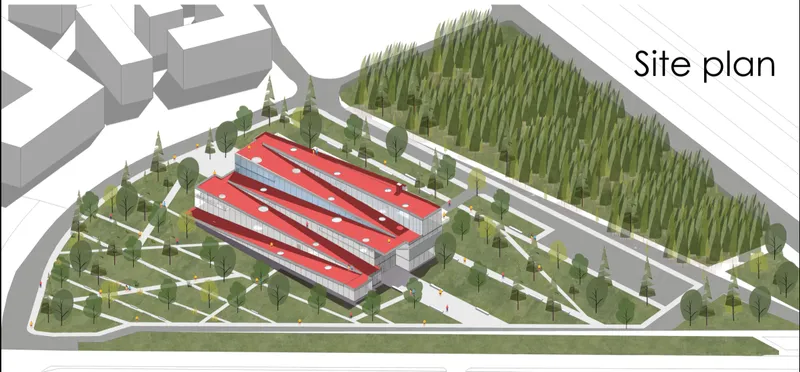
The building reads as a series of sweeping horizontal bands, layered and slightly offset to create a sense of accumulated strata. Long ribbon windows punctuate each level, giving the exterior a quietly monumental presence without resorting to sculptural excess. Scattered trees and walking paths surround the volume, and the site plan axonometric reveals how deliberately the structure is embedded in its context: landscaped routes connect the adjacent forest to the library's entrances, reinforcing the open philosophy at the core of the project.
The choice to keep the massing low and elongated rather than vertical is significant. It avoids the institutional tower typology and instead suggests accessibility. You approach it through a park, not across a plaza. The building does not announce authority; it invites passage.
Five Levels from Book Storage to Rooftop


A cross-section through the building reveals five levels, including a basement, with stepped floor plates that shift in plan from one story to the next. The basement houses book storage, while upper levels progressively open up to accommodate more social and interactive programmes. An exploded axonometric paired with floor plans makes the vertical logic legible: each level serves a distinct mode of learning, from quiet individual study to group experimentation, without ever formalizing these into rigid departments.
The stepped section is more than formal play. By offsetting the floor plates, the design creates double-height zones and visual connections between levels. Interior silhouettes in the section drawing show occupants at different scales and postures: standing, sitting, walking between zones. The building is designed for movement, not stillness.
Spatial Typologies That Replace the Classroom

If there are no teachers, there are no classrooms. Instead, Верещагина proposes a catalog of spatial typologies, each supporting a different mode of engagement. Isometric diagrams illustrate multifunction stairs designed for informal lectures and flexible interaction, glass-enclosed rooms for focused small-group work, solo and group worktables with and without equipment, and bookcase seating that integrates furniture with the collection itself. These are not novelties; they are practical responses to the reality that people learn in fundamentally different ways.
The diagrams work as a kind of pattern language for self-directed education. Rather than prescribing a single learning environment, the project offers a menu of conditions. A user might move from a tiered stair where someone is giving an impromptu talk, to a partitioned room for quiet reading, to a shared table for collaborative prototyping, all within a single visit. The architecture does not teach; it provides the conditions for teaching to happen organically.
A Reading Hall Built for Presence
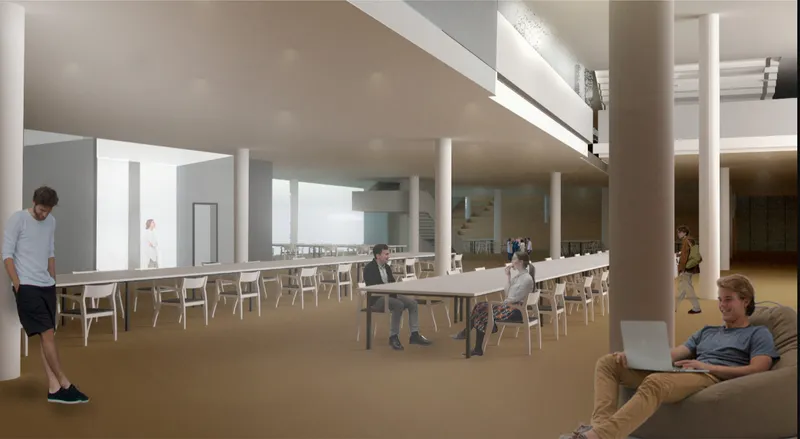
The interior rendering shows a reading hall defined by cylindrical columns, light wood tables, and a deliberately low ceiling that compresses the space into something intimate rather than monumental. Occupants work at individual and shared tables, and the material palette is warm without being decorative. The low ceiling is a calculated move: it brings the scale of the room down to the body and encourages sustained focus rather than awed distraction.
Notably, this is not the hushed, reverent reading room of a 19th-century library. People are seated close together. The tables accommodate both books and electronic devices. The project explicitly positions digital access as a tool for bridging educational gaps and democratizing information, and the physical space reflects that: there is room for a laptop next to a printed volume, and the furniture does not privilege one medium over the other.
Why This Project Matters
The most interesting claim this project makes is not about architecture at all. It is about institutions. By arguing that a library can function as a university without teachers, formal curricula, or hierarchical instruction, Верещагина positions the public library as the last truly inclusive educational space, one where everyone, regardless of gender, nationality, language, religion, or social background, is welcome. That is a political statement embedded in a floor plan.
Architecturally, the project succeeds because it takes that statement and gives it spatial specificity. The layered horizontal volumes, the catalog of learning typologies, the deliberate blending of built and green space: these are not abstract gestures. They are legible design decisions that support a clear programmatic vision. In a competition field often dominated by formal experimentation for its own sake, University Without Teachers stands out for its insistence that the shape of a building should follow the shape of an idea about how people learn.
View the Full Project
About the Designers
Designer: Ольга Верещагина
Enter a Design Competition on uni.xyz
uni.xyz runs architecture and design competitions year-round that reward proposals with spatial conviction and real site intelligence.
Project credits: University Without Teachers by Ольга Верещагина Libgen 2019 (uni.xyz).



Popular Articles
Popular articles from the community


Riyadh For All: Intergenerational Urban Design for Active Aging in Rabat
Riyadh For All reimagines urban design in Rabat with intergenerational co-living, adaptive courtyards, and Moroccan cultural exchange today.

The Earth Pod: 3D Printed Homes for Resilient Refugee Communities
The Earth Pod reimagines refugee housing through 3D printed homes made from clay, combining resilience, self-sufficiency, and rapid shelter.

Conexión: Biophilic Design Reimagines High-Rise Living in Hong Kong
Conexión reimagines high-rise living in Hong Kong through biophilic design, green facades, shared spaces, daylight, water and nature within.

Hill & Cross Opera: Sculptural Opera House Architecture Shaped by Tallinn’s Landscape and Identity
Hill & Cross Opera reimagines opera house architecture in Tallinn through its sculptural hill, civic plaza, glass wave and a luminous cross.


Similar Reads
You might also enjoy these articles

Bao Huynh Watercolor Atelier: A Serene Art Retreat in Hội An
Bao Huynh Watercolor Atelier in Hội An blends multifunctional art spaces, sustainable design, local materials, and family-friendly living in a serene environment.

Atelier Macri Concept Store Interior Design by CASE-REAL
Atelier Macri store features a "ko" counter, walnut wood details, cork displays, blending retail, gallery, and seamless customer experiences.

Manuel Vargas Izquierdo Stadium and High-Performance Sports Center: Architectural Excellence in Jalpa de Méndez
The Manuel Vargas Izquierdo Stadium blends sustainable design, inclusive sports facilities, and cultural-inspired architecture, revitalizing Jalpa de Méndez’s public spaces.

KAKR Buluh Awar Hall: Revitalizing Community and Ecology Through Bamboo Architecture
Community built bamboo hall revitalizes Buluh Awar village, empowering youth, restoring ecology, celebrating vernacular craftsmanship through sustainable architecture and culture.
Explore Learning Spaces Competitions
Discover active competitions in this discipline



Challenge to design locus for the upliftment of human rights


Challenge to design public laboratory


Design challenge to reuse E-waste
Comments (0)
Please login or sign up to add comments
No comments yet. Be the first to comment!