
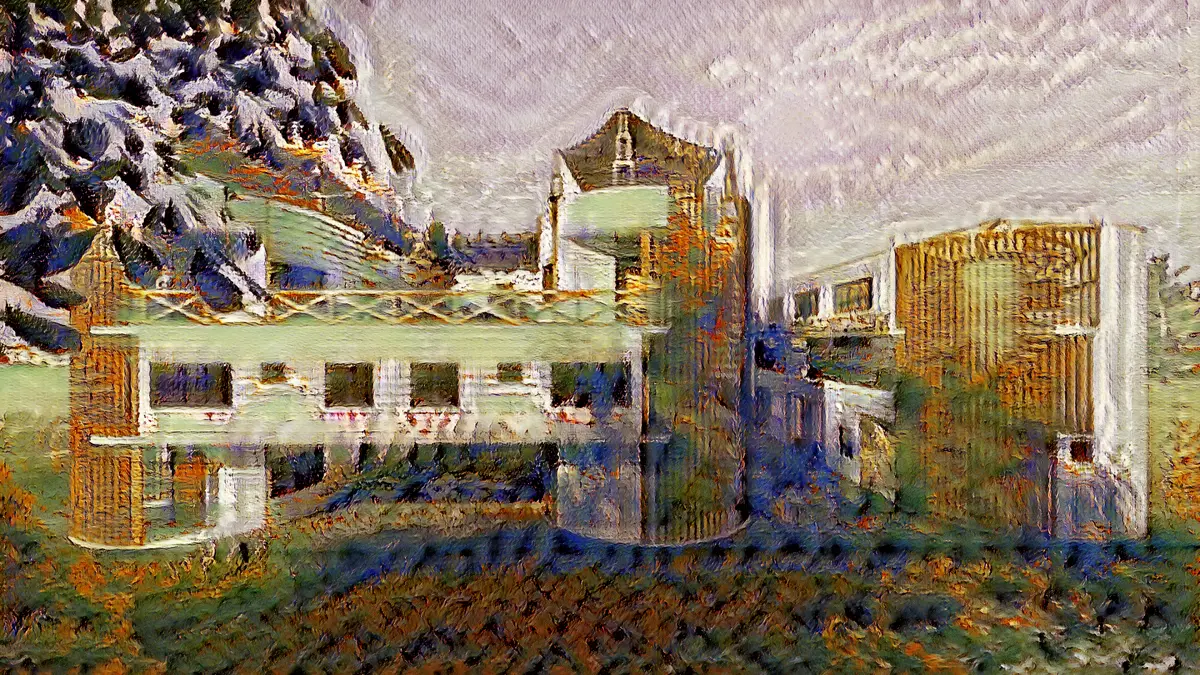
'Unpuzzled' - Lodging Center
A Design Treatise on the future of Grain Bins set in a Lodging Center Complex.

The challenge to design a lodging facility out of grain bins gave me an idea to focus on the replicability of the form. With the challenge predominantly focusing on adaptive reuse, I took it as a challenge to find a future use for the grain bins. The concept of the design is called ‘Unpuzzled’ - it literally ‘unpuzzles’ the question of what to do with grain bins. I came up with a concept that allowed me to focus on creating a solid lodging center design (complete with secondary functions such as recreational spaces) while also focusing on creating ‘Capsule’ modules that can be replicated in a relatively easy manner to show that grain bins have a future in architecture, both as a structure and as a building material. We’re so used to having adaptive reuse applied to old buildings, why not expand the definition to mean that we can use some of those structures as a building material.
I used shipping containers paired with the grain bins because they’re both essentially the same materials, and shipping containers have been used the way I conceptualized the ‘Capsule’ Module. Because the challenge was focusing on adaptive reuse and recycled architecture and the challenge allowed for additions, I thought it would best serve my concept if I added a material to the design that was already used for the idea that I was aiming for. Conceptually, the design works to fruition as evidenced by the spaces that I was able to program into the design.
The Lodging Center is comprised of 10 Living Quarters (inside 10 Capsule Modules), a Gym and Auxiliary Bathroom (located in 1 Capsule Module), a Communal Kitchen, a Supervisor/Super-Intendent’s Quarters, a Theatre Room, an Arcade Room, a Discussion Room, and finally, a Greenhouse (Greenhouse added because of the nature of the Lodging Center). It is mostly made up of recycled materials, i.e., reclaimed wood as the cladding (for both interiors and exteriors), the structural frame (comprised of the Grain Bin and Shipping Container Hybrid), to name a few. Since the site is in a rural part of the United States, I opted to design it in a Mid-Century Modern Style - the said style allows for the use of more simple forms and rustic elements, both of which were needed to create a comforting place for the trainees to stay in. While the Living Quarters may be a bit small, the spaces included meet the requirements of the brief - for example, each trainee will have their own room, a shared bathroom (with an auxiliary bathroom available), a kitchenette, and a living space, all of which have been provided in proportional ratios. The design also features multiple courtyards within the multiple levels of the center. The design also incorporated several recreational facilities should the need arise - social spaces are available as well, chief among them, are the roof decks. The roof decks are something of a focal point in the design - while they do allow for socializing and recreational activities, the deployable canopy concept that I added to those spaces also allows for more ergonomic use of the space. Should the day be hot, the deployable canopy is present to help make the roof deck more usable - the deployable canopy is also made out of recycled materials (apart from the canvas sheet) that helps boost the initial recyclability and replicability concept.
The design is something of an architectural treatise more than anything - it presents a solid foundation of design via the lodging center. It proves that the ‘Capsule’ module can be used to create a decent lodging center with secondary functions (i.e. recreation) while simultaneously showcasing that the ‘Frame’ Module and subsequently ‘Capsule’ Module can be used to make other buildings/structures/complexes. It was designed to create a statement - and that statement is that adaptive reuse should be viewed in two ways: first, adaptive reuse applies to old buildings that need an update, and secondly, adaptive reuse can mean that sometimes those structures can and should be used as building materials. It solidifies the sense that grain bins can fulfill both of these functions (not simultaneously) depending on the use.
Thankfully, the concept of the ‘Capsule’ Module allowed me to fulfill the design requirements of the living quarters with relative ease, the spaces provided are within reason and the relationship and program of said spaces were not compromised due to the lack of space. The design is essentially a proof of concept for me more than anything else - while designing a lodging center out of a grain bin was an exciting challenge, the future potential of this concept is what excites me more - this design, in my opinion, can be made as a template for exploratory mid-rise complexes made out of these materials. It promotes recycled architecture and adaptive reuse while simultaneously proving that a proper design isn’t out of reach when dealing with these kinds of materials and structures (grain bins). Maybe exploring more structures made out of grain bins will help move our architecture forward, just like how shipping containers have helped us create new and better things.

Popular Articles
Popular articles from the community


Opera on the Sea: Driftwood Logic Shapes a Timber Opera House on Estonia's Coast
Trevor Orgill's opera house translates the entangled drift of floating timber into a civic building where wood, water, and music converge.

Manzana Morphosis: Stretching Barcelona's Grid into a Living Landscape for 2050
A radical reworking of the Eixample manzana turns density into a tool for generous public space, vertical ecology, and environmental performance.

Opera by the Sea Estonia: Three Shells Dissolving Architecture into Tallinn's Coastline
A winning opera house proposal replaces monumental form with interconnected shells that blur the boundary between building, park and Baltic Sea.

Temporary Home for Dogs: A Reversed Zoo Rethinks Animal Shelter Architecture
In Bucharest, a sinuous corridor and freed landscape flip the logic of containment, designing a shelter that works to make itself unnecessary.

Similar Reads
You might also enjoy these articles

Shakur's House: Exposed Brick as an Interior Organiser in a 168 m² Mashhad Residence
Brick moves indoors in this Mashhad residence, where masonry walls, glass partitions and teal planes sequence a compact home without closing it off.

Day and Night Park: A Time-Based Urban Newsstand in Beijing
A temporary urban newsstand in Beijing blending travel, light, and reading through poetic colors, compact form, and community-focused design.

Modernist Patio Renovation in El Masnou, Barcelona by Oliver Segura Arquitectura + Cebrià Arquitectura
Modernist patio renovation blending tradition and innovation with a movable pool, leveled floors, and Catalan materials in El Masnou.

Alto Residencial Coop: Cooperative Housing Development in Santiago de Compostela by Carbajo Barrios Arquitectos
A linear cooperative housing complex blending white volumes and perforated metal façades, enhancing community living, natural light, privacy, and urban integration.

Comments (0)
Please login or sign up to add comments
No comments yet. Be the first to comment!