
UpLift
A network of hugs
UpLift
"UpLift" is a word play with a nod at both the high elevation of this rooftop park design and a need for positive experiences in a world of negativity. We would like for this space to become an oasis for anyone in the community to come up to the rooftop, take a walk, chat with a friend, and breathe a little easier.
Research
You say "rooftop" and we immediately imagine ourselves on top of the world, looking over a beautiful cityscape, feeling the cool breeze in our faces. Rooftops are cool.
We started our work on this competition with some precedent research, looking for themes and elements to borrow or maybe just spark our imagination.
Our international team also needed some familiarization with the Irish climate. Thankfully, we've all travelled and lived abroad and are well-versed in climate-responsive design.
A lot of the precedent research showed rooftop places that were open to the elements, typically in geographically warmer locations. Early on, we realized that this approach would not work in Belfast, especially if we wanted to maximize the community uses in all seasons.
What might work, though, is taking advantage of the greenhouse effect on a small scale - essentially, creating a glazed enclosure that could collect solar heat during the colder months. During the summer, the glazing could be opened for ventilation.
Ideation
Our initial design was born as a response to the program, calling for a multi-use public space and a café, supplemented by rooftop landscaping. The parti evolved around the idea of an embrace of the core public space by more peripheral, semi-private uses. As the idea took shape, it became a winding loop hugging the center “stage.”
As we continued sketching and “sculpting” the design in 3D, the war in Ukraine begun. Our whole team was affected by these events and weeks passed in paralyzed shock. We took a lot of walks in solitude as we pondered our places in this new world order.
We returned to the rooftop design with a sadness and quiet contemplation of the world. Our somber walks inspired the elevated slow ramp that rises above the busy common area below and offers room for uneasy feelings and difficult conversations.
Program
Our approach in developing the program has been both introspective (what would we want in a space like this?) and democratic (how do we make it useful to everyone?). These two questions enabled us to squeeze a wide variety of uses into this small, overlooked rooftop:
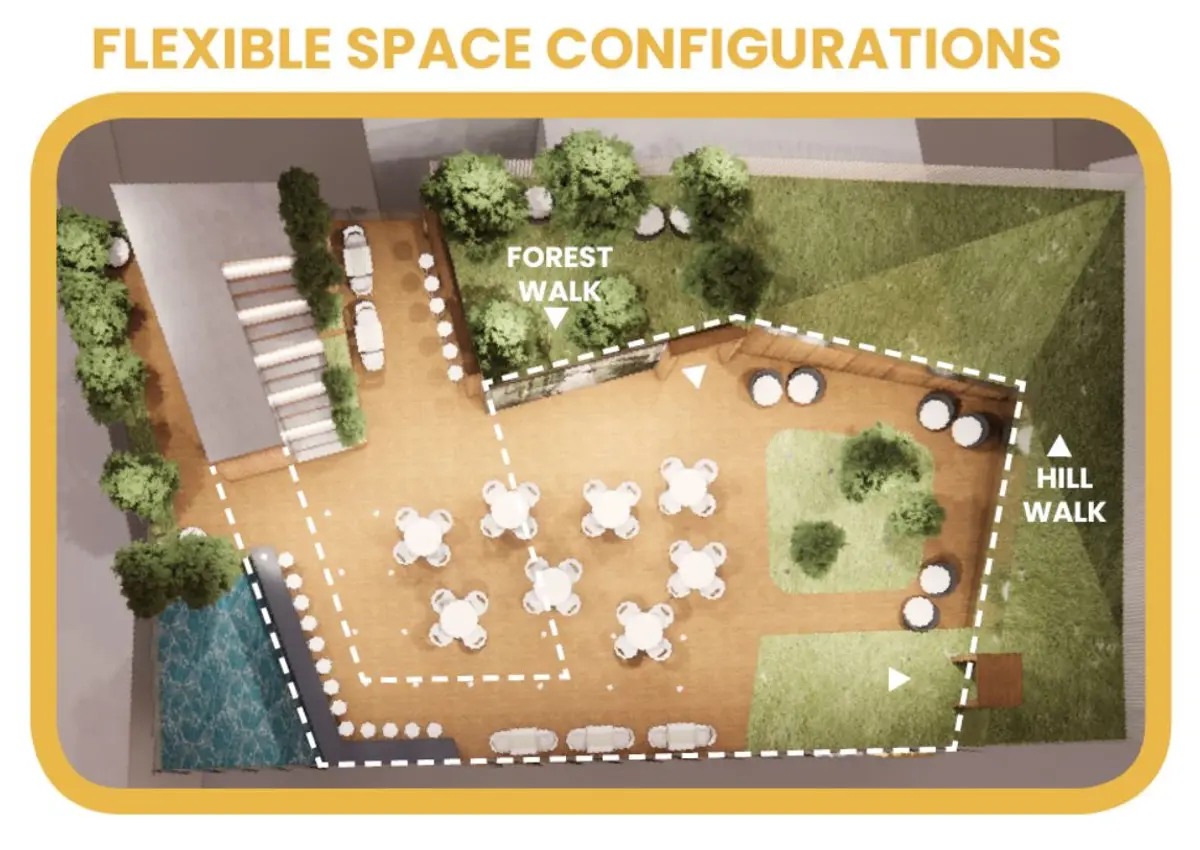
1. Multi-functional common space that can be used for movie screenings, concerts, weddings, birthdays and networking events.
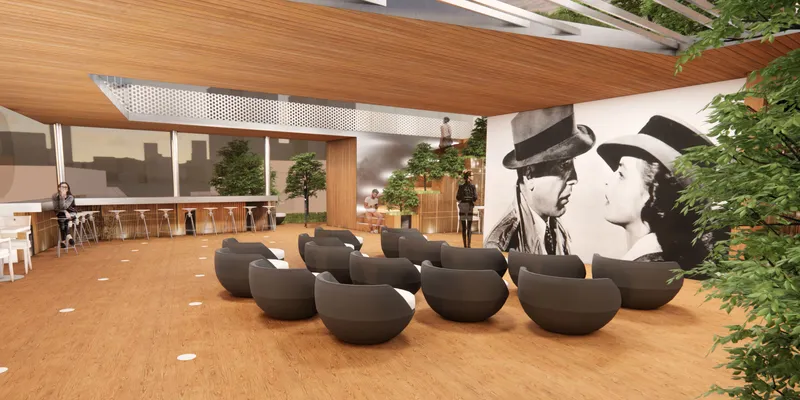
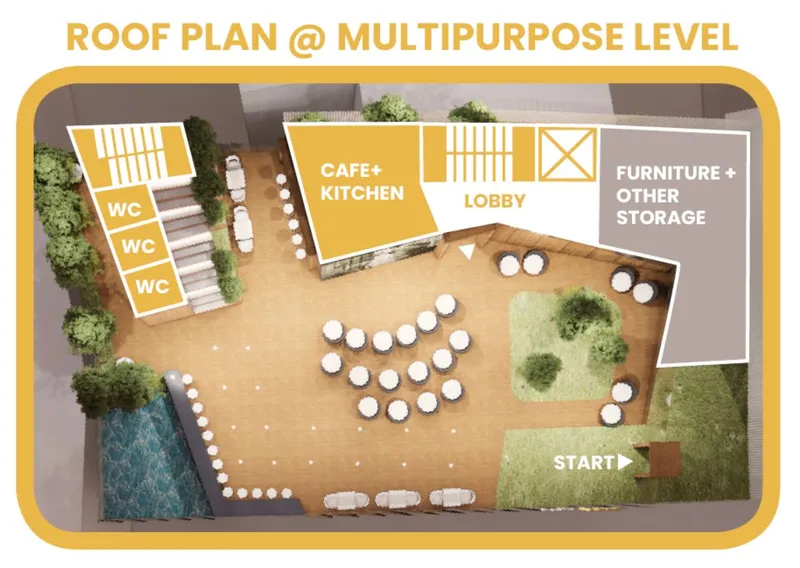
2. Café, which can become a destination – imagine saying to your friend, “Meet me at UpLift for lunch!” and enjoy the city views together, while chatting about life and pursuit of happiness.

3. Restrooms, which are tucked away for privacy and feature inclusive layout and a waiting area.
4. The Walk – a climbing, winding, elevated walkway, visible immediately after you exit the elevator to the rooftop and beckoning you to take a slow walk and ponder the world.
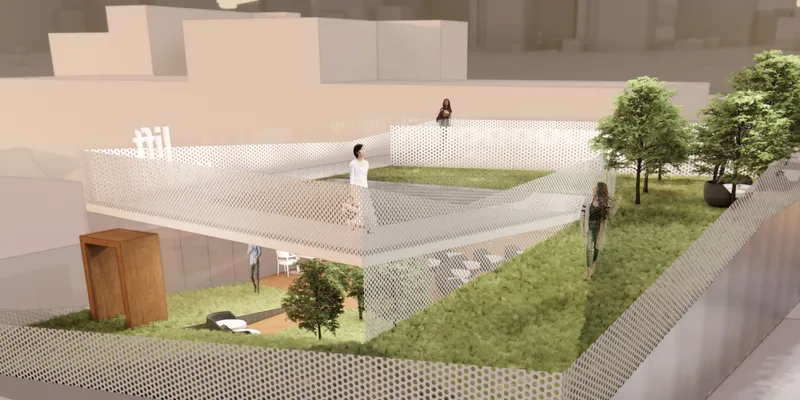
5. Multiple landscaped “hills”, which use lightweight turf and locally sourced plants.

6. A rainwater collection pond, with a re-circulating system, allowing the water to be used for the restroom needs and landscape irrigation in dry weather.
7. Storage rooms under the “hills”, a necessary support element for the common space. These will store chairs, portable stage and other equipment that will be used to turn a dancefloor into a banquet hall or lecture room.
Thanks to the presence of the elevator in the building, UpLift can be accessed by anyone, from young parents with strollers, to wheelchair users. Once on the rooftop, all areas are accessible, including The Walk.
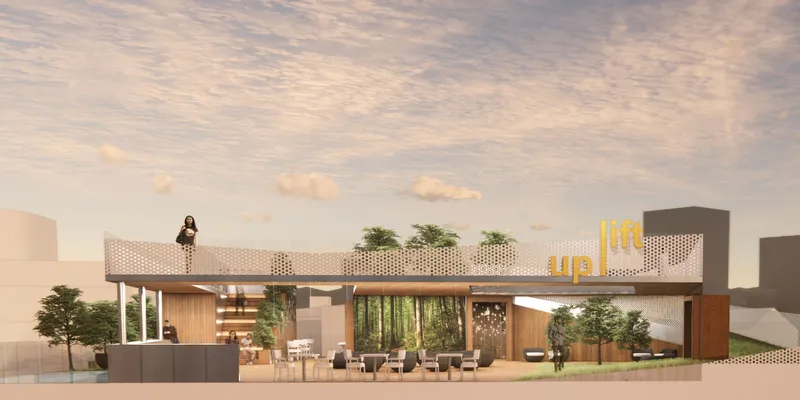
We envision the space to play different roles at different times of the day. For example, in the morning, adults can meet up for coffee, while watching their children run up and down The Walk or play in the central common area set up with bean bags. During the day, it could be booked for a private business event and host a small international design awards ceremony. At sunset, it could become the romantic destination, with a special table right on the edge of the building, and a couple celebrating their love while toasting the lit-up city of Belfast that brought them together.
Sustainability
We believe that sustainability should be an integral part of every project, not just a cutting edge thought experiment. Our design process includes the considerations of climate and sustainability at every stage. Some of the features mentioned above (greenhouse, rainwater collection, landscaping choices) came to life as a direct result of this design process. They are meant to reduce waste of resources and promote energy conservation by way of climate-responsive design. Our choice of materials also strongly favors renewable and recyclable ones, such as wood and aluminum metal panels.

In reviewing the site, we were struck by the glaring absence of trees. Trees are the lungs of the city, and we need to help it breathe. Native Irish trees of the appropriate size will populate the UpLift planters and grow with time.
Modularity
Imagine walking down a continuous walkway, which leaps from roof to roof and winds through the city. Because of its flexible geometry, UpLift can adapt to virtually any site. We envision the organic growth of parks like these, connected by skybridges and spilling over to adjacent vacant rooftops. As more and more areas of the city invest in their own rooftop park, UpLift will become a network of rooftop urban parks, connecting friends and neighbors, and adding much-needed greenery to the city landscape.
Imagine a network of walkways, trees, and small public spaces embraced by the meandering paths. A network of hugs and connections, making the world just a little bit better one park at a time. This is UpLift.

Popular Articles
Popular articles from the community


Co-Life: Senior Housing Design That Reconnects Older Adults With the City
Co-Life reimagines senior housing design through healing gardens, shared streets, workshops, and a sustainable community across generations.

The Ocean Hive: Sustainable Architecture for a Self-Sufficient Civilization at Sea
The Ocean Hive imagines sustainable architecture at sea, where modular habitats, algae, wave power and ocean waste sustain a growing colony.

Lunar Spiral: Space Architecture Shaped by the Mathematics of the Universe
Lunar Spiral reimagines space architecture through Fibonacci geometry, lunar regolith, levitating habitats, and self-sustaining Moon living.

ALGAL REALM: A Bio-Integrated Lunar Habitat Design for Life Beyond Earth
ALGAL REALM reimagines lunar habitat design with algae-powered life support, 3D-printed regolith, and vertical living for a lunar future.

Similar Reads
You might also enjoy these articles

Day and Night Park: A Time-Based Urban Newsstand in Beijing
A temporary urban newsstand in Beijing blending travel, light, and reading through poetic colors, compact form, and community-focused design.

Modernist Patio Renovation in El Masnou, Barcelona by Oliver Segura Arquitectura + Cebrià Arquitectura
Modernist patio renovation blending tradition and innovation with a movable pool, leveled floors, and Catalan materials in El Masnou.
Alto Residencial Coop: Cooperative Housing Development in Santiago de Compostela by Carbajo Barrios Arquitectos
A linear cooperative housing complex blending white volumes and perforated metal façades, enhancing community living, natural light, privacy, and urban integration.
Vil Genis School by BPA ARCHITECTURE – Massy, France
Vil Genis School in Massy, France, features sustainable design, south-facing classrooms, community integration, accessible spaces, and modern educational architecture.

Explore Urban Park Competitions
Discover active competitions in this discipline


Challenge to reimagine the Iron Throne

Photograph architecture without architects

Illustrate the lost glory of Angkor Wat - Render Challenge

Design challenge to reuse E-waste
Comments (0)
Please login or sign up to add comments
No comments yet. Be the first to comment!