
InsideOut Dissolves the Walls of a Harajuku Basement to Build Mihara Yasuhiro's URA Store
A 47-square-metre concept shop in Tokyo uses mirrored steel, Komatsu stone, and 10mm glass to erase the line between street and store.

Semi-basements in Harajuku are among the least forgiving retail footprints in Tokyo: low ceilings, narrow widths, no street frontage worth mentioning. For the URA Store, the concept shop of fashion designer Mihara Yasuhiro, InsideOut took all of those constraints and turned them into the project's central proposition. Rather than designing a fashion shop, the firm set out to construct a landscape, one where reflections, stone, gravel, and glass conspire to make 47 square metres feel borderless.
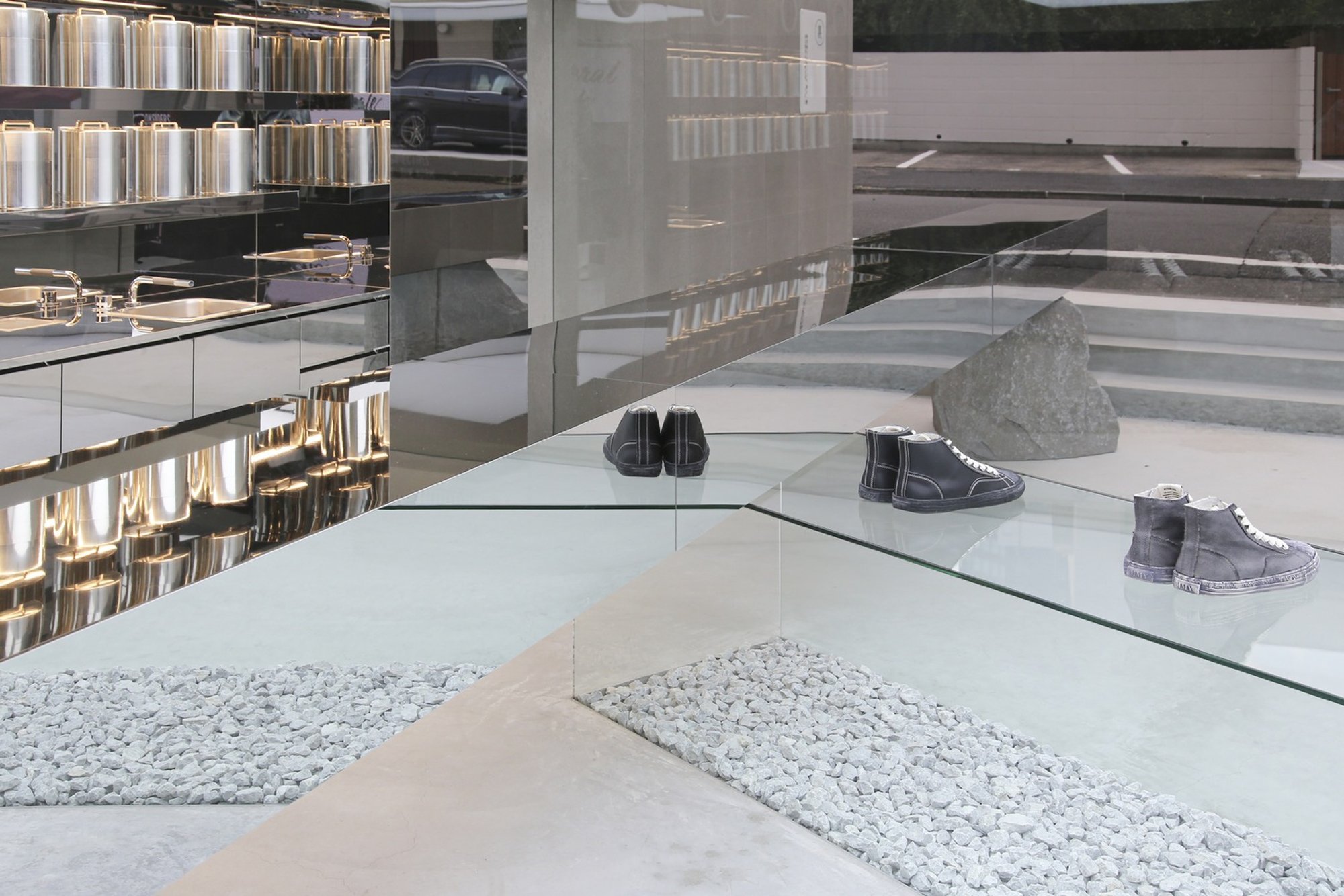
The name "URA" translates loosely as "reverse" or "behind," and the store occupies exactly that kind of position: tucked at the back of a late-1960s office building on a quiet Jingumae back street. What makes the project worth studying is not its size but its obsessive detailing. Every joint, every material transition, and every lighting decision is calibrated to weaken the boundary between inside and outside. Mirrored stainless steel display tables physically penetrate the glass envelope, their surfaces anchored to blocks of Komatsu stone quarried from the Manazuru Peninsula in Kanagawa Prefecture. The result is a space that reads less as a room and more as a continuous field of surfaces.
Glass as Membrane, Not Barrier
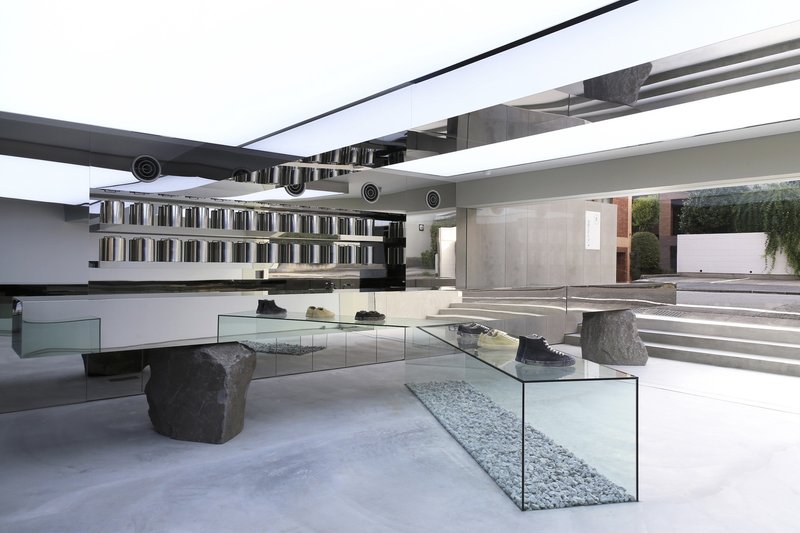
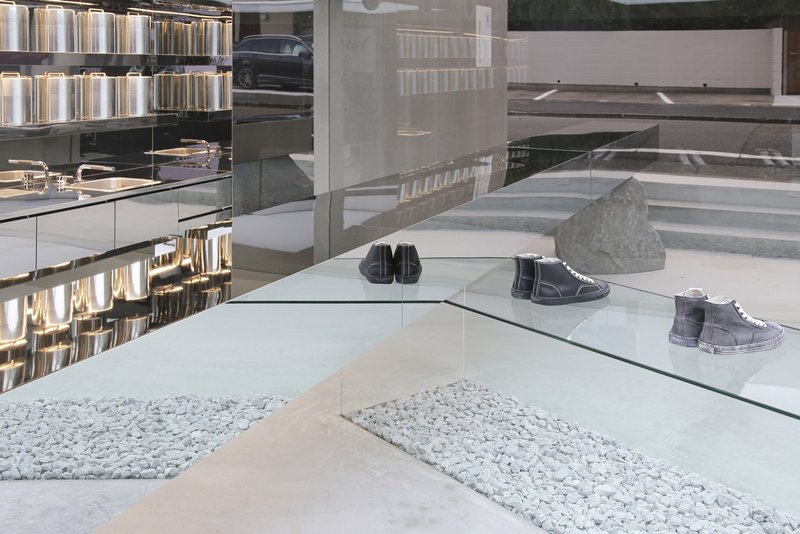
The 10mm glass panels that define the storefront are detailed with concealed frames, a deliberate move to erase the visual evidence of enclosure. From inside, the glass reads as open air; from outside, the interior merges with the street. InsideOut pushed this further by running the mirrored display tables through the glass wall so that the same object occupies both the outdoor terrace and the selling floor simultaneously. The vertical load of each table rests on the stone block at one end and a steel structure on the other, not on the glass box below it, keeping the pane free of structural responsibility and maintaining its visual thinness.
Counters are fixed with adhesive rather than bolts, because drilling into the glass was out of the question. Invisible rotational hardware was installed during construction so that the angle of each stone element could be fine-tuned on site. These are the kinds of decisions that separate a polished render from a built reality.
Mirrored Steel and the Illusion of Depth
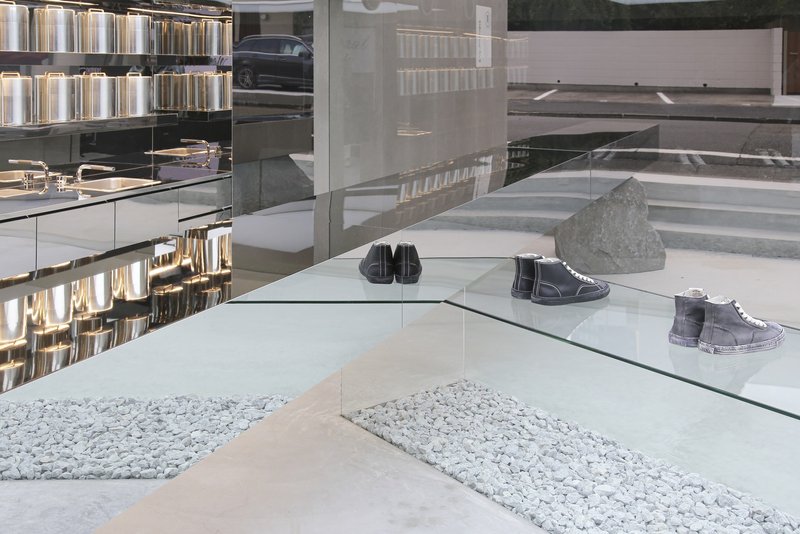
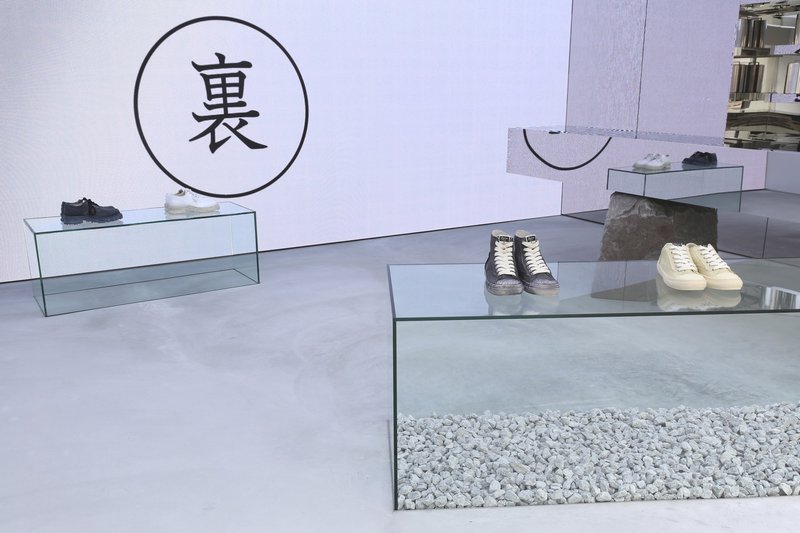
Low ceilings and narrow floor plates can suffocate a retail space. InsideOut's response was to amplify depth through reflection. The mirrored stainless steel rectangles that serve as display surfaces double every sightline, folding the room back on itself and pulling the exterior streetscape into the interior. Full-length LED monitors along the back wall add another layer of visual extension, projecting imagery that shifts the spatial perception of the store throughout the day.
The light-membrane ceiling system was designed specifically for this problem. In a room filled with highly reflective materials, conventional downlights would produce unbearable glare. Instead, the ceiling allows color temperature and illumination intensity to be adjusted, keeping the light diffuse and even. Footwear and garments sit atop the mirrored tables as isolated objects, what InsideOut calls "dots" against a dynamic field of lines and surfaces. The products do not compete with the architecture; they exist within it.
Stone and Gravel as Interior Landscape
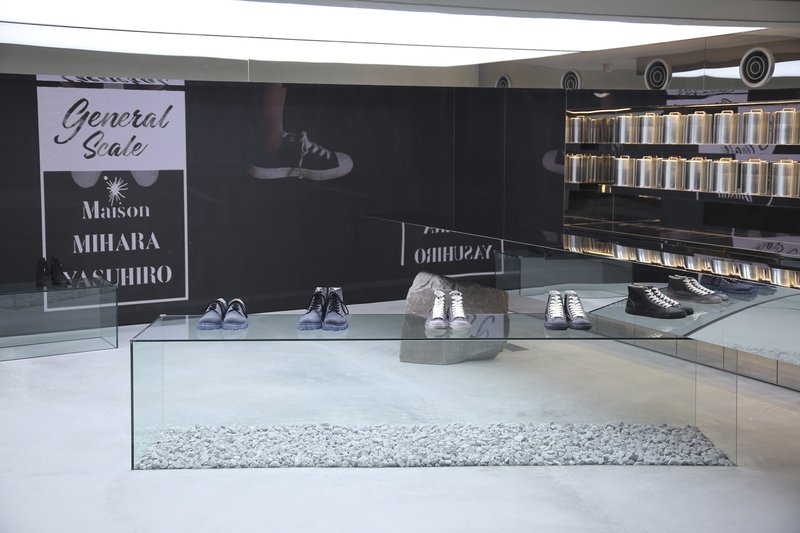
Komatsu stone, sourced from the Manazuru Peninsula, gives the project a material weight that counterbalances all the transparency and reflection. The stone blocks anchor the mirrored display tables both structurally and visually, grounding the composition and introducing a geological texture into an otherwise pristine interior. Beneath the glass display boxes, beds of white Sawa-ishi gravel evoke the raked stone gardens of Japanese temple complexes. The gravel is not decorative filler; it reinforces the idea that this is a landscape, not a showroom.
The choice to use regional materials carries quiet significance. Kanagawa stone, quarried less than 100 kilometres from the site, ties the project to a specific geography even as its mirrored surfaces try to dissolve every spatial boundary. It is a productive tension: the store is both rooted and weightless at the same time.
Retail as Installation
URA Store does not follow the conventions of retail merchandising. There are no wall-mounted racks, no mannequins, no visual hierarchy directing you toward a cash register. The program is compressed into a glass box, a counter, a back counter, a terrace LED screen, and a stock room. Products are placed sparingly on the mirrored tables, and the circular wall graphic and black signage wall operate more like gallery elements than point-of-sale displays.
This aligns with Mihara Yasuhiro's approach to fashion, which has always leaned into contrast and provocation. The architecture does not frame the clothing; it frames the act of looking. You walk into URA Store and your first instinct is to figure out where the room ends, not what is for sale. That disorientation is the point.
Plans and Drawings
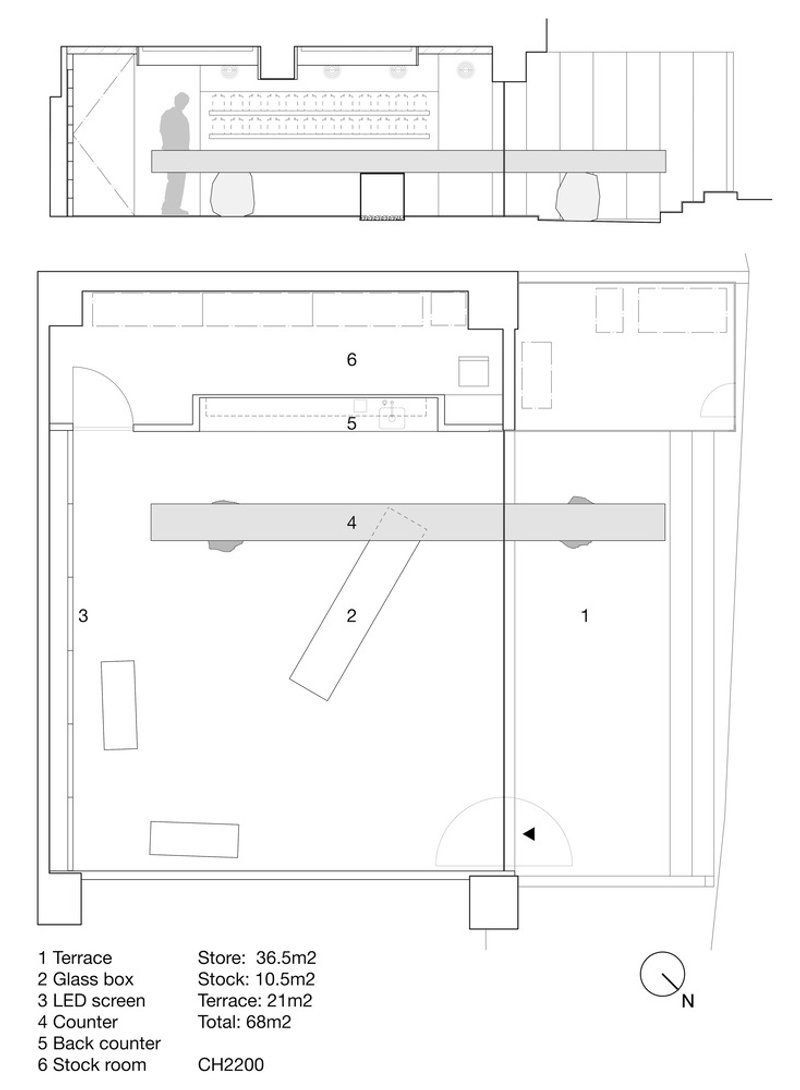
The floor plan and section reveal just how compact the program is. At 47 square metres, every zone is tightly choreographed: the glass display boxes occupy the center of the plan, the counter and back counter line the perimeter, and the stock room is pushed to the rear. The section drawing shows the semi-basement condition clearly, with wide concrete steps leading down from the street to the selling floor. That descent is part of the experience, a gradual transition from the city into an entirely different spatial register.
Why This Project Matters
Retail architecture has a tendency to treat small spaces as problems to be overcome with clever storage and bright lighting. InsideOut treats this small space as an argument. The argument is that boundaries, between inside and outside, between architecture and landscape, between store and street, are choices, not givens. By engineering every joint and surface to dissolve those boundaries, the firm produces a 47-square-metre room that feels genuinely unbounded.
The project also demonstrates that material precision can substitute for square footage. The adhesive-fixed counters, the concealed glass frames, the site-adjustable stone hardware: none of these details are visible to the casual visitor, but their cumulative effect is what makes the space feel effortless. URA Store is a reminder that the most powerful retail environments are not the largest ones; they are the ones where every decision has been made on purpose.
URA Store by InsideOut. Located in Shibuya City, Tokyo, Japan. 47 square metres. Completed in 2023. Photography by Hiroto Kubo.
About the Studio
Share Your Own Work on uni.xyz
If projects like this are the kind of work you want to make, uni.xyz is a place to publish your own, find collaborators, and enter design competitions.




Popular Articles
Popular articles from the community

Bernardes Arquitetura Stretches a Timber Roof Along a Reservoir's Edge in Minas Gerais
Dam House in Itaúna lets a sweeping wooden canopy dissolve the boundary between hillside terrain and open water.
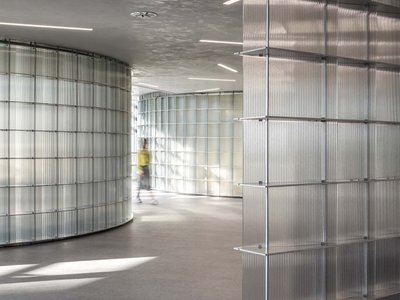
HCCH Studio Wraps a Shanghai High-Rise Office in Curved Walls of Translucent Glass
A 1,000 square meter fit-out in Lujiazui replaces the typical tech-office palette with layered glass, micro-cement, and quiet rigor.

20 Most Popular Office Building Projects of 2025
From biophilic workspaces in India to net-positive energy offices in New Delhi, 20 office building projects that defined architecture in 2025.
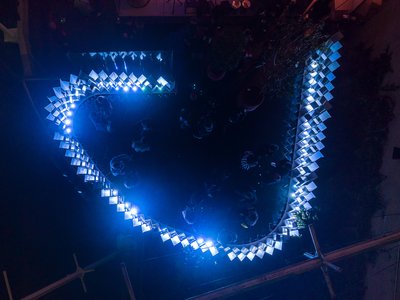
Rojkind Arquitectos and Think Parametric Build a Glueless Pavilion from 67 Interlocking Panels
A serpentine fiber-cement installation in Chapultepec Park celebrates a decade of architectural media in Mexico City.
Similar Reads
You might also enjoy these articles
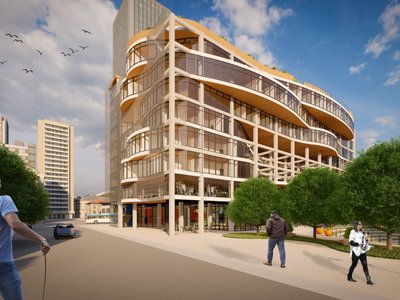
Olio Towers: A Mid-Rise for Performers That Fuses Housing, Rehearsal, and Stage
Located blocks from Houston's Theater District, this modular tower stacks living units around a central performance atrium.
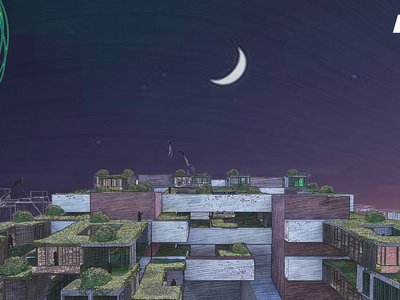
Oasis: Modular Green Housing Carved into Dhaka's Urban Fabric
A shortlisted Plugin Housing entry reclaims unauthorized settlements in Dhaka with stepped concrete volumes, green roofs, and ventilation-driven design.

Black Hole: A Floating Megastructure for the Post-Physical Era
Emiliano Mazzarotto envisions a spherical, self-scaling arena where e-sports, digital hotels, and holographic stadiums replace traditional public space.
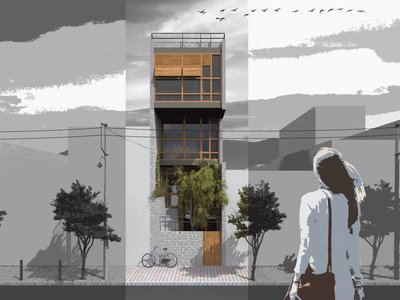
Compact & Sustainable Living in Piraeus: A Four-Level Family Home Built Around Light and Air
A narrow townhouse in one of Greece's densest port cities uses a central atrium and passive strategies to house three generations under one roof.


Explore Architecture Competitions
Discover active competitions in this discipline




The International Standard for Design Portfolios


The Global Benchmark for Architecture Dissertation Awards


The Global Benchmark for Graduation Excellence


Challenge to reimagine the Iron Throne
Comments (0)
Please login or sign up to add comments
No comments yet. Be the first to comment!