
Beatriz Arroyo and Lys Villalba Turn a Madrid Apartment into a Cabinet of Color and Craft
A 1970s flat in Madrid becomes a testing ground where furniture logic, bold color, and architecture collapse into one proposition.


There is a long tradition of architects treating the domestic interior as a miniature city, a place where walls become facades and cupboards become buildings. Beatriz Arroyo and Lys Villalba take that idea literally in their Urban Cabinets series, beginning with this apartment in Madrid. The premise is direct: rather than renovating a flat and then furnishing it, they designed the furniture and the architecture as a single integrated system. Wardrobes frame doorways. A kitchen wall doubles as a storage cabinet rendered in saturated yellow. The boundary between object and room dissolves.
What makes the project genuinely interesting, beyond its palette, is the discipline with which a small set of materials and colors is deployed to give each room a distinct identity without fragmenting the apartment. Yellow belongs to the kitchen and bathroom. Pale blue belongs to the study and the children's room. Terrazzo, timber, and concrete appear everywhere as connective tissue. The result feels neither neutral nor chaotic. It feels authored, in the way a well-edited book feels authored: every detail serves the argument.
The Kitchen as Yellow Cabinet
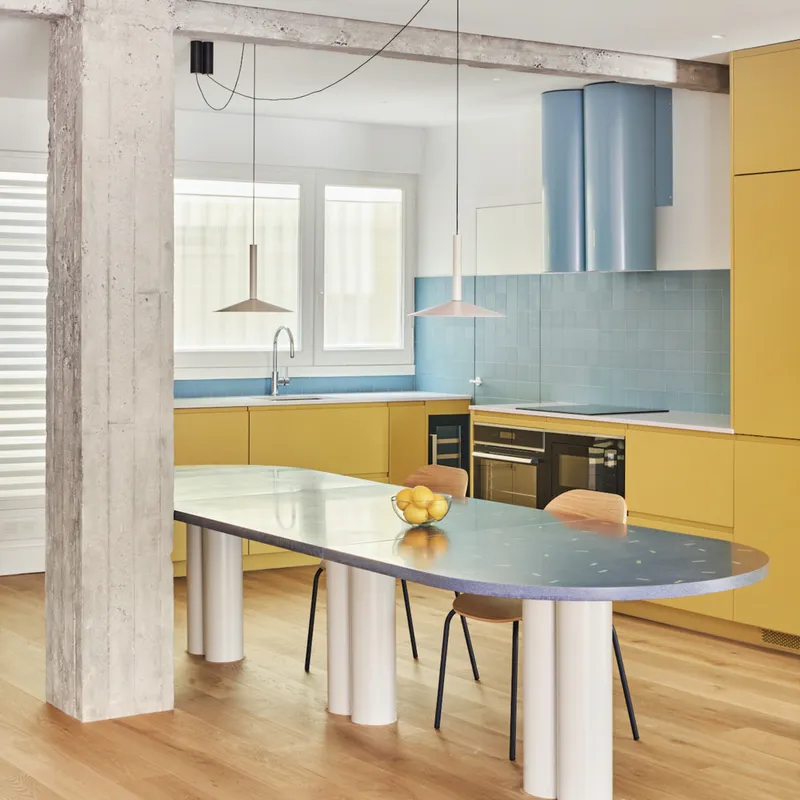
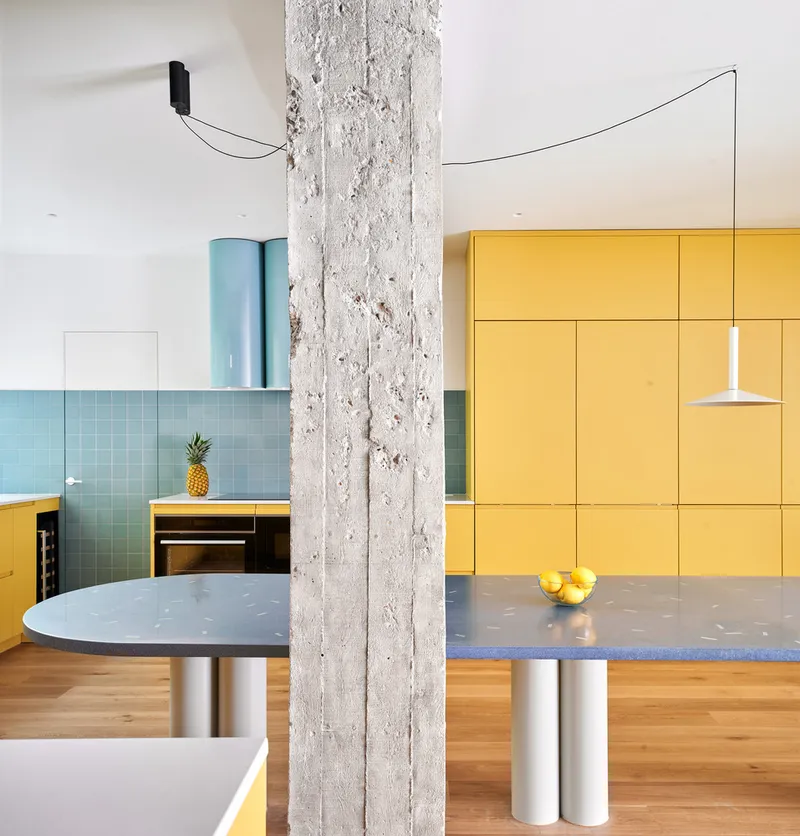
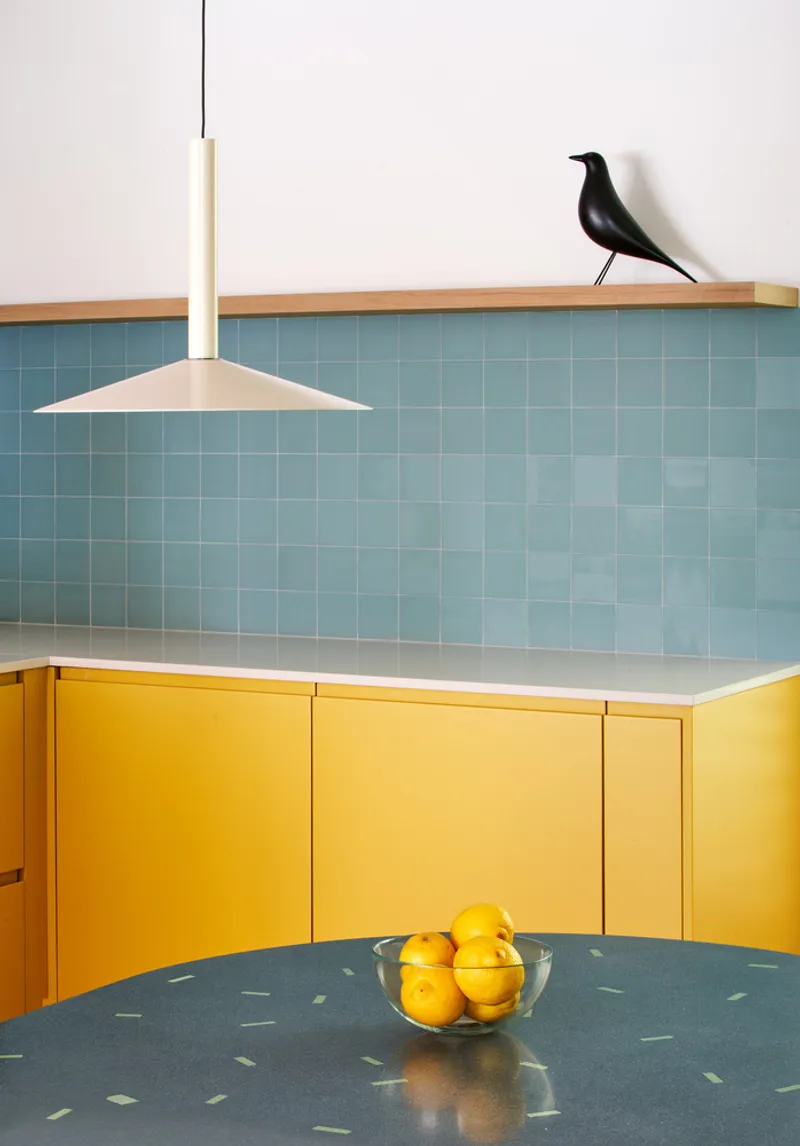
The kitchen is the most assertive room in the apartment, and the one that best illustrates the "urban cabinet" thesis. A full wall of yellow cabinetry runs floor to ceiling, its lacquered surface reading less like millwork and more like a piece of freestanding furniture that has been grafted onto the architecture. Against it, a blue terrazzo countertop introduces a cooler counterpoint, while a backsplash of small-format blue tiles adds texture at a finer grain.
The exposed concrete beam and column are left deliberately raw, a structural frankness that prevents the saturated colors from tipping into sweetness. A pendant light drops down over the oval dining table on twin cylindrical legs, reinforcing the sense that every object in the room was conceived alongside the room itself. Nothing was selected from a catalog; everything was negotiated.
A Wardrobe That Becomes a Wall
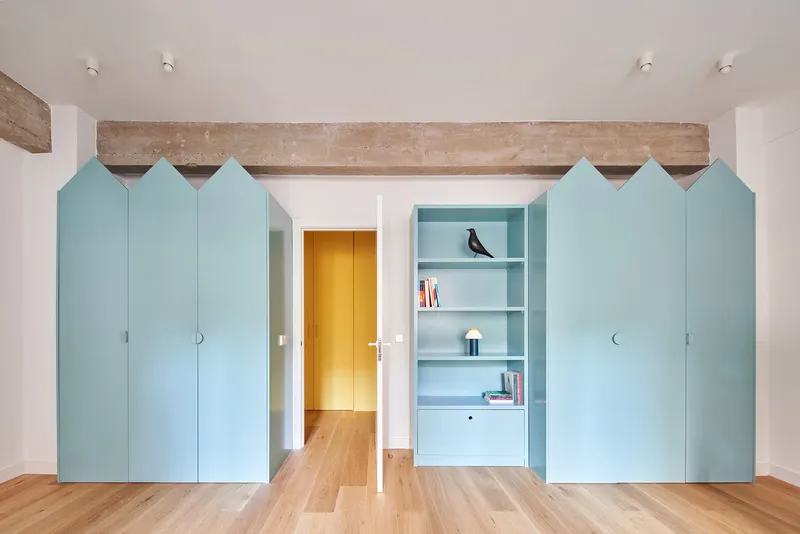
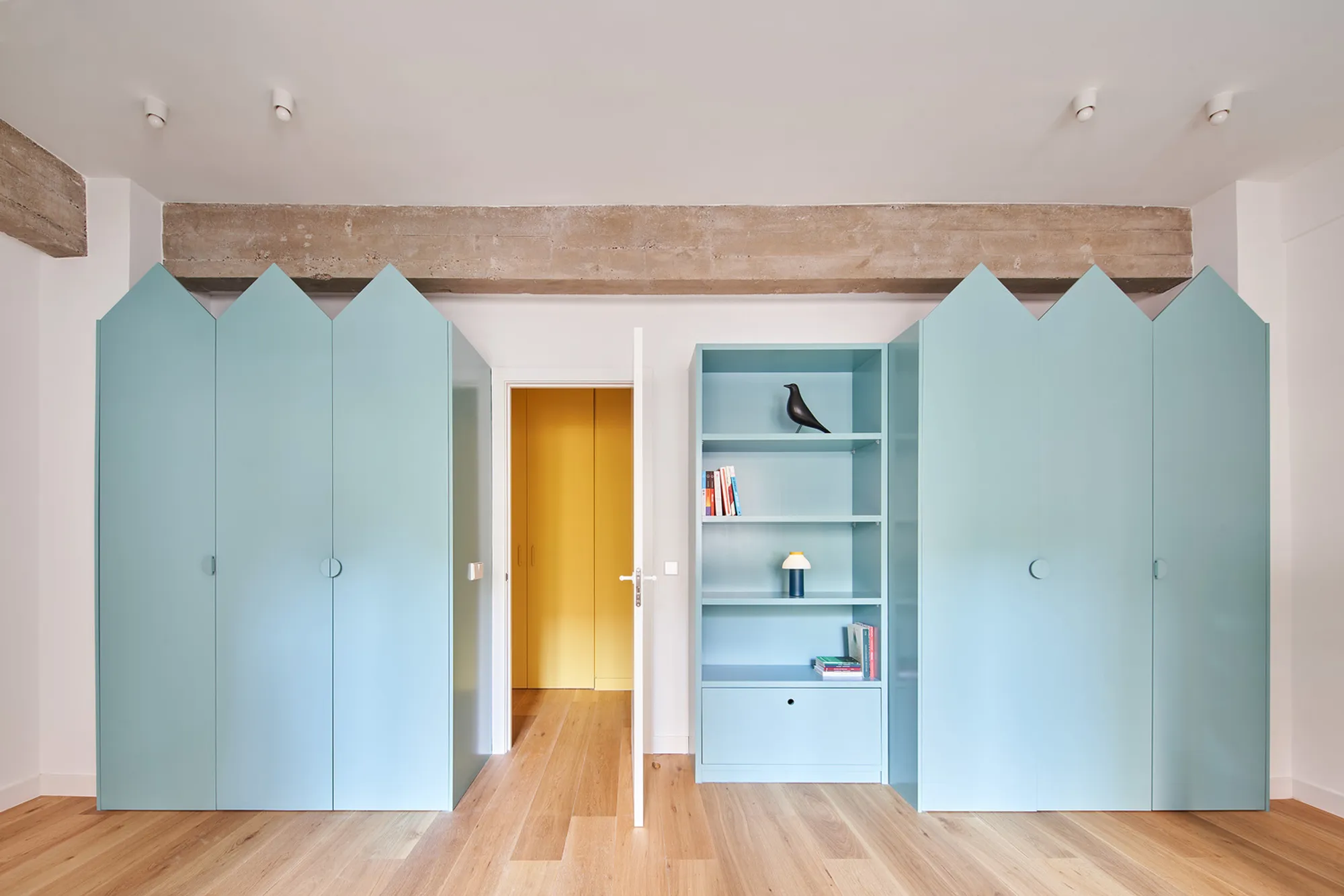
The children's room is where the concept lands most poetically. Two pale blue wardrobe panels, shaped like abstracted house silhouettes, flank a central doorway and meet an exposed timber beam overhead. The effect is architectural in scale but playful in character: the wardrobes are not hidden, not flush, not minimized. They announce themselves as the primary gesture of the room.
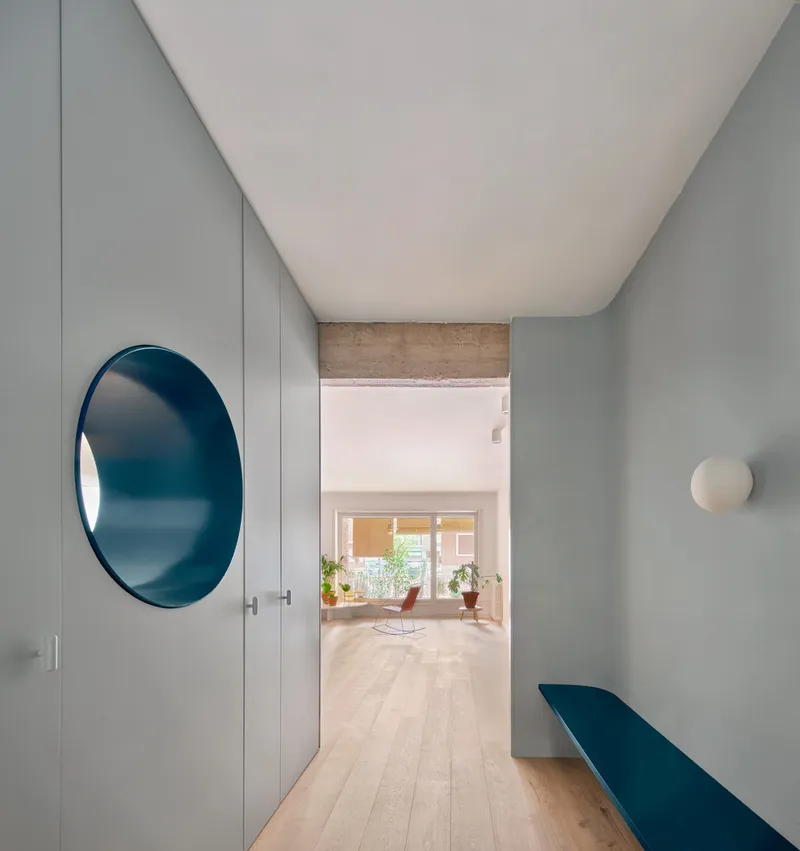
Moving through the hallway toward this room, the apartment reveals its sequencing. Pale wood flooring, grey walls, and a circular blue mirror establish a restrained corridor that heightens the impact of the colored rooms at either end. The architects understand that restraint in circulation amplifies intensity in destination.
The Study Nook and the Logic of Blue
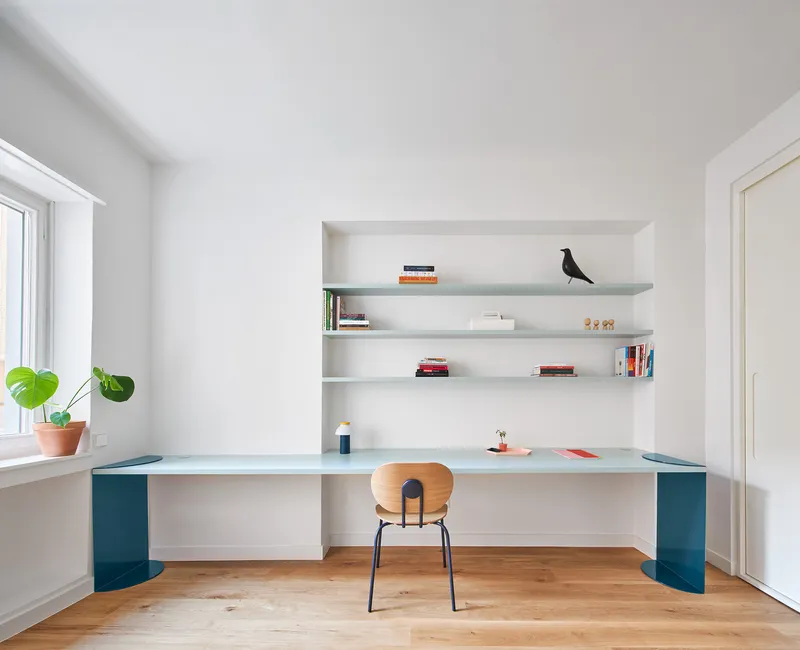
A built-in desk and shelving unit in light blue creates a compact study nook near a window, where potted plants on the sill bring a living edge to the composition. The blue here is quieter than in the kitchen, applied to cabinetry that wraps the corner and integrates storage, work surface, and display into a single element. It is the kind of detail that could easily be generic but instead carries the signature of the larger project.
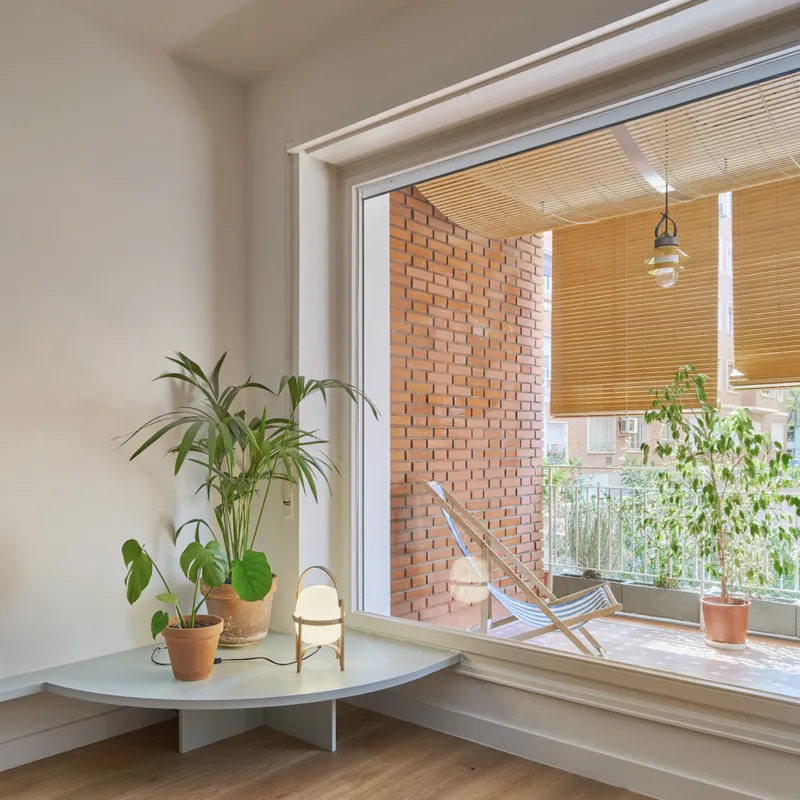
Adjacent to the study, an interior window alcove opens onto a balcony defined by a perforated brick wall and a slatted timber ceiling. The balcony operates as a threshold between the controlled interior palette and the looser materiality of the city outside. Plants colonize the ledge, softening the transition.
Material Details: Terrazzo, Tile, and Cane
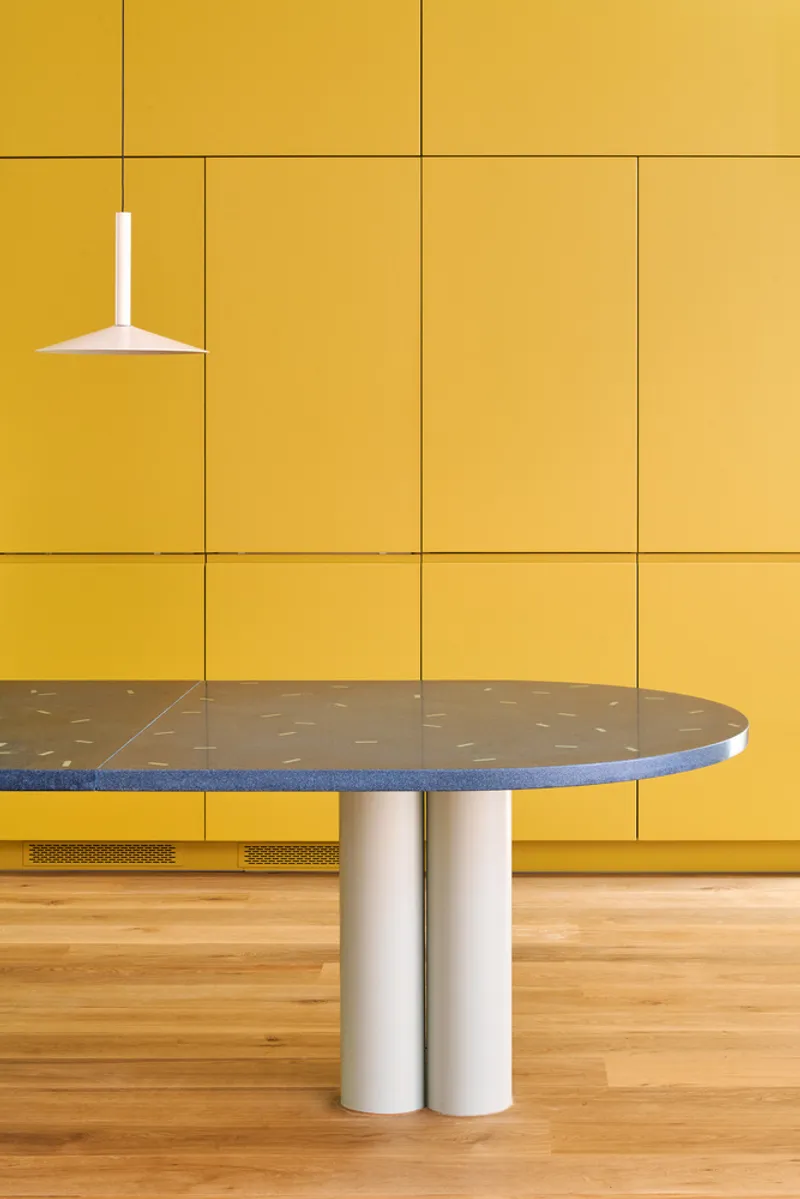
Two moments in the apartment reveal the care taken at the scale of the detail. A round terrazzo table with twin cylindrical white legs sits against a yellow tile wall, its speckled surface rhyming with the kitchen countertop several rooms away. The repetition is deliberate: terrazzo becomes a material thread that stitches the apartment together across its color zones.
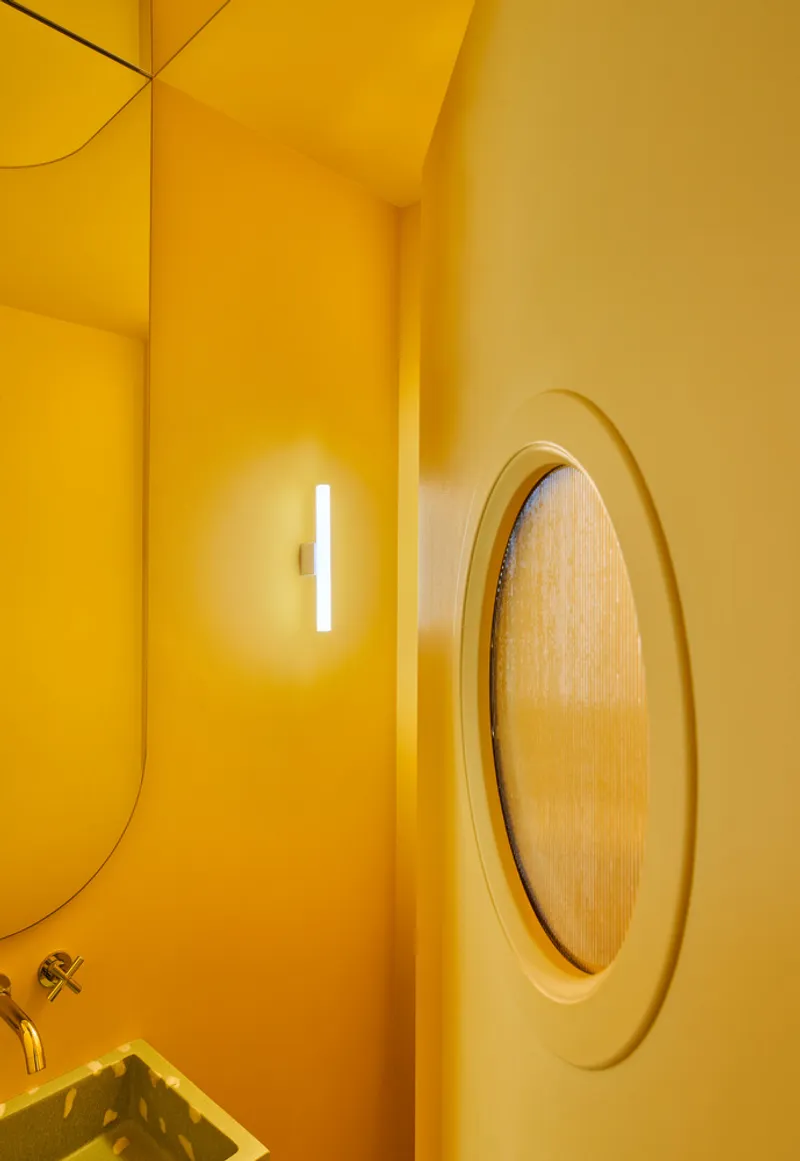
In the bathroom, the yellow palette returns, now applied to walls and paired with an oval mirror featuring a cane insert. A vertical luminaire descends beneath a curved ceiling, a small formal move that gives the room spatial generosity despite its modest size. The cane, a craft material, introduces a warmth that the lacquered surfaces alone could not provide. It is a reminder that the project's ambition is not just chromatic but tactile.
Plans and Drawings
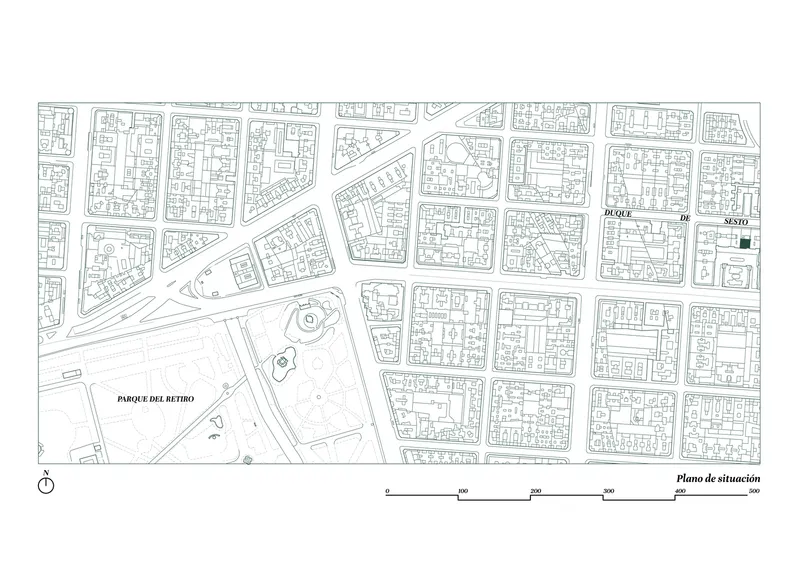
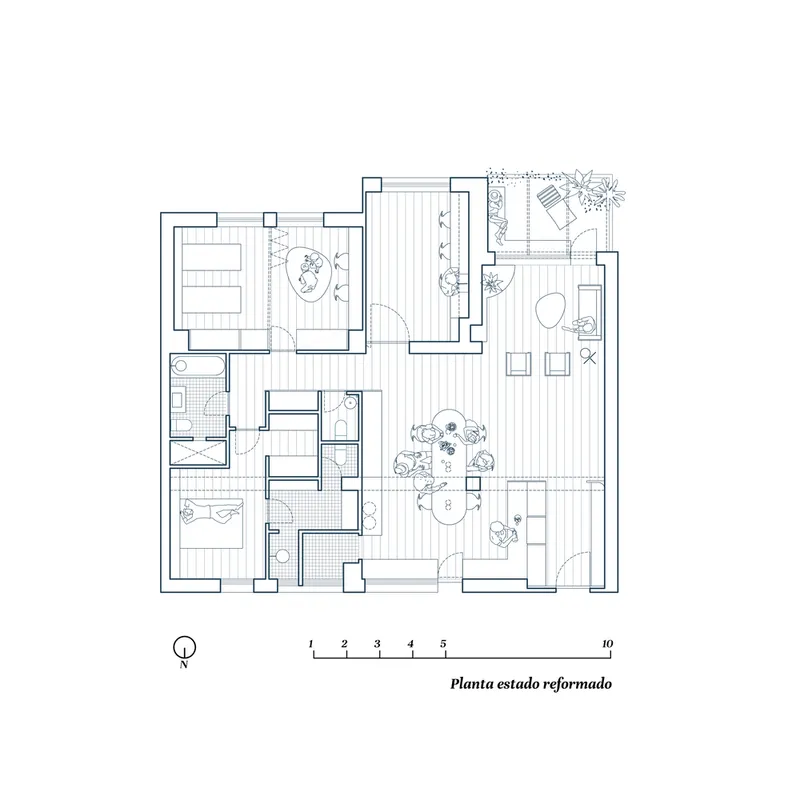
The site plan locates the apartment within a typical Madrid urban block, bordered by streets on three sides and a park to the west. The floor plan reveals a compact layout organized around a central corridor with bedrooms to one side, a kitchen and living area to the other, and a balcony with planted areas along the exterior edge. The plan is conventional in its bones, which is precisely the point: the Urban Cabinets strategy does not require structural heroics. It works within the given envelope, using furniture-scale interventions to transform the character of ordinary rooms.
Why This Project Matters
Apartment renovation is one of the most common commissions an architect can receive, and one of the easiest to phone in. Most renovations either retreat into safe neutrality or overcompensate with surface decoration that has no relationship to the plan. Arroyo and Villalba avoid both traps by treating furniture and architecture as a single design problem. The yellow wall is not a color choice; it is a storage strategy. The blue wardrobe is not decor; it is a spatial divider. Every visible element does structural or functional work.
As the first installment of a declared series, the project also raises a productive question: can this method scale? Can the idea of the "urban cabinet," a piece of furniture that rewrites the room it inhabits, be adapted to other apartments, other cities, other programs? If the answer is yes, then Arroyo and Villalba have identified something genuinely useful, not just a style but a transferable design protocol for upgrading inherited domestic space.
Urban Cabinets Series (1) by Beatriz Arroyo and Lys Villalba. Madrid, Spain. Photography by José Hevia.
About the Studio
Share Your Own Work on uni.xyz
If projects like this are the kind of work you want to make, uni.xyz is a place to publish your own, find collaborators, and enter design competitions.




Popular Articles
Popular articles from the community


The Musturak Paradise: Senior Living Architecture for a Connected Future in Temara, Morocco
The Musturak Paradise reimagines senior living architecture in Temara via private homes, social spaces, culture, community, and shared care.

Riyadh For All: Intergenerational Urban Design for Active Aging in Rabat
Riyadh For All reimagines urban design in Rabat with intergenerational co-living, adaptive courtyards, and Moroccan cultural exchange today.

Play: Fragments of Their World
Familiar architecture becomes modular playground design, creating safe spaces where displaced children can learn, connect, imagine and play.

Co-Life: Senior Housing Design That Reconnects Older Adults With the City
Co-Life reimagines senior housing design through healing gardens, shared streets, workshops, and a sustainable community across generations.


Similar Reads
You might also enjoy these articles


Hodi-Mandai Geram
Project Function: Preservation and revitalization of the Intangible heritage and socio-spatial identity of the Hodi by Housing, Cultural Memory Center, Sacred Grove, landscape, local tourism economy


Olio Towers: A Mid-Rise for Performers That Fuses Housing, Rehearsal, and Stage
Located blocks from Houston's Theater District, this modular tower stacks living units around a central performance atrium.

Oasis: Modular Green Housing Carved into Dhaka's Urban Fabric
A shortlisted Plugin Housing entry reclaims unauthorized settlements in Dhaka with stepped concrete volumes, green roofs, and ventilation-driven design.

Black Hole: A Floating Megastructure for the Post-Physical Era
Emiliano Mazzarotto envisions a spherical, self-scaling arena where e-sports, digital hotels, and holographic stadiums replace traditional public space.

Explore Urban Furniture Competitions
Discover active competitions in this discipline



Challenge to reimagine the Iron Throne


Photograph architecture without architects


Illustrate the lost glory of Angkor Wat - Render Challenge


Design challenge to reuse E-waste
Comments (0)
Please login or sign up to add comments
No comments yet. Be the first to comment!