
Urban Cemetery: A Vertical Sanctuary That Reintegrates Death into City Life
A circular, introverted tower of remembrance offers faith-neutral funerary space through hanging terraces and cloister-inspired geometry.


What happens when a cemetery stops apologizing for its presence in the city? Most urban cultures have spent centuries pushing burial grounds to the periphery, treating death as an inconvenience to be zoned away. Urban Cemetery reverses that trajectory entirely, proposing a vertical funerary tower that claims its place at the center of civic life. Rather than sprawling outward across land that growing cities cannot afford to surrender, the design ascends, choreographing grief, ritual, and remembrance into a spiraling spatial sequence that treats elevation as symbolic ascension.
Designed by Annabelle Iszatt, the project received an Honorable Mention at Circle of Life, the uni.xyz competition exploring how architecture can reimagine the rituals and spaces surrounding death. Iszatt's proposal responds directly to two converging pressures: rising urban density that makes traditional cemeteries unsustainable, and a diversifying cultural landscape that demands spaces free from doctrinal imposition. The result is a faith-neutral sanctuary whose circular geometry deliberately avoids hierarchy, allowing beginning, end, and transition to coexist without privileging any single tradition.
Circular Geometry as Spatial Neutrality

The composite drawing board reveals the project's organizing logic: a circular courtyard building whose plan, section, and perspective all reinforce the absence of directional hierarchy. There is no front door and no back entrance in a doctrinal sense. The circular form creates what Iszatt calls an "introverted oasis," a building whose exterior reflects the surrounding city while its interior transforms into a sacred park layered with silence and filtered light. Trees occupy the courtyard at multiple levels, establishing a vertical garden that softens the architecture and anchors the experience in the rhythms of natural growth and decay.
This geometry is not arbitrary. By refusing a linear axis of procession, the design allows mourners from any cultural background to enter and move through the building without encountering a spatial narrative that contradicts their own beliefs. Time, not doctrine, structures the journey. Each architectural sequence symbolically marks the passage from life to death, and the circular plan ensures that every path eventually returns to its origin.
Hanging Terraces: Modular Memorials for Diverse Traditions

The axonometric drawings and floor plans on this presentation board unpack the building's interior organization across multiple levels. Central to the concept are "hanging terraces," modular platforms where families choose personalized memorials according to their own traditions: cremation niches, traditional burials, plantations, or sculptural monuments. No faith is excluded, and no single memorial type dominates the spatial composition. The terraces stack vertically around an interior atrium filled with greenery, creating what Iszatt describes as a living tapestry of global traditions.
The sustainability logic here is precise. The cemetery operates on a three-stage model of remembrance: funeral, mourning, and eventual release. After a designated period, names are engraved on communal memorials rather than occupying dedicated plots indefinitely. This strategy allows for spatial renewal and reuse without erasing history, solving the fundamental land-use problem that plagues conventional cemeteries in dense urban contexts. The vertical stacking is not merely a space-saving trick; it reimagines funerary space as a spiritual ascension, with rituals choreographed into the act of moving upward through layers of memory, grief, and eventual peace.
An Entry Hall Between City and Sanctuary

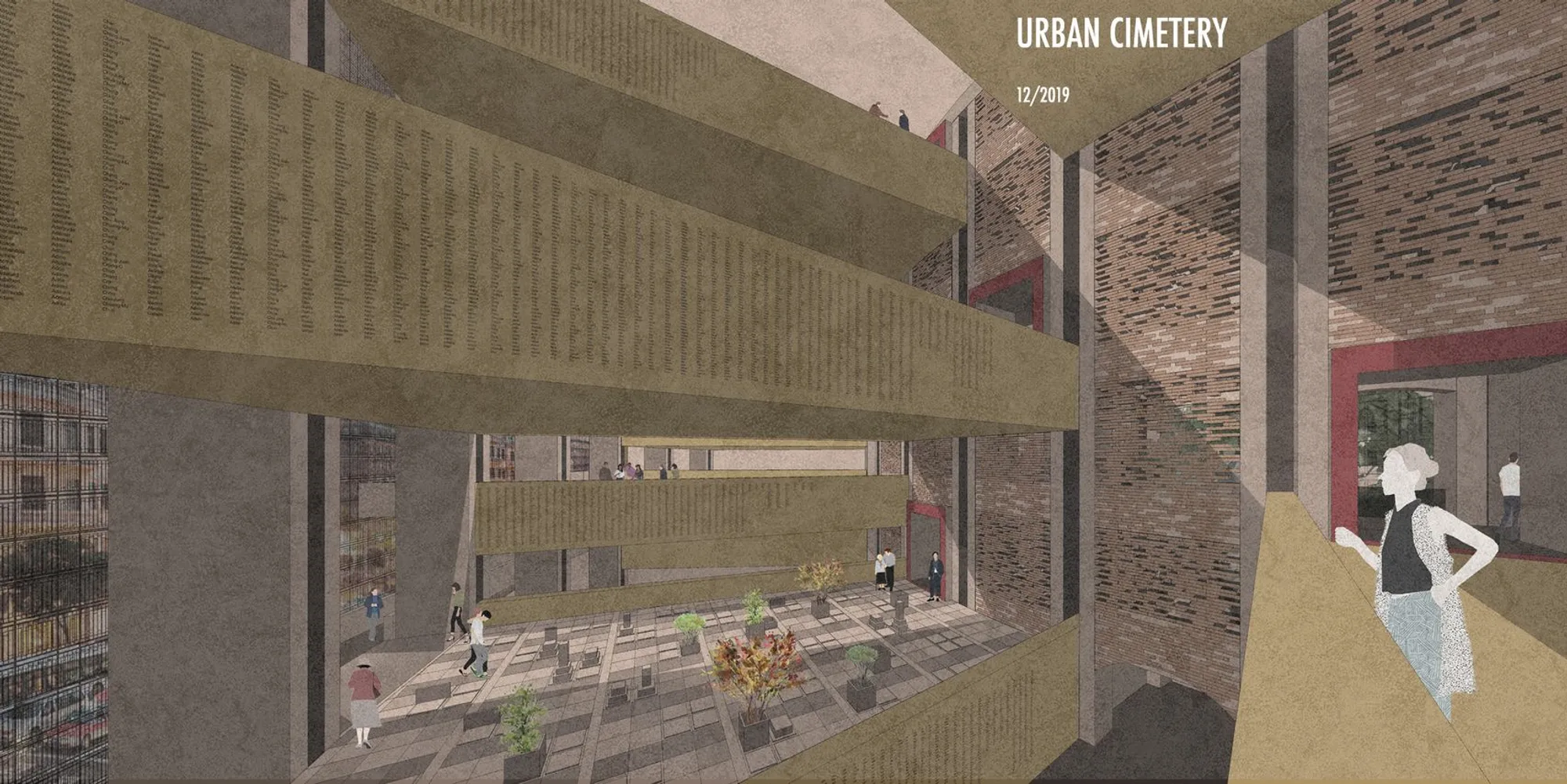
The interior rendering of the entry hall captures the critical threshold moment where the noise of the city gives way to contemplation. Visitors pass through ornamental screens that filter light and view, while a hanging plant installation descends from the ceiling, establishing the building's dual atmosphere of constructed architecture and living nature. Figures in the rendering move at different paces, some pausing, some walking, illustrating Iszatt's intention that the building accommodates both ceremonial procession and casual public access.
Two distinct circulation paths organize movement throughout the building: one ceremonial, one public. This separation ensures that active mourning rituals remain undisturbed by everyday visitors, while still allowing the cemetery to function as a genuine piece of urban infrastructure rather than a sealed-off precinct. The architectural language here draws from cloister typology, integrating a strong ambulatory layout that evokes spiritual connection without prescribing a specific religious framework.
Vertical Ascension Through the Terraced Atrium

The section perspective is the project's most revealing drawing. It cuts through the terraced interior atrium to show figures occupying multiple levels simultaneously: mourners in the depths of the building, visitors on intermediate terraces, and pedestrians walking across a roof plaza that connects the cemetery back to the city's ground plane. The roof becomes public space, completing the argument that death and daily life need not be spatially segregated. Below, suspended terraces allow for both intimate reflection and communal gathering, with geometry serving as narrative and elevation as metaphor.
What this section makes clear is that the vertical strategy is not about efficiency alone. The layering creates a graduated emotional landscape. Near the base, ceremonial halls and quiet gardens foster the intensity of grief. As visitors ascend, filtered views of the city begin to reappear, reintroducing the world of the living. The roof plaza completes the transition, offering open sky and urban panorama as a kind of release. The architecture does not dictate how to mourn; it provides a spatial scaffold within which mourning can unfold at its own pace.
Why This Project Matters
The question of where and how we bury our dead is, at root, a question about what cities value. Iszatt's proposal refuses the default answer that cemeteries belong on the margins. By reintegrating the cemetery into the urban fabric as a vertical, faith-neutral, publicly accessible landmark, the project challenges architects to treat funerary design with the same spatial ambition they bring to museums, libraries, or civic plazas. The three-stage burial model and communal memorial strategy offer a pragmatic framework for cities running out of ground.
More importantly, Urban Cemetery demonstrates that functional constraints can generate poetic architecture rather than merely practical solutions. The circular plan, the hanging terraces, the cloister-derived ambulatory, and the vertical procession from grief to release all emerge from the problem itself. Nothing is applied as decoration. The result is a building that speaks, as Iszatt puts it, "not through religion, but through architecture itself," offering a model for how contemporary cities might honor their dead without turning away from the living.
View the Full Project
About the Designers
Designer: Annabelle Iszatt
Enter a Design Competition on uni.xyz
uni.xyz runs architecture and design competitions year-round that reward proposals with spatial conviction and real site intelligence.
Project credits: Urban Cemetery by Annabelle Iszatt Circle of Life (uni.xyz).




Popular Articles
Popular articles from the community


Co-Life: Senior Housing Design That Reconnects Older Adults With the City
Co-Life reimagines senior housing design through healing gardens, shared streets, workshops, and a sustainable community across generations.

Conexión: Biophilic Design Reimagines High-Rise Living in Hong Kong
Conexión reimagines high-rise living in Hong Kong through biophilic design, green facades, shared spaces, daylight, water and nature within.

Co-life: Sustainable Architecture for Age-Friendly Community Living
Co-life reimagines sustainable architecture for seniors through courtyards, rammed earth, shared gardens, and spaces designed for belonging.

The Earth Pod: 3D Printed Homes for Resilient Refugee Communities
The Earth Pod reimagines refugee housing through 3D printed homes made from clay, combining resilience, self-sufficiency, and rapid shelter.

Similar Reads
You might also enjoy these articles

Day and Night Park: A Time-Based Urban Newsstand in Beijing
A temporary urban newsstand in Beijing blending travel, light, and reading through poetic colors, compact form, and community-focused design.

Modernist Patio Renovation in El Masnou, Barcelona by Oliver Segura Arquitectura + Cebrià Arquitectura
Modernist patio renovation blending tradition and innovation with a movable pool, leveled floors, and Catalan materials in El Masnou.

Alto Residencial Coop: Cooperative Housing Development in Santiago de Compostela by Carbajo Barrios Arquitectos
A linear cooperative housing complex blending white volumes and perforated metal façades, enhancing community living, natural light, privacy, and urban integration.

Vil Genis School by BPA ARCHITECTURE – Massy, France
Vil Genis School in Massy, France, features sustainable design, south-facing classrooms, community integration, accessible spaces, and modern educational architecture.
Comments (0)
Please login or sign up to add comments
No comments yet. Be the first to comment!