
Urban Improvement: Turning a Neglected Linear Strip into a Sequence of Shared Public Rooms
Guillermo del Río threads a stage, garden, play area and court along a degraded urban strip, built from reversible timber and steel modules.


Most cities have them: long, thin leftovers squeezed between apartment blocks, too narrow for a building and too awkward for a park. Urban Improvement starts from a simple question. What if the narrowness is the brief rather than the problem? The project does not try to tame its degraded strip with a single monumental gesture. It strings together a chain of small, interconnected spaces, and together they behave like one continuous public realm.
Designed by Guillermo del Río and published as a project on uni.xyz, the proposal frames the site as a socio-cultural corridor, a place of reunion where everyday activity can take root. Pergolas, seating zones, planted areas, open courts and a performance stage are arranged in sequence along the strip. Elevated walkways run along its edges, and access points at both ends tie into existing staircases. The result is less a finished object than a framework that is meant to evolve through use.
A Glazed Stage Between Brick Banks and Pines
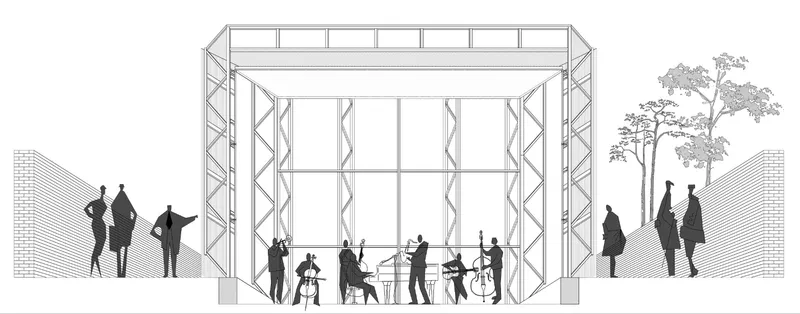
The section through the performance pavilion is the clearest statement of the project's character. A light steel frame encloses a glazed box just big enough for a small band. Figures gather on sloped brick banks to either side, and pine trees soften the edges. The stage does not dominate the strip. It sits within it, and the surrounding ground becomes informal seating, so an audience can form without fixed rows or barriers.
This is also where the construction logic becomes legible. The proposal uses metallic trusses for key programmatic elements such as the stage, while wooden structural systems define pathways and shaded areas. The whole kit is modular and prefabricated, which keeps the intervention reversible. Here architecture acts as a temporary yet consequential layer on the city, not a permanent imposition on it.
A Steel Cube and a Garden Bed Give the Narrow Strip Its Landmarks
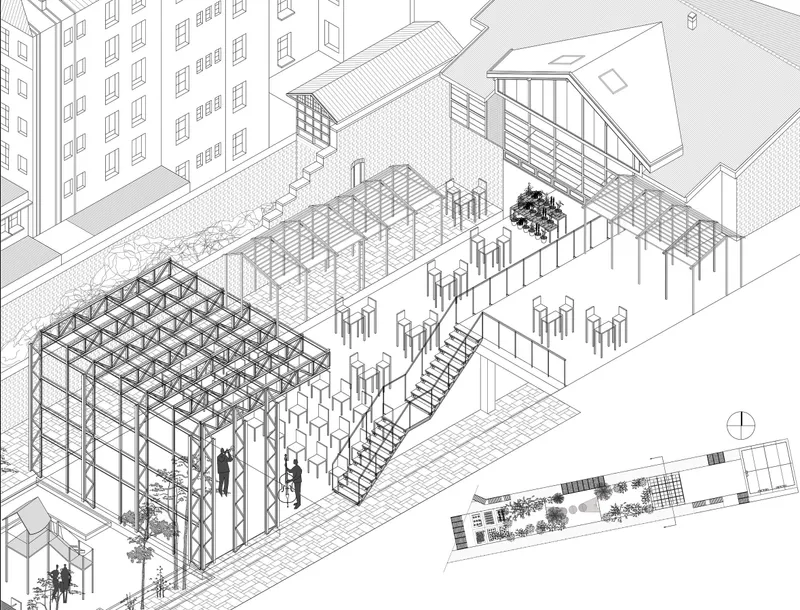
The first axonometric centres on a steel-frame cube, crossed by a diagonal stair and surrounded by high tables and pergolas. A small site plan inset places the moment within the larger linear scheme. The cube is open and skeletal, closer to a climbing frame for adults than a building. It works as a landmark and a vantage point, and it gives the strip vertical interest in a site that is otherwise defined by length.
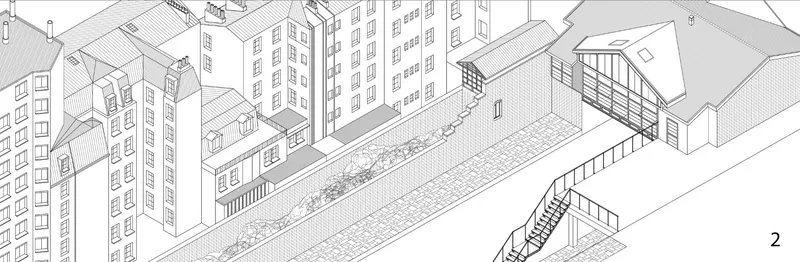
The second drawing pulls back to show what the project is up against. Tall apartment blocks press in on both sides, and the courtyard strip runs between them toward a gabled building at the far end. A stone-edged garden bed occupies the ground plane. This drawing makes the human-scale ambition clear. In a corridor this tight, planting and seating are not decoration. They turn a passage into a place to stop.
Swings and Hoops as the Everyday Anchors of a Vital Place
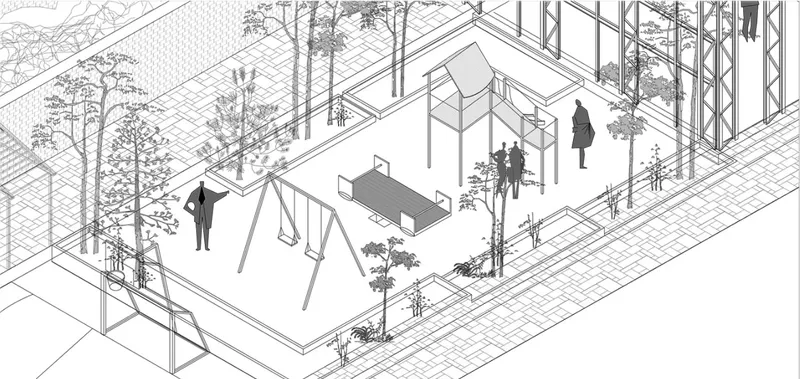
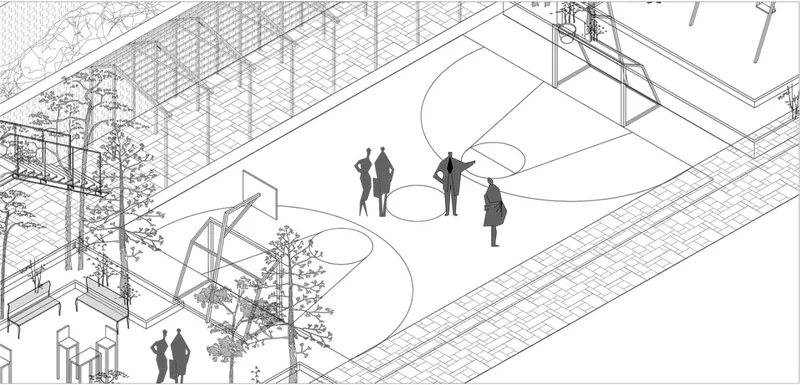
Del Río's stated aim is a "vital place", and the play area and basketball court are where that idea becomes most practical. The children's zone gathers swings, a seesaw bench and a raised play house inside a ring of planters and slender trees. The ring gives the youngest users a defined edge without walling them off from the rest of the strip. The court next to it is plainer: painted arcs, two hoops, benches and trees along the perimeter.
Placed side by side, these two rooms show how the linear programme operates. Each zone has a distinct function, yet repeated scale and modular edges let one space flow into the next. A parent at the play area can watch a game on the court, and a teenager on the court shares the strip with a café crowd further along. The programmatic mix does the social work the proposal promises.
Reading the Strip End to End from the Elevated Walkways
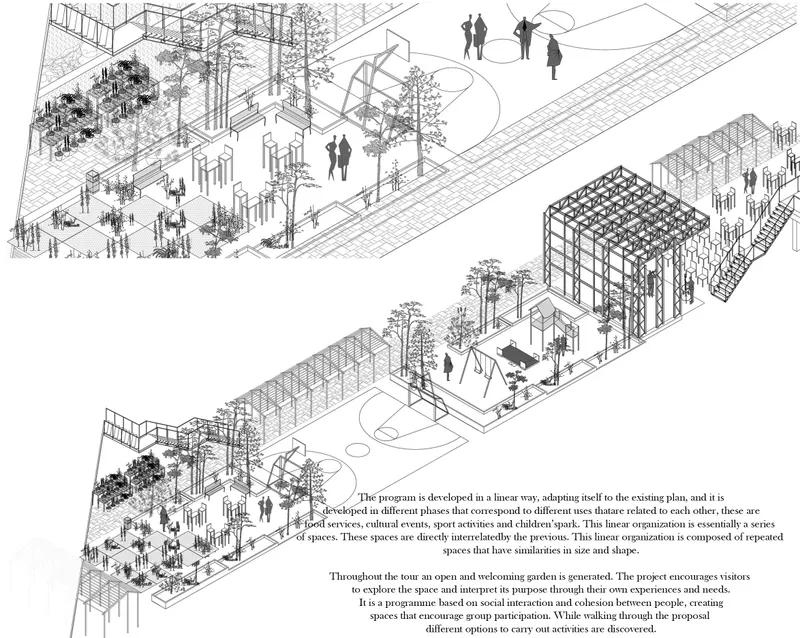
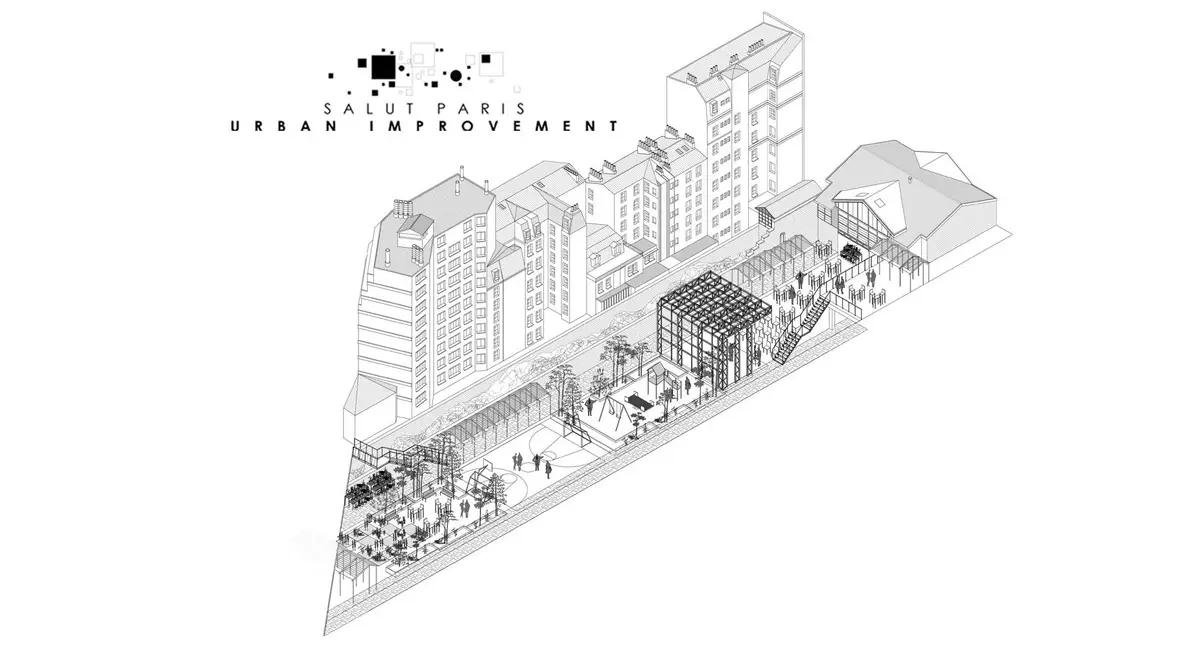
The overall axonometric pulls the pieces into a single reading: café tables, the court, the play area, the steel cube and the stair, set out in a continuous line. What the drawing reveals is a sequence with rhythm, where active and calm rooms alternate rather than blur into one undifferentiated plaza.
Circulation reinforces that rhythm. Parallel elevated walkways run along the edges of the site and act as observational corridors, so visitors can look down onto the activity in the central zone as they move through. Access at both ends connects to existing staircases, which stitches the strip back into the surrounding urban fabric. The two layers, moving above and gathering below, turn a shortcut into a promenade.
Why This Project Matters
Urban Improvement treats linearity as an organising principle rather than a constraint, and that shift in attitude is its most transferable lesson. Instead of forcing a residual strip to behave like a square, the project accepts its length. It divides the strip into a sequence of legible rooms, each sized for a specific everyday use, and joins them with continuous edges and walkways. The approach could apply to countless similar voids in dense neighbourhoods.
The commitment to modular, prefabricated and reversible construction matters just as much. Timber pathways and shaded areas, plus steel trusses where structure has to work harder, give the scheme a lightness that suits public space in flux. It prioritises activation over occupation and leaves room for residents to reinterpret the strip over time. The proposal suggests that regeneration does not always need a monument; sometimes it needs a well-sequenced set of places to sit, play and gather.
View the Full Project
About the Designers
Designer: Guillermo del Río
Enter a Design Competition on uni.xyz
uni.xyz runs architecture and design competitions year-round that reward proposals with spatial conviction and real site intelligence.
Project credits: Urban Improvement by Guillermo del Río.


Popular Articles
Popular articles from the community


David Ortega Stacks a Two-Story Mexico City Penthouse Around a Steel Stair and a Pergola-Shaded Roof Terrace
In Colonia Roma, a 300 m² penthouse uses oak joinery, a planted steel stair and a slatted roof pergola to make a new-build apartment feel like a house.

Juan García Correa, John González and Claudia Rueda Sink a Circular Amphitheater into a Manizales Engineering Building
On the La Nubia campus in Manizales, Colombia, the S1 Building folds labs and offices into a hillside of ramped lawns that double as a campus route.

GROUP A Strips a 1969 Rotterdam Harbor Headquarters to Its Frame and Wraps It in Timber Louvers
In Rotterdam's M4H harbor district, Ferro Offices reuses a 1969 frame, adds one timber storey and reaches BREEAM-NL Outstanding.

Architekt Andreas Gruber Scatters 23 Dark Timber Chalets Across a South Tyrolean Forest Edge
In Molini di Tures, Amonti Chalets breaks a resort into a hamlet of gabled timber houses, with parking, storage and services pushed into the slope.

Similar Reads
You might also enjoy these articles
Healing Façade: A Modular Chapel System That Restores Ethiopia's Sacred Forests
Winner of the Eco-Chapel competition, this circular timber façade collects water from air to rebuild soil and reforest degraded Ethiopian landscapes.
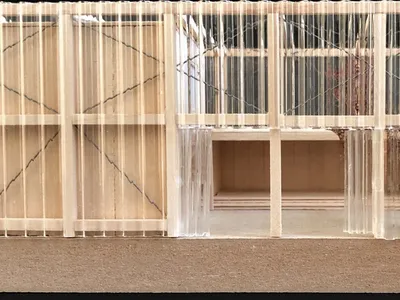
Kaffeebühnen: Where Coffee Shop Architecture Becomes a Civic Stage in Vienna
A linear sequence of timber boxes, transparent shells, and open yards turns the Viennese café tradition into a public performance space.
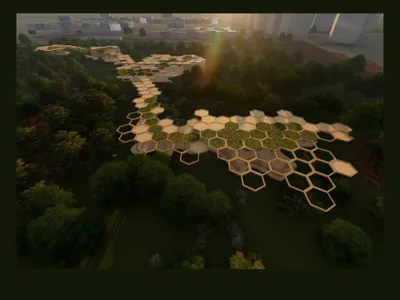
Eco Chapel: A Modular Forest Pavilion That Grows Like the Landscape It Protects
Hexagonal timber modules weave through existing trees, turning a chapel into a living system for prayer, education, and reforestation.


Urban Forest: A Vertical Ecosystem for 5,000 Workers in Singapore's Changi Business Park
Radially stacked pods and layered green decks turn a 7-acre plot into 47 acres of ecological workspace projected for 2040.


Comments (0)
Please login or sign up to add comments
No comments yet. Be the first to comment!