

Urban Meal Mine: A Tri-Axial Grid for Growing Food in Nine Elms
A modular farming infrastructure in London negotiates the tension between urban order and ecological liberty to feed a neighbourhood.


What if a building could grow? Not metaphorically, but literally: expanding module by module along a tri-axial grid, filling itself with soil, crops, markets, and classrooms as the neighbourhood around it evolves. The Urban Meal Mine (UMM) treats architecture as living infrastructure, a voxel-based scaffold where food production, community gathering, and ecological performance are not separate programmes but layers of the same organism.
Shortlisted in the Urban Meal Mine competition, the project is the work of Artem Barkhin and Samuel H. Cutajar. Sited in Nine Elms, London, between Battersea Power Station, Vauxhall Centre, and the Thames, the proposal targets underused land in one of the city's most actively transforming districts. The designers frame the concept around a dialectic they call Order and Liberty: the rigid grid of the city versus the free-flowing logic of ecological systems. UMM sits at the intersection, using prefabricated modular units to create an adaptable structure that can support over 200 businesses while offering green terraces, learning hubs, and public promenades to thousands of daily visitors.
A Voxel Grid Rooted in Nine Elms
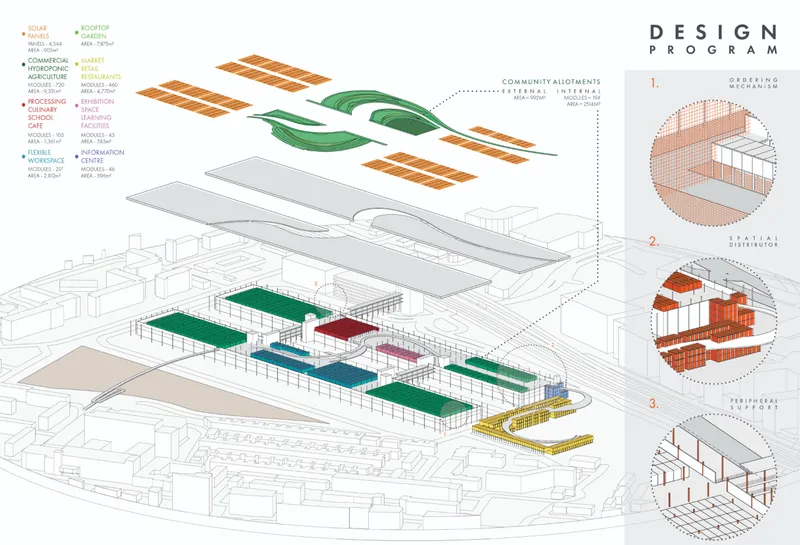
The site sits at a critical convergence of commerce, transit, and waterfront. Strategic links to Battersea and Nine Elms stations anchor the project's mobility strategy, while prevailing winds, seasonal cycles, and surrounding vegetation inform its orientation and envelope. Rather than imposing a single monolithic form, the designers deploy a voxel-based ordering mechanism that distributes programme across a three-dimensional matrix. Each cell in the grid can receive a prefabricated unit designed for rapid transport and assembly, meaning the building can grow incrementally as demand shifts. The peripheral structural framing acts as a skeleton, welcoming new modules without disrupting what already exists.
Growing Food at Every Level
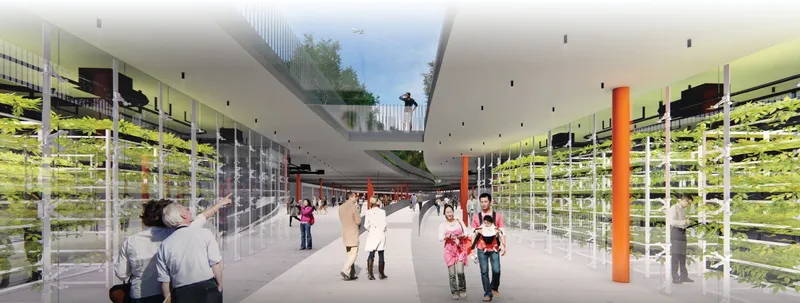
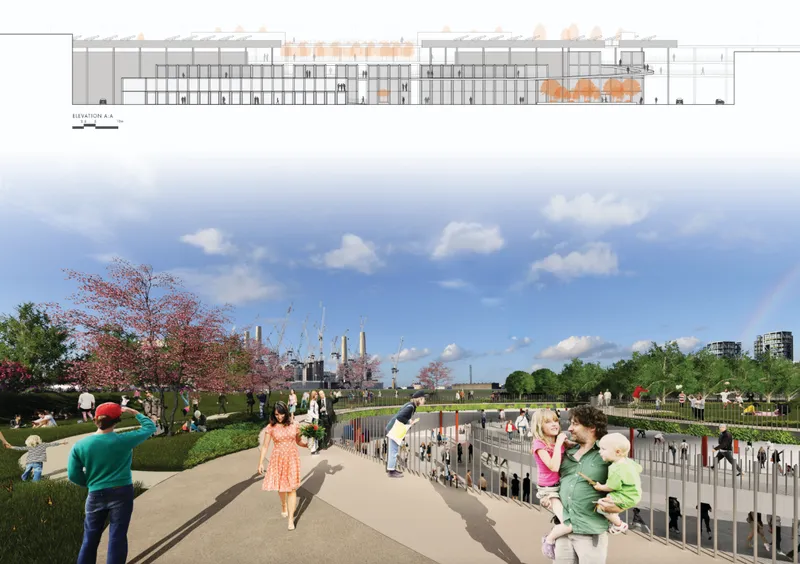
At its core, UMM is an urban farming architecture. Indoor and rooftop cultivation spaces enable vertical food production throughout the year, shortening supply chains and reducing carbon emissions associated with conventional distribution. Market spaces occupy the ground and lower levels, creating open areas where locally grown produce can be sold directly to residents. Above them, learning hubs offer programming on ecology, food systems, and sustainability, ensuring that the knowledge needed to maintain these systems circulates as freely as the produce itself.
Green terraces and public promenades thread through the structure, blurring the line between farm, park, and marketplace. These landscaped zones serve multiple functions simultaneously: leisure for residents, habitat for urban biodiversity, and additional growing surface for crops. The result is a building where every circulation route doubles as a productive landscape, and every social space is also a greenhouse.
Modular Assembly as Architectural Strategy
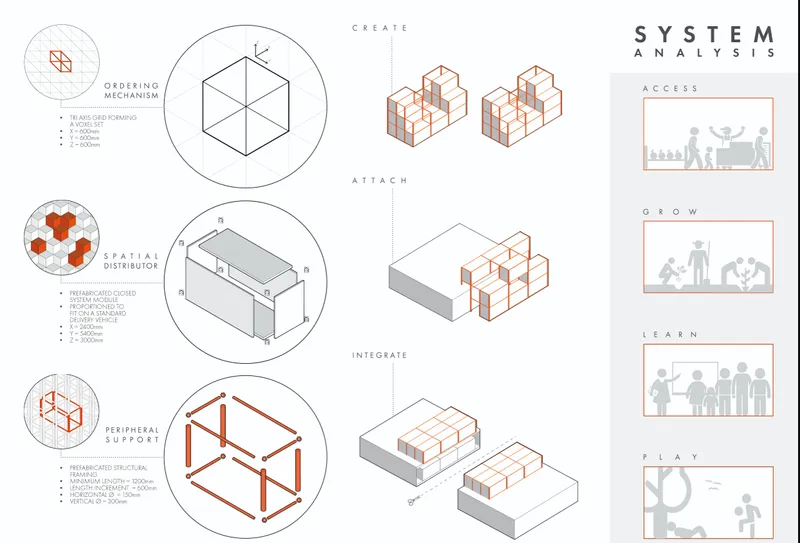
The modularity of the system deserves particular attention. The tri-axial grid is not merely a structural convenience; it is a philosophical commitment to adaptability. Prefabricated spatial distributors can be created off-site, transported, and attached to the existing framework, allowing the building to respond to shifting urban needs over decades. Programmatic layers are stacked according to function: access at grade, growing spaces above, learning and play distributed where daylight and circulation allow. The peripheral support structure ensures that each addition strengthens the whole rather than straining it.
Solar panels and green circulation systems complement the vertical farming programme, pushing the project toward net-positive energy performance. By integrating renewable generation directly into the building envelope, the designers avoid the common trap of treating sustainability as an afterthought bolted onto a conventional plan. Here, the energy strategy and the food strategy are the same strategy.
Why This Project Matters
Urban food security is rarely treated as an architectural problem. It is usually delegated to logistics planners and policy documents, surfacing in building design only as a token rooftop garden. Barkhin and Cutajar refuse that separation. UMM proposes that the building itself is the supply chain: the structure grows the food, houses the market, trains the growers, and feeds the neighbourhood. In Nine Elms, a district already navigating massive redevelopment pressures, that proposition is not utopian. It is practical.
The tri-axial modular system is the project's most transferable contribution. If architecture is to address food insecurity at urban scale, it needs frameworks that can adapt without demolition, expand without master-plan revisions, and produce without consuming more than they return. UMM offers one such framework, grounded in a real London site, calibrated to real transit connections, and designed to support real businesses. That specificity is what separates a compelling competition entry from a diagram.
View the Full Project
About the Designers
Designers: Artem Barkhin, Samuel H. Cutajar
Enter a Design Competition on uni.xyz
uni.xyz runs architecture and design competitions year-round that reward proposals with spatial conviction and real site intelligence.
Project credits: Urban Meal Mine by Artem Barkhin, Samuel H. Cutajar Urban Meal Mine (uni.xyz).



Popular Articles
Popular articles from the community


Lunar Spiral: Space Architecture Shaped by the Mathematics of the Universe
Lunar Spiral reimagines space architecture through Fibonacci geometry, lunar regolith, levitating habitats, and self-sustaining Moon living.

Hill & Cross Opera: Sculptural Opera House Architecture Shaped by Tallinn’s Landscape and Identity
Hill & Cross Opera reimagines opera house architecture in Tallinn through its sculptural hill, civic plaza, glass wave and a luminous cross.

The Ocean Hive: Sustainable Architecture for a Self-Sufficient Civilization at Sea
The Ocean Hive imagines sustainable architecture at sea, where modular habitats, algae, wave power and ocean waste sustain a growing colony.

Conexión: Biophilic Design Reimagines High-Rise Living in Hong Kong
Conexión reimagines high-rise living in Hong Kong through biophilic design, green facades, shared spaces, daylight, water and nature within.

Similar Reads
You might also enjoy these articles
Lunar Spiral: Space Architecture Shaped by the Mathematics of the Universe
Lunar Spiral reimagines space architecture through Fibonacci geometry, lunar regolith, levitating habitats, and self-sustaining Moon living.
The Main Dream: Modular Architecture for Play, Learning, and Community
A modular playground turns recycled plastic into adaptable spaces where refugee children can play, build, learn, and reconnect.

Play: Fragments of Their World
Familiar architecture becomes modular playground design, creating safe spaces where displaced children can learn, connect, imagine and play.

Wadi Rum Observatory: Desert Architecture Designed for the Night Sky
Wadi Rum Observatory turns desert architecture into a quiet instrument for astronomy, hiding research spaces under Jordan's starlit terrain.





Comments (0)
Please login or sign up to add comments
No comments yet. Be the first to comment!