

Urban Meal Mine: Layered Food Systems Embedded in London's Urban Fabric
A shortlisted proposal fuses aquaponic farms, soil-based cultivation, and public market halls into a single multi-layered urban building.


What if a building could feed a neighborhood, teach a generation, and grow alongside its community? That is the provocation at the heart of Urban Meal Mine, a proposal that stacks aquaponic vertical farms, traditional soil plots, a biological museum, and a public marketplace into one integrated structure. Rather than treating food production as something that happens outside the city limits, the project pulls agriculture directly into the architectural section, making cultivation visible, accessible, and communal.
Designed by Елена Панфилова, this shortlisted entry in the Urban Meal Mine competition is sited in London, where it connects to key transportation nodes to ensure citywide accessibility. The project reads as both a manifesto and a working blueprint: it argues that architecture should not be static but should grow, adapt, and sustain the people it serves.
A Composite Strategy: From Site Analysis to Systems Thinking
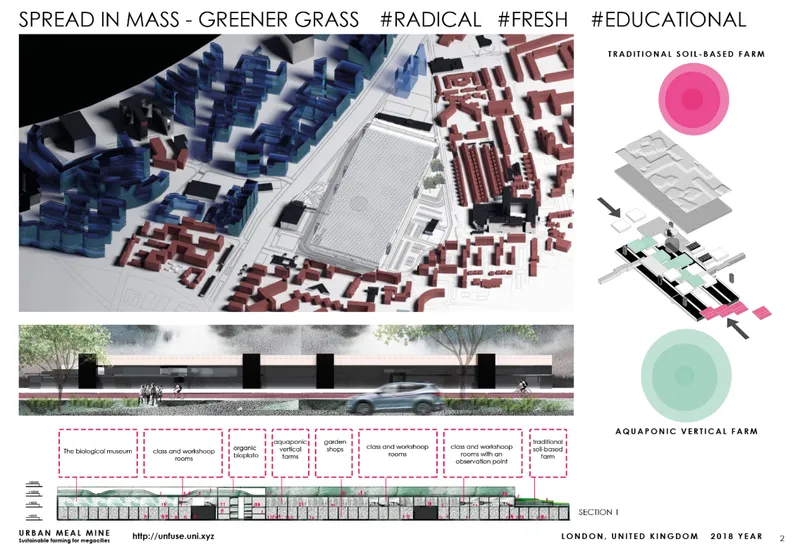
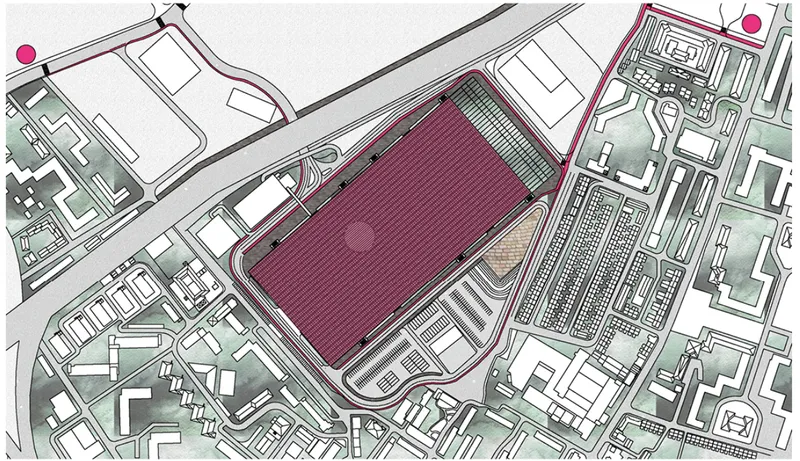
The opening presentation board lays out the project's ambition in a single dense spread. A site model, street elevation with mature tree planting, sectional cut, and systems diagrams communicate how aquaponic loops, soil-based beds, and educational programs coexist within the same envelope. The site plan drawing reveals a substantial central building with a prominent maroon roof nestled into London's existing urban grain. Roads, rail lines, and pedestrian routes converge on the structure, reinforcing Панфилова's emphasis on clean mobility and reduced transportation costs for locally grown produce.
What stands out here is the deliberate legibility of the diagrams. The designer does not bury the farming systems behind architectural form; instead, each cycle of water, nutrient, and energy is annotated and traced. The building is presented as a machine with inputs and outputs, inviting scrutiny rather than hiding complexity.
Ribbed Screens and Street Presence
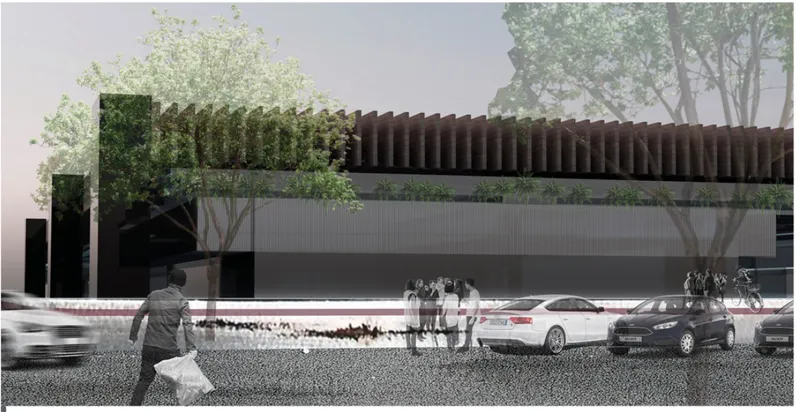
At street level, the rendering shows a ribbed facade screening system that mediates between the productive interior and the public sidewalk. Pedestrians cross freely near parked vehicles, and a generous row of planted trees softens the threshold between city and building. The facade treatment is neither opaque nor fully transparent; it filters light and views, hinting at the activity inside without overwhelming the streetscape. This calibrated permeability is critical: it signals that the building belongs to the neighborhood, not just to the farmers working within it.
Exploded Layers: Program as Vertical Landscape
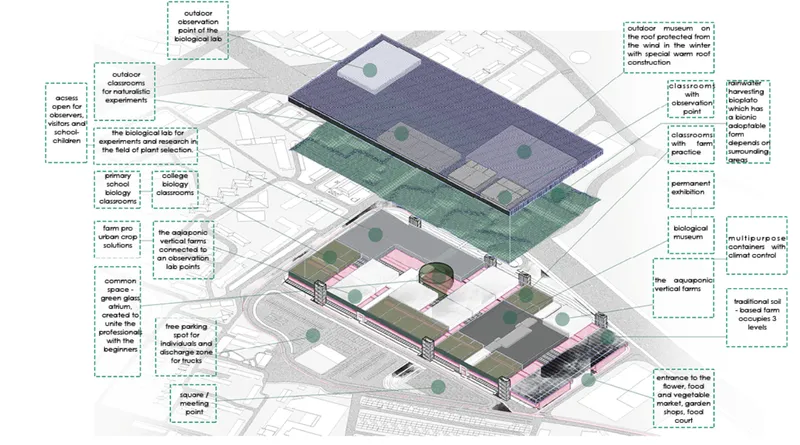
The exploded axonometric drawing is the project's most revealing graphic. It peels apart the building into its constituent volumes: rooftop gardens crown the structure, while aquaponic vertical farms, workshops, classrooms, and organic bioplots occupy distinct horizontal bands below. Each layer is annotated with its programmatic role, making the vertical stacking strategy immediately comprehensible. The drawing also reveals how the project achieves its modularity and adaptability: individual layers can expand or reconfigure as community needs evolve, without destabilizing the structural logic of the whole.
Rooftop cultivation is not treated as an afterthought or a green roof for certification points. Here it is a primary productive surface, continuous with the farming systems below. The axonometric makes clear that every floor contributes to the building's ecological output, collapsing the conventional distinction between served and servant spaces.
The Market Hall: Where Harvest Meets Community
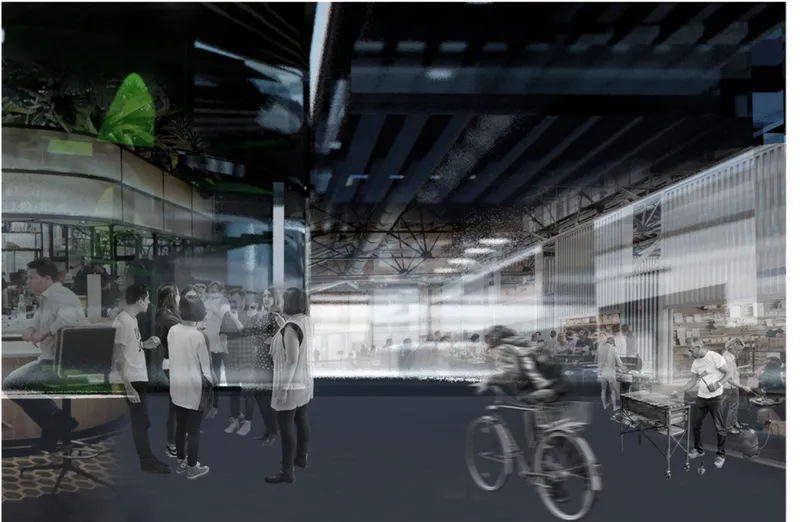
The interior rendering of the market hall captures the social dimension that separates this project from a pure agricultural facility. Exposed steel trusses span a generous volume, while translucent wall panels wash the space with diffused daylight. Crowds of visitors fill the hall, suggesting a space designed for gathering, exchange, and spectacle as much as for commerce. The public marketplace is the building's social engine, the place where the seed-to-harvest cycle reaches its conclusion and the broader community can participate without any prior farming knowledge.
Панфилова positions this hall as essential to the project's educational mission. Schools, universities, and individuals move through the market on their way to workshops and lab visits, encountering locally grown produce as a tangible artifact of the building's productive systems. The architecture frames food not as a commodity delivered from elsewhere but as something cultivated, visible, and shared.
Why This Project Matters
Urban Meal Mine succeeds because it refuses to separate the technical from the social. Aquaponic loops and soil-based beds are not hidden in a basement; they are stacked, annotated, and made legible to every visitor. The biological museum, the classrooms, and the market hall are not optional amenities bolted onto a farm; they are structurally and programmatically interwoven. The result is a building that teaches by existing, that produces food and produces citizens who understand where that food comes from.
As a model for London and for cities worldwide, the proposal offers a clear thesis: repurposing urban land into food-producing hubs is not only ecologically sound but socially generative. By connecting productive architecture to transit infrastructure, public education, and community commerce, Панфилова outlines a path toward urban self-sufficiency that is adaptable, modular, and, most importantly, open to everyone. In a competition field concerned with the future of urban farming, this shortlisted entry earns its place by treating architecture itself as the crop.
View the Full Project
About the Designers
Designer: Елена Панфилова
Enter a Design Competition on uni.xyz
uni.xyz runs architecture and design competitions year-round that reward proposals with spatial conviction and real site intelligence.
Project credits: Start point by Елена Панфилова Urban Meal Mine (uni.xyz).


Popular Articles
Popular articles from the community


Aquadapt: An Underwater Habitat That Rewrites Its Rooms by the Hour
Curved modules ring the seabed while one shell shifts from breakfast room to cinema, farm and football pitch as residents' needs change.

Manzana Morphosis: Stretching Barcelona's Grid into a Living Landscape for 2050
A radical reworking of the Eixample manzana turns density into a tool for generous public space, vertical ecology, and environmental performance.

Singing Woman: An Opera House That Performs Before the Curtain Rises
Ovidiu Cristian Pavel's conceptual opera house translates Estonia's choral identity into a sculpted waterfront landmark facing the Baltic Sea.


graciastudio Turns a Viewless Tijuana Lot Inward Around a Courtyard of Concrete, Timber and Trees
In Tijuana, Jorge Gracia's GA2 House stacks a timber-clad private floor over exposed concrete and replaces a missing view with a planted interior patio.

Similar Reads
You might also enjoy these articles
Aquadapt: An Underwater Habitat That Rewrites Its Rooms by the Hour
Curved modules ring the seabed while one shell shifts from breakfast room to cinema, farm and football pitch as residents' needs change.

Play: Fragments of Their World: Remembered Architecture Rebuilt as a Modular Playground for Refugee Camps
Tom Gardner abstracts domes, arches and towers from the homelands of displaced families into a kit of child-scaled play parts for camp settlements.
REBIRTH: A Circular Settlement Where Afghan Widows and Their Children Rebuild Life Together
A shortlisted Resile entry turns the circle into a protective ring of timber and brick, gathering homes, classrooms and gardens around a shared landscape.
The Main Dream: A Recycled Plastic Kit That Lets Refugee Children Build Their Own Playground
Thirty-centimetre interlocking cubes that connect on three axes turn play into construction, letting children author the spaces they occupy.

Comments (0)
Please login or sign up to add comments
No comments yet. Be the first to comment!