

Urban Recovery: Rebuilding Aleppo Through Food, Music, and Women-Led Resilience
A culture-led urban regeneration proposal stitches Aleppo back together through agricultural networks, musical traditions, and community memory.


Rebuilding a war-torn city is never just about replacing concrete and stone. In Aleppo, one of the oldest continually inhabited cities on earth, the real task is reconstructing belonging: the social rituals, trade networks, and cultural continuities that once made the city a living archive of human civilization. That requires architects willing to work at scales ranging from regional agricultural corridors down to the dimensions of a courtyard, and to treat food, music, and women's labor not as soft programming but as structural elements of recovery.
Mariam Bazzi and Cindy Houeis take on exactly that challenge in Urban Recovery: A Reinforcement of Resilience Networks, a comprehensive urban regeneration proposal for the area surrounding the Aleppo Citadel. Rather than producing a master plan fixated on building footprints, the designers map overlapping networks of cultural production, from rural-urban food supply chains linking surrounding communities like Adanan, Kafar Hamra, Hratan, and Mansoura, to music learning nodes threaded through school courtyards and religious centers. The result is a spatial strategy that treats culture as infrastructure.
Women as the Foundation of Urban Recovery

The most striking panel in the proposal maps the lived realities of Syrian women who sustained families through the crisis via food production, dairy farming, clothing making, carpentry, sanitation work, and agricultural labor. The infographic names women like Soumia, Lina, Ghasoun, Wesaal, Rehab, and Rana, anchoring their stories of self-reliance and dignity across a geographic diagram that connects their activities to specific locations and supply chains. It is a rare and powerful move: foregrounding individual human narratives as the generative logic of an urban design strategy.
By centering women-led production, Bazzi and Houeis reframe economic revival and intergenerational continuity as spatial concerns. Food markets, cooking collectives, and women-run workshops are not afterthoughts slotted into empty storefronts; they are programmatic anchors around which the proposal organizes public space. The implication is clear: if you design for the people who actually held the city together during its worst years, the architecture will serve everyone.
Recovery Corridors Layered onto a Wounded Fabric
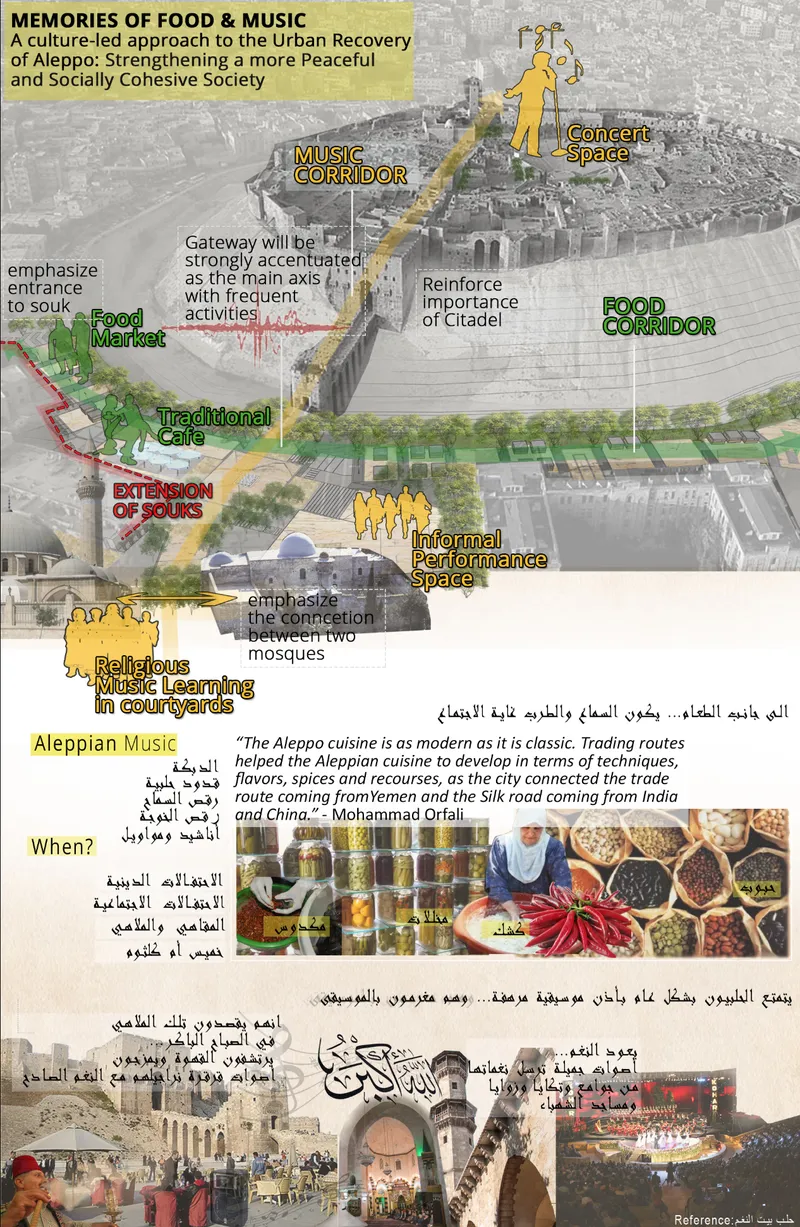
The second board overlays proposed urban recovery corridors onto aerial photography of the site, revealing the extent of destruction: full collapse, partial collapse, and structural damage rippling through the city fabric. Text annotations identify zones that once functioned as markets, administrative districts, commercial edges, and tightly woven residential quarters. The corridors cut through this damage not as erasures but as connective tissue, linking surviving fragments of urban life to new cultural and public programs.
What makes this diagram compelling is its honesty about scale. The proposal does not pretend that a single building or plaza will heal a city. Instead, it treats the entire site around the Citadel as a field of interlocking systems: food and agriculture networks linking rural hinterlands to urban markets, music heritage nodes activating youth participation, and pedestrian corridors restoring the legibility of pre-crisis movement patterns. The architecture emerges from these networks, not the other way around.
Concentric Green Corridors Radiating from the Citadel
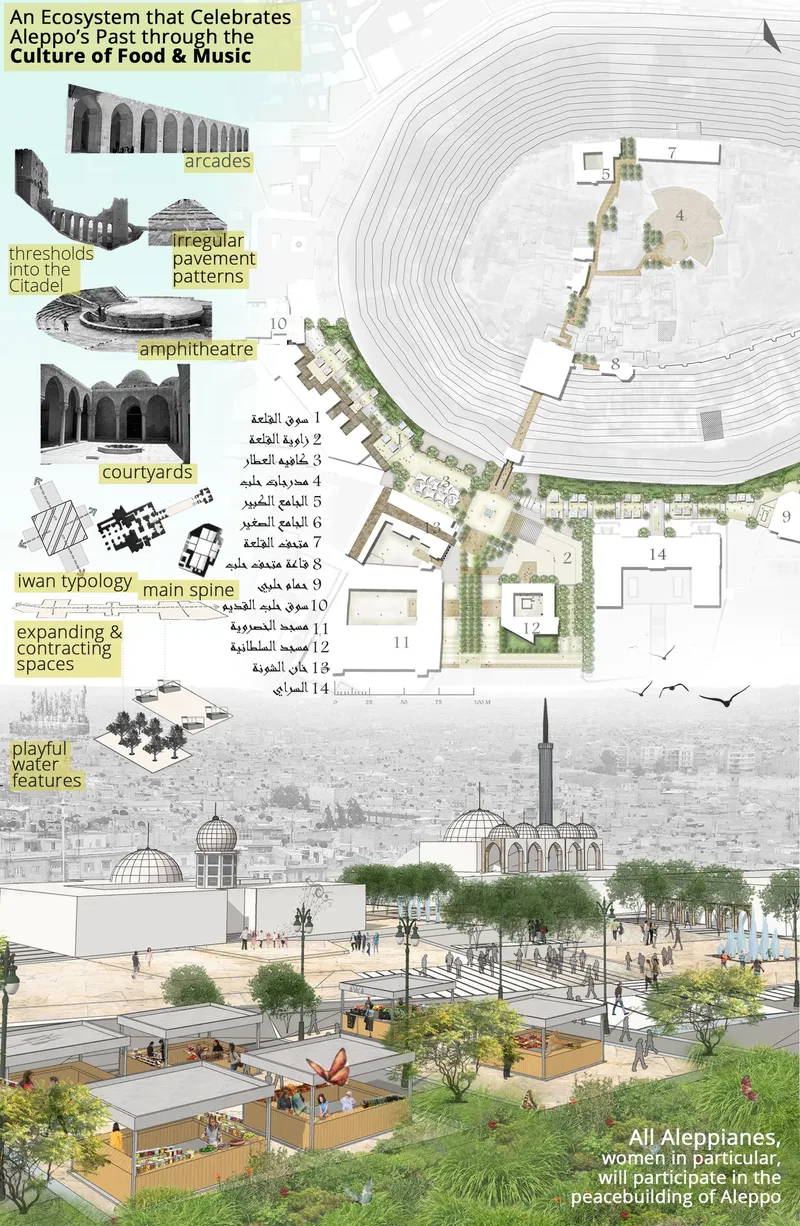
The site plan reveals a bold organizational gesture: concentric topographic lines radiating outward from a central plaza at the base of the Citadel, with green corridors extending into the surrounding urban fabric. The drawing reads almost like a topographic map of cultural influence, with the Citadel as the high point from which public life cascades downhill through planted axes and open spaces. It is a strategy that acknowledges the monumental presence of the ancient fortress while redistributing civic activity across a broader territory.
The green corridors serve multiple functions simultaneously. They reintroduce vegetation into a landscape scarred by conflict, they provide shaded pedestrian routes through what were once military transition zones, and they create a legible spatial framework that can absorb incremental development over time. The plan is generous enough to accommodate the uncertainty inherent in post-conflict reconstruction, where timelines are unpredictable and resources arrive in waves.
A Pedestrian Plaza Beneath the Citadel's Gaze
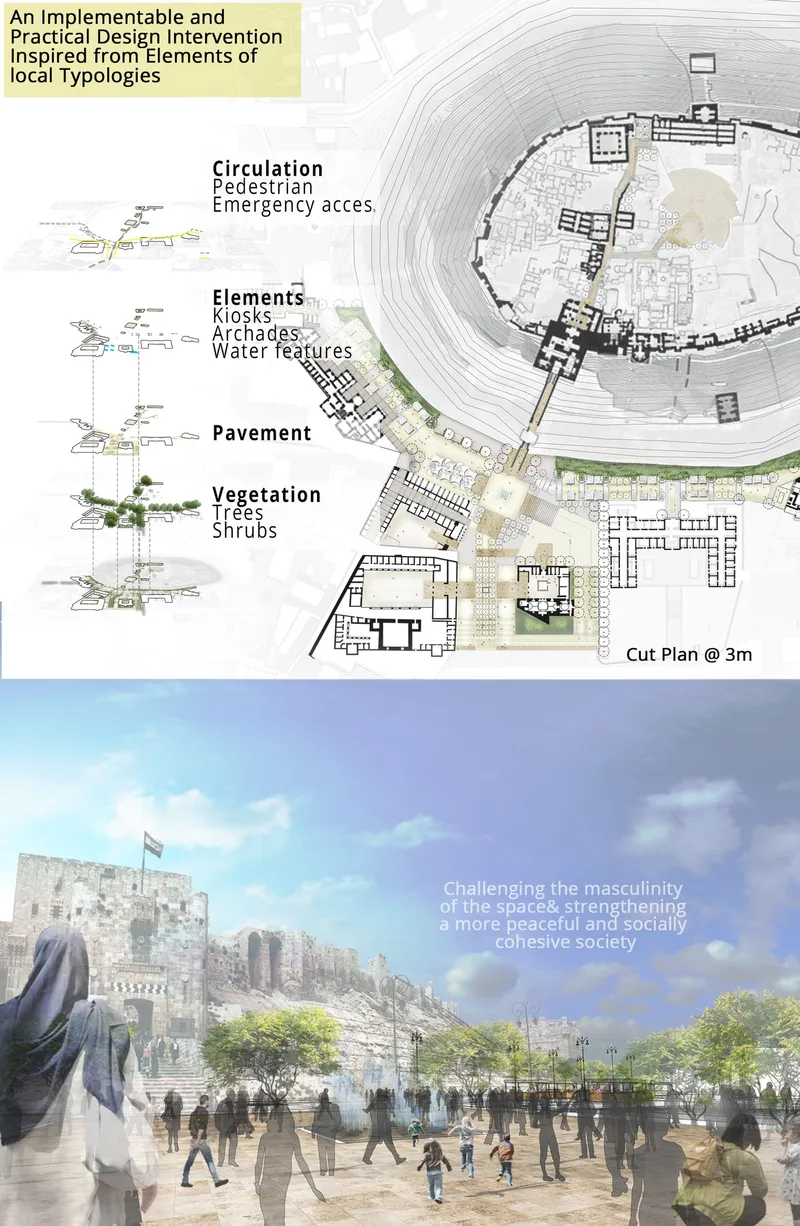
The perspective rendering situates the viewer at ground level within a new pedestrian plaza, looking up toward the Citadel on its hillside. Trees punctuate the open ground, providing shade and vertical rhythm without competing with the monumental silhouette above. The plan view confirms the plaza's role as a gathering space at the convergence of several green corridors, a place designed to host the markets, performances, and communal life that once defined Aleppo's public realm.
The restraint here is notable. The designers resist the temptation to insert a dramatic architectural object at the foot of the Citadel. Instead, the plaza works through careful grading, tree placement, and programmatic flexibility, deferring to the existing monument while creating a stage for everyday cultural activity. It is the kind of design intelligence that trusts people more than form.
Arcaded Public Spaces Along the Slope
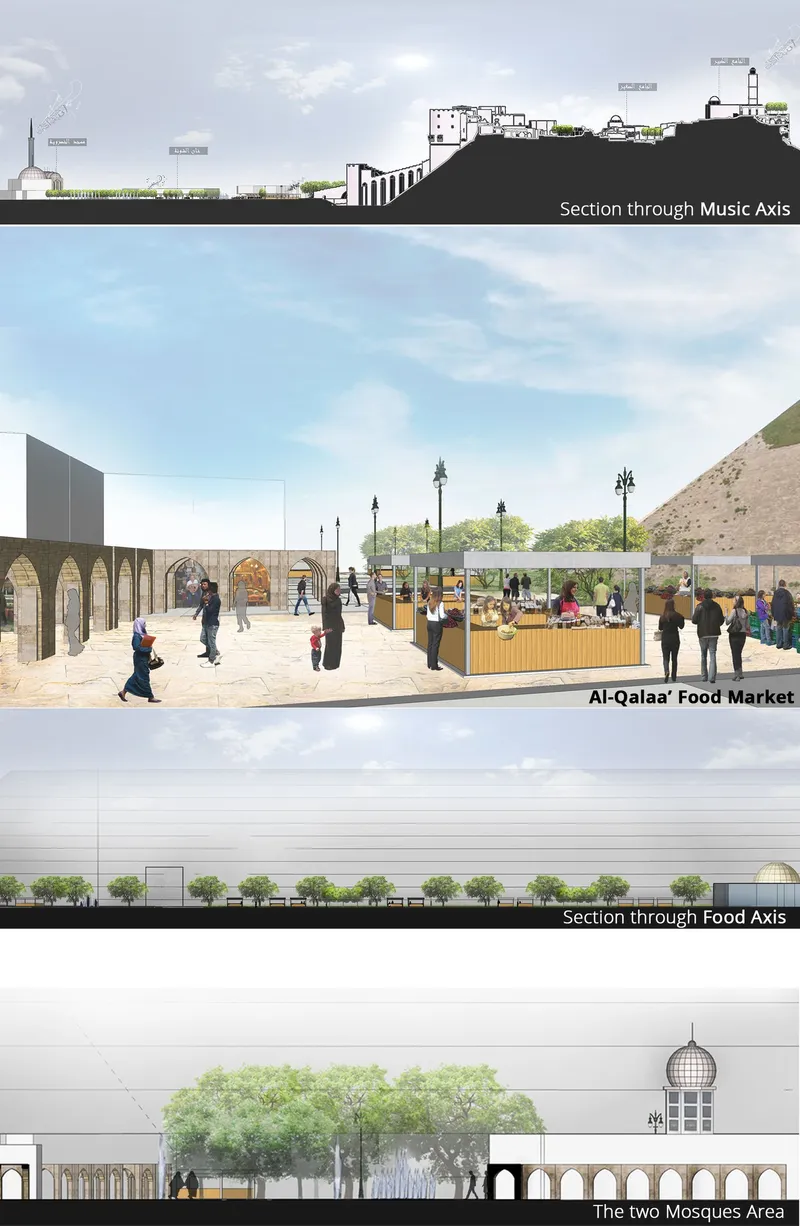
The section drawings reveal how the proposal negotiates the sloped topography between the Citadel and the lower city. Arcaded public spaces step down the hillside, creating covered gathering zones, market stalls, and workshop areas beneath vaulted or colonnaded structures. Vegetation grows along terraced edges, softening the transition between architecture and landscape. The sections read as a contemporary reinterpretation of the souk typology, channeling Aleppo's mercantile heritage into a spatial language suited to recovery.
The elevation views reinforce this reading, showing how the arcades frame views toward the Citadel while sheltering pedestrians from sun and weather. These are not decorative gestures; they are functional responses to climate, culture, and the specific demands of a post-conflict public realm that must feel welcoming and safe. The choice to work with familiar typologies, courtyards, arcades, narrow corridors, signals continuity with Aleppo's pre-crisis identity without resorting to pastiche.
Why This Project Matters
Urban Recovery succeeds because it refuses the false choice between top-down master planning and nostalgic reconstruction. Bazzi and Houeis build their proposal from the ground up, starting with the women, farmers, musicians, and craftspeople who sustained Aleppo through its worst years, and then designing spatial systems that amplify their agency. The result is a form of urban regeneration architecture that treats cultural production as infrastructure, not decoration.
The proposal also offers a model for thinking about post-conflict design more broadly. By mapping resilience networks before drawing building plans, the designers demonstrate that recovery begins with understanding what survived, not just what was lost. In a city where public spaces were erased and cultural memory fragmented, the act of naming women's stories, tracing food networks, and reactivating musical traditions becomes as architecturally significant as any section drawing. That integration of the human and the spatial is what gives this project its conviction.
View the Full Project
About the Designers
Designers: Mariam Bazzi, Cindy Houeis
Enter a Design Competition on uni.xyz
uni.xyz runs architecture and design competitions year-round that reward proposals with spatial conviction and real site intelligence.
Project credits: Urban Recovery: A Reinforcement of Resilience Networks" by Mariam Bazzi, Cindy Houeis.


Popular Articles
Popular articles from the community


Opera by the Sea Estonia: Three Shells Dissolving Architecture into Tallinn's Coastline
A winning opera house proposal replaces monumental form with interconnected shells that blur the boundary between building, park and Baltic Sea.

Tsunami Convergenics: Turning Catastrophic Ocean Forces into Underwater Housing Infrastructure
A speculative underwater settlement off the coast of Onagawa, Japan, treats tsunamis and typhoons as energy sources rather than threats.

Opera on the Sea: Driftwood Logic Shapes a Timber Opera House on Estonia's Coast
Trevor Orgill's opera house translates the entangled drift of floating timber into a civic building where wood, water, and music converge.

Manzana Morphosis: Stretching Barcelona's Grid into a Living Landscape for 2050
A radical reworking of the Eixample manzana turns density into a tool for generous public space, vertical ecology, and environmental performance.

Similar Reads
You might also enjoy these articles

The Amber Palace Opera: A Geological Fiction Surfaces on Tallinn's Baltic Waterfront
Pierre Brillard reimagines a Baltic legend as a public landscape, opera house, and waterfront promenade rooted in Tallinn's coastal identity.
Dynamic Modules Shelter: A Telescopic Ring for Mountain Pilgrimage
A circular modular framework of steel, bamboo, and fabric grows vertically with demand, wrapping communal ground in adaptable shelter.

Singing Woman: Contemporary Architecture Inspired by Estonia’s Voice and the Sea
Singing Woman turns Estonia’s song culture into flowing opera house architecture, blending public life, landscape, sea, and national memory.
HYPERBLOCK: Flexible Urban Design for Barcelona’s Future City
HYPERBLOCK reimagines Barcelona as flexible urban design, layering density, daylight, public space and adaptable housing above Cerdà’s grid.

Comments (0)
Please login or sign up to add comments
No comments yet. Be the first to comment!