

Incandescence: Red Neon and Shipping Containers Rekindle a Forgotten Paris Railway
A shortlisted Salut Paris entry turns a dormant rail corridor in the 18th arrondissement into a lit, modular public spine for markets, art and music.


Some sites ask to be rebuilt. Others ask to be switched back on. Incandescence treats an abandoned railway corridor in Paris as the second kind: a dormant piece of infrastructure that does not need erasing, only reigniting. Its central move is disarmingly simple. Run red neon along the old rails, scatter movable pieces across the ballast, and let the linear void become a stage for whoever shows up. The tracks stay. What changes is the voltage of life around them.
Designed by Xiaozhen Zhang, Tang Yuanyuan and 祯 方, the proposal was shortlisted in the Salut Paris competition. The site sits in the 18th district, a corridor that served industrial logistics for more than 70 years before falling idle for decades. It is surrounded by dense mixed-use blocks and housing, and lies close to subway stations, bus routes and pedestrian corridors. Access is not the problem. The designers diagnose a different deficit: fragmented movement and an absence of activation have left a highly reachable strip of the city with almost nothing to do on it.
Rails That Glow: Turning Track Into the Main Event
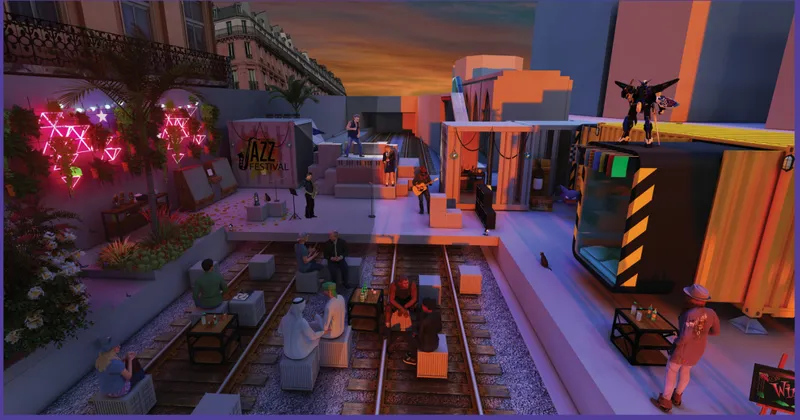
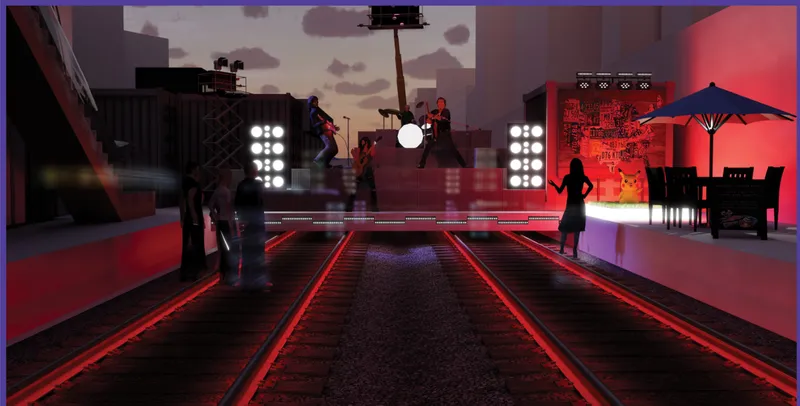
These two renderings make the thesis legible at a glance. In the first, a jazz festival unfolds at sunset, with seating cubes lined along the old tracks, a modest stage and a neon wall closing the view. In the second, the camera drops to rail level and looks down a pair of tracks lit in red toward a band on a raised stage at dusk. The rails do the wayfinding, frame the perspective and point the crowd toward the performance. Infrastructure built to carry freight now carries attention.
The team frames incandescence as something beyond physical illumination, a symbolic reactivation of spatial and social energy. The red neon is how that abstraction gets built. It gives the corridor a nighttime identity it never had, and it keeps the linearity that made the site difficult in the first place, recasting it as a procession. The movable cubes matter just as much: according to the designers they double as seating and as stage elements, so the same kit of parts supports a quiet evening or a full concert.
Containers as a Market That Can Rearrange Itself
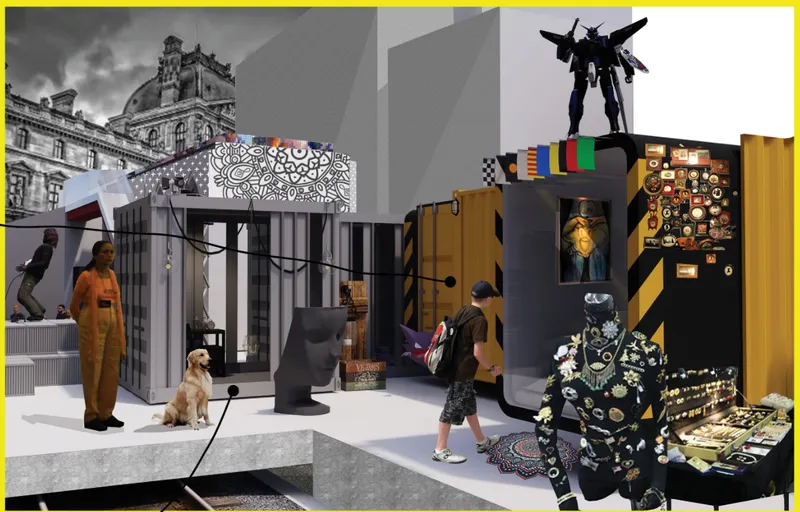
The collage of stacked shipping container stalls, complete with a pin-covered mannequin, a seated dog and a passing visitor against a grey domed building, captures the scheme's commercial layer. Containers are repurposed as modular units for vendors, artists and small entrepreneurs, and because they are movable, the market can reconfigure as demand shifts. The choice carries a quiet logic. A corridor that once moved goods returns to trade, and the container itself, an emblem of logistics, becomes the unit of a local economy.
This is also where the project's nostalgia earns its place. The designers draw on vintage markets, locomotives and retro aesthetics to build a narrative between past and present. Here that reads less as theming and more as continuity: the corridor's industrial character is kept visible while its users change from freight operators to tourists, residents, artists and makers. The flexibility is the strategy; the site is meant to evolve rather than be finished.
A Living Wall That Holds the Night
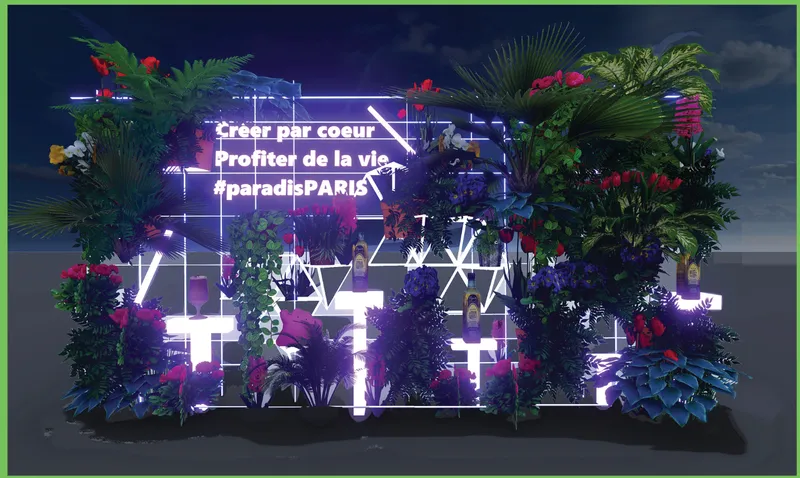
Against a dark sky, a planted wall of ferns and red flowers wraps around a glowing grid sign lined with bottles. It is a small vignette, but it shows how the proposal softens hard infrastructure. The red of the blossoms picks up the red of the neon, so planting and lighting read as one palette, and the wall works as both a backdrop and a bar-like moment of pause along the route.
The designers describe the night as the moment when lighting becomes the defining feature, with illuminated rails, performance stages and installations producing an immersive atmosphere. This image suggests that atmosphere is not only spectacle. Greenery, warm glow and intimate scale offer places to linger between performances, which is what keeps a nighttime venue from feeling like an empty stage between shows.
Climbing Out of the Cutting
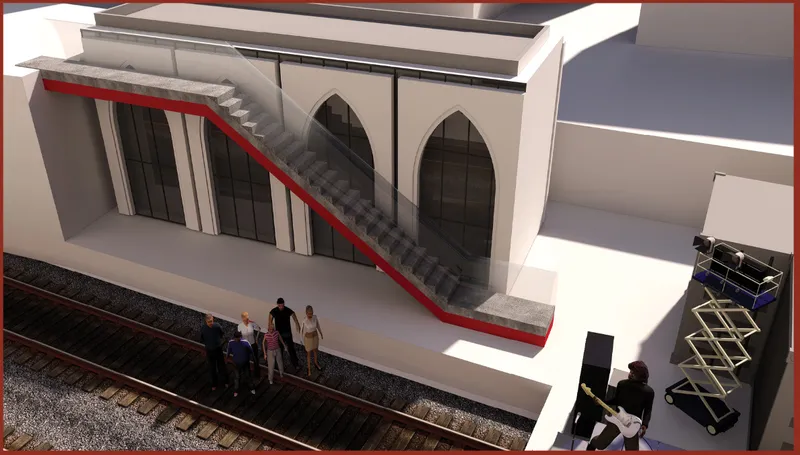
The aerial view introduces a concrete stair with a red underside rising along a pointed-arch facade above the tracks, with a guitarist and a scissor lift nearby. The stair addresses the corridor's chief spatial flaw head on. A railway alignment is rigid by nature, and the designers respond by introducing north-south connections that cut across it, making the site more permeable and letting people move fluidly from neighbourhood to track and back again.
The red underside ties the stair into the same visual language as the neon rails, so new circulation reads as part of one system rather than an add-on. The scissor lift is a telling detail too: it hints at a site in constant setup, where installations, exhibitions and events are assembled and dismantled. During the day the corridor works as a marketplace with galleries, cafés and workshops; at night it turns into a venue. Elements like this stair make that switch possible by keeping the corridor connected to the streets around it at every hour.
Why This Project Matters
Incandescence resists the temptation to over-design. Rather than paving over the rails or burying them under a landscaped promenade, the team keeps the industrial artefact intact and adds a light, reversible layer of neon, cubes, containers and connections. That restraint is the project's strongest argument. Adaptive reuse often loses the very character it sets out to save; here the tracks remain the protagonist, and the interventions can shift as the neighbourhood's needs change.
The proposal also understands that activation is as much about programming as about form. By planning for distinct day and night scenarios, and for users ranging from tourists to local entrepreneurs, it treats public space as something that must keep earning its audience. The broader lesson for cities with idle linear infrastructure is clear: you may not need to build much. Sometimes it is enough to connect a forgotten strip back to its surroundings, give people a reason to stay after dark, and let the old corridor glow again.
View the Full Project
About the Designers
Designers: Xiaozhen Zhang, Tang Yuanyuan, 祯 方
Enter a Design Competition on uni.xyz
uni.xyz runs architecture and design competitions year-round that reward proposals with spatial conviction and real site intelligence.
Project credits: Incandescence by Xiaozhen Zhang, Tang Yuanyuan, 祯 方 Salut Paris (uni.xyz).


Popular Articles
Popular articles from the community


Cube Design Draws an Ecological Corridor Between Two Shenzhen Hills with the Nankai Building
Beside Shenzhen's container docks, the Nankai Building pairs stacked balconies with a climbing green screen to connect two hillsides across its height.

FCC Arquitectura Expands a Portuguese Granite House with a Board-Marked Concrete Wing
In Portugal, JV House pairs a cleaned-up whitewashed and granite dwelling with a timber-shuttered concrete extension, courtyards and a garden pool.


Opera on the Sea: Driftwood Logic Shapes a Timber Opera House on Estonia's Coast
Trevor Orgill's opera house translates the entangled drift of floating timber into a civic building where wood, water, and music converge.

The Amber Palace Opera: A Geological Fiction Surfaces on Tallinn's Baltic Waterfront
Pierre Brillard reimagines a Baltic legend as a public landscape, opera house, and waterfront promenade rooted in Tallinn's coastal identity.

Similar Reads
You might also enjoy these articles
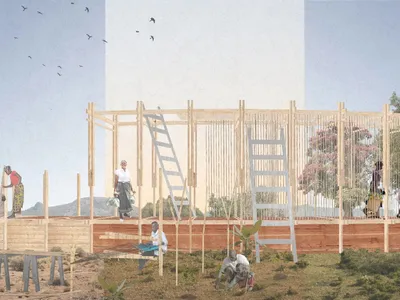
Healing Façade: A Modular Chapel System That Restores Ethiopia's Sacred Forests
Winner of the Eco-Chapel competition, this circular timber façade collects water from air to rebuild soil and reforest degraded Ethiopian landscapes.
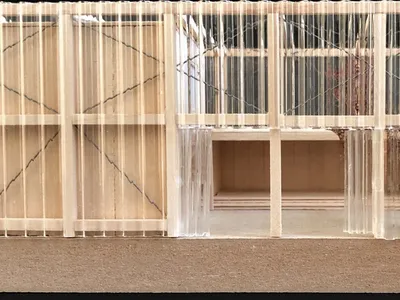
Kaffeebühnen: Where Coffee Shop Architecture Becomes a Civic Stage in Vienna
A linear sequence of timber boxes, transparent shells, and open yards turns the Viennese café tradition into a public performance space.
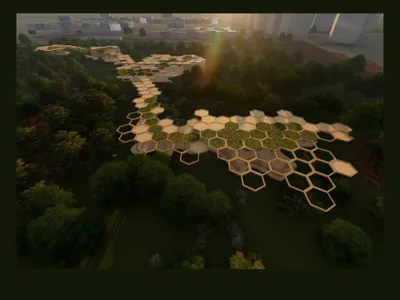
Eco Chapel: A Modular Forest Pavilion That Grows Like the Landscape It Protects
Hexagonal timber modules weave through existing trees, turning a chapel into a living system for prayer, education, and reforestation.


Urban Forest: A Vertical Ecosystem for 5,000 Workers in Singapore's Changi Business Park
Radially stacked pods and layered green decks turn a 7-acre plot into 47 acres of ecological workspace projected for 2040.


Comments (0)
Please login or sign up to add comments
No comments yet. Be the first to comment!