
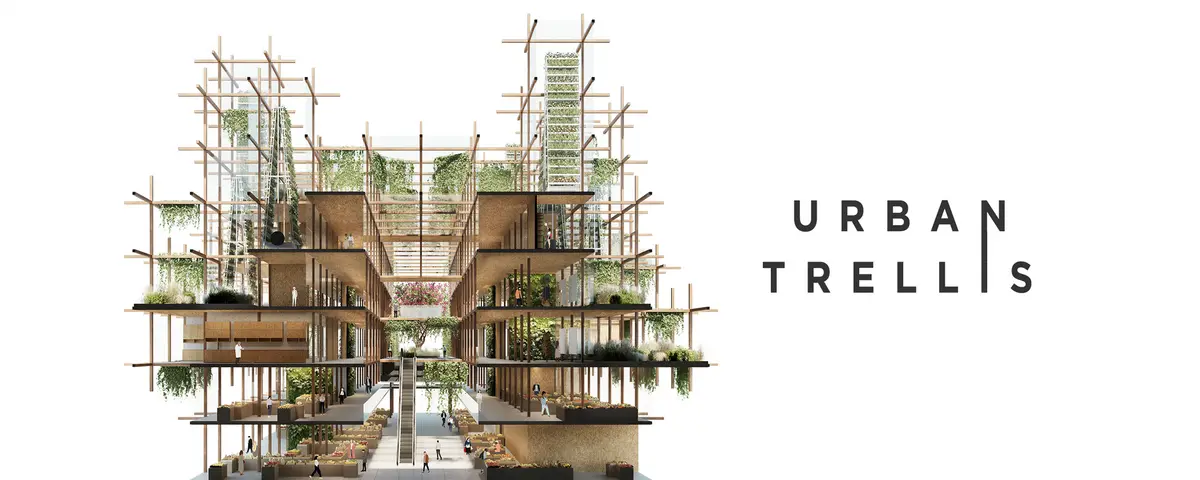
Urban Trellis: A Vine-Like Timber Framework for Hong Kong's Former Central Market
Modular acacia wood and CLT structures reclaim a historic market site as a living seed bank and vertical urban ecosystem in Hong Kong.


Hong Kong builds upward out of necessity. Urban Trellis takes that vertical impulse and rewires it, proposing a modular timber skeleton that grows not to maximize floor area but to host vegetation, seed preservation, and public life. Sited on the former Central Market, once a vital node in the city's trade and communication networks, the project replaces hard density with a porous, irregular grid that lets air, daylight, and greenery penetrate deep into the urban fabric.
Designed by Agata Mila and shortlisted in the Seed Bank competition, Urban Trellis takes its formal cue from a vine trellis: a skeletal frame designed not to be complete in itself but to support organic growth over time. The result is a building that functions as much as infrastructure for nature as it does for human occupation, layering food markets, research labs, vertical farms, and an underground seed bank into a single resilient ecosystem.
A Green Rooftop Planted Among Towers
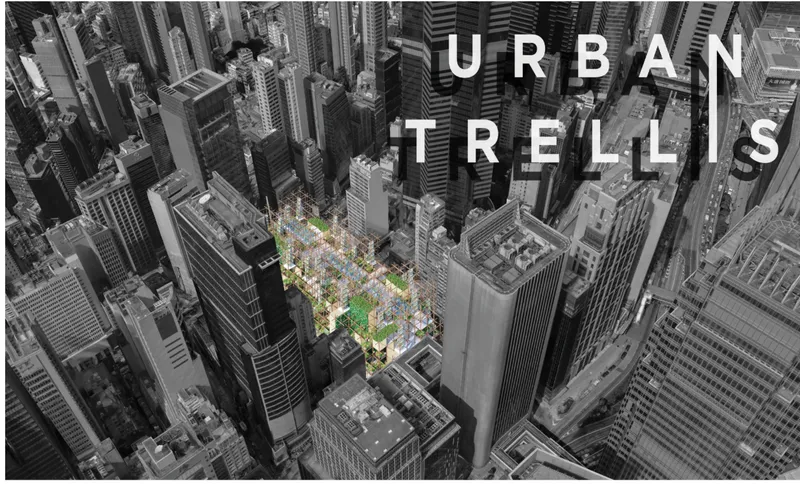
Seen from above, the contrast is stark. The planted rooftop pavilion sits low and green amid a canyon of monochrome high-rises, its vegetated surface reading as a deliberate rupture in the surrounding density. The aerial perspective reveals the project's ambition clearly: not to compete with Hong Kong's towers but to counterbalance them, inserting a living surface where the city otherwise offers only glass and concrete. The irregular footprint avoids the rigid geometries of its neighbors, hinting at the modular logic beneath.
Stacking Programs from Seed Vault to Sky Garden
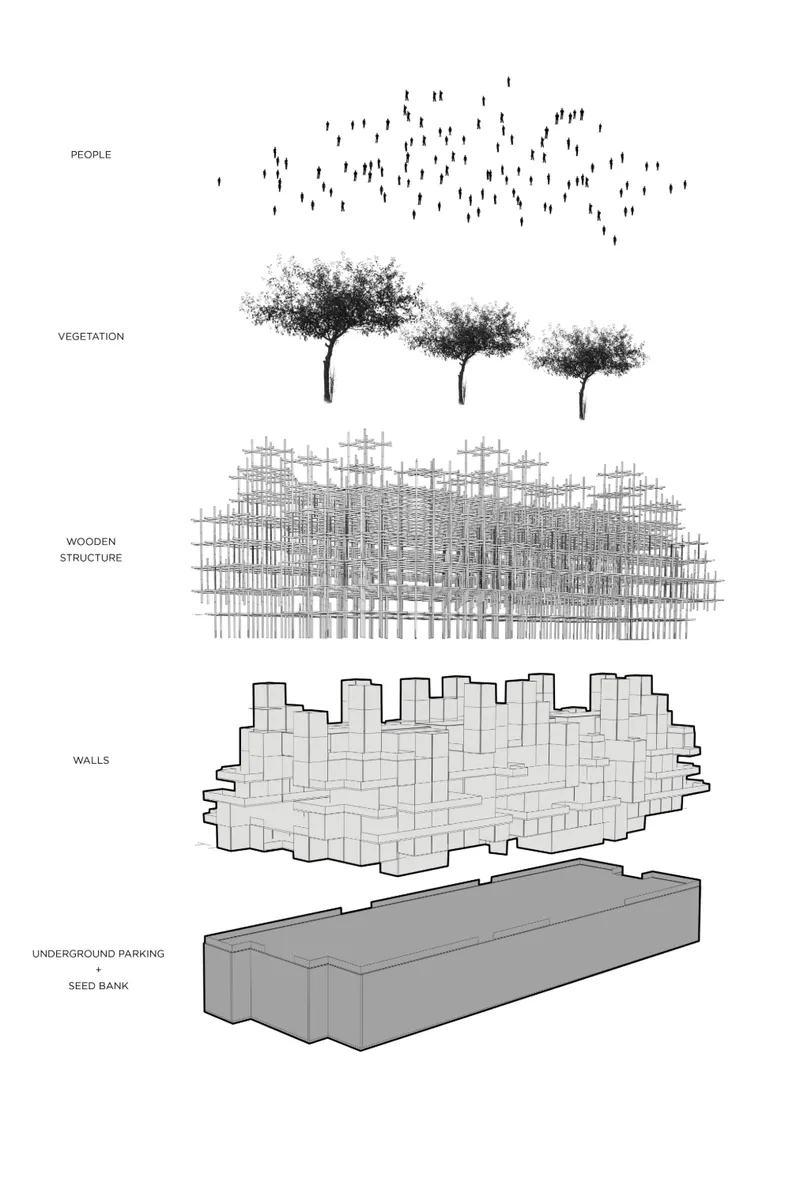
The exploded axonometric pulls the building apart to show how its programs stack. At the base, an underground seed bank anchors the project's mission of biodiversity preservation. Above ground, layers ascend through a food market, workshops, research labs, cafes, seed preservation rooms, vertical farms, and exhibition spaces. People and vegetation appear at every level, reinforcing the idea that the building is occupied as much by plants as by humans. A central void runs through the section as a multifunctional passage, connecting these layers while maintaining air circulation.
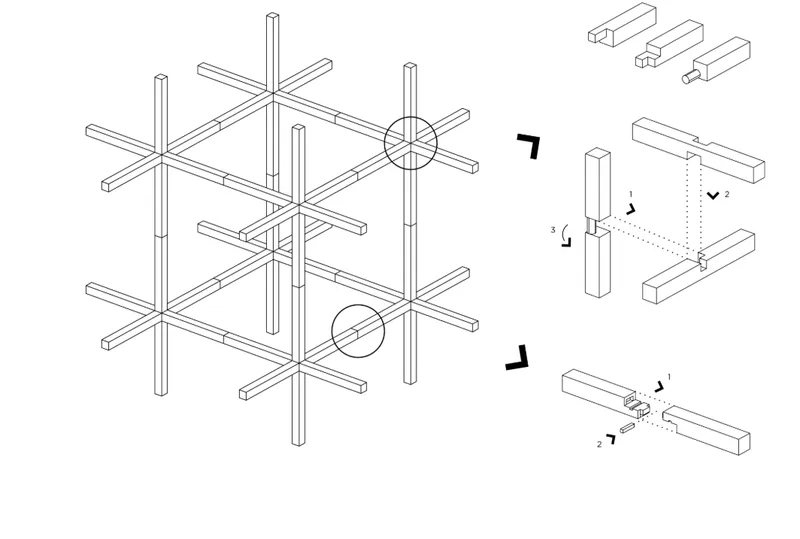
The structural isometric reveals the construction logic: a modular post-and-beam framework built from solid acacia wood and cross-laminated timber. Circular connection details at the joints suggest a system designed for disassembly and reconfiguration. The grid is deliberately irregular, allowing modules to adapt and grow over time rather than locking the building into a fixed configuration. Material efficiency is central here; the timber frame does structural work while simultaneously serving as the trellis on which vegetation climbs.
The Street as Threshold Between City and Ecosystem
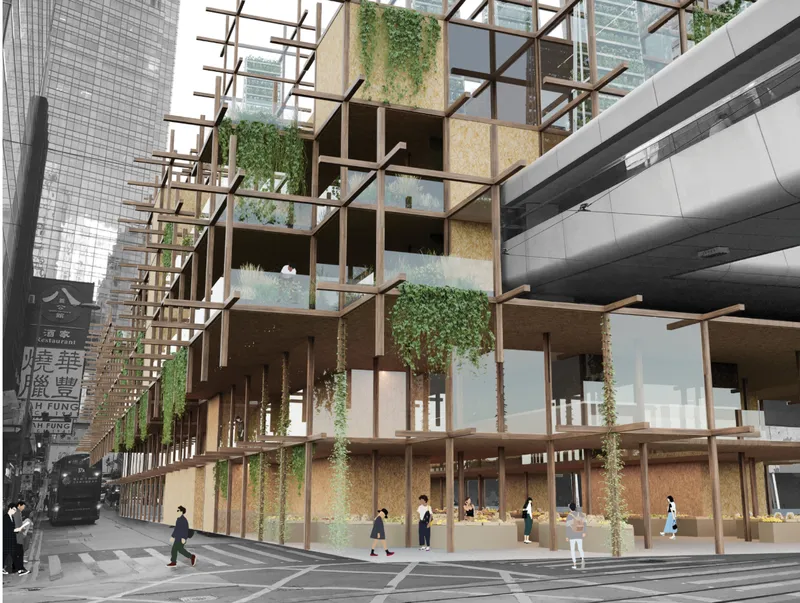
At ground level, the building dissolves into the street. The open timber grid frames planted boxes at various heights while pedestrians pass freely below, encountering the structure as a permeable canopy rather than a sealed facade. The glazed and vegetation-cloaked exterior blurs the boundary between architecture and landscape. There are no hard edges separating interior from exterior; the grid simply becomes denser or sparser as programs demand. For a site in one of the world's most congested urban cores, this porosity is a radical gesture, trading enclosure for exchange.
Nine Levels of Spatial Flexibility
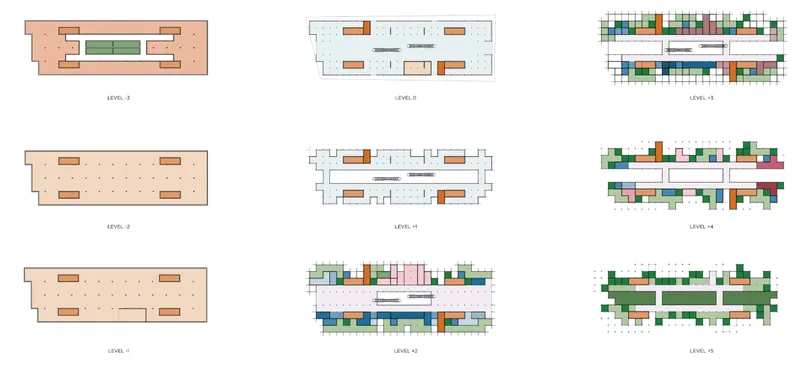
The floor plans across nine levels reveal how the structural grid accommodates programmatic diversity without forcing uniformity. Color-coded zones distinguish food markets from research facilities, exhibition spaces from seed storage, vertical farms from public circulation. The grid persists as a constant, but the spatial configurations within it shift from level to level. Some floors are densely subdivided; others open up around the central void. The flexibility is not hypothetical. The modular CLT system is designed to be reconfigured as the building's needs evolve, making the plan a snapshot of one possible arrangement rather than a permanent layout.
Why This Project Matters
Urban Trellis demonstrates that density and ecology are not opposing forces. In a city defined by the relentless pursuit of buildable area, Mila's proposal argues that a building's value can be measured not by its floor-area ratio but by its capacity to support living systems. The underground seed bank, the vertical farms, the vegetation threading through every floor: these are not decorative gestures but core programmatic commitments that tie the project to its competition brief and to urgent questions about urban food security and biodiversity loss.
What sets the project apart is its structural honesty. The trellis metaphor is not applied as ornament; it is the building's organizing principle. The acacia and CLT grid does the work of structure, facade, and planting scaffold simultaneously, collapsing those systems into a single legible framework. For a shortlisted competition entry, it presents a convincing argument that sustainable architecture does not require formal novelty so much as systemic intelligence: designing a frame that grows with the city rather than against it.
View the Full Project
About the Designers
Designer: Agata Mila
Enter a Design Competition on uni.xyz
uni.xyz runs architecture and design competitions year-round that reward proposals with spatial conviction and real site intelligence.
Project credits: Urban Trellis by Agata Mila Seed Bank (uni.xyz).


Popular Articles
Popular articles from the community


The Musturak Paradise: Senior Living Architecture for a Connected Future in Temara, Morocco
The Musturak Paradise reimagines senior living architecture in Temara via private homes, social spaces, culture, community, and shared care.

Play: Fragments of Their World
Familiar architecture becomes modular playground design, creating safe spaces where displaced children can learn, connect, imagine and play.

Co-life: Sustainable Architecture for Age-Friendly Community Living
Co-life reimagines sustainable architecture for seniors through courtyards, rammed earth, shared gardens, and spaces designed for belonging.

Lunar Spiral: Space Architecture Shaped by the Mathematics of the Universe
Lunar Spiral reimagines space architecture through Fibonacci geometry, lunar regolith, levitating habitats, and self-sustaining Moon living.

Similar Reads
You might also enjoy these articles

Day and Night Park: A Time-Based Urban Newsstand in Beijing
A temporary urban newsstand in Beijing blending travel, light, and reading through poetic colors, compact form, and community-focused design.

Modernist Patio Renovation in El Masnou, Barcelona by Oliver Segura Arquitectura + Cebrià Arquitectura
Modernist patio renovation blending tradition and innovation with a movable pool, leveled floors, and Catalan materials in El Masnou.

Alto Residencial Coop: Cooperative Housing Development in Santiago de Compostela by Carbajo Barrios Arquitectos
A linear cooperative housing complex blending white volumes and perforated metal façades, enhancing community living, natural light, privacy, and urban integration.

Vil Genis School by BPA ARCHITECTURE – Massy, France
Vil Genis School in Massy, France, features sustainable design, south-facing classrooms, community integration, accessible spaces, and modern educational architecture.


Comments (0)
Please login or sign up to add comments
No comments yet. Be the first to comment!