

+us: Turning Calgary's Elevated Walkways into Ground-Level Public Life
A modular intervention beneath Calgary's Plus-15 bridges transforms 83 vacant underpasses into activated community micro-spaces using adaptive reuse.


Calgary's downtown empties out every evening. The towers stay lit, but the streets go quiet. A 14-kilometer elevated walkway system called the Plus-15 Network, once lauded as a climate-responsive pedestrian solution, has inadvertently drained the ground plane of foot traffic and street life. The infrastructure that was supposed to connect buildings has disconnected people from the city itself. With a 26.5% downtown office vacancy rate, the problem is not a shortage of built space. It is a shortage of reasons to be there.
+us, a People's Choice Award entry in the Urbanscape: Symbiosis competition, takes aim at exactly this condition. Designed by Alea Reid and Isabelle Jackson, the project reframes the dim, overlooked spaces beneath 83 Plus-15 bridges as sites for community activation. Rather than proposing new construction, the designers deploy modular, lightweight installations that attach to existing infrastructure without permanently altering it. The result is an urban strategy that is scalable, reversible, and deeply social.
A Downtown That Disappears After Five

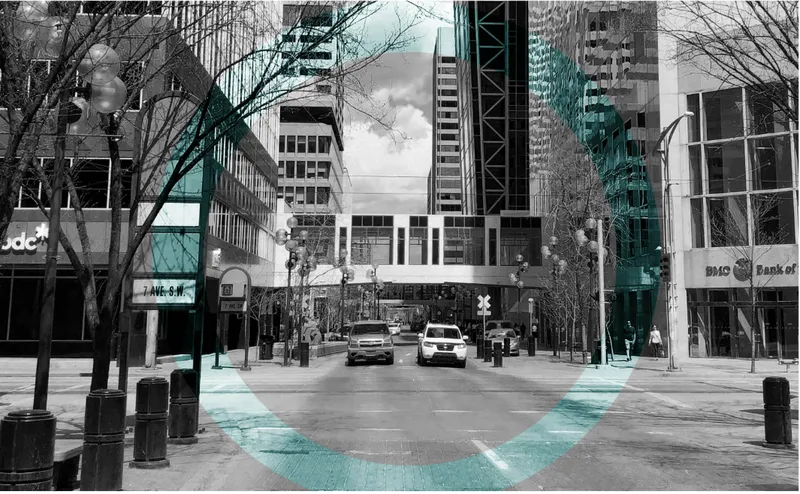
The panoramic skyline view reveals Calgary's corporate core in its full vertical ambition: tower clusters rising above a low-slung residential foreground, the colored graphic overlays mapping the density and distribution of the Plus-15 system across the downtown grid. At street level, the picture shifts. A winter corridor stretches ahead, lined with bare trees and vacant pavement, the colored overlay patterns tracing the pathways where pedestrian life should be but rarely is. Together, these images establish the core tension of the project: a city with enormous built infrastructure and almost no ground-level vitality outside business hours.
Reid and Jackson use this analysis to argue that the problem is one of activation, not absence. The downtown has sidewalks, plazas, and covered passages. What it lacks are reasons for people to linger, sit, or interact. The Plus-15 system, by routing foot traffic above grade, has turned the street into little more than a car channel. +us proposes to reverse this equation by making the underside of each bridge a destination rather than a dead zone.
Parasitic Installations on Elevated Infrastructure
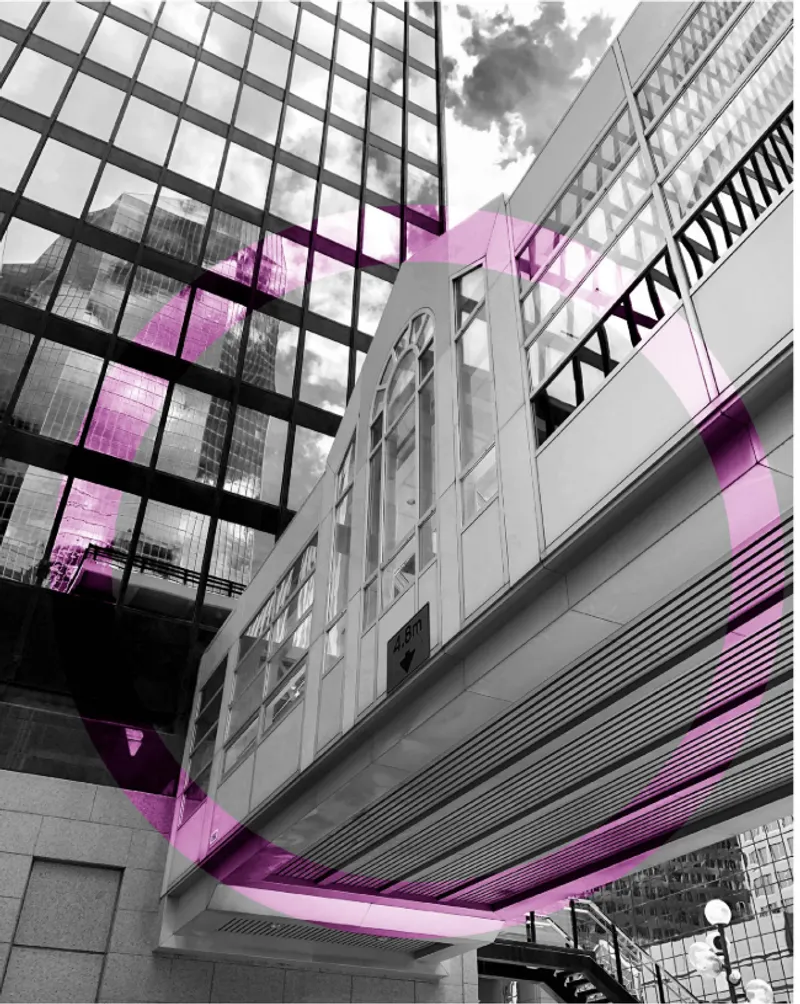
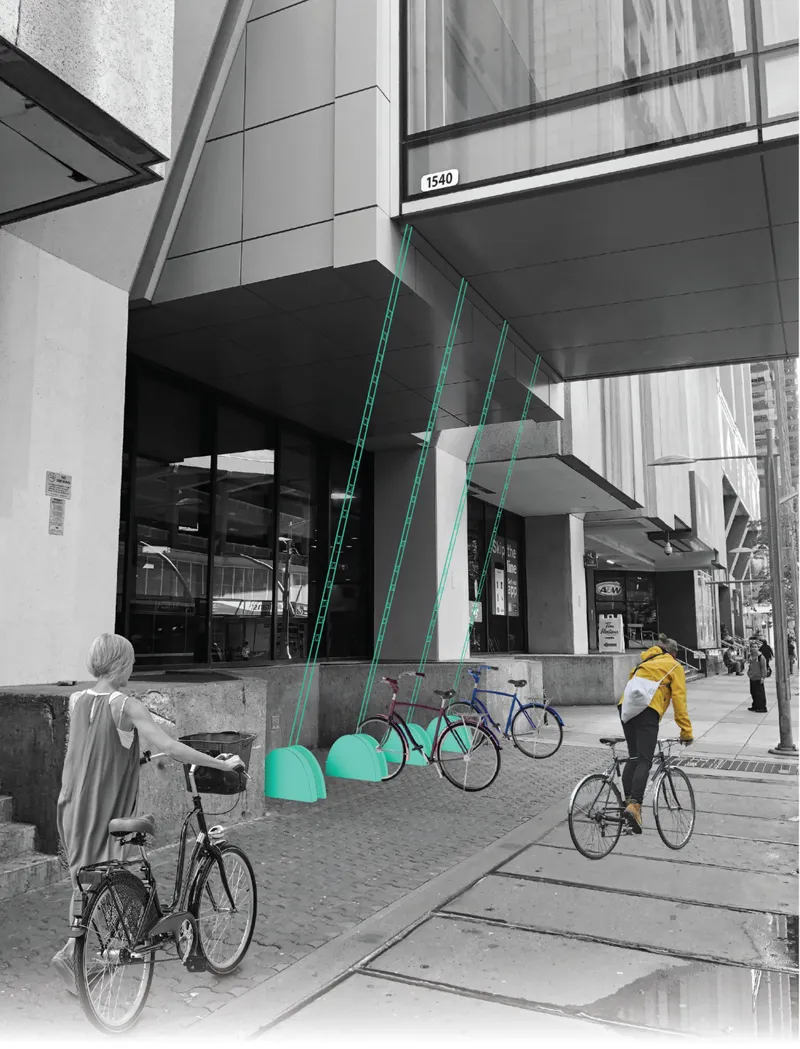
Looking upward at a glass curtain wall facade and the underside of a Plus-15 bridge, you can see the architectural opportunity that most pedestrians walk past without noticing. The bridge creates a canopy, a sheltered zone between buildings that currently serves no programmatic purpose. The colored overlay accents in the rendering hint at where modular elements could attach: hanging chairs that double as tables, kinetic installations for children, and sculptural bike racks, all suspended from or affixed to the existing structural frame.
At ground level, the entrance canopy with its angled supports already frames a covered passage where cyclists pass on the sidewalk. The designers read this as readymade infrastructure for intervention. The material palette reinforces the parasitic logic: acrylic panels refract color onto concrete surfaces, dyed rope and macramé knots provide a unified visual and structural language, and all components are locally sourced and recyclable. Nothing is permanent. Every element can be removed, relocated, or reconfigured, making the system viable across all 83 bridges in the network.
Micro-Spaces for Sitting, Swinging, and Planting
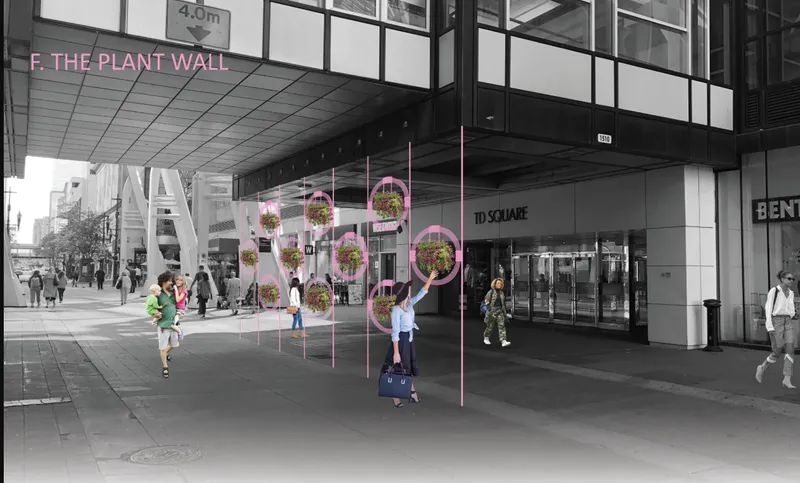
The public plaza rendering shows the most developed scenario: suspended circular planter elements hang beneath a glazed overhang while pedestrians move through the space below. Plant walls for community gardening, vibrant seating, and interactive surfaces transform what was a pass-through corridor into a place people choose to occupy. The interventions are deliberately tactile. You can sit, swing, rest, or plant a flower. Each action is small, but the cumulative effect is a reactivated streetscape where shared experience replaces disconnection.
The scalability here is the real architectural proposition. A single installation beneath one bridge is a pleasant surprise. The same system deployed across a city-wide network of 83 bridges becomes a new layer of urban infrastructure, one that operates at human scale rather than vehicular or corporate scale. The modularity of the components means that individual neighborhoods can customize their installations, turning a standardized system into a collection of distinct micro-identities along the Plus-15 corridor.
Why This Project Matters
+us makes a compelling case that the most effective urban interventions do not require new buildings. Calgary already has the infrastructure; it just needs someone to look at it differently. By treating the Plus-15 Network as a structural host rather than a pedestrian highway, Reid and Jackson propose a form of adaptive reuse that is lighter, faster, and more socially responsive than conventional redevelopment. The 26.5% vacancy rate is a statistic about offices, but the real vacancy is on the streets below them.
What distinguishes this entry is its refusal to treat public space as a design object. The hanging chairs, plant walls, and kinetic elements are not decorative additions. They are social catalysts, each one engineered to provoke a specific form of engagement: sitting, swinging, gardening, locking up a bike. In a city where the elevated walkway system has trained people to avoid the ground plane entirely, +us offers a persuasive counter-argument: that the space beneath our feet, and beneath our infrastructure, is worth inhabiting.
View the Full Project
About the Designers
Designers: Alea Reid, Isabelle Jackson
Enter a Design Competition on uni.xyz
uni.xyz runs architecture and design competitions year-round that reward proposals with spatial conviction and real site intelligence.
Project credits: +us by Alea Reid, Isabelle Jackson Urbanscape: Symbiosis (uni.xyz).


Popular Articles
Popular articles from the community

Tsunami Convergenics: Turning Catastrophic Ocean Forces into Underwater Housing Infrastructure
A speculative underwater settlement off the coast of Onagawa, Japan, treats tsunamis and typhoons as energy sources rather than threats.
Cloaked Colonization: A Mobile Underwater Habitat That Moves Like a Fish
Micah Abaya's shortlisted EHC Pacific entry reimagines ocean settlement as a dispersed network of self-sustaining architectural organisms.

The Amber Palace Opera: A Geological Fiction Surfaces on Tallinn's Baltic Waterfront
Pierre Brillard reimagines a Baltic legend as a public landscape, opera house, and waterfront promenade rooted in Tallinn's coastal identity.
Faces of the Soviet Avant-Garde: Turning Moscow's Street Names into an Open-Air Museum
A network of sculptural installations across a Moscow residential district transforms forgotten architect names into spatial encounters with cultural memor

Similar Reads
You might also enjoy these articles

Pixel Gardens: One Repeated Module Stacked Into a Terraced Social Housing Tower for Famagusta
Salem Bader's shortlisted housing tower builds a vertical neighbourhood from one repeated module, offsetting units to carve terraces, light and air.

Bao Huynh Watercolor Atelier: A Serene Art Retreat in Hội An
Bao Huynh Watercolor Atelier in Hội An blends multifunctional art spaces, sustainable design, local materials, and family-friendly living in a serene environment.

Atelier Macri Concept Store Interior Design by CASE-REAL
Atelier Macri store features a "ko" counter, walnut wood details, cork displays, blending retail, gallery, and seamless customer experiences.

Manuel Vargas Izquierdo Stadium and High-Performance Sports Center: Architectural Excellence in Jalpa de Méndez
The Manuel Vargas Izquierdo Stadium blends sustainable design, inclusive sports facilities, and cultural-inspired architecture, revitalizing Jalpa de Méndez’s public spaces.

Comments (0)
Please login or sign up to add comments
No comments yet. Be the first to comment!