
V - FARM
V-farm is a modular unit which aims to create a new typology that can propose a new way of farming in an urban environment.

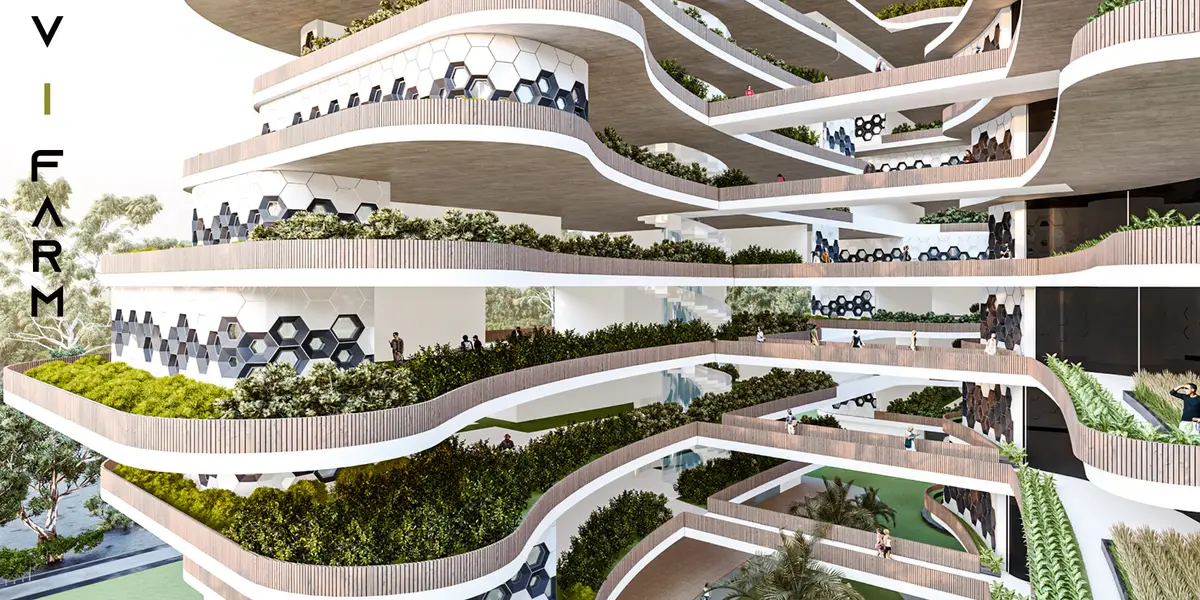
V-farm is a modular unit which aims to create a new typology that can propose a new way of farming in an urban environment. Its a project that comprise living around farm units by creating modules that can be applied to different sites. This new proposal accomodates various design parameters such as sustainable farming practices, minimum active system usage, renewable energy sources, experimentation, innovational farming approach, zero carbon foot print, modularity, flexibility, efficiency, holistic approach to accomadation units. Its a different approach to the use of the land to gain maximum capacity. To achieve this land use a vertical design was proposed. Every module is grouped by function in vertical scale and then connected by bridges in horizantal scale. Proposed design provides a new way of farming because it integrates a function that is traditionaly located in rural areas to urban environments. This integration is possible due to vertical connection of the modules and its compact land use.
This vertical design consist of four units of modules and each units are seperated trough spatial and functional requirements. Accessibility becomes a major concept in the form of this modules. Flats are proposed as detached house with ther own gardens and each dwellings seperated with social areas. It allows individuals to have a to sense of belonging and the feel of ‘’home’’to their household whilst making their work environment much more accessible.
The general forms proposed for differentiate each layers to provides individual various spatial experience. As it is also a place where people can experince how farming can be implemented in an urban environment both in traditional ways and with new technologies.
Residential, farming and livestock units have moduler facade technology. This facade system aims to use solar energy without losing its original function. While its glass surfaces are functioning as normal windows and provides its users with fresh air and day light the white metallic surfaces contains solar panel system. This panels proposed as hexagons to imply on curvilinear angles. Each units have different daily light needings because of their functions. Therefore three types of facade typology are suggested. The main purpose is to maximize energy sufficency and minimize active energy usage.
To further maximize the individual based design approach and enhance the users belonging each hexagon glass panels design with kinetic frame attributes. The system works like camera lenses. The glass surface’s levels can be change by using each glass panel’s frames central motion. This maximize the users adaptation and optimum mental state. Its also allow make adjustments based on the spatial needs of farming and livestock units.
The farming unit consist of two different spatial typology. The main purpose of this seperation is to create an area with maximum efficiency for production’s environmental needings. Whilst outdoor area gives opportunuity to users experience of growing farm in semi open space in a traditional way, the indoor space provides both vertical farming technologies and experimental studies under the controlled climate conditions.
Since the main purpose is the improve the farm sufficiency and capacity, new method of farming technologies such as hidrophonic gardening systems, smart irrigation apllies, data feeds, smart harvesting systems, are applied. With the spatial gains by vertical usage and technological implies, responsibility of food supply used to be on individuals of rural areas is distributed between new actors in urban environment.
The process of farming has four actor with different roles of new farming typology and each actor has different steps. These actor actions co-exist in an environment where each steps impacts one another.
In addition of new farming technologies, a new approach suggested for livestock. Different farm animal spices are locate different levels of livestock units based on their transportation needings. The semi-open and closed spaces are seperated with resemble idea as farm unit. Semi-open spaces works like open areas that gives opportunity to animals for roam freely. Closed spaces was design in order to create a climate controlled area for optimum life conditions of animals.
Since the main purpose is to improve the livestock sufficiency, functionality is emphasized and new approach is developed such as biomass, data feeds, smart animal care system, technological poultry implies, sustainable production.
With this new ecosystem, giving care to other living beings improves individuals belonging, meaningfullness, responsibility, relaxation etc. Furthermore it provides economic, social and sustainable benefits that enhances the food production. Eventually all of these elements generates an interconnected system and each unit works as part of it.

Popular Articles
Popular articles from the community


Faces of the Soviet Avant-Garde: Turning Moscow's Street Names into an Open-Air Museum
A network of sculptural installations across a Moscow residential district transforms forgotten architect names into spatial encounters with cultural memor

The Amber Palace Opera: A Geological Fiction Surfaces on Tallinn's Baltic Waterfront
Pierre Brillard reimagines a Baltic legend as a public landscape, opera house, and waterfront promenade rooted in Tallinn's coastal identity.
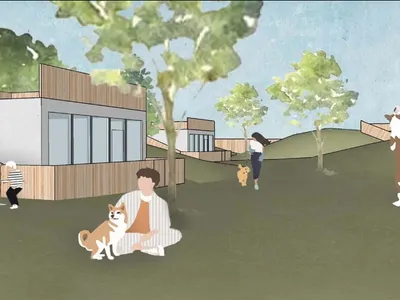
Temporary Home for Dogs: A Reversed Zoo Rethinks Animal Shelter Architecture
In Bucharest, a sinuous corridor and freed landscape flip the logic of containment, designing a shelter that works to make itself unnecessary.

Manzana Morphosis: Stretching Barcelona's Grid into a Living Landscape for 2050
A radical reworking of the Eixample manzana turns density into a tool for generous public space, vertical ecology, and environmental performance.

Similar Reads
You might also enjoy these articles
The Rhythm of Seasons
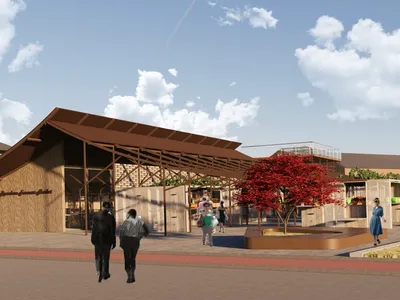
A Farmers' Market Connecting Nature and the City

More Than a Building-Designing a Living System
More Than a Building-Designing a Living System
Base Beyond
DESERT COMPOUND ARID: TOURISM OF ABSENCE AND ABUNDANCE

Explore Modular Farm Competitions
Discover active competitions in this discipline


Challenge to reimagine the Iron Throne

Photograph architecture without architects

Illustrate the lost glory of Angkor Wat - Render Challenge

Design challenge to reuse E-waste
Comments (0)
Please login or sign up to add comments
No comments yet. Be the first to comment!