

Vallribera Arquitectes Tucks a Full Family Home Inside a Single-Storey Row House Near Barcelona
A blue steel mezzanine, exposed brick, and clever passive strategies turn a modest Vallès terrace into an A-rated family home.


The story starts with a familiar trade-off. A young couple in Barcelona wants a house with a yard. The city says no, at least not at their budget. So they look outward to the Vallès Occidental, where a modest single-storey row house wedged between two taller neighbours offers something the capital cannot: a roofline high enough to hide an entire second floor. Vallribera Arquitectes took that geometric gift and turned it into a 90 m² family home with two bedrooms, two bathrooms, a study, and a courtyard, all without altering the building's original footprint.
What makes 105JON worth studying is the way economy becomes an aesthetic. Every constructive decision doubles as an interior design decision. The new steel structure is painted a saturated blue and left fully exposed. Oriented strand board lines the mezzanine soffit and the storage walls, unapologetic about its industrial origins. The existing brick party walls stay bare on the ground floor, where moisture management matters more than insulation. The result is a home where you can read every material choice as a direct answer to a constraint, budget, physics, or programme, rather than as decoration.
The Blue Frame
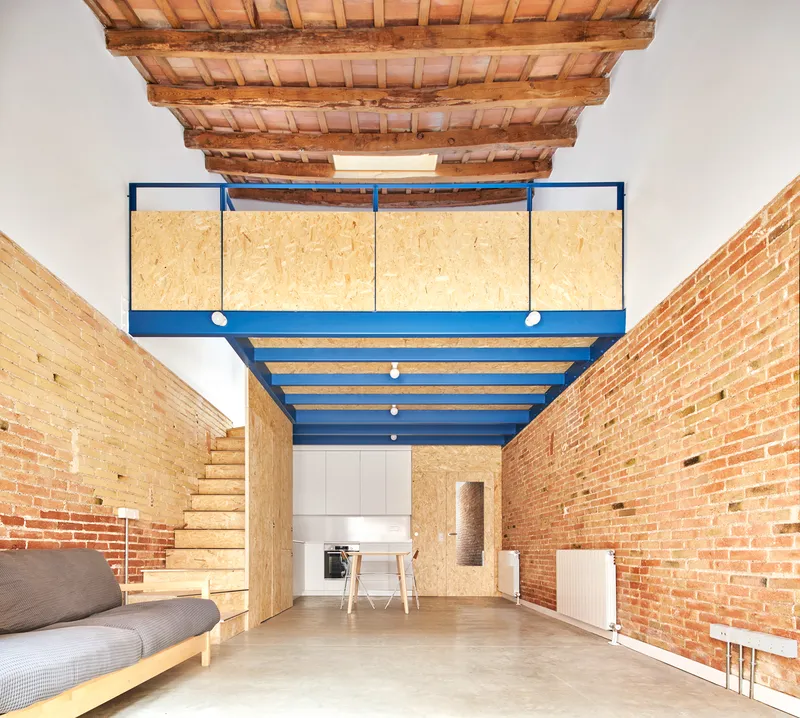
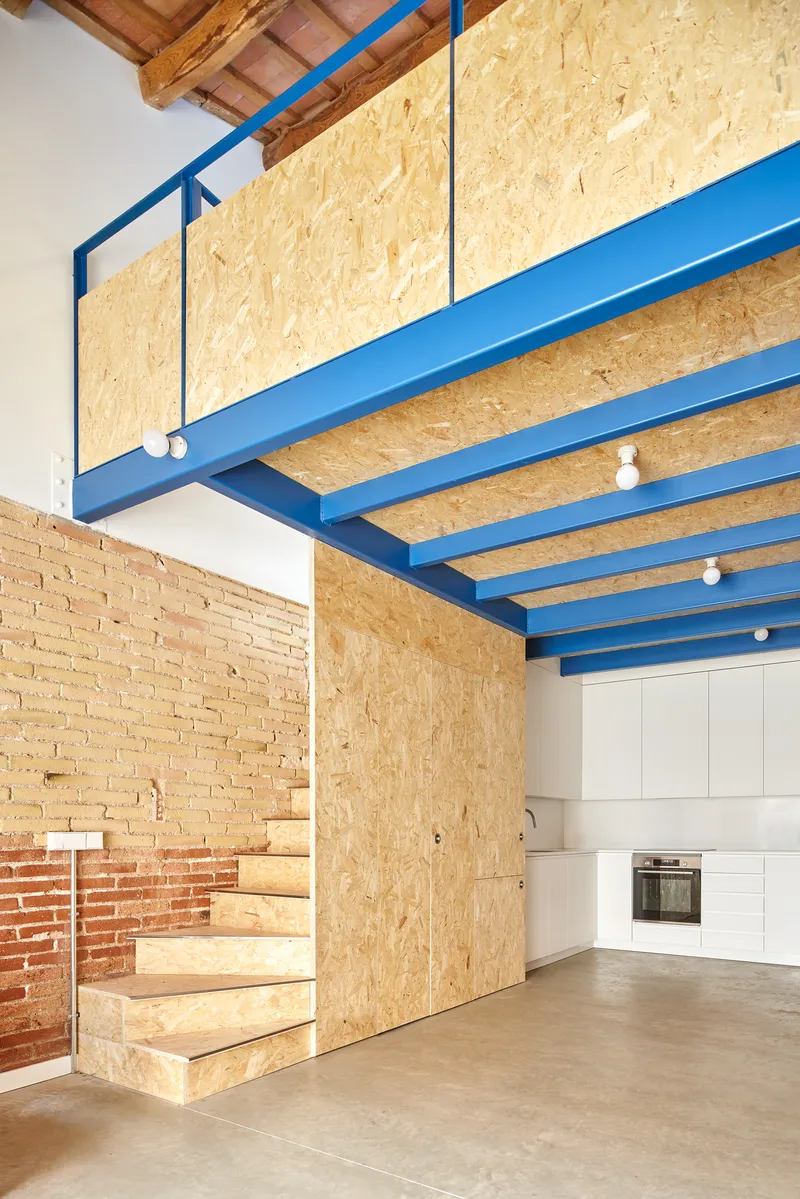
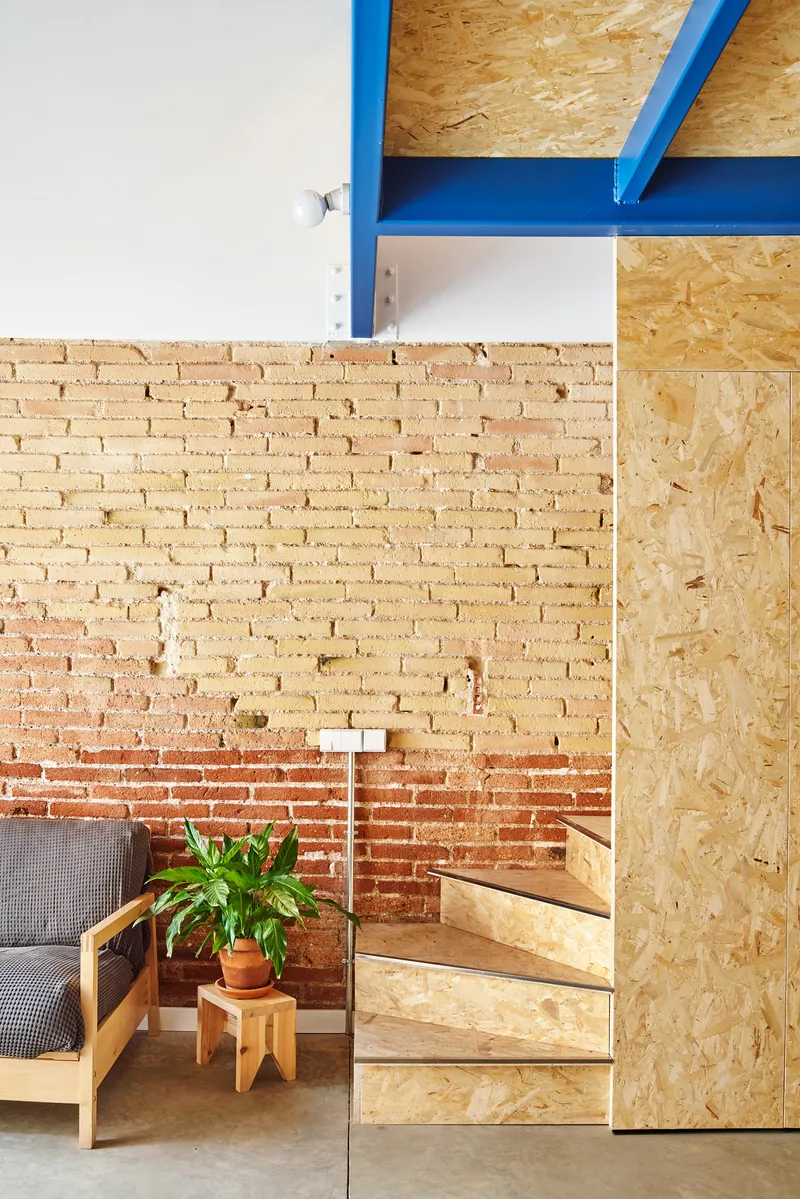
The mezzanine structure is the project's signature move. Blue-painted steel beams span between the load-bearing party walls, carrying a new upper level made from OSB panels. The colour is bold enough to read as deliberate rather than incidental, marking the new intervention against the warm tones of brick and timber above. It also keeps the ground floor feeling open: rather than boxing in the kitchen and dining area, the steel frame visually connects the two levels while clearly announcing that the upper volume is an insertion, not an original feature.
Painting steel is cheap. Cladding it in plasterboard would have been more conventional but would have erased the most legible record of how the house was remade. By leaving the structure exposed, Vallribera Arquitectes lets the construction sequence tell a story. You see the old roof, you see the new beams, and you understand immediately how one generation of building supports the next.
Ground Floor: Brick, Concrete, and Open Air
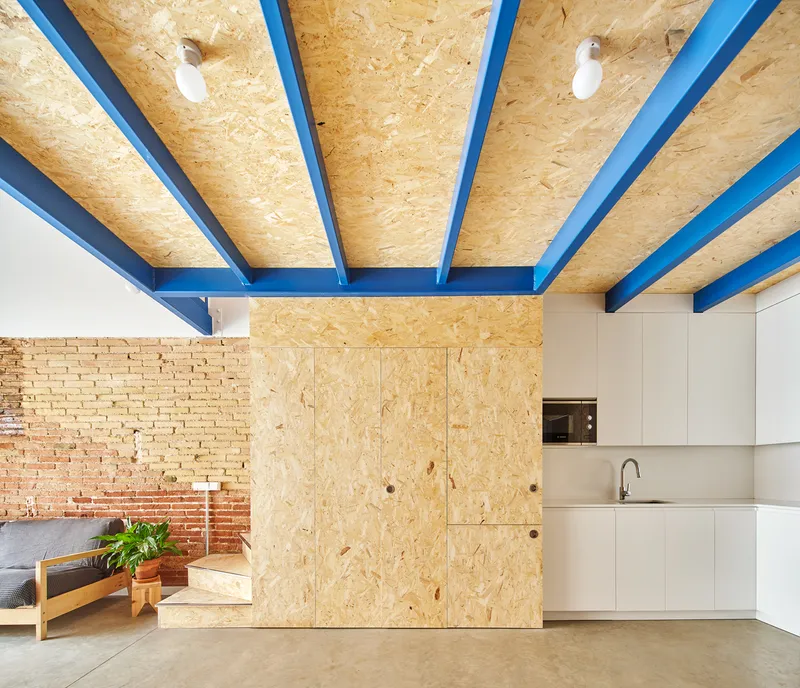
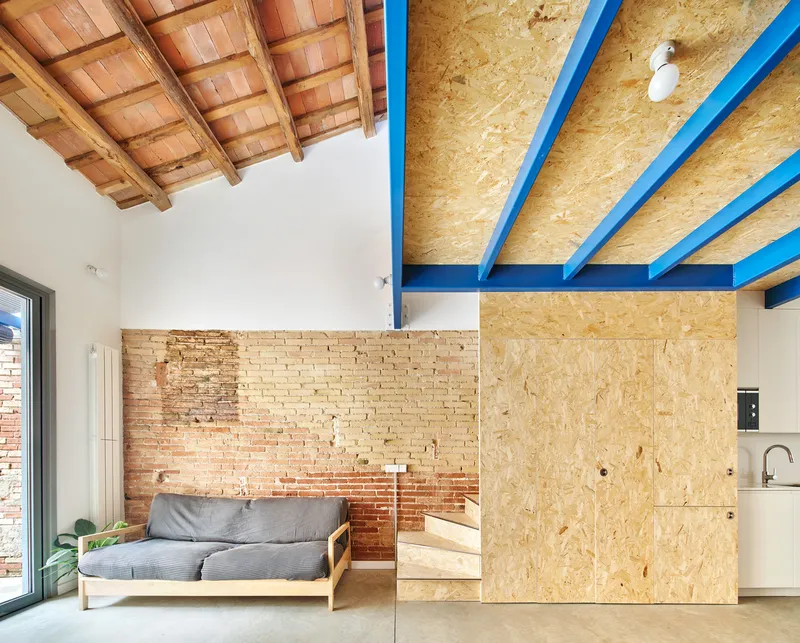
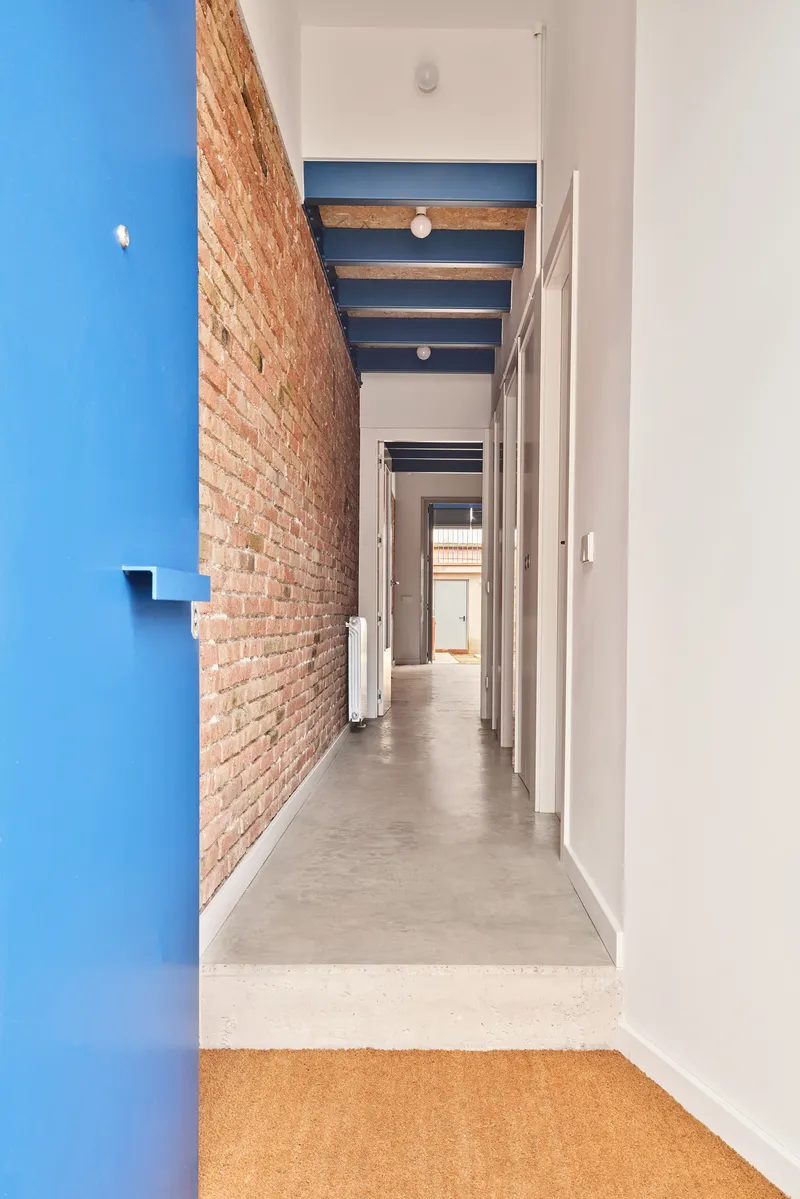
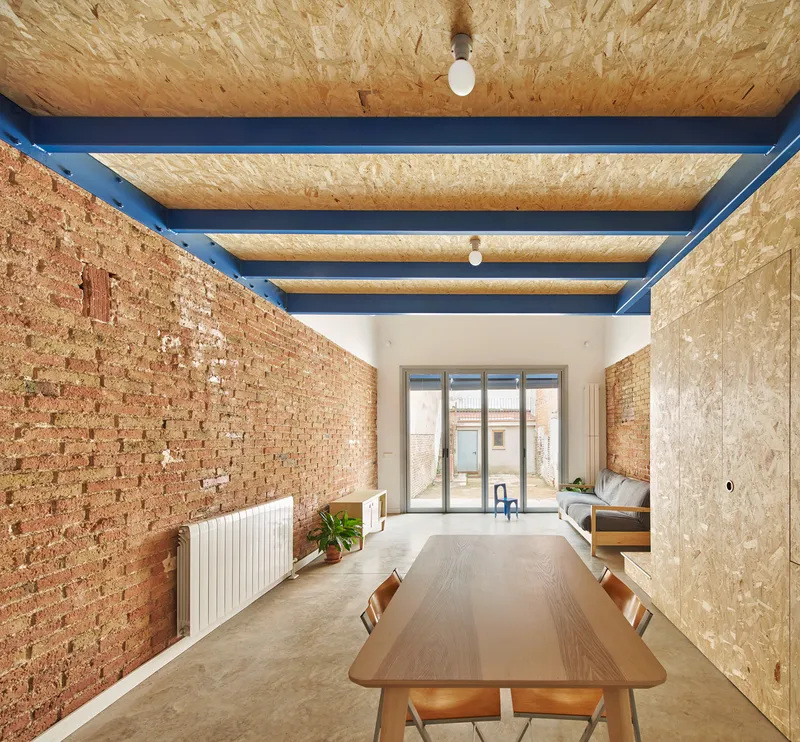
At ground level the plan is deliberately linear, following the narrow lot between its party walls. A polished concrete floor runs the length of the space, providing thermal inertia that stores coolness in summer and warmth in winter. The brick walls are left uninsulated here, a deliberate choice to avoid trapping moisture in a traditionally ventilated masonry assembly. Insulation is applied only where it can perform without risk: in bedrooms, in the roof, and in the new floor slab.
The exposed brick gives the ground floor a textured, almost archaeological quality. It contrasts sharply with the smooth concrete underfoot and the crisp OSB overhead. A narrow corridor lined with one wall painted blue and the other left as raw brick captures the project's material philosophy in a single frame: old and new coexist without pretending to be the same thing.
The Courtyard as a Room
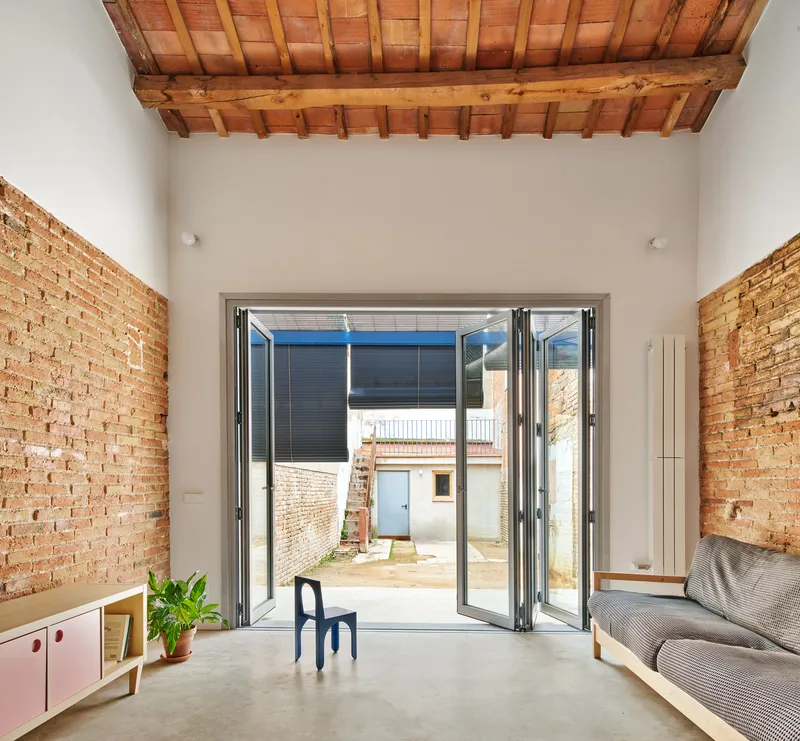
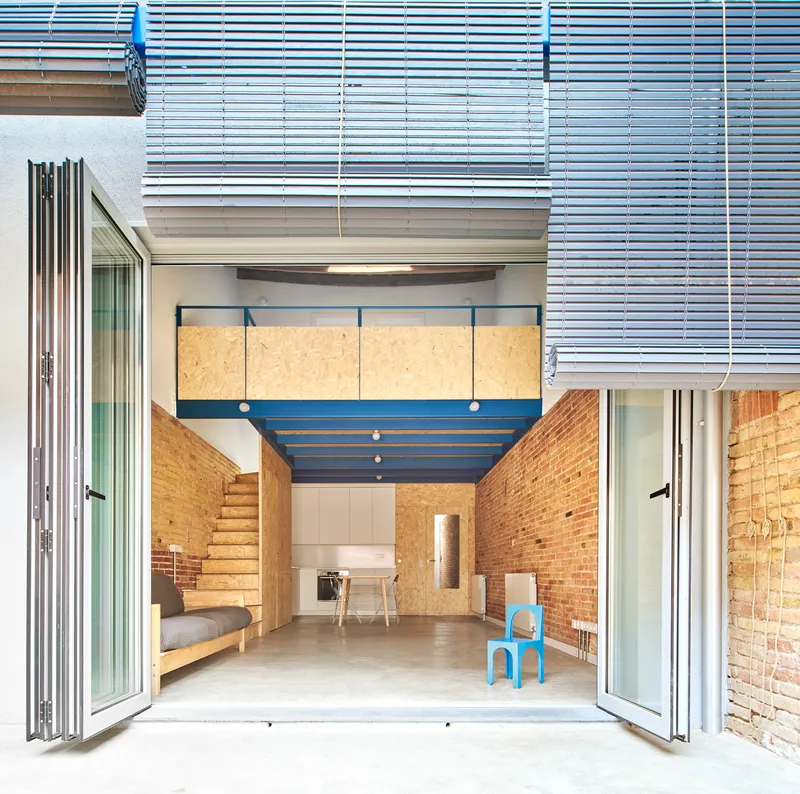
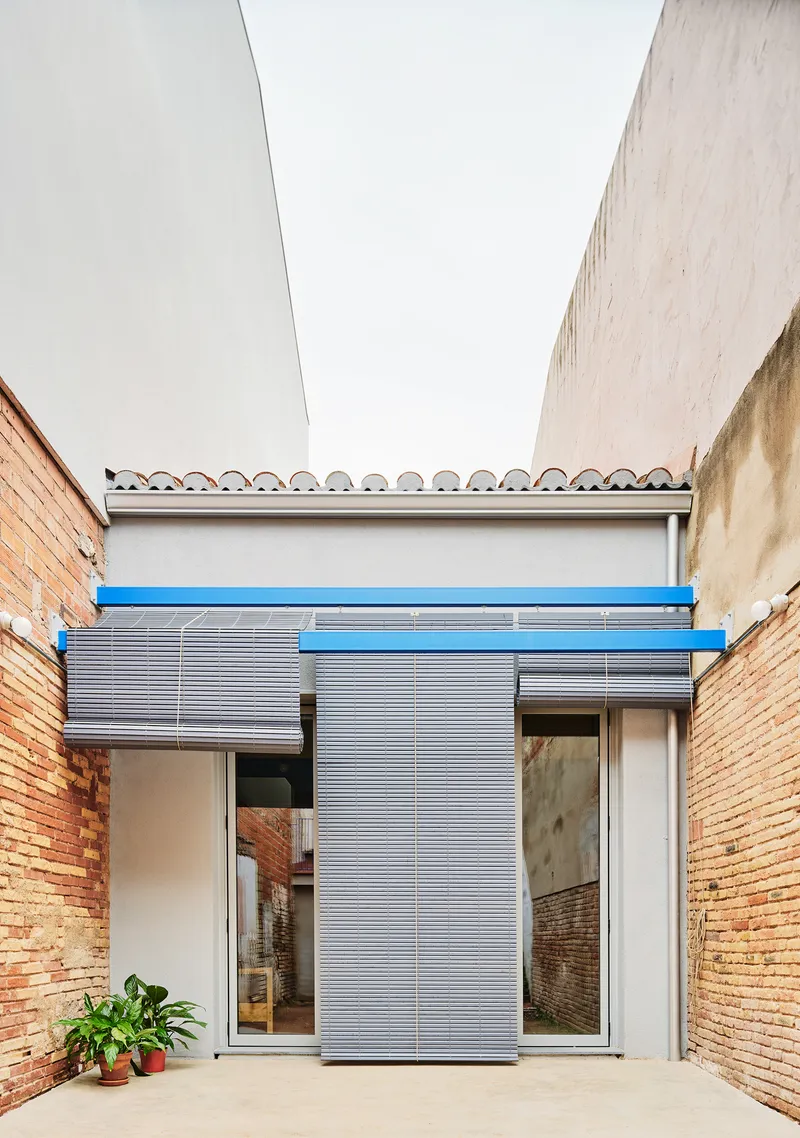
Folding glass doors dissolve the boundary between the kitchen-living area and a walled courtyard at the rear. The yard is no afterthought; it is the primary source of daylight and ventilation for the lower floor. Flanked by the same exposed brick party walls that define the interior, the courtyard reads as a roofless extension of the house rather than an exterior garden. A metal louvered canopy with roller blinds doubles as a pergola, offering sun protection without blocking airflow.
From outside, looking back into the house through the open doors, you see the full section at once: concrete floor, blue steel, OSB ceiling, timber rafters. It is one of those rare moments in a small project where the architecture reveals its entire logic in a single glance.
Mezzanine Life
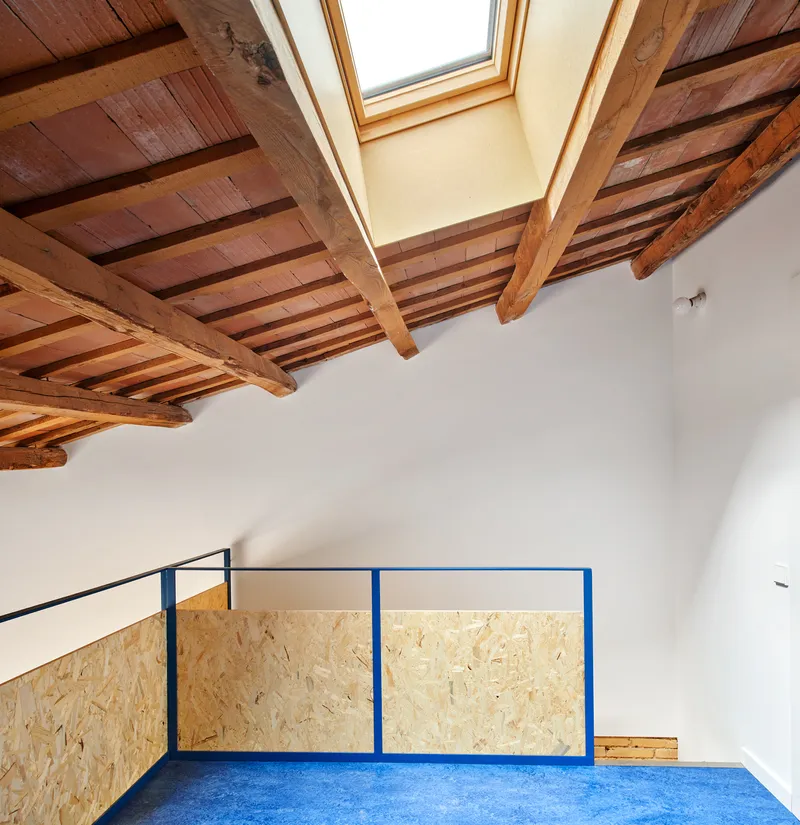
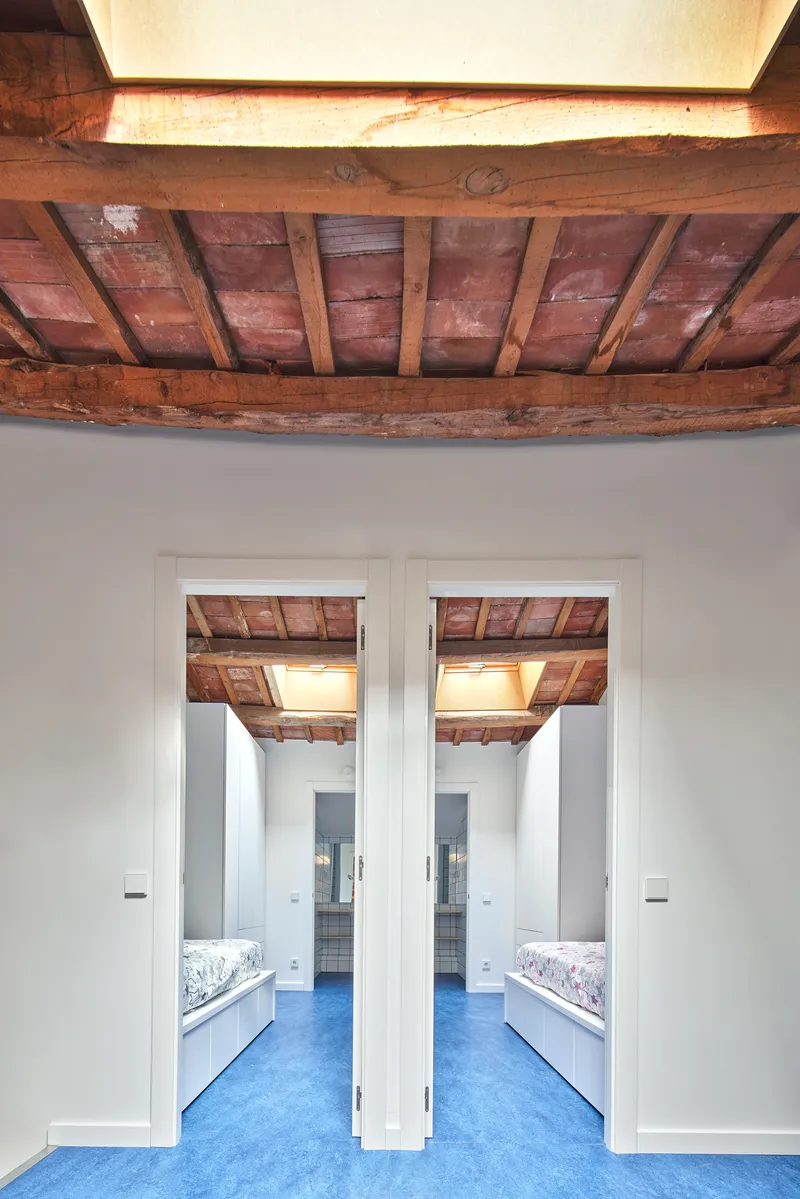
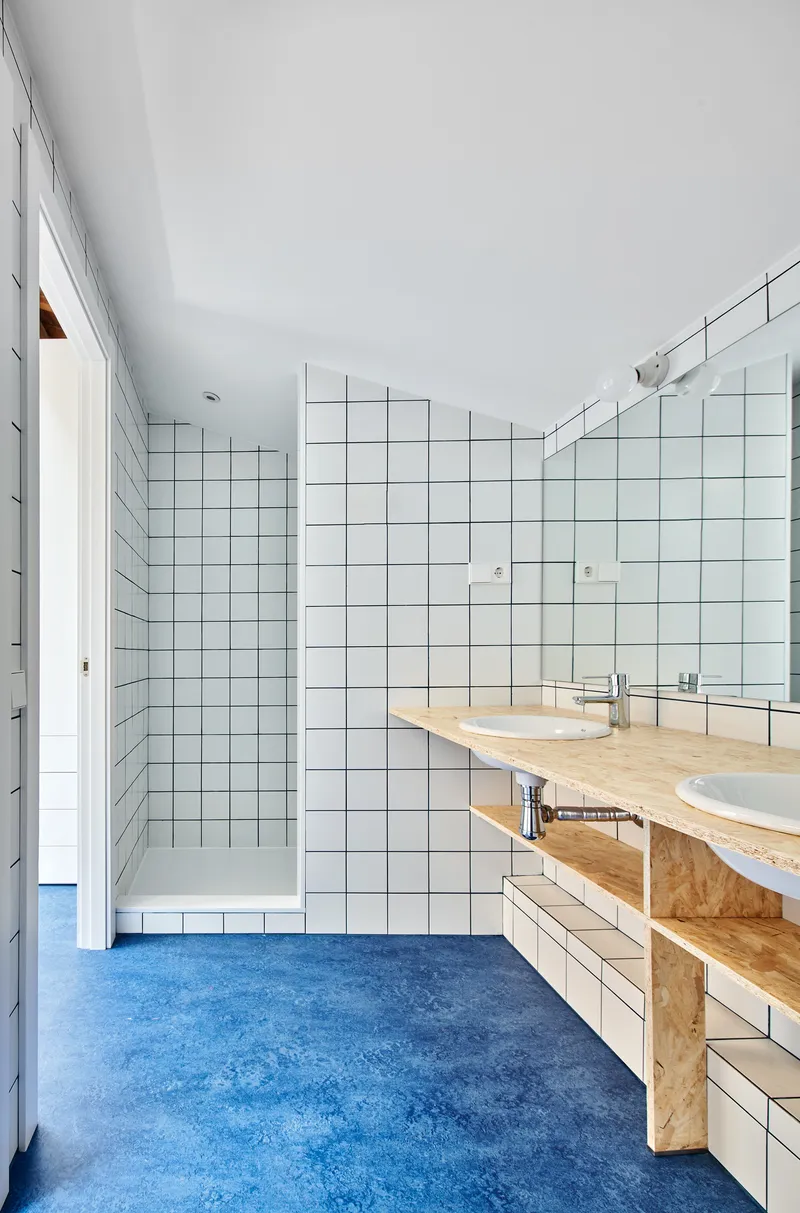
The upper level squeezes a children's room, a study area, and a second bathroom into the space between the new OSB floor and the original pitched roof. Skylights punch through the tiles to bring natural light into what would otherwise be a low, enclosed attic. Blue rubber linoleum replaces the polished concrete of the lower floor, warmer underfoot and lighter in weight, important considerations on a platform carried by steel beams.
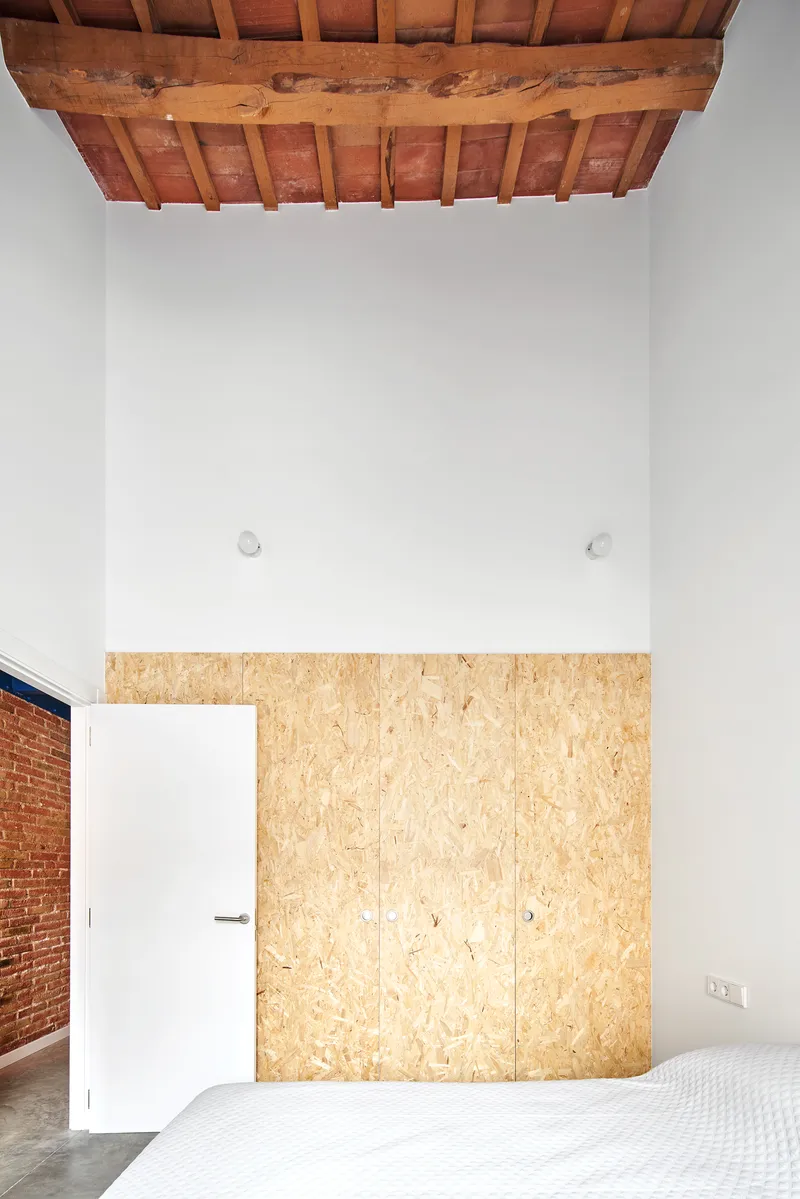
Twin doorways open into mirrored bedrooms, a spatial trick that makes the narrow plan feel symmetrical and generous. The timber ceiling beams are original, left exposed and restored, so you sleep under a roof that predates the entire renovation. OSB panels serve as headboards, wardrobes, and partition walls simultaneously. Nothing up here exists for only one reason.
The Street Face
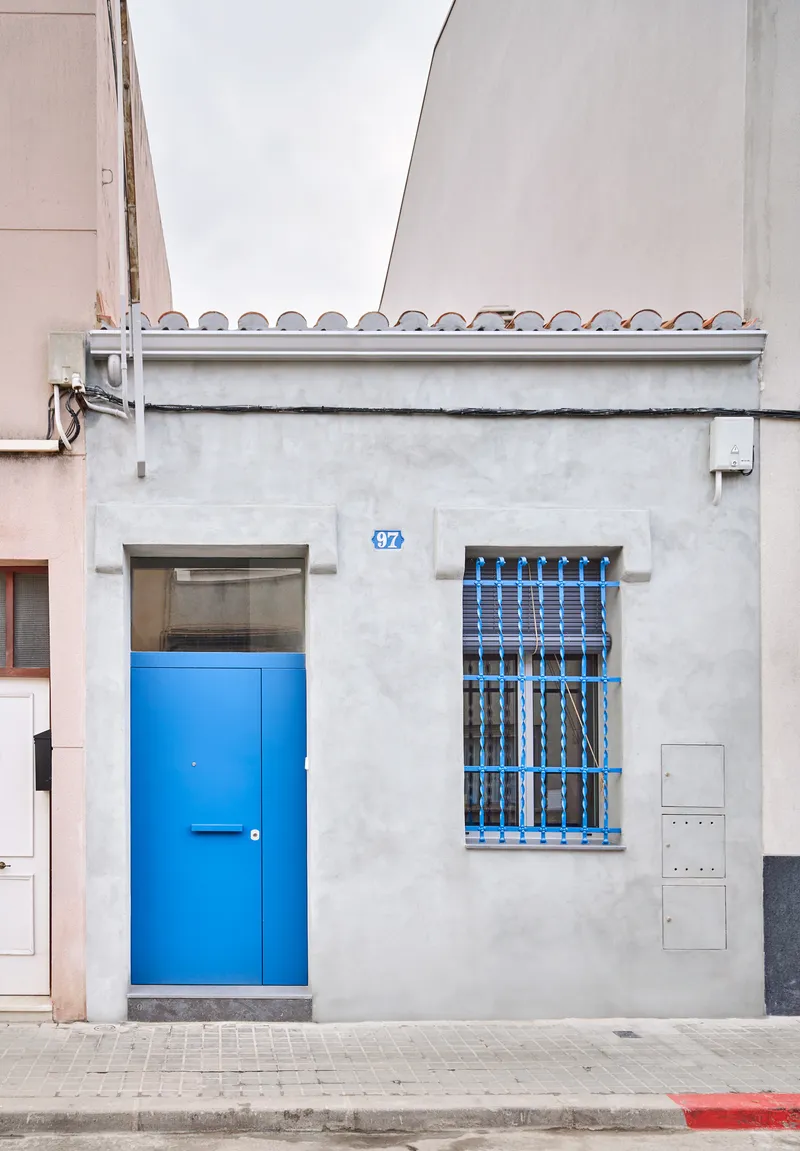
The façade is almost comically restrained: a white lime-mortar wall, a barred window, and a bright blue door. The colour of the door is the only external clue to the saturated world inside. Lime mortar was chosen for its breathability and its compatibility with the existing masonry, a decision that keeps the street elevation honest to its row-house neighbours while quietly improving thermal performance. The house does not announce itself. It saves its energy, literally and figuratively, for the interior.
Passive Performance at Scale
For a renovation of this size, the energy numbers are striking. Total primary energy consumption hits 42.14 kWh/m² per year, earning an A-rated energy performance certificate. CO₂ emissions sit at just 9.14 kg/m² per year. These figures come not from expensive mechanical systems but from insulation applied where it works, thermal mass in the concrete floor, cross-ventilation through the courtyard, and skylights that reduce dependence on electric lighting.
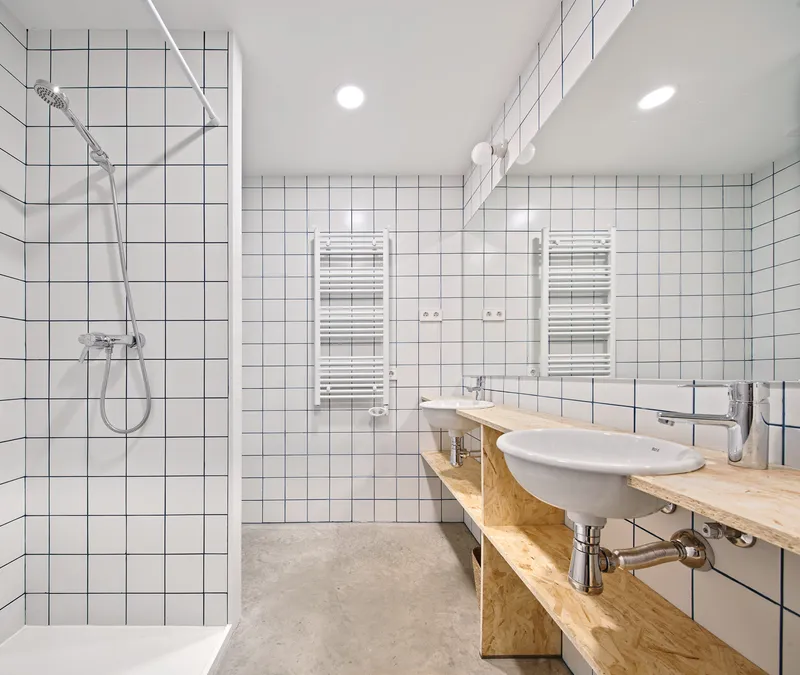
The bathrooms illustrate this disciplined approach. White square tiles and plywood vanities keep costs down, while the blue rubber flooring from the mezzanine carries through to maintain material continuity. Nothing is premium, but everything is considered.
Plans and Drawings
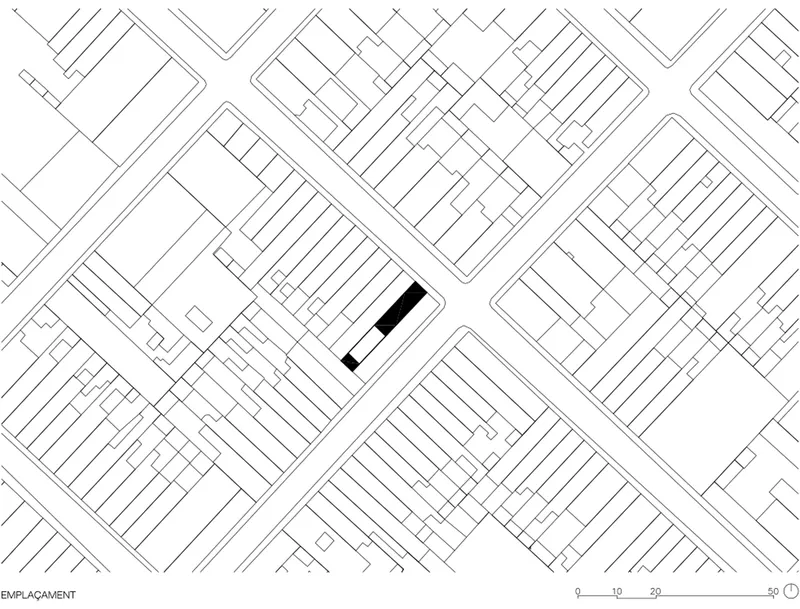
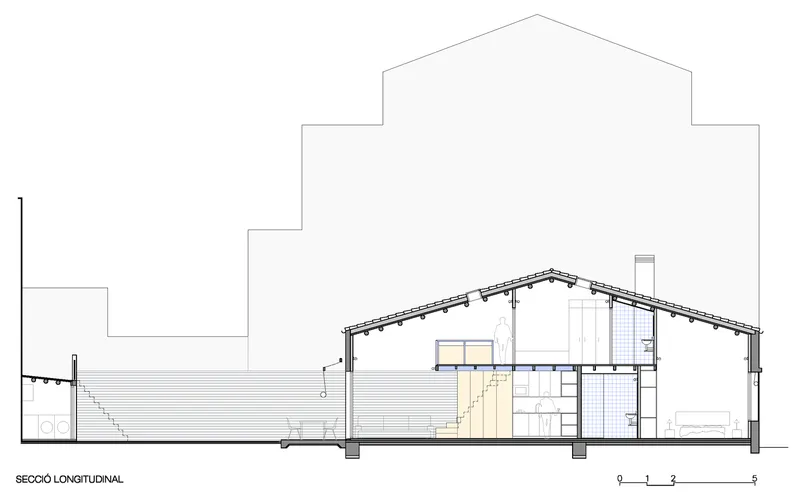
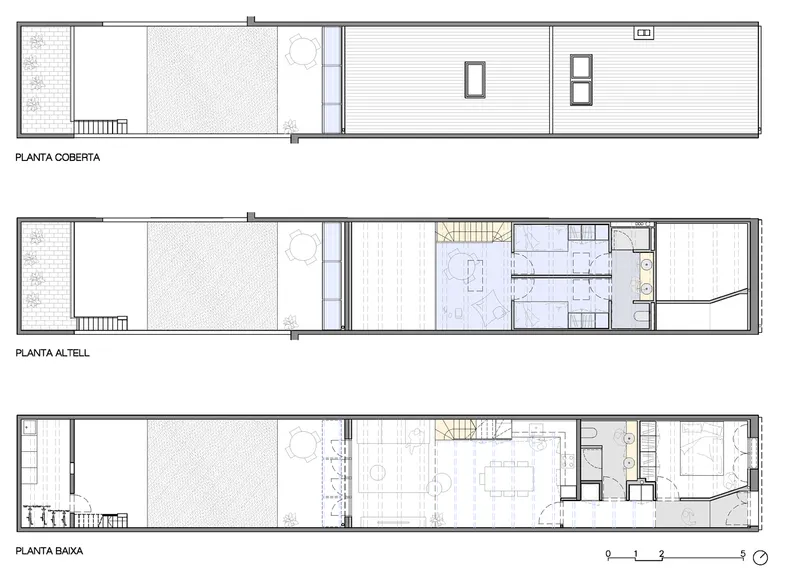
The site plan reveals how tightly the house is packed into its lot, a sliver between party walls on a block where every neighbour shares the same typology. The longitudinal section is the most telling drawing: it shows how the high ridge of the pitched roof creates enough vertical clearance for the mezzanine, with the staircase threaded into the gap between the two levels. The three floor plans, ground, mezzanine, and roof, confirm just how linear the organization is. Every room is a single width, and circulation runs along one wall. There is no wasted space because there is no space to waste.
Why This Project Matters
105JON is not a trophy renovation. It is a proof of concept for how young families priced out of dense cities can find real architecture in overlooked housing stock just a few towns away. The project's intelligence lies in its refusal to change the footprint: every square metre of additional floor area comes from reading the existing roof geometry and exploiting it with lightweight steel and OSB. That strategy keeps costs, carbon, and construction time low while doubling the usable area.
More broadly, the project makes a case for honesty as a budget strategy. When you cannot afford to hide your structure behind finishes, exposing it becomes both an economic and an aesthetic decision. The blue steel, the raw brick, the OSB: these are not styling choices layered on top of a building. They are the building. And they achieve an A-rated energy certificate at 90 m² without solar panels, heat pumps, or any headline technology. Sometimes the most sustainable thing you can do is just pay close attention to what is already there.
105JON Renovation of a House Between Dividing Walls by Vallribera Arquitectes. El Vallés Occidental, Spain. 90 m². Completed 2020. Photography by José Hevia.
About the Studio
Share Your Own Work on uni.xyz
If projects like this are the kind of work you want to make, uni.xyz is a place to publish your own, find collaborators, and enter design competitions.


Popular Articles
Popular articles from the community


Cloaked Colonization: A Mobile Underwater Habitat That Moves Like a Fish
Micah Abaya's shortlisted EHC Pacific entry reimagines ocean settlement as a dispersed network of self-sustaining architectural organisms.
Opera by the Sea Estonia: Three Shells Dissolving Architecture into Tallinn's Coastline
A winning opera house proposal replaces monumental form with interconnected shells that blur the boundary between building, park and Baltic Sea.

Opera on the Sea: Driftwood Logic Shapes a Timber Opera House on Estonia's Coast
Trevor Orgill's opera house translates the entangled drift of floating timber into a civic building where wood, water, and music converge.
Temporary Home for Dogs: A Reversed Zoo Rethinks Animal Shelter Architecture
In Bucharest, a sinuous corridor and freed landscape flip the logic of containment, designing a shelter that works to make itself unnecessary.

Similar Reads
You might also enjoy these articles

Bao Huynh Watercolor Atelier: A Serene Art Retreat in Hội An
Bao Huynh Watercolor Atelier in Hội An blends multifunctional art spaces, sustainable design, local materials, and family-friendly living in a serene environment.

Atelier Macri Concept Store Interior Design by CASE-REAL
Atelier Macri store features a "ko" counter, walnut wood details, cork displays, blending retail, gallery, and seamless customer experiences.

Manuel Vargas Izquierdo Stadium and High-Performance Sports Center: Architectural Excellence in Jalpa de Méndez
The Manuel Vargas Izquierdo Stadium blends sustainable design, inclusive sports facilities, and cultural-inspired architecture, revitalizing Jalpa de Méndez’s public spaces.

KAKR Buluh Awar Hall: Revitalizing Community and Ecology Through Bamboo Architecture
Community built bamboo hall revitalizes Buluh Awar village, empowering youth, restoring ecology, celebrating vernacular craftsmanship through sustainable architecture and culture.

Explore Renovation Competitions
Discover active competitions in this discipline

Challenge to design mud housing for contemporary communities

Challenge to design luxury tourism on rails

VR headsets Storefront design competition

Designing a staircase for a client
Comments (0)
Please login or sign up to add comments
No comments yet. Be the first to comment!