
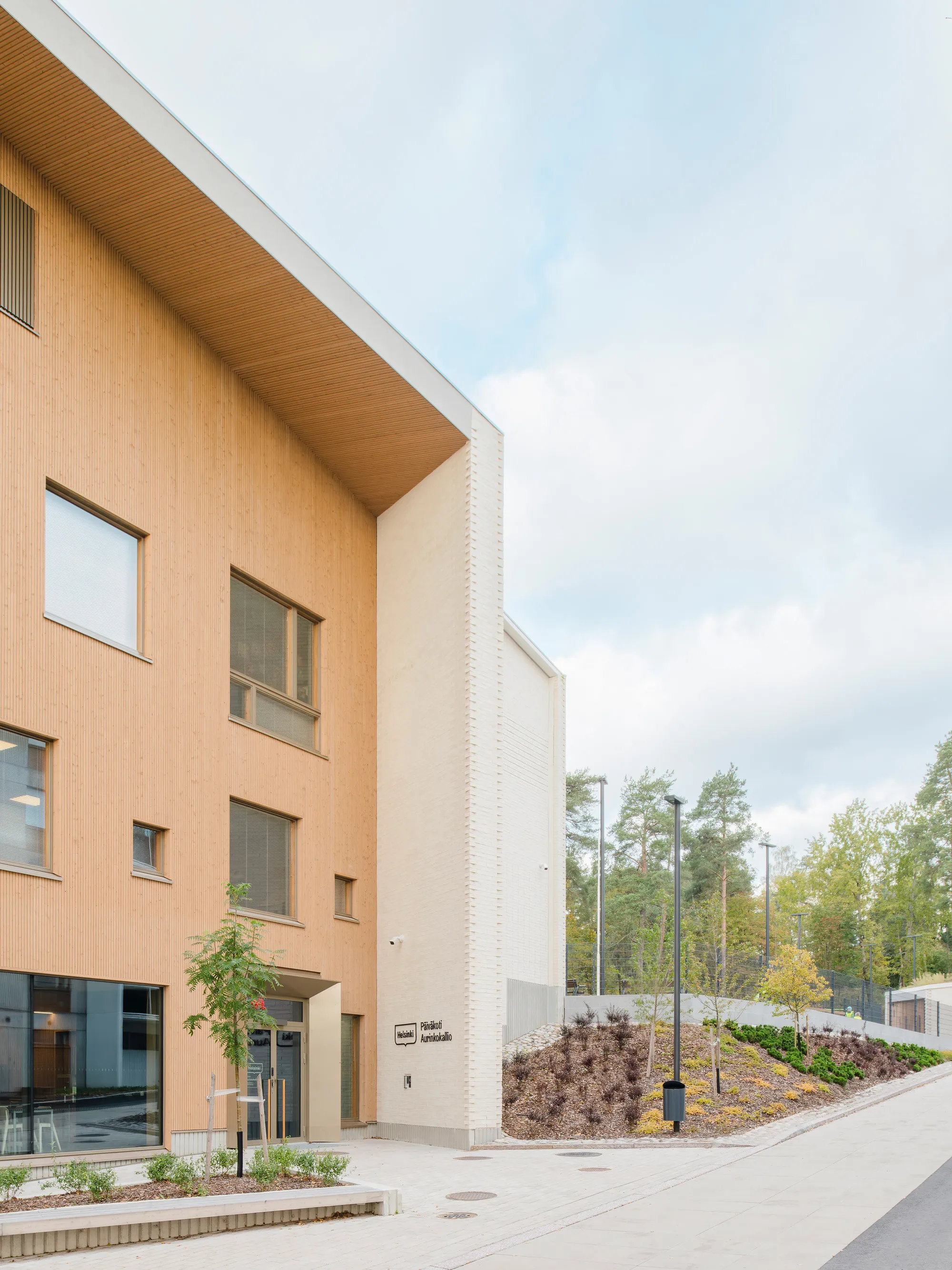
Verstas Architects Nestles a Three-Story Daycare Center Between Helsinki's Apartment Blocks and Forest
Aurinkokallio Daycare Center replaces a 1970s building in Kannelmäki with timber-clad volumes that mediate between urban density and nature.


Replacing a worn-out 1970s daycare building in Kannelmäki, one of Helsinki's mid-century residential districts, Verstas Architects has completed a 2,270 square meter facility that refuses to treat childcare architecture as either a miniature playground or a scaled-down office block. Aurinkokallio Daycare Center sits on a sloping plot wedged between existing apartment buildings and a verdant forest park, and the architects have used that in-between condition as the project's organizing principle: the building mediates between urban fabric and landscape, between civic scale and domestic intimacy.
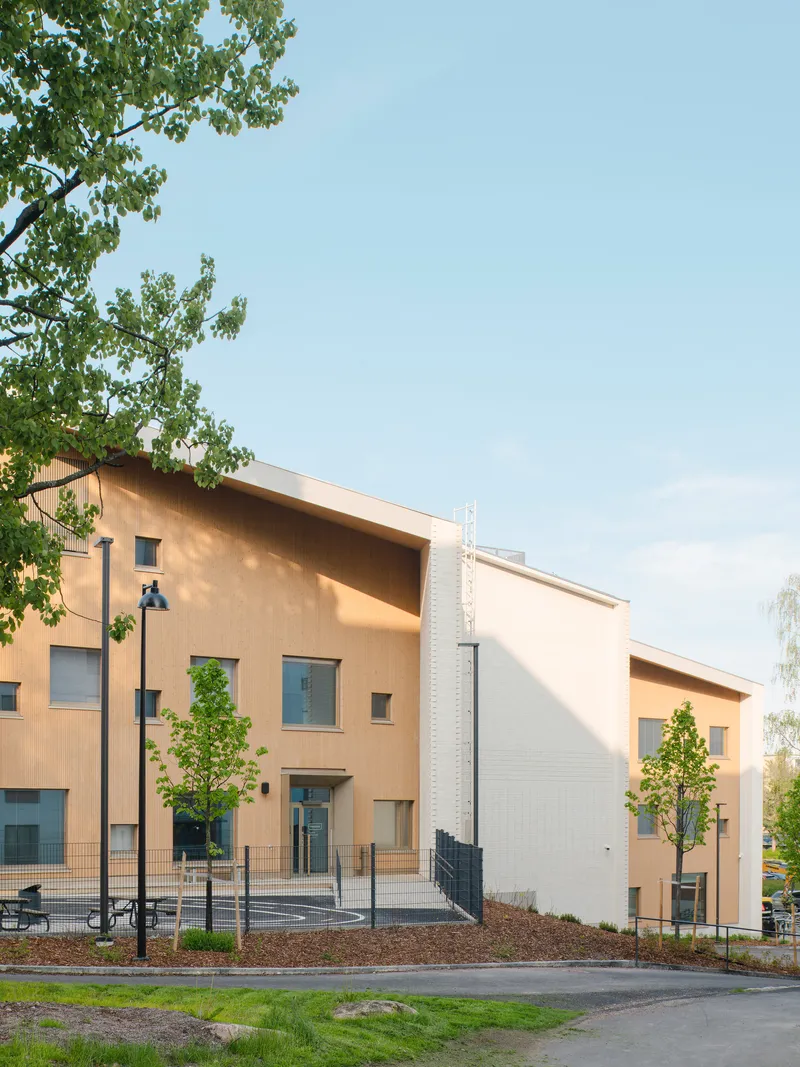
What makes this project worth studying is the way it manages material identity across a genuinely complex brief. The three-story volume breaks down into articulated parts, some clad in pale brick that echoes the surrounding residential blocks, others wrapped in warm timber panels that respond to the adjacent forest. The result is a building that belongs to its neighborhood without mimicking it, a piece of urban infill that reads as both institution and home.
A Dual Material Language
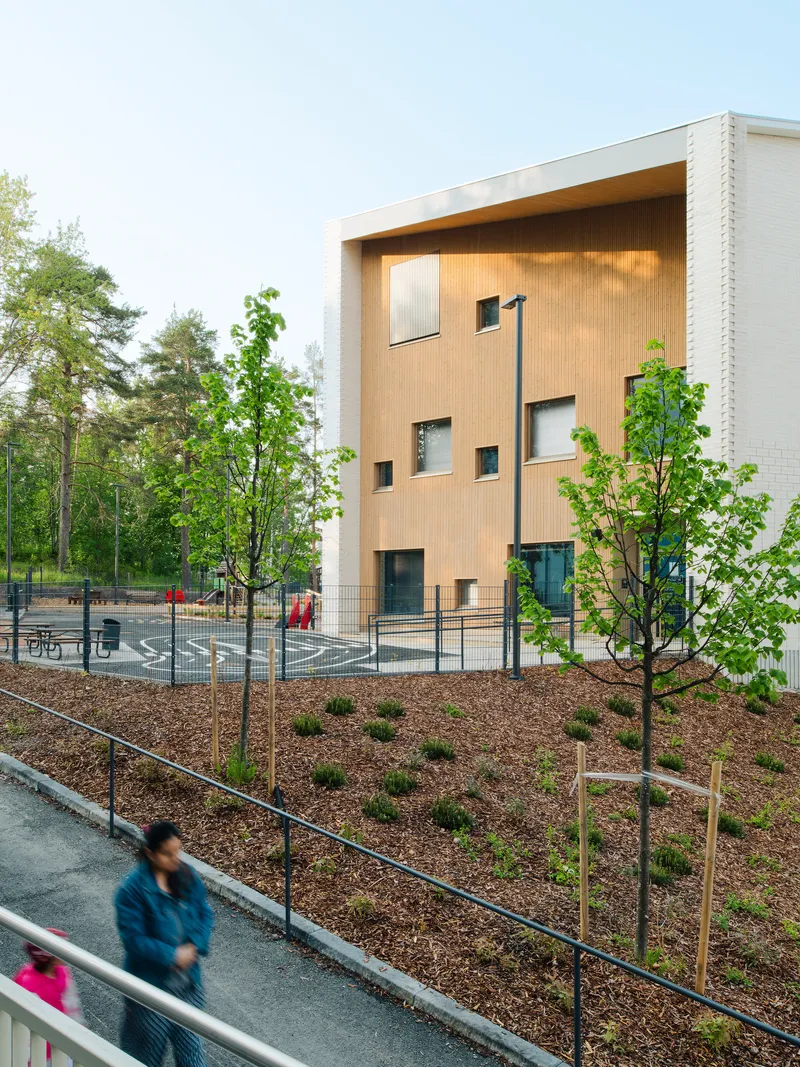
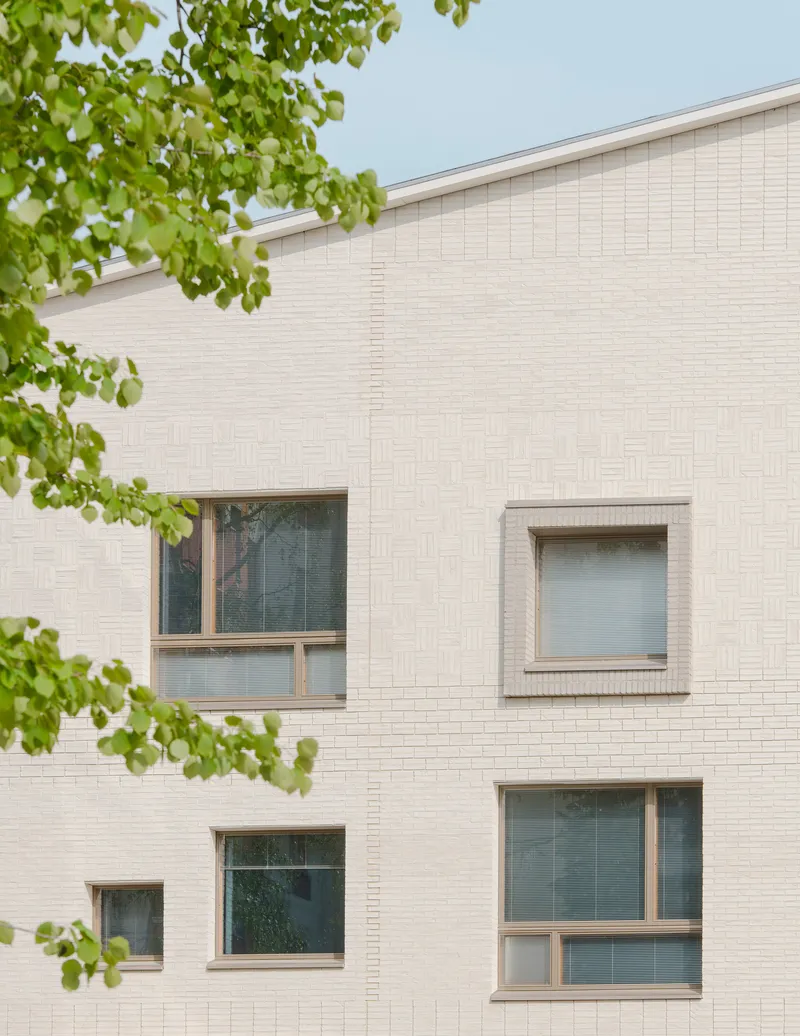
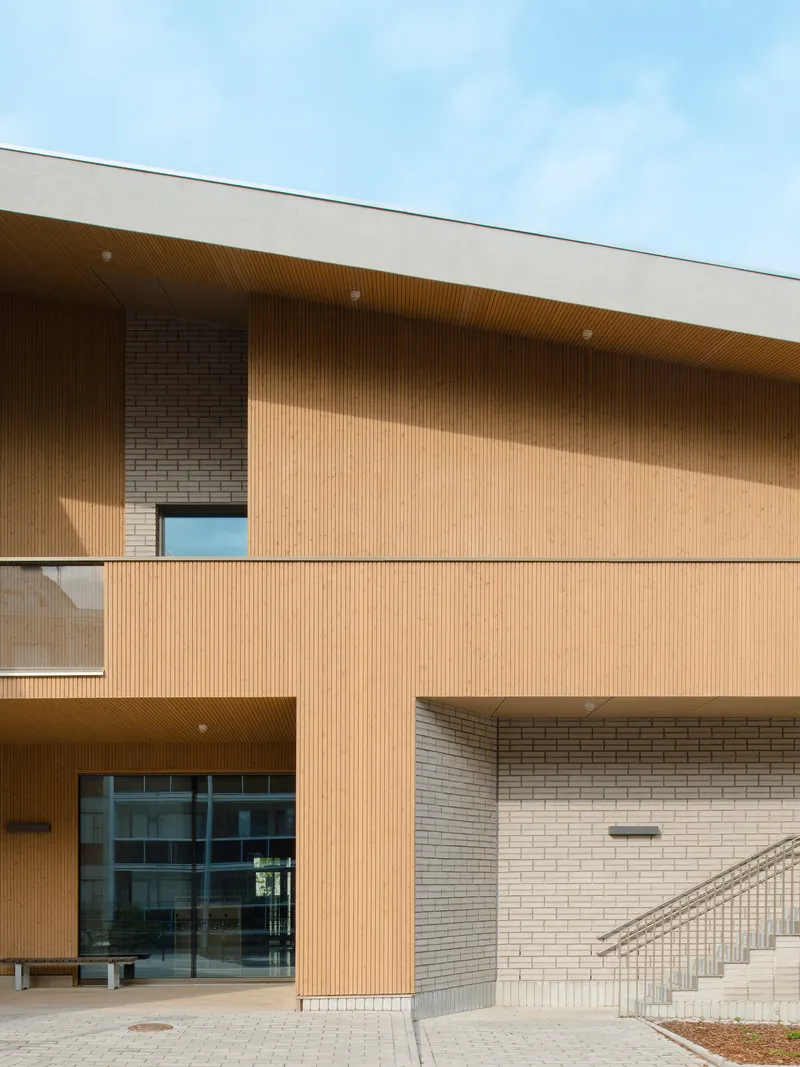
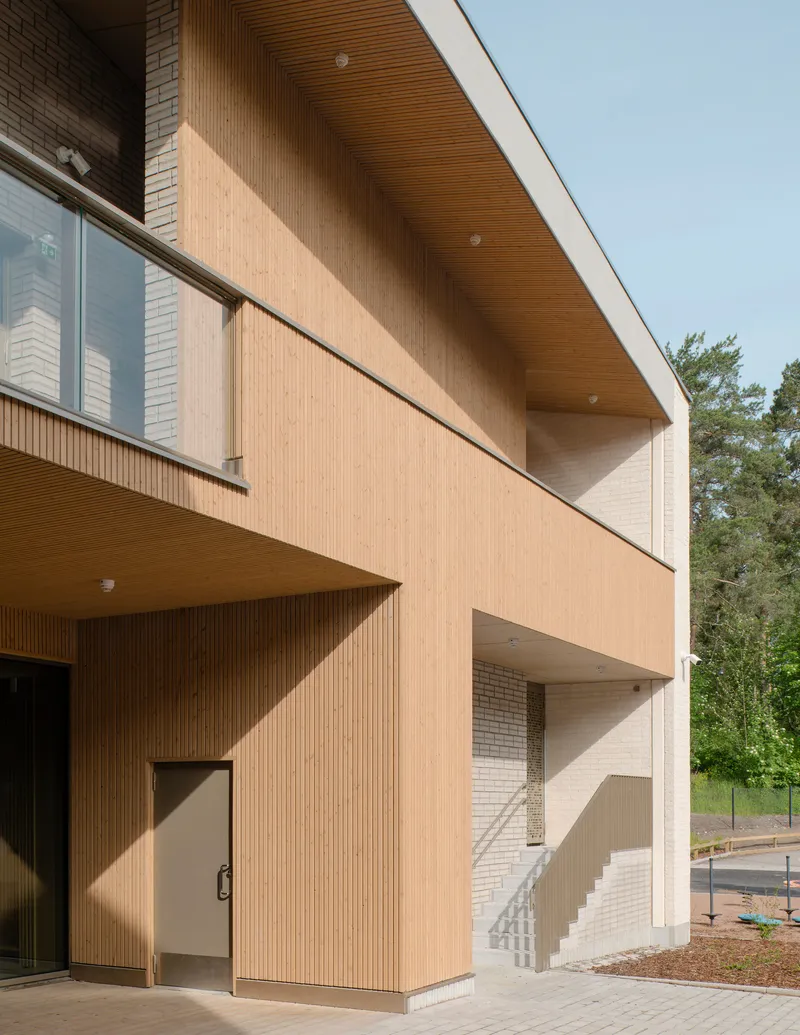
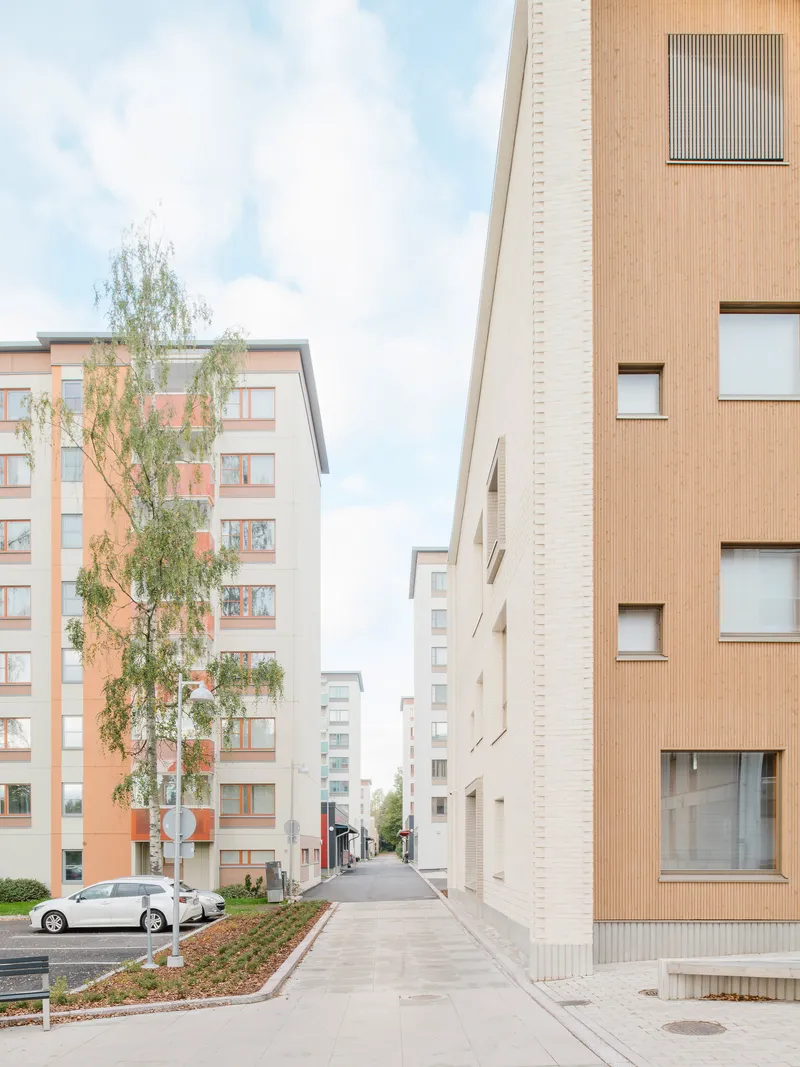
The building's exterior alternates between two primary cladding systems: pale brick and vertical timber panels. The brick surfaces, visible from the street side, ground the daycare in the language of Kannelmäki's postwar apartment blocks. They are restrained, punctured by scattered windows of varying sizes that avoid the monotonous grid typical of institutional facades. From the forest side, timber takes over, lending the building a softer, more organic presence that sits comfortably among the pines and birches.
The junction between these two material worlds is handled with care. Timber-slatted soffits run beneath overhanging volumes and recessed balconies, creating a warm threshold zone that bridges the brick and wood. An exterior staircase reinforces the building's vertical reading without adding bulk. The material palette is deliberate and limited: no gratuitous color, no decorative gestures, just the honest contrast between masonry mass and timber warmth.
Courtyard as Core
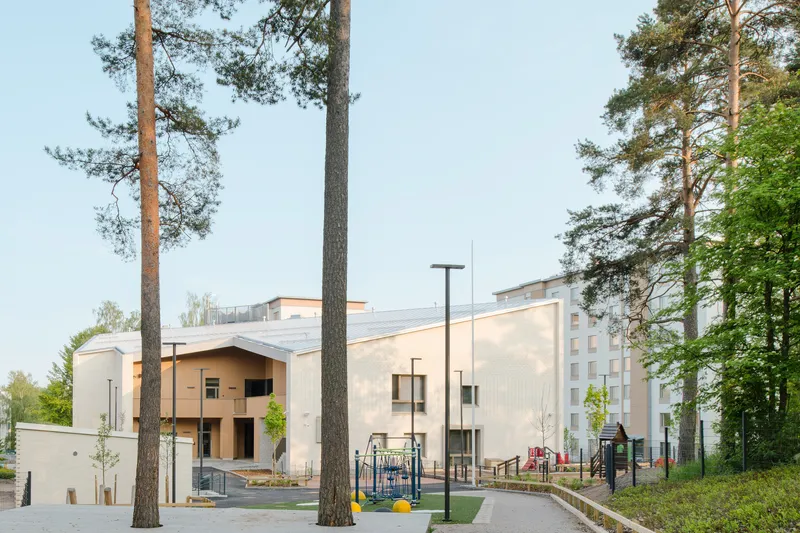
Seen through tall pines at dusk, the pale metal-clad volumes frame what appears to be a central courtyard, the building wrapping around an outdoor space that gives every wing visual access to both sky and ground. For a daycare serving young children, this is not merely a design move; it is a pedagogical one. The courtyard creates a protected outdoor room where supervised play happens within sight lines from multiple classrooms. It also brings daylight deep into the plan, critical during Helsinki's short winter days.
The entrance approach is understated. Young trees line the street-facing facade, and a planted entry court softens the transition from sidewalk to lobby. There is no monumental gesture, no oversized canopy or branded signage. The building announces itself through proportion and material, which is exactly how a neighborhood institution should work.
Learning Spaces with Legible Identity
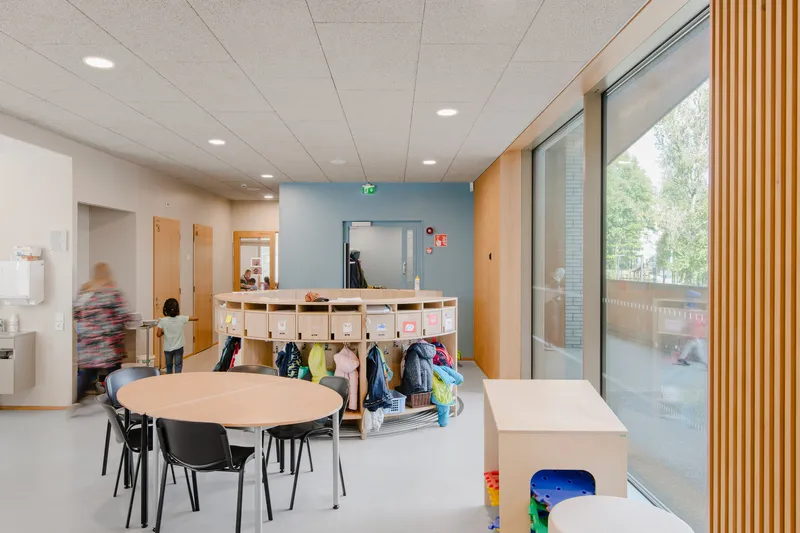
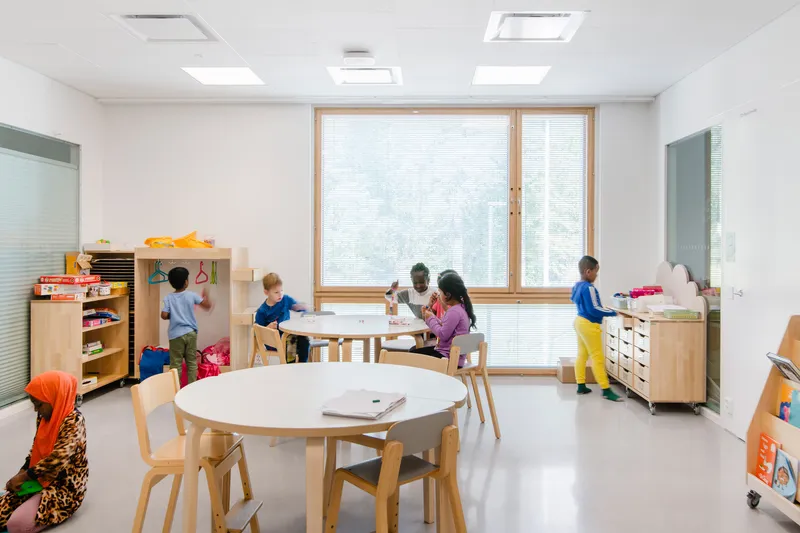
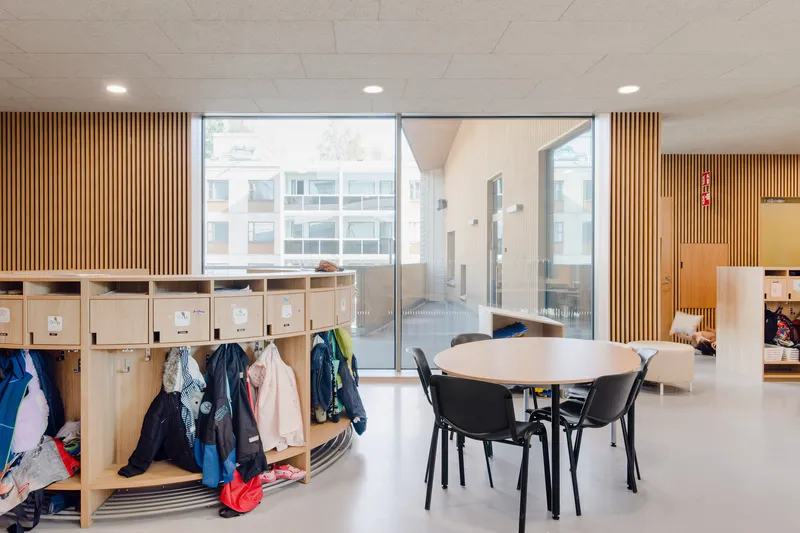
Inside, each classroom has a distinct character while sharing a consistent material vocabulary. One room features a blue accent wall paired with timber slat screens that filter light and define zones. Another is almost entirely white, relying on ceiling skylights and a large timber-framed window to create a calm, luminous workspace where children sit at low tables. A third opens onto the courtyard through a full glazed partition, with curved cubby storage lining the perimeter and a round table at the center.
The variety matters. Children orient themselves in space through difference, and giving each group room a recognizable identity helps even very young users develop a sense of place. The architects avoid the trap of making everything too uniform or too chaotic, striking a balance between coherence and variation that reflects a mature understanding of early childhood environments.
Circulation and Shared Spaces
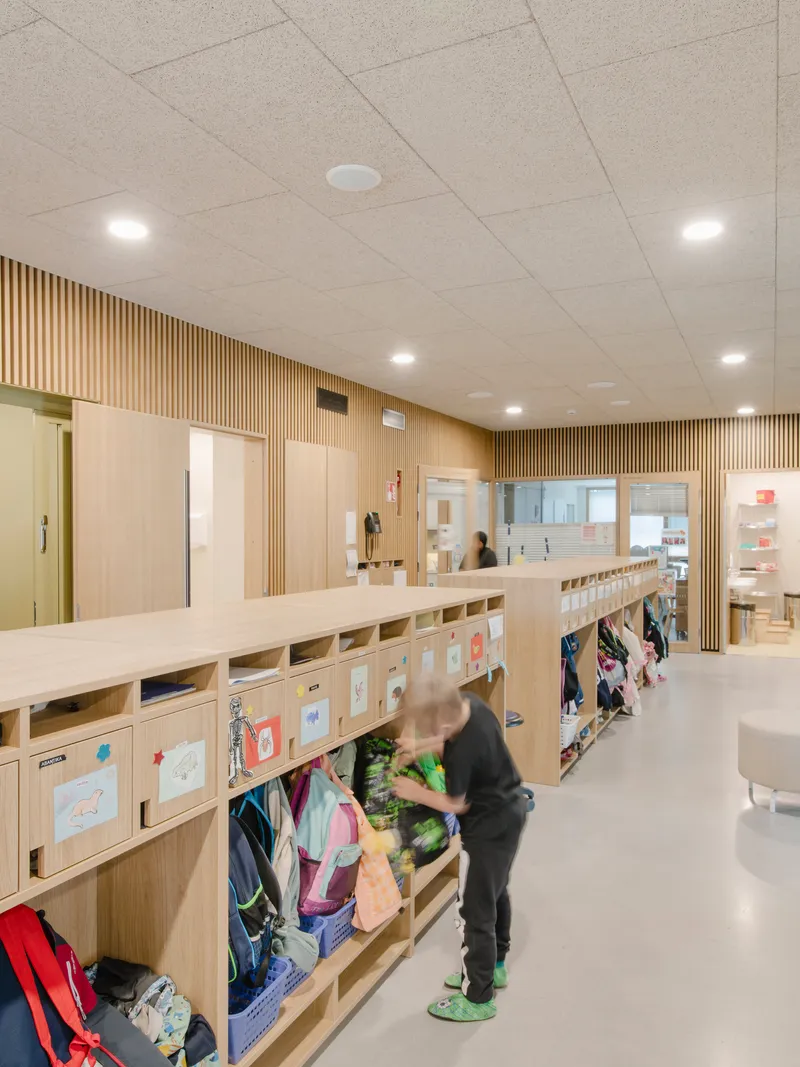
The hallways do real work. Timber cubby storage lines the corridors, transforming them from mere connectors into active zones where children hang coats, stash backpacks, and negotiate the daily rituals of arrival and departure. The cubbies are scaled to their users, low enough for small hands but integrated into the architecture rather than treated as furniture afterthoughts.
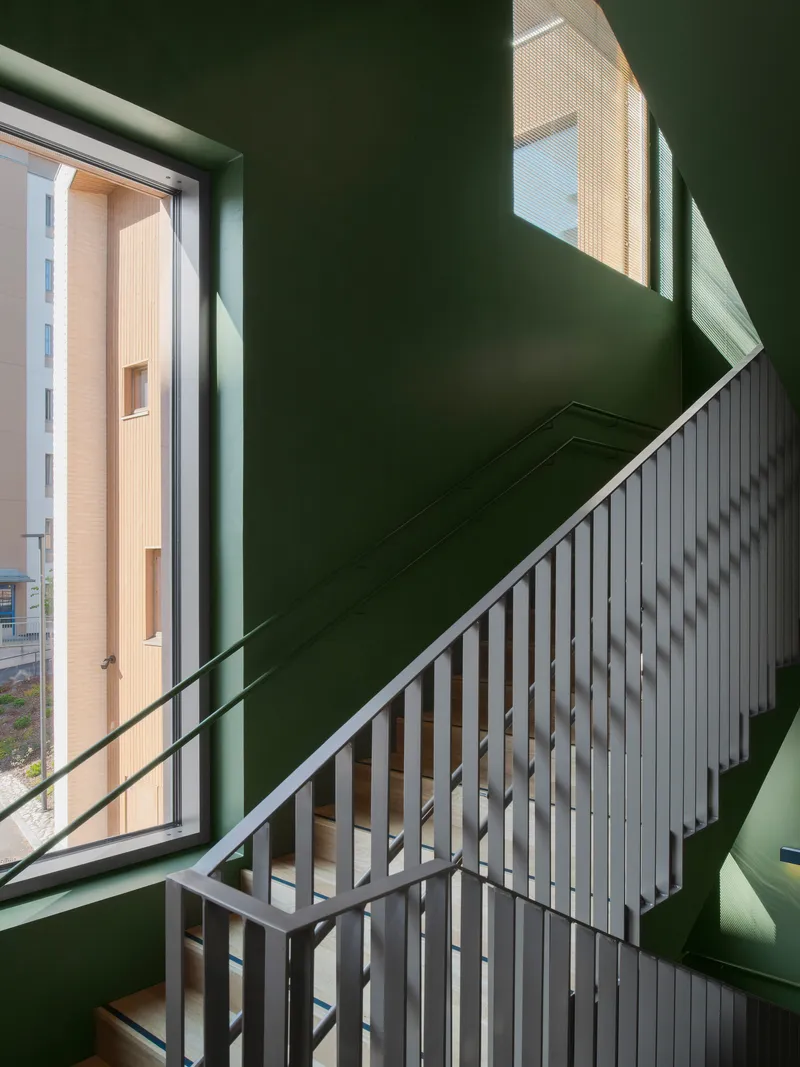
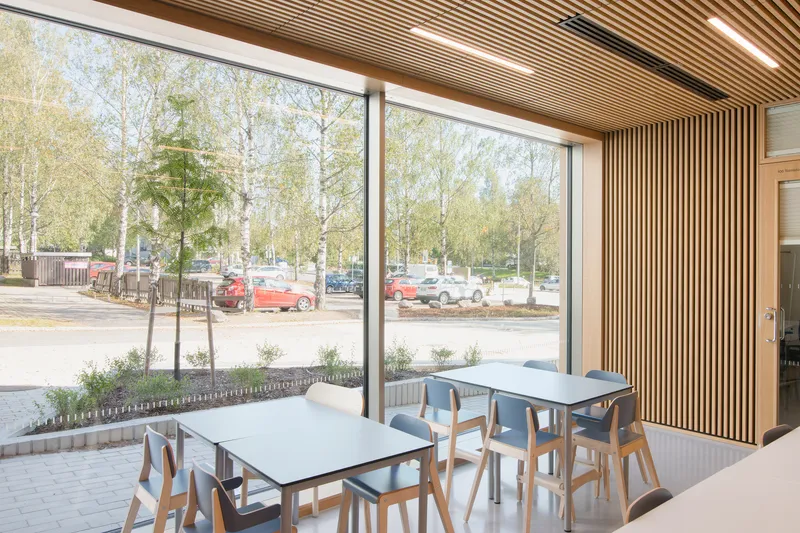
A stairwell painted in deep green, with grey vertical slat balustrades catching morning sunlight, is one of the building's most atmospheric moments. It is a simple composition, color and light and rhythm, but it demonstrates that even a code-driven element like a fire stair can reward attention. The dining area takes a different approach: a timber slat wall mediates between the interior and full-height glazing that opens onto birch trees, turning lunch into a moment of connection with the surrounding landscape.
The Gymnasium
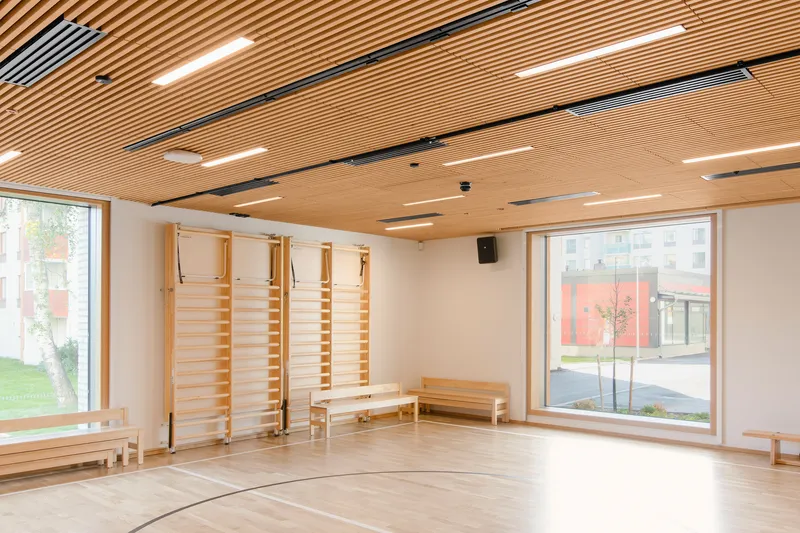
The gymnasium occupies a generous volume topped by a slatted timber ceiling that gives the room acoustic warmth without sacrificing height. Wall bars, benches, and large windows overlooking the street keep the space functional and connected to the neighborhood outside. It reads as a proper sports hall rather than a token gesture, which is notable in a building of this scale.
The view from the surrounding pedestrian street confirms how well the daycare integrates into Kannelmäki's residential grain. Parked cars, young trees, and brick facades on either side make the context clear: this is a workaday Helsinki neighborhood, and the building operates at its scale without condescending to it.
Plans and Drawings
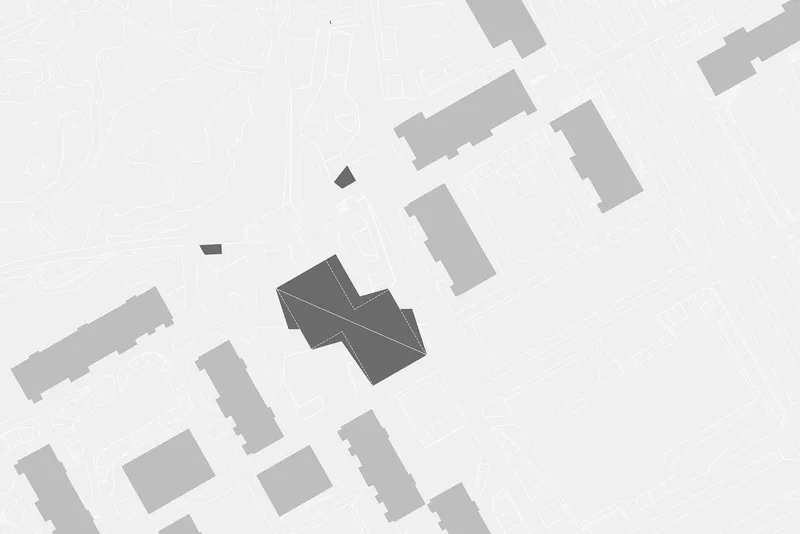
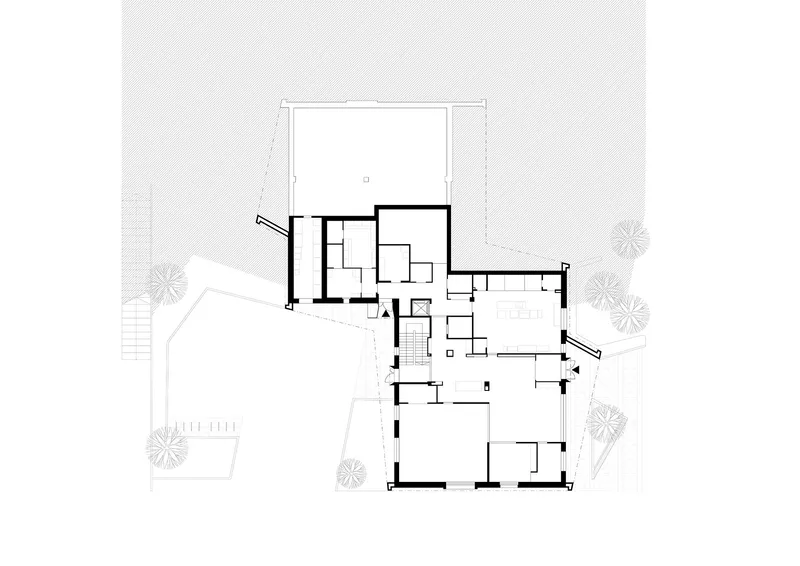
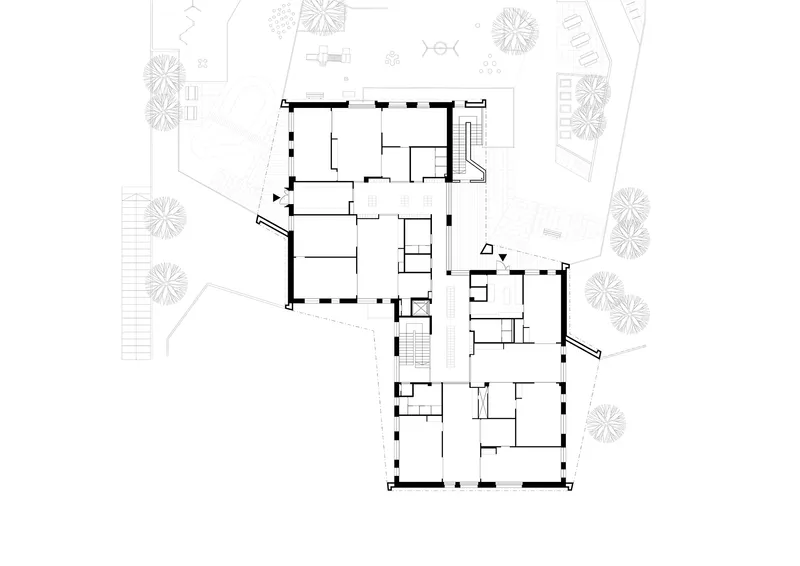
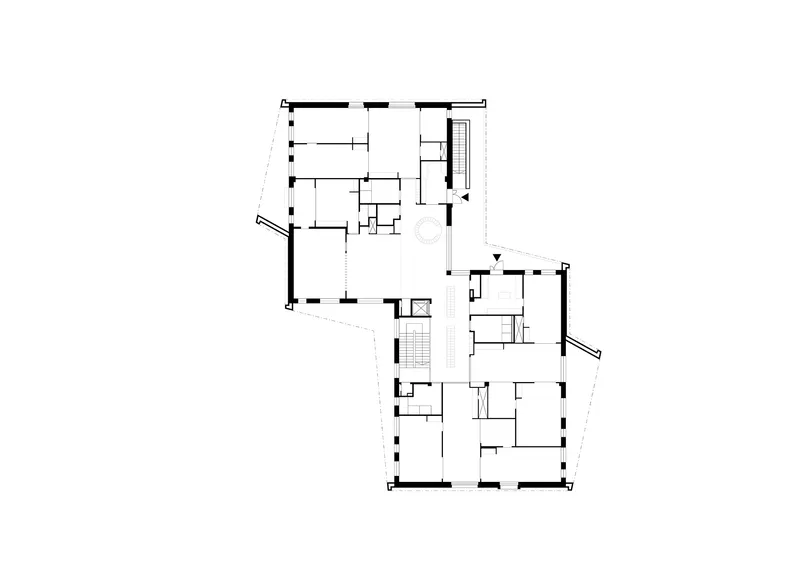
The site plan reveals the logic of the angled footprint, the building pivoting to negotiate the slope and the surrounding structures while carving out usable outdoor space. The three floor plans show rooms organized around central staircases, with perimeter classrooms gaining exterior exposure on all sides. Terraces and landscaped edges blur the boundary between building and ground.
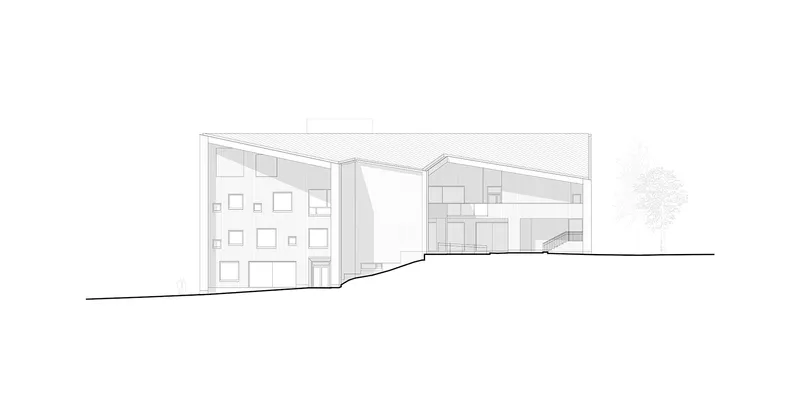
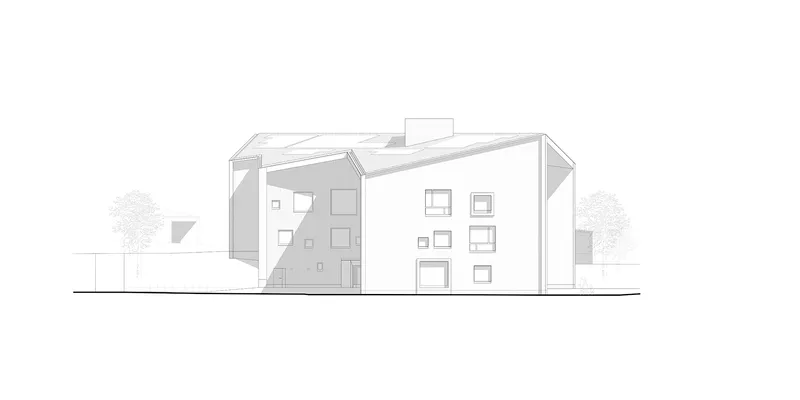
The section drawing is particularly revealing: sloped rooflines create varied interior heights, and scattered window openings confirm that the facade pattern visible from outside is driven by spatial logic, not graphic composition. The gabled volumes shown in elevation reinforce the domestic scale that the architects have pursued throughout, a building of civic importance that borrows from the residential language around it without imitating it.
Why This Project Matters
Daycare architecture rarely gets the attention it deserves, partly because the buildings are small and partly because the clients are too young to write about them. Aurinkokallio Daycare Center is a reminder that the buildings we make for children shape their earliest understanding of what architecture can be. Verstas Architects has delivered a facility that takes its users seriously: legible spaces, honest materials, generous light, and a thoughtful relationship with the landscape that every room looks out onto.
As urban infill, the project also demonstrates how public institutions can stitch neighborhoods together rather than disrupting them. By matching Kannelmäki's scale and borrowing its material palette while introducing timber warmth and a more contemporary spatial openness, the building bridges decades of development without erasing the character of either era. It is the kind of quiet, competent civic architecture that cities need far more of.
Aurinkokallio Daycare Center by Verstas Architects. Helsinki, Finland. 2,270 m². Completed 2025. Photography by Niclas Mäkelä.
About the Studio
Share Your Own Work on uni.xyz
If projects like this are the kind of work you want to make, uni.xyz is a place to publish your own, find collaborators, and enter design competitions.




Popular Articles
Popular articles from the community


Co-Life: Senior Housing Design That Reconnects Older Adults With the City
Co-Life reimagines senior housing design through healing gardens, shared streets, workshops, and a sustainable community across generations.

Lunar Spiral: Space Architecture Shaped by the Mathematics of the Universe
Lunar Spiral reimagines space architecture through Fibonacci geometry, lunar regolith, levitating habitats, and self-sustaining Moon living.

Conexión: Biophilic Design Reimagines High-Rise Living in Hong Kong
Conexión reimagines high-rise living in Hong Kong through biophilic design, green facades, shared spaces, daylight, water and nature within.

Hill & Cross Opera: Sculptural Opera House Architecture Shaped by Tallinn’s Landscape and Identity
Hill & Cross Opera reimagines opera house architecture in Tallinn through its sculptural hill, civic plaza, glass wave and a luminous cross.


Similar Reads
You might also enjoy these articles

Bao Huynh Watercolor Atelier: A Serene Art Retreat in Hội An
Bao Huynh Watercolor Atelier in Hội An blends multifunctional art spaces, sustainable design, local materials, and family-friendly living in a serene environment.

Atelier Macri Concept Store Interior Design by CASE-REAL
Atelier Macri store features a "ko" counter, walnut wood details, cork displays, blending retail, gallery, and seamless customer experiences.

Manuel Vargas Izquierdo Stadium and High-Performance Sports Center: Architectural Excellence in Jalpa de Méndez
The Manuel Vargas Izquierdo Stadium blends sustainable design, inclusive sports facilities, and cultural-inspired architecture, revitalizing Jalpa de Méndez’s public spaces.

KAKR Buluh Awar Hall: Revitalizing Community and Ecology Through Bamboo Architecture
Community built bamboo hall revitalizes Buluh Awar village, empowering youth, restoring ecology, celebrating vernacular craftsmanship through sustainable architecture and culture.


Comments (0)
Please login or sign up to add comments
No comments yet. Be the first to comment!